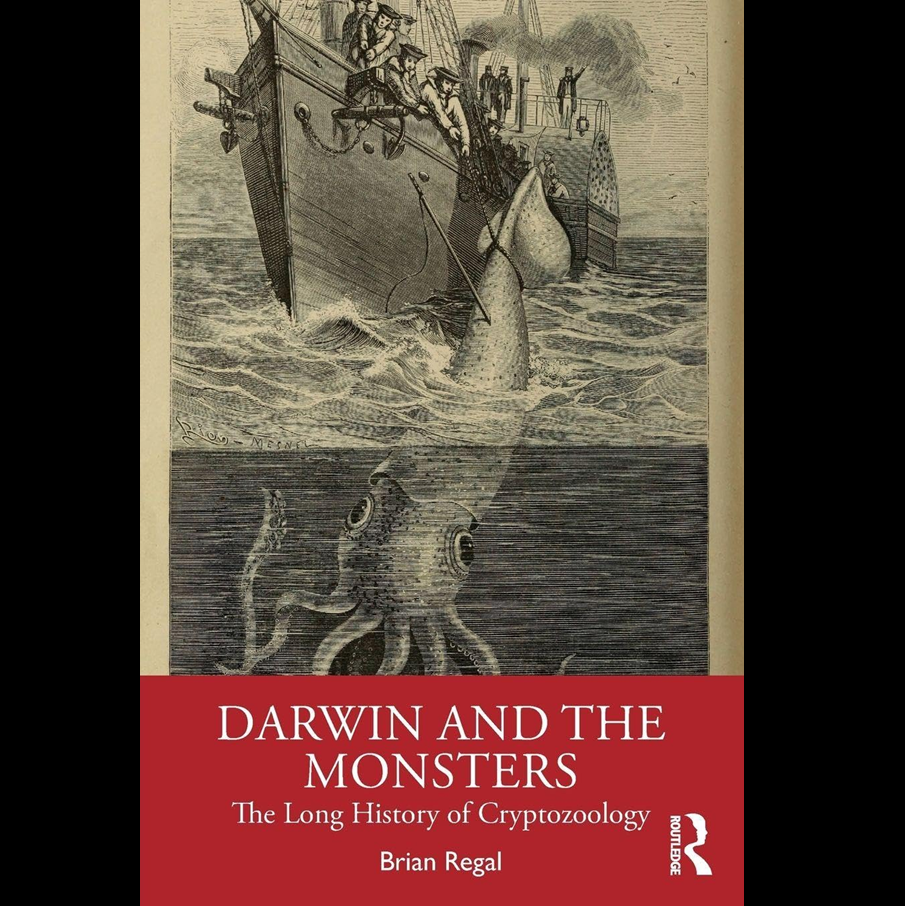
🐺 S05E44 – Darwin and the Monsters (with Dr. Brian Regal)
Blake welcomes back Dr. Brian Regal – historian of science, technology, and medicine, and now Professor Emeritus at Kean University – to talk about his final academic book, Darwin and the Monsters: The Long History of Cryptozoology. Regal has been a MonsterTalk guest since the show was still in single digits, and he was the first guest to reach out to the podcast rather than the other way around. He has also been sitting on this particular book for a very long time: he first floated the title on this show back in 2013, and then spent more than a decade writing everything else instead. Karen is away in the UK promoting Beyond Words, so this episode is a two-hander between Blake and an old friend.
The book runs monsters forward from the classical world – Lucretius, Pliny, Aristotle, and a Sumerian hero fighting a monster in the oldest story we have – through the Middle Ages, the age of curiosities, and into the modern hunt for anomalous primates.
🔦 In This Episode
- Why the book is priced the way it is, and Blake’s advice to check the library before the bookstore – a small tangent on academic publishing and the old “priced to rent” sticker era.
- How Darwin and the Monsters almost became a doctoral dissertation, and why Brian wrote about Henry Fairfield Osborn instead.
- Brian’s journey from student to author.
- The publish-or-perish treadmill: every new contract pushed the Darwin book back another few years.
- What the book is not: it is not a Bigfoot book, and Brian has notes for the critics who wanted more Bigfoot.
- Too many werewolves? Brian’s 2009 paper for the British Society for the History of Science on how Darwinian thinking killed off the wolf-man – and how anomalous primates moved into the vacancy.
- The dogman problem – the most popular cryptid going is arguably a werewolf, which is arguably a medieval dog-headed man, which is arguably not an animal at all.
- Why the coelacanth is a bad advertisement for cryptozoology: no folkloric background, nobody was looking for it, and “living fossil” is not as accurate as people seem to think.
- Grover Krantz, missing Bigfoot bones, and the Pennsylvania records of bears that died without being hunted.
- Writing for an audience of one, and Brian’s cheerful refusal to take criticism personally.
- What is next: a long-gestating novel about a historian of science who gets into wacky trouble, and the real-life model for its main character.
- Retirement, luck, and the case for going to a smaller school that will let you study monsters.
- The origin of The Monster of Newark, which started as notes toward an examined life and turned into an autobiography.
📝 Correction noted in the episode: the exchange where Brian first mentioned the Darwin book was MonsterTalk #071 in 2013 – thirteen years ago, not seventeen. The point stands.
🔗 Links and References
- Darwin and the Monsters: The Long History of Cryptozoology 💵 – Brian Regal (Routledge, 2026)
- The Monster of Newark: The Life and Adventures of an Historian of Science 💵 – Brian Regal (Fortean Zoology Press)
- Brian Regal’s Amazon author page 💵
- Brian Regal – Wikipedia
- MonsterTalk #071 – His Tory of the Jersey Devil – the 2013 episode where the Darwin book first got mentioned
- MonsterTalk S04E09 – THEM! and The Monster of Newark – Brian’s most recent previous visit
- Darwin Killed Off the Werewolf – coverage of Regal’s 2009 British Society for the History of Science paper
- Darwin as Slayer of Werewolves – Science interview with Regal on the same thesis
- British Society for the History of Science – Wikipedia
- On the Origin of Species – Wikipedia
- Henry Fairfield Osborn – Wikipedia – subject of Regal’s first book; named Tyrannosaurus and Velociraptor
- Roy Chapman Andrews – Wikipedia – the AMNH explorer sent to the Gobi
- Epic of Gilgamesh – Wikipedia
- Cynocephaly – Wikipedia – the dog-headed men of the medieval imagination
- Blemmyes – Wikipedia – the headless men with faces on their chests
- Werewolf – Wikipedia
- Michigan Dogman – Wikipedia
- Coelacanth – Wikipedia
- Living Fossil – Wikipedia
- Gigantopithecus – Wikipedia
- Grover Krantz – Wikipedia
- Okapi – Wikipedia – required reading before you groan at the pun
- Sabine Baring-Gould – Wikipedia
- The Book of Were-Wolves (1865) – free at Project Gutenberg
- Sabine Baring-Gould Appreciation Society archive – the society was dissolved in 2018, but the site and its back catalogue remain online
- Centre for Fortean Zoology – Wikipedia – Jonathan Downes’ outfit, publisher of Brian’s autobiography
- Ann Wilson – Wikipedia
- Phryne Fisher – Wikipedia
🎓 About Our Guest
Dr. Brian Regal is Professor Emeritus of the History of Science, Technology, and Medicine at Kean University in Union, New Jersey. He grew up in Newark’s Ironbound neighborhood, served in the armored cavalry, and came to academia without a family map for how any of it worked. His scholarship has consistently pointed at the places where credentialed science and enthusiastic amateurs collide: eugenics and human-origins research, the Jersey Devil, pseudoscience and pseudohistory, alternative theories of who “discovered” America, and the long strange career of monster hunting. He is a Fellow of the Linnean Society and a longtime contributor to the journal Endeavour, and he is one of the most frequent guests in MonsterTalk’s history.
📚 Recommended Reading
- Darwin and the Monsters: The Long History of Cryptozoology 💵 – Brian Regal. The book under discussion. Academic pricing, so the library may be your friend.
- The Monster of Newark 💵 – Brian Regal. The autobiography, and the answer to why it is called that.
- Searching for Sasquatch: Crackpots, Eggheads, and Cryptozoology 💵 – Brian Regal. The Grover Krantz book, and still the best single history of how cryptozoology organized itself.
- Henry Fairfield Osborn: Race and the Search for the Origins of Man 💵 – Brian Regal. The dissertation-turned-first-book that delayed the Darwin project by about twenty years.
- The Book of Were-Wolves 💵 – Sabine Baring-Gould. The 1865 classic returns from Saga Press in a hardcover edition with a new introduction by Stephen Graham Jones, out in September.
📣 Promotions
- Karen Stollznow is currently in the UK promoting Beyond Words: How We Learn, Use and Lose Language 💵. She will be back on the show very soon.
- Brian Regal’s The Monster of Newark 💵 is out now from Fortean Zoology Press, and Darwin and the Monsters 💵 is available from Routledge. Everything else he has written is on his author page 💵.
- Blake also co-hosts In Research Of with Dr. Jeb Card, a rewatch podcast working through the classic Leonard Nimoy series In Search Of…
🎧 Credits
Host and producer: Blake Smith
Co-host: Dr. Karen Stollznow (away this episode)
Guest: Dr. Brian Regal
MonsterTalk theme music: Peach Stealing Monkeys
SEO Transcript
This is not a fully accurate transcript, and was machine generated. It’s here for helping search engines find the episode but not intended to be a faithful transcript of the episode. (But it’s not AWFUL.) Some of the material in this transcript only exists in the Patreon/Premium edition of the show and was excised for the commercial version.
———————
Monster House presents…
This is the ad-supported version of Monster Talk.
We’re dependent upon the revenue from these ads and from the support of our patrons at patreon.com forward slash monster talk to continue making this show.
As a disclaimer, your hosts are unable to control what ads you will hear, and while we have done what we can to avoid ads that are divisive, the system that injects them sometimes ignores our preferences and always seems to ignore our efforts to not interrupt the conversational flow.
While we understand this can be disruptive, we’re trying our best.
Patreon remains the best way to enjoy commercial-free listening to our content.
Plus, you generally get extended coverage of the subject.
We’re working on other ways to consume our content as well, so please stay tuned.
It’s actually quite unlike anything we’ve ever seen before.
A giant, hairy creature.
Part ape, part man.
In Loch Ness, a 24 mile long bottomless lake in the highlands of Scotland.
It’s a creature known as the Loch Ness Monster.
Monster Talk.
Welcome to Monster Talk, the science show about monsters.
I’m Blake Smith.
And I’m Karen Stollznow.
Brian Riegel returns again to talk about science and monsters.
He’s now retired from teaching and he’s joining us to talk about his final academic book, Darwin and the Monsters.
It’s a somewhat bittersweet discussion for reasons that will be clear in the interview, but I enjoyed reading his book.
The volume is from an academic publisher, and it reminds me a bit of ye olde blockbuster video days, when some monsters were priced for home purchase, and others were mysteriously priced to rent, with a sticker putting it out of range for most people.
That said, I enjoyed reading it, especially across the first few chapters.
Those describe how monsters were viewed in the ancient world and walked the reader through the centuries to bring them from myth to curiosities to controversy to cryptozoology.
I’ll put a link in the show notes if you want to snag a copy, but as I said, you might want to check the library instead of the bookstore on this one.
But this episode is not a book review, it’s a chat with an old friend.
And I don’t know what Brian will do next, but I’ve enjoyed talking to him across the entire history of the show, and this is no exception.
Despite being retired now, somewhere in there he’s still just a kid from New Jersey who loved monsters.
Despite a career that spans Cold War military deployment and academic achievements, he never lost that sense of wonder and excitement.
If you enjoy our Monster Talks, you’d probably enjoy hearing from his autobiography, which I’ll also link to in the show notes.
It’s called The Monster from New York.
Karen was not available to be here this week as she’s in the UK promoting her new book, Beyond Words, How We Learn, Use, and Lose Language.
She’ll be back very soon for more Monster Talks.
Welcoming back Brian Riegel to Monster Talk.
My God, Brian, you’ve been with us as a repeat guest since we were in the single digits.
In fact, I’m almost positive you were the first guest who reached out to us to make an introduction.
And you saw somehow presciently that your work would overlap with our mission.
And that has continued to be true for all this time.
That’s amazing.
So I really appreciate that.
Oh, so you’re Brian Riegel, and you are now an emeritus professor of history from Keene.
Emeritus, historian emeritus of the history of science, technology, and medicine.
All right.
Do you ever really stop being a historian?
Don’t you always have to be?
No, no.
So we’re here today to talk about your new book.
So I’m holding up your book for listeners who are not on YouTube.
This is Darwin and the Monsters, The Long History of Cryptozoology by Brian Riegel.
Now, I got questions, Brian.
First of all…
Based on the pricing, is this meant to be a textbook?
I mean, it’s a little pricey for my poor, poor, poor pocket.
So can you talk about that?
How did this book come to be?
Who’s the target audience?
Because I love the content, and I know our readers, sorry, our listeners would love the content, but I don’t know how this, I’d like to hear how this book came to be and who you had in mind when you wrote it.
Well, if you remember…
Way back in the Stone Age, the first time I appeared, you were good enough to have me on the show.
The last thing you always ask is, do you have anything new going on?
Yeah.
And I said, yeah, I’ve got this idea for a book called Darwin and the Monsters.
Holy cow.
Wow.
I do not remember.
That is amazing.
A quick correction.
This exchange was actually in episode 71 back in 2013.
So that was 13 years ago instead of 17.
But the point stands.
Brian’s been planning this book a long time.
Don’t I know that feeling?
I never got around to doing it.
It was supposed to be loosely my doctoral dissertation.
but I didn’t think the school would let me do a doctoral dissertation on monsters.
So I said, well, I’ll put it away.
I did the next best thing.
I did the life of Henry Fairfield Osborne, who was the president of the American Museum of Natural History forever.
literally died in his office.
He’s the guy who named Tyrannosaur.
He named Velociraptor.
He sent Roy Chapman Andrews, the guy that Steven Spielberg based Indiana Jones on.
He sent Andrews off to Outer Mongolia.
And so that was deemed acceptable.
And so I said, well, I’ll get to this Darwin thing when…
I’m finished with my doctoral dissertation.
I finished a doctoral dissertation.
And for those in the audience who are working on a doctorate or thinking about working on a doctorate, I had a publisher for that Osborne book before I was done writing it.
In fact, I only had three chapters.
I had no idea how books were written or published.
The neighborhood I grew up in, in Newark, I didn’t know anyone
who knew anyone, who knew anyone, who knew anyone who had ever published a book.
You know, so I was, I had no one to, there were my professors, they had all published a lot of stuff, but no one had published anything recently.
And so I came along and I contacted Ashgate and I, because they had put a little tiny ad on,
in the Journal of Vertebrate Paleontology.
And it said, oh, do you have an idea for a history of science book?
Let us know.
So again, being as naive as I was at the time, I just sent them like a one-page outline.
I said, oh, here’s an idea I have.
And they said, oh, we like this.
Can you send us a little more fleshed out version?
And so I did that and they liked that.
And then they said, can you send us a more detailed multi-page explanation of what you’re doing?
And I did that.
And the next thing I knew, they sent me a contract.
Wow.
But I only had three chapters done.
And I was like, I can’t tell them I only have three chapters.
They’ll take the contract back.
Excuse me.
And I was living in Providence at the time.
And my late wife, Lisa, was living with me there.
And I said to her, what do I do?
She had never published anything yet either.
And we were like two innocent babes wandering through the woods trying to figure out what to do.
And so I figured, well, let me just be honest.
And I said, look, I only have three chapters.
And they said, we don’t care.
We want you to do it anyway.
Take 18 months to finish it.
And so that became the book on Henry Fairfield Osborne.
Just as I was finishing that, I got contacted by ABC Clio.
They wanted a book on evolution controversies.
So that’s when I did the human evolution controversies.
And I don’t even remember what my own book was titled.
And so I said, okay, well, I’ll do that.
And then I’ll do the Darwin book.
And just as I was finishing the human evolution controversies, I got offered another chance to do another book.
And at the time…
which is what got me kind of in trouble with this new thing.
All my professors and everybody in academia who pays attention to doing doctoral dissertations, they tell you, you have to get published.
You have to get published.
The only way you’re going to get a job is to be published.
The only way you’re going to get tenure is if you get published.
The only way you’re going to get promoted is if you get published.
I had this kind of schizophrenic need.
Anybody who would let me write something, I’d write.
Articles, books, and the stuff just kept piling up.
And every time I got something to do, I’d say, I’ll do this, and then I’ll come back to Darwin.
And then something else would come along.
And I felt I couldn’t not, if someone was offering me a contract to write something, I felt I couldn’t say no because I need published work to get a job, to get promoted, you know, all that stuff, get tenure.
And so it took forever.
And finally, I decided to get around to it.
And the problem was,
Routledge, I contacted a couple of places.
Routledge said they liked the Darwin and the Monsters concept.
But then Lisa came down with cancer and I couldn’t work on it as much.
And then she passed away.
And when that happened, all the excitement I’d always felt for the last 40 years about writing and publishing and talking about, it just disappeared.
know it was just gone and so i tried desperately to tell routledge could you cancel this contract because i really don’t want to do it you know yeah and they said no no we love it we love it and so i asked a few times and they just kept saying no we want you to do it so i did it i did it but my heart really wasn’t in it so it didn’t come out as well as i had hoped
That’s why it’s really thin.
I never write huge, thick tomes anyway.
Because I figure, once I said what I wanted to say, I’m not very good at padding out things.
Some people are, but I’m not.
And so, you know.
But I think there are good parts to it.
I like the sea monster part.
I thought that came out well.
Well, if you don’t mind me throwing in a comment, I especially enjoy… Monster Talk listeners, they’re going to know.
People get fascinated with a kind of monster or a certain part of the story and they get really into that.
And I think it’s really hard to write for an audience who’s a cryptozoology enthusiast because it’s kind of like Godzilla.
I like Godzilla, but I’ve met real fans.
I am not worthy to talk to them.
like you know what i mean so like there are people who will be so absurdly into cryptozoology that i can’t keep up with the level of factual minutiae but you do a great job of introducing that road of how did we go from just pure folklore
to a taxonomy and having a concept of some of these monsters might be real and some of these monsters are relegated to folklore.
And how does that influence that journey from a non-scientific world to a scientific world?
I think you did well.
Thank you.
Well, that’s what the book is really all about.
Yeah.
It’s not about Bigfoot.
I’ve had some critiques already.
You didn’t talk enough about Bigfoot.
Shut up.
What I wanted to do is tell the story of how cryptozoology, even though the word is fairly new, the idea goes all the way back to the classical world.
Lucretius and Pliny and Aristotle, all those people were talking about monsters.
You know, the Epic of Gilgamesh, the oldest known piece of literature, is a monster story written in ancient Sumerian.
And so that’s what I wanted to try to track, that progression from the ancient world, because there were people…
in ancient Greece.
And everything we know about monsters initially comes from India.
So Alexander the Great invades India.
And that’s what kind of opens up India to the West.
And they immediately start encountering in India all these stories about monsters.
A lot of the most popular monsters of the European Middle Ages start off as Indian monsters, and they just give them sort of westernized names.
And so I wanted to tell the story of how does that go?
How do we go from Lucretius saying, there are so many stupid people out there, they’ll believe in anything, to…
modern cryptozoology.
And so that, I’m not sure if I managed to pull it off, but that’s what my attempt was.
Yeah, I mean, I think that comes across.
And I think if someone’s coming to the book and they’re looking for a thorough history of cryptozoology, that’s not what it is.
But you lay out your case pretty clearly that you’re trying to talk about that journey.
So I think if you know what the book is and you put it right there in the signpost, what the book’s about, I think they should be satisfied.
I think so.
But maybe since this was actually on your mind way back when we first talked, it was your original premise was Darwin and the werewolves and how that Darwin killed the werewolves.
Right.
Right.
Well, I did that as a joke.
Yeah.
But it’s.
but is it a joke?
It’s like scripted.
I did scripted as a joke, but is it a joke?
You know, not really, you know, but that interplay between movies and monsters and fiction and reality, like it turns out to be way more real than just the wordplay.
Right.
And I think the same thing is true with Darwin, but let’s talk about it because what you are discussing.
And there’s kind of a filter at play because when people are starting to classify these monsters, and there is, even way back then, this sort of, I’m going to say, euhemerist need to try to find the fact behind the legend.
And sometimes people look at the legend and they go, okay, well, that’s just not so, right?
But yet people are still looking for Cynoscephalic Saints, and they’re looking for headless monsters with the face on the chest, right?
Right.
That journey from deciding these are not possible because we now know enough about our model of the universe to realize these have to be filtered out.
So that’s an interesting journey.
And you talk about it.
Do you want to kind of lay out some of that?
When does that distinction start to emerge in a sort of formal way?
And I guess we have to acknowledge that it never really does because people are all…
Always really to discard everything we’ve learned and say, no, no, no, magic’s real.
This is all real.
Right.
Well, it’s sort of a long journey.
And like you said, it never really goes away.
The fact of modern cryptozoology being done in the way it’s done shows that people are still as gullible today as in Lucretius’ day.
He would not be surprised by any of this.
And so you find it comes sort of in stages.
One of the…
One person wrote to me and critiqued it, said, you spend too much time on werewolves.
Wait, can you ever spend too much time on werewolves?
Exactly.
What are you talking about?
You can’t talk enough about werewolves.
For a lot of reasons, not just because they’re cool.
Right.
I wanted to say, actually, I had this pulled up.
In your acknowledgments, you mentioned Martin Grabe of the Sabine Baring Gould Appreciation Society.
Right.
Okay.
So I bring this up because I don’t know how they got my name, but out of the blue…
Simon and Schuster reached out to me to ask if I wanted to have a review copy of their new edition of Sabine Baring Gould’s Werewolf book.
It’s coming out in September.
It is so beautiful.
I mean, I already have, obviously, a copy.
Sure.
It’s just a gorgeous little book.
It’s so well done.
I am delighted that these classics are still being printed.
I thought that was really funny because I had pulled this up because they wanted me to mention it.
Ta-da!
I don’t even have to make up a connection.
It’s literally right there.
I don’t know if you have a copy of this.
I’ve got an older copy.
You can never have too many werewolves.
You cannot.
Right.
So, yeah.
So, werewolves.
Sorry, I didn’t mean to get off track, but werewolves sometimes get me off track.
Too many werewolves, the cryptozoologist said.
Yeah.
How can they say that, though?
What is the dog man, if not some kind of werewolf?
I put it to you.
Starts off as a cynocephaly, the dog-headed man back in the Middle Ages, you know.
That’s part of my underlying argument, is that cryptozoology is not something new.
It’s been around literally…
literally as long as humans have been writing things down, they wrote about monsters.
And werewolves have been around
You mentioned that thing I did on Darwin, which a paper I actually gave before the British Society for the History of Science.
And, you know, so I’m up in front of like 300 of the world’s, you know, leading Darwin scholars because it was for the Darwin of Palooza, the 2009.
anniversary of the publication of The Origin of Species.
So you’ve got this idiot from New Jersey
standing amongst all these world-renowned scholars.
And I’m talking about how Darwin helped get rid of werewolves because, you know, the whole idea of evolution is things change slowly from one to another.
And that even though humans and werewolves and canines are ultimately linked evolutionarily because all things are linked evolutionarily.
But they’re really not that close on the evolutionary scale.
And sort of tongue-in-cheek, I said, you start to see, after Darwin, you start to see this fall off in belief in werewolves.
But, I said, it doesn’t exist in a vacuum.
Because once werewolves start sort of dying off, as it were,
who takes their place, but anomalous primates, Yeti, Bigfoot, those sorts of creatures, they start coming to the fore.
So there’s this constant sort of replacement going on.
Survival of the fittest.
I mean, for real.
I think these ideas exist.
I’ve started to argue that there’s sort of a narrative Darwinism going on where we can’t predict what’s going to survive, what’s not.
But these ecosystems change.
You can sort of see a Darwinian model of monsters as narrative versus living creatures.
And I sort of see that the magic seems to be coming back strongly.
Not that it was ever gone, but I mean, this whole thing with the Dogman in particular is frustrating because for people who take cryptozoology, they want it to be a real science.
But then when they look around at the ecosystem of monsters with which they have to work, those monsters…
less and less comport with a biologically reasonable model, right?
Right.
Well, that’s the big problem.
The whole concept of these creatures runs into Darwin and stops dead in its tracks because you don’t see any evolution of, you know,
The Thunderbird or, you know, the Mothman.
You see that with other animals.
You see even extinct animals.
I mean, we can trace the lineage of dinosaurs, for example, back quite a ways.
And there’s fossils and there’s, you know, that support it.
But, you know, with the exception of Gigantopithecus, there’s no fossil material around anomalous primates.
And, you know, I know that I’ve gotten caught up in these kind of discussions before about the whole, well, the reason you don’t find Bigfoot bones in the woods is because you don’t find bear bones in the woods either.
I said, yeah, but we know what bears are.
Yeah.
Also, just pet peeve, we do find bear bones in the woods.
I know, I’m just mentioning this, you know it, but I did research and the state of Pennsylvania keeps records of their bear kills and included in there every year is statistics for bears that weren’t hunted.
They were just found dead naturally.
What Grover Krantz said didn’t exist, but yeah, they do.
It’s just nice to see it on paper.
Right, right.
Yeah, and, you know, I caught a lot of flack a few years back.
when i blasphemed and said the coelacanth is not a good model for cryptozoology yeah cryptozoology by by definition of cryptozoologists is the study of unknown animals that have a mythological background that people were talking about like bigfoot has a mythological background
The coelacanth didn’t have a mythological background.
They just started pulling them up, you know, alive out of the ocean in East Africa.
So I don’t think that is really a good model to use.
No, I agree 100%.
I do think…
Maybe if they had like a no copy with a British Black Panther on the back.
No, people would say you’re just being a no copy cat.
Bada bing.
Okay.
But seriously, there’s no folklore around coelacanths.
It’s just, it’s a weird fish that came up and it is not.
I love the idea that it’s a living fossil.
Although as a pro science person, I have to remind people, this will sound super nerdy.
But just because it has a strongly conserved phenotype doesn’t mean that it’s literally a living fossil.
The underlying molecular coelacanth is definitely different than its ancient ancestor.
Like evolution still happens.
Like every now and then you find these creatures that for whatever reason, they don’t seem to change much on the outside.
But on the inside, they do change.
That’s just what happens.
It’s like people who say humans have stopped evolving because of whatever.
No, no, we haven’t.
It’s just really slow.
Sorry.
And no one was looking for the coelacanth.
No.
It was just found.
There was one day.
Thank you for putting it with my silly rant.
Sorry.
I just that stuff.
This is a very nerdy field.
And so it gets a lot of really it’s like you want to be broadly informative.
And I think your book is.
But you can’t.
you can’t gloss some of this stuff without triggering the pedants, you know?
Right, right.
So that’s a challenge.
But I think you make a good case in here.
And I think it’s one that’s important.
It’s one of those things where I think when you read it, we’re like, well, of course.
You know, of course, but you wrote it down and nobody else has, right?
You know what I mean?
So, I mean, I think true ideas sometimes seem really obvious, but somebody needs to make the argument.
But I don’t think it’s obvious.
I don’t mean to dismiss it.
On the contrary, I think this is an important insight that this change, and I guess we’re seeing the fallout from it again as people are having to like…
filter their monsters through the the brutal sieve of science and what comes out the other end is either nothing or creatures that have to be magical and that that’s uh right it is it it’s it’s quite a filter and i i think it’s it’s inadvertently pushing us further and further into a world where if we want to have monsters we have to we have to
you know, we have to believe in magic where I don’t know how else to put it.
Like they’re, they’re just, there aren’t a lot of monsters that can survive that filtering, you know, it’s brutal.
I still like monsters.
I still like them too.
I think that’s the other thing is I, it’s obvious from reading it, you love this stuff, which is, that’s really good.
And I, I am so sorry about the circumstances like this, just that’s, it’s so hard, but I, man, I appreciate you getting it done anyway.
That’s really good.
Yeah.
which brings us back to the price.
It’s kind of pricey, but I’m going to put a link to the book in the show notes.
So are people going to be using this, do you think in a textbook environment or is this primarily?
I have no idea.
The only audience I’ve ever written for is me.
I’ve never thought I’m going to write this book in this way because this audience is going to like it.
I’m very good at not paying attention to criticism.
even when it’s good criticism.
Yeah.
I wrote this for me, the person I envisioned reading all of my work from, from my doctoral dissertation on up to this, I wrote for an audience of one and that’s me.
And if other people like it, that’s fantastic.
If not.
Well, if our listeners take the time to read it, they’re going to learn some stuff.
I’m confident of that.
Well, I hope so.
And I think they’ll have fun along the way.
I’ll tell you something my wife said to me, which I was kind of, she says a lot of things, but this one was actually shocking to me.
Like she said, I’m working on a book on technology and innovation.
And it’s a lot of things, but I was talking to her about, you know, who the target audience is and this sort of thing.
And she said,
Don’t write the book that you think people want.
Write the book that you know people need.
I was like, damn, girl, you should be writing on me.
I hope I could do that someday.
We’ll see.
If I get it done, I’ll send you a copy for sure.
Great.
I’d love to see it.
Well, is there anything that you’re working on now that you’re retired?
What’s next for Brian Riegel?
I think this is going to be my last academic book.
Okay.
I had an idea for a novel that went all the way back to before I even went to college about a historian of science who…
gets involved in a lot of wacky stuff.
And I wanted to cram every bit of wackiness into it.
And I’d worked on it a little bit on and off over the years.
And the main character is a woman.
Originally, I based it on Ann Wilson of Heart.
Oh, wow.
You know, at least visually.
Yeah.
And then I switched over to Counselor Troy from Star Trek.
And then, of course, it just, you know, I’m lying in bed with this character.
And so it became Lisa.
I had students last year, my last semester, because Lisa had adjuncted at Kane a couple of times.
So a couple of students said, well, what was she like?
Because she had passed away by then.
And I said, she was a combination of Dr. Mrs.
Girlfriend.
from the Venture Brothers and Franny Fisher, the Australian female private eye.
And so I said, if you want to know what she was like, that’s it right there.
I was fortunate enough to meet her once, as you’ll recall.
And I thought she was a delight.
And for a thousand reasons, it broke my heart to hear of her passing.
But I really did want her to read my book.
I really did.
So she’s in my mind a lot.
She really is.
Right.
Well, I had somebody write to me just recently who found the podcast we did about them.
Oh, yeah.
Yeah.
And immediately became a huge fan of yours.
Oh, that’s nice.
And, you know, and Monster Talk.
And so, you know, it’s…
People enjoy this stuff.
Yeah.
And I like that this show is kind of timeless, too.
You don’t need to be listening episode to episode.
You can hop in anywhere, which is good.
All right.
Well, Brian, thank you so much for coming back to talk with us here again.
It’s been a long-ass journey.
I really appreciate you letting us be a part of it.
I had no idea what I was doing.
when I started off on this.
Yeah.
You know, I was, as I laid out in my recently published autobiography, The Monster of Newark, all I knew was I wanted to do something like this.
Yeah.
I had no idea how to go about doing it.
You know, I never knew anybody who’d gone to college, certainly not the graduate school.
And I just sort of played it by ear.
I did stuff that I was I was very lucky that I didn’t go to some big world conquering university.
because it would have been fun to go to Princeton or Oxford or Cambridge or whatever.
But I have a feeling that no one there would have supported me in the work I did on monster history.
Luckily, I went to a slightly smaller school where I found, even amongst the administration, I found a lot of support for doing this.
And I think that was in part because I wasn’t searching for monsters.
I’ve never searched for a monster.
I always looked at the history of other people who were searching for monsters and tell the history of it.
And so I, you know, I’ve basically been my whole career sort of stumbling around in the dark, trying to sort of move forward.
All I ever really focused on was moving forward and doing something that I enjoyed, doing something that was fun.
If it wasn’t fun, I didn’t want to do it.
That’s a good way to live, I think.
Yeah, I am technically a historian of science.
In this book, I talk a little bit about Darwin.
But I never did sort of mainstream science history.
First off, because there were already a huge number of people already working on it who had much greater resources than I did.
And secondly, this is something I found extremely interesting.
I found it a lot of fun.
I didn’t want to do, you know…
there have been so many books published on Ben Franklin.
You know, I’m not going to be able to add anything to that body of knowledge.
Even with Darwin, there’s, you know, there’s hundreds and hundreds of books on Darwin.
And there are scholars around the world who have done these amazing works.
And I said, I can’t keep up with that.
You know, I,
There’s nothing I can add to the story of Darwin or Madame Curie or, you know, any of that.
Or Henry Ford.
I didn’t want to work on Henry Ford because, first off, other people were doing it.
And secondly, Henry Ford was a real douchebag.
He really was.
Why do I want to spend several years researching this guy’s life?
He’s kind of the Elon Musk of his day.
Yeah, yeah.
And so I’ve been extremely lucky.
And for most of that journey, I had this great partner who understood and supported what I was doing.
And, you know, that’s I can’t ask for better.
I got to do this fun stuff with this fun person and meeting guys like you and others.
So I can’t really I can’t really complain.
Well, I want to tell you, you did a great job with the title, The Monster of Newark, for your autobiography.
If people want to find out why it’s called that, you can buy the book.
It’s in the show notes, the link.
I was going to suggest you call it Tanks for the Memory.
But, you know, you went your own way.
Fine.
Well, there is a chapter about my military service with the armored cavalry.
But as I told you once, I didn’t start off to write an autobiography.
I was making notes because I was trying to figure out, you know, Aristotle says the unexamined life is not worth living.
And I started thinking about what I was doing.
How did I get to be this person that does the history of monsters?
And I started making notes and thinking about it and writing a little bit more.
And the next thing I know, bada-boom, bada-bing, bada-bam, I’ve got a whole book.
And fortunately, Jonathan Downs and the Fortean Press…
wanted to publish it and so you know there we are the strangest autobiography there is
Brian, I wish you well with the book.
And again, as always, thank you for taking the time to talk to the Monster Talk audience.
It’s always a pleasure.
I’ve never regretted coming on your show.
Well, I appreciate that so much.
And you knew at this point the puns were there.
So, you know, you came anyway, and I appreciate it.
Oh, I should have said, Karen wanted to be here, but she is away in the UK, probably hunting ghosts and monsters on her own.
Well, be sure to tell her I said hi.
I will do so.
And she regretted not being here.
It was a pleasure being here.
All right.
Have a good night, Brian.
You too.
Thanks a lot.
All right.
See ya.
Monster Talk.
You’ve been listening to Monster Talk, the science show about monsters.
I’m Blake Smith.
And I’m Karen Stollznow.
You just heard an interview with Brian Regal about his latest book, Darwin and the Monsters.
Links to Brian’s books are in the show notes.
Karen is in England promoting her book, Beyond Words, but we’ll be back soon.
You know, Karen lost her mom about a year ago, and my own mother’s probably going to be gone in the next few days.
And talking with Brian reminded me of meeting his partner Lisa back in 2014, when she had been so vibrant.
And it’s really hard for me to see so many reminders of death and mortality, but at least metaphorically, the burdens we face as living would crush us if we had to face them alone.
And when we share our pain with our friends, it spreads the load a little bit.
And I know it helps take a little bit of the pain away, but it also binds us together.
So thank you for supporting our show.
Thank you for listening.
Thank you for being part of the Monster Talk family.
And if you’ve got someone in your life that you love and care about, take a minute and tell them.
Monster Talk’s theme music is by Peach Stealing Monkeys.
If you finish, say, over and out.
But she knows I’m through talking.
I know she does, Doctor.
It’s a rule, though.
You gotta say it.
Isn’t that right, General?
Right, sir.
This is ridiculous.
A lot of good your rules are gonna do us if we don’t locate them.
Over and out.
Oh, now you’re happy.
This has been a Monster House presentation