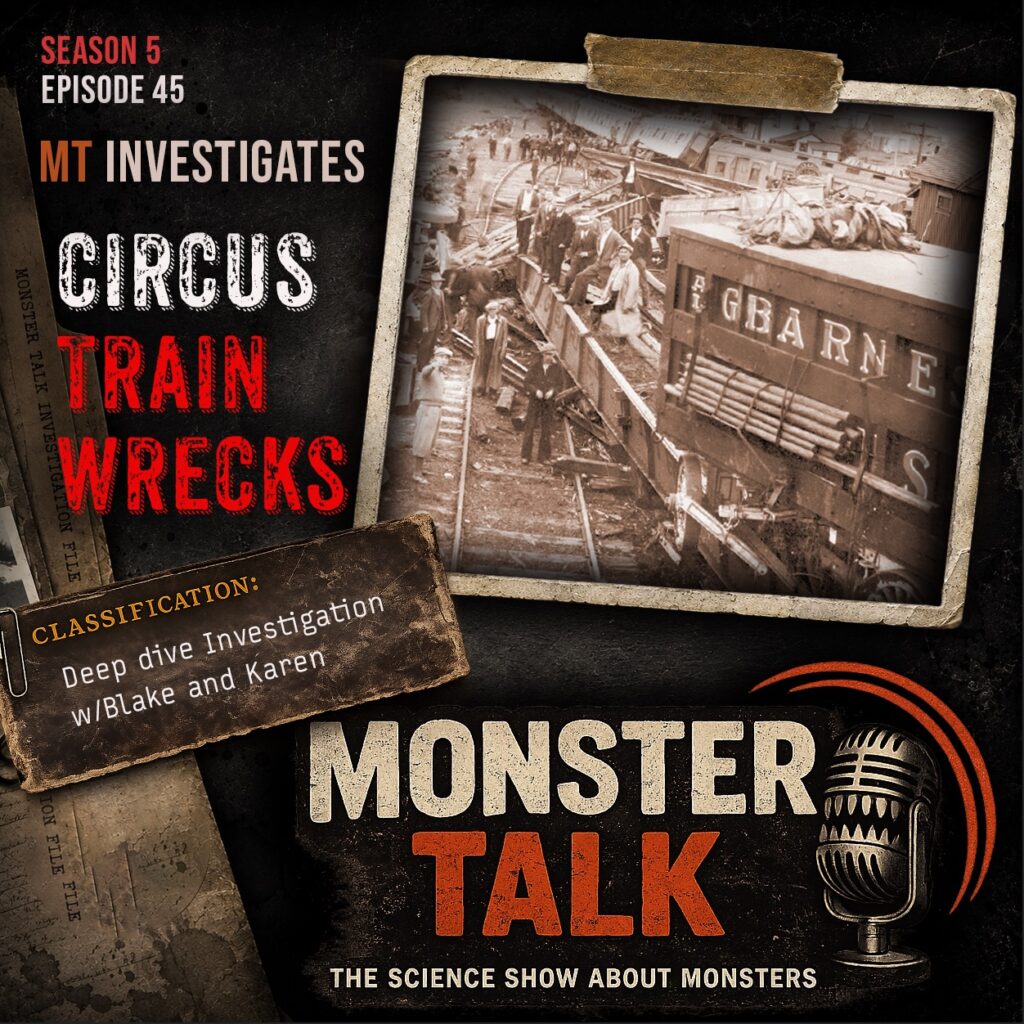
S05E45 – Circus Train Wrecks 🎪🚂
⚠️Content Warning: This episode contains sustained discussion of animal injury and death, including the killing of working animals, animals shot after escaping, and graphic period newspaper accounts. ⚠️
Blake and Karen discuss Circus Train Wrecks as an explanation for mysterious “real” animal sightings, as well as a source of folklore monsters of high improbability.
🚂 In This Episode
- Why circus trains wrecked so often
- The economic event that ended the era – and why regulation wasn’t the answer
- An inversion of survivorship bias, and the data set nobody has built yet
- A 1917 newspaper story about lions in a butcher shop that is not what it appears to be
- The 1931 wire story about a colony of Bengal tigers in the mountains of Mexico
- How armadillos actually got to Florida
- Gypsy the elephant, Tifton to Valdosta, November 1902
- Wallace the Lion, the Exeter mail coach lioness, and Christian the Lion
- Why the Beast of Gévaudan may be the oldest “it escaped from a menagerie” case on record
- How Gévaudan subverts myths about the Enlightenment
📊 The Data
Blake’s working database draws on archival newspaper accounts running from 1877 – the earliest wreck he could document – through the late 1940s. Across the peak decades the rate averages close to two wrecks per year, and the years with none at all are the exception rather than the rule.
Decade-by-decade distribution across 68 catalogued accounts:
1870s – 1
1880s – 17
1890s – 12
1900s – 23
1910s – 7
1920s – 6
1940s – 2
Of those 68 accounts, 55 involved human injuries or fatalities (80.9%), 30 involved animal injuries or fatalities (44.1%), and 21 involved animal escapes (30.9%).
The golden era peaks between 1902 and 1910, with 21 wrecks in nine years. The 1893 Walter L. Main wreck at Tyrone, Pennsylvania is the deadliest of the early period. The 1918 Hagenbeck-Wallace wreck at Hammond, Indiana is the deadliest in the history of American circus railroading. The last recorded wreck in the set is Missoula, Montana, 1949.
A fuller article laying out the sources, the clippings, and the methodology is forthcoming in the UK’s The Skeptic. Blake has said he will share everything he has gathered with anyone who wants to take the research further – particularly the schedule data that would turn his numerator into an actual rate.
🐘 The Chronological List of Historical Animal Escapes
1882 – Paint Lick, KY (Sells Bros. Circus)
A large, fierce tiger escaped from its partially crushed cage after a steep-grade brake failure and roamed the Kentucky hills before eventually being recaptured.
1886 – Putnam, CT (Robbins’s Circus)
Several monkeys broke out of their enclosures during the wreck and escaped into the surrounding Connecticut woods.
1887 – St. Louis, MO (John Robinson Circus)
Multiple wild beasts were freed in a derailment. A great commotion ensued, and a leopard bit a showman before it was successfully caught.
1893 – Tyrone, PA (Walter L. Main Circus)
In one of the most famous wrecks in Pennsylvania history, multiple tigers and other exotic animals escaped. While most were rounded up, at least one tiger roamed loose for some time.
1893 – Grass Valley, CA (Sells & Rentfrow)
A cage car containing performing bears was smashed in a collision, freeing the bears into the California woods. They were eventually recaptured.
1895 – Chicago, IL (George W. Hall Circus)
Two massive boa constrictors escaped from their cages during transit. One was caught quickly, while the other was hunted through the city by local police and schoolboys.
1902 – Tifton to Valdosta, GA (W. H. Harris Nickel Plate Circus)
A legendary, tragic escape in which an elephant named Gypsy, badly shaken after a collision with a yard engine, killed her keeper aboard the car, broke loose near Valdosta, terrorized the town, and was eventually hunted down and shot by an armed posse.
1905 – Arkansas City (Unknown Circus)
Following a severe derailment, a wide assortment of menagerie animals broke loose into the surrounding countryside.
1905 – Temple, TX (Campbell Bros. Circus)
Nearly all of the show’s wild animals escaped into the Texas brush, triggering a massive, widespread local panic in the rural districts.
1905 – Brockville, Ontario (Robinson Circus)
A rare non-panic escape in which a massive elephant named Tillie, sensing the impending collision of her train car, physically jumped from the moving car to safety and remained under her trainer’s control.
1906 – Edison, OH (Robinson Show)
Seven elephants were liberated from their derailed cars, ran amuck through the local area, and were eventually rounded up by circus handlers.
1910 – Ebensburg, PA (Frank A. Robbins Circus)
A massive menagerie escape occurred when two lions, an elephant, a leopard, a hyena, a jaguar, and an ibex all escaped into the Pennsylvania mountains, terrorizing local communities.
1921 – Lincoln, NE (Palmer Brothers Circus)
A train washout freed several lions and other wild animals, prompting armed citizen search parties to patrol the area.
1923 – Topeka, KS (Carl Hagenbeck-Wallace Circus)
A Siberian tiger named Lenine broke out of its demolished cage, chased onlookers, and fled half a mile into the countryside before being shot by a posse.
1925 – Norwood, NY (Ringling Bros. and Barnum & Bailey)
A kangaroo and an emu went missing from their transport cars during transit between New York and Montreal.
1927 – Aurora (near Chicago), IL (Hagenbeck-Wallace Circus)
A passenger train slammed into a stalled circus train, killing one elephant. In the chaos, six other elephants stampeded directly through the streets of Aurora before being recaptured.
1945 – Rubiera, Italy (Yatz Circus)
A dramatic wartime collision freed nine lions, fifty monkeys, a hyena, and a boa constrictor. Allied troops in armored cars had to be deployed to assist farmers in hunting down the escaped lions.
🦁 Before the Trains – Real Menagerie Escapes
The Exeter Mail Coach Lioness (1816)
On the night of 20 October 1816, a lioness escaped from Ballard’s Menagerie, camped near an inn in Wiltshire. She emerged from the dark and attacked the lead horse of the Exeter mail coach. The guard attempted to shoot her with a blunderbuss; the menagerie owners eventually distracted her with a mastiff, which she killed, and pinned her under a granary. The coach horse was so badly injured it had to be put down.
Wallace the Lion (1830s)
Wallace was a famous attraction touring Britain withWombwell’s Menagerie. He had a history of mauling his keepers, and the situation escalated into tragedy when he escaped his enclosure in Derbyshire and killed a man. Because exotic animals were enormously valuable financial assets, he was captured and returned to the tour rather than being put down.
Christian the Lion (1969)
Not a monster, but a famous real case of exotic animal keeping. John Rendall and Anthony Bourke boughtChristianas a cub from the Pet Kingdom department at Harrods in London, raised him in a London flat, and exercised him in a local churchyard. He was eventually rewilded in Kenya, and the footage of his reunion with Rendall and Bourke remains one of the most-shared animal videos on the internet.
👹 Monsters Blamed on Circus Train Wrecks
These are the creatures whose origin stories reach for a wreck, a zoo, or a menagerie as their anchor in the plausible:
The Honey Island Swamp Monster– Louisiana
The Pope Lick Monster– Kentucky
The Sidehill Gouger
The Werewolf of Werewolf Springs
The Beast of Neamț– Romania
The Santer– North Carolina
The Tennessee Wildman
The Grunch – covered in our Louisiana lore episode
The Chatawa Monster – Mississippi ape man
The Beaman Monster – Missouri ape man
Phantom kangaroos– numerous, and almost always attributed to a zoo or circus escape
Broadly, they sort into three types: “alien” or out-of-place animals (alien big cats, lions, phantom kangaroos, gorillas), folklore monsters proper, and the plain escaped predator – which is not really monstrous at all unless you happen to be the cow.
🐆 The Trope in the Wild
Florida’s armadillos.The popular local legend is that the state’s armadillo population came from an overturned circus truck or train wreck near Titusville or Cocoa. Historians and biologists say otherwise: the animals expanded their range naturally from Texas, supplemented by deliberate local releases.
Eastern cougars and black panthers.Loren Coleman documented a farmer’s claim that “a circus train wreck that happened in the 1950s released the panthers,” and an Associated Press report quoting a keeper at Peoria’s Glen Oak Zoo that “the mystery cat was an escaped circus animal.” Coleman found the same explanation deployed in Britain and Australia – and when he checked Australian government records from 1958 to 1974 for the early-1960s wreck that supposedly loosed the cats, he found no documentation of any such accident.
The Florida Skunk Ape.Coleman has been blunt about the claim that “those apes in Florida were the end result of a Ringling Brothers Barnum & Bailey circus train wreck which loosed apes into the Florida landscape,” filing it alongside other misguided attempts to explain a hairy hominid as a feral pongid.
Coleman on the wreck explanation, 2007–Cryptomundo
The tiger colony of Villa del Carbón.An Associated Press story dated 30 June 1931 out of Pachuca, Mexico reported that a colony of ferocious Bengal tigers in the mountains descended from three animals that escaped an 1913 wreck of the Maravilla Circus train. Blake could find no evidence of a breeding population of Bengal tigers in Mexico, and no evidence the wreck ever happened.
The Rotterdam red panda, 1978.A red panda escaped from Diergaarde Blijdorp and died very near the zoo shortly afterward, its body recovered by staff. The public did not know. Local media kept broadcasting the appeal to watch for it – and more than a hundred people reported sightings of an animal that was already dead, in a country with no other red pandas in it. A useful case for anyone thinking about how expectation manufactures sightings.
📰 “Animals Escape in Circus Train Wreck”
Buried in the archives, dated Thursday 19 July 1917 in the Camden, New JerseyCourier-Post, is a jaw-dropping account of a wrecked circus train loosing lions, tigers, elephants, bears, leopards, kangaroos, monkeys, and snakes into a village within half an hour. A woman is pursued through an upper story by a baboon. Three lions enter a butcher shop and devour four steers, sparing only the cashier, who is safe because she is in a cage. Leopards wreck a barber shop. Rattlesnakes clear out a saloon. Bears take the grocery.
Listen to the end of that one. It is worth it.
🎵 Get Wombling
Wombwell’s Menagerie led, as these things do, somewhere else entirely.The Wombleswere a British children’s television series that first aired in 1973, based on the books by Elizabeth Beresford, and spawned a novelty band whose members dressed as the burrowing, litter-collecting creatures. Underground, overground, wombling free.
The Wombles at the BBC
The Wombles – “Get Wombling!”
The Wombles theme
🙏 Thanks
Thanks toSharon Hill, who took a side quest to help Blake obtain an important research source. That particular case is barely touched here, but it is central to the essay version of this project.
And once again our thoughts turn toJoe Nickell, who would have loved this one. He genuinely liked the circus and sideshow world and interviewed the people who lived in it.
📚 Books Mentioned
Beyond Words– Karen Stollznow💵
Secrets of the Sideshows– Joe Nickell💵
Unscheduled Stop: The Town of Tyrone and the Wreck of the Walter L. Main Circus– Paula Zitzler with Susie O’Brien💵
Mysterious America– Loren Coleman💵
Monsters of the Gévaudan: The Making of a Beast– Jay M. Smith💵
🎟️ Promotions
Karen Stollznow’s latest book,Beyond Words, is out now, and she has just returned from touring it in the UK. 💵
Blake’s full write-up of the circus train wreck research is forthcoming inThe Skeptic, with the complete run of newspaper clippings, sources, and references. A link will be shared here when it is published.
If you are a researcher in circus history, folklore, or rail history and want the raw data, Blake has said repeatedly that he will share everything he has. Get in touch.
🎧 Support the Show
MonsterTalk is listener supported. You can find all the ways to help at monstertalk.org/support, including ourPatreon, where you can get the commercial-free version of the show with extended coverage.
Please rate and review us wherever you listen, and share the show on your favorite social platforms.
MonsterTalk theme music is by Peach Stealing Monkeys.
SEO Transcript
This is not a fully accurate transcript, and was machine generated. It’s here for helping search engines find the episode but not intended to be a faithful transcript of the episode. (But it’s not AWFUL.) Some of the material in this transcript only exists in the Patreon/Premium edition of the show and was excised for the commercial version.
_____
Monster House presents…
This is the ad-supported version of Monster Talk.
We’re dependent upon the revenue from these ads and from the support of our patrons at patreon.com forward slash monster talk to continue making this show.
As a disclaimer, your hosts are unable to control what ads you will hear, and while we have done what we can to avoid ads that are divisive, the system that injects them sometimes ignores our preferences and always seems to ignore our efforts to not interrupt the conversational flow.
While we understand this can be disruptive, we’re trying our best.
Patreon remains the best way to enjoy commercial-free listening to our content.
Plus, you generally get extended coverage of the subject.
We’re working on other ways to consume our content as well, so please stay tuned.
It’s actually quite unlike anything we’ve ever seen before.
A giant hairy creature, part ape, part man.
In Loch Ness, a 24 mile long bottomless lake in the highlands of Scotland.
It’s a creature known as the Loch Ness Monster.
Monster Talk.
Welcome to Monster Talk, the science show about monsters.
I’m Blake Smith.
And I’m Karen Stollznow.
This week, we have to talk about the elephant in the room.
And specifically, whether it snuck here on its own, making its way from India through a series of wacky adventures, or whether there’s a more rational explanation that doesn’t involve her donning sunglasses and mocking up a passport for a Mrs. Ellie Funt in order to get past border security and explain why she is here today.
I am speaking, of course, about circus train wrecks.
You know how there’s FAQs, frequently asked questions?
There probably should be FGAs, frequently given answers.
And in the world of mystery beasts and out-of-place animals, at least here in North America, explaining away a mysterious sighting with a wave of the hand and a John Lovett-style circus train wrecks, that’s the ticket, has been a go-to FGA for a long time.
For a few months now, I’ve been saying that I wanted to look into this topic, and this week I took some time and shared some of my findings with Karen.
She had been out of town in the UK promoting her latest book, Beyond Words, so we still needed to catch up, and I want to hear all about the new slew of beloved weird locales that she and Matt managed to visit while they were there.
But that’s not this week.
I’ve been following up on this circus train wreck stuff, and like a phantom elephant’s trunk, there’s a lot to unpackaderm here.
I really, really enjoyed this research, and an article that lays out my findings should serve as a useful guide to anyone looking deeper into the topic.
That’ll be forthcoming.
In the meantime…
I need to thank Sharon Hill, who took a side quest to help me obtain an important research source.
I won’t be talking much about that particular case in this episode, but it’s an important story for the essay version of this effort.
So keep an eye out for that write up and I’ll be sure and share a link here when it’s completed.
Monster Talk.
Yeah, what are we talking about today?
And I think this is a topic that keeps popping up again.
And it’s good to kind of delve into it a bit more.
I don’t remember how many episodes.
I probably could actually look it up now that I’ve started doing transcripts.
But over several episodes, I think it actually started when we were discussing monsters from Louisiana.
I think there was a story in there about the idea that a monster emerged from an escape after a train wreck or a circus train wreck in particular.
And I was like, I know that happens a lot.
But I have never bothered to look into how often did circus train wrecks even happen.
Such a specific thing.
It is.
But I think we have talked about it before, just with regards to alien big cats and just, I guess, flora and fauna that we don’t expect to be in a certain place.
Yeah.
I mean, it doesn’t sound better than a paranormal explanation.
Well, it does.
I think Lauren Coleman kind of it’s funny that I think he and I are both in agreement that it’s not a very good explanation.
But I think Shuker, Carl Shuker.
kind of likes it because it does give you a non supernatural sort of rational explanation for why an unusual animal might be spotted somewhere that it’s not supposed to be.
But how many times can that happen?
That’s seems.
And that’s the question, right?
I, because I don’t know about you, but I just assumed.
And then.
I just assumed this would be a really unusual occurrence.
You wouldn’t think.
Yeah, so I guess, let’s start with the claims.
What are some of the claims?
A quick correction slash insert here.
Despite my having notes in front of me, for some reason my mind went blank, but circus train wrecks have been used as a cryptid and out-of-place animal explanation for a long time.
The Grunch was the monster from our Louisiana lore coverage.
But other folkloric monsters, like the Honey Island Swamp Monster and the Popelik Monster, the Sidehill Galger and the Werewolf of Werewolf Springs, the Beast of Nymphed, maybe it’s D’Ampt, I’m not sure, the Tennessee Wildman, and any number of phantom kangaroos and gorillas and ape man are all tied to circus train wrecks and zoo or menagerie escapes.
I see all of these as being of a family of a kind of rational explanation, even if it’s wrong.
The Popelik monster, which I find that that’s such a strange one because it’s basically a satyr, like it’s a goat man.
But but rather than postulate this escape from a Greek myth, the story is that it was some sort of circus freak show and a train wreck happened.
And that’s why it’s associated with a particular bridge.
Right.
Yeah.
It seems like these claims can be found around the world or at least Anglophone countries.
Yeah.
But but yes.
And they have to be countries where there would be a train.
I mean, so but there is rail in England, but they didn’t have really there’s no history of traveling menageries going by rail like the way like that.
Apparently in the United States, it turns out.
This was actually, there were a lot of train, circus trains.
It was a thing.
And apparently not as safe as I would have suspected it.
Well, you’re making me think of just when my son was a little younger and he liked going to kind of amusement parks and places where they had trains.
And often they would have a circus train.
uh kind of um uh what do you call it like a um compartment train but oh uh like a like a passenger car sort of thing yeah i guess i guess but with bars like bars on it or oh oh for the cage for the for like to show like a cage tiger or whatever yeah or like but
Typically, that’s just one of the kind of cars that have, you know, you’ve got all the different kinds of flat cars and oil tanks and things like that.
And so they usually have a circus one.
So I think that this has been a thing in folklore and reality for quite some time.
Yeah.
So I’ll tell you that what surprised me is.
And not much surprises you.
And I’m very pleasantly surprised.
I mean, let me just, I have to put a whole bunch of caveats here because these are stories about horrible train tragedies and people died.
And the animals died and there was terrible lack of safety and a complete disregard for human life.
And some of these stories ended up with horrible outcomes for the animals in question.
But it was it was not.
A very rare occurrence for circus trains to wreck.
My data showed the first one I was able to find was in 1877.
And they continued with alarming frequency up until right around…
1930 i’m gonna go ahead and spoil something here the the i i first my initial thought was oh i bet that’s when they started implementing like rail safety rules or it’s like no no no that’s not it
No, 1929, the great crash, the economic crash actually caused that precipitous drop in circus train wrecks because a lot of the circuses went out of business and then they consolidated.
And then the newer train, the companies that could actually afford to buy up all these companies and their stock, their rolling stock, were able to start using safer rail cars.
They used to make them out of literally like varnished wood.
Seems a little cheap.
It’s okay.
There is a monster in this story.
The monster is…
the businesses that ran these circuses and their complete disregard for safety.
Oh my gosh.
All right.
So I know your kid loved trains, right?
I love trains.
Not the way my son does, but the, I don’t know.
We had a G scale model rail rate.
Like that’s the big garden size.
Like I had that running around his room.
Oh, you’re kidding me.
Wow.
Oh, it was so cool.
It was so cool.
I still got it, but we took it down.
But on the top, if you look on the cars, on some of them, you’ll see there’s kind of like a wheel on the back that looks like a…
door on a ship where like they would lock the doors, you know, like you rotate to that.
Those were the brakes.
And so before they invented air brakes, the cars themselves would have these brakes.
You have to like go back and rotate the wheel.
So the brakeman would have to be assigned either assigned to a car and like rotate them on command or whatever.
It turns out that when loading the train.
It was really inconvenient to have that big metal wheel sticking up.
So they often just didn’t put it on.
It would take them off and it would make it easier to roll stuff from the back of the train forward, load the train.
And guess what?
That turns out to be horribly unsafe.
I was going to ask you, the natural question is, why were these circus trains so prone to wrecks?
So you’re saying this is the main reason or one of the reasons?
It’s one of the reasons.
I was going to say, they’re also made of wood and varnished wood at that.
And then they were… Oh, man.
Some of these cars…
There’s a story in there about one of these trains where…
at the end after they made all their modifications to load it there were only four sets of brake across the whole train they’re they’re loaded down with heavy circus equipment and humans personnel they had 80 people in a car sleeping in a wooden car that was lit by a lantern so yeah not great to fire hazards and fire hazards safety hazard yeah like this is pre-osha what
so it sounds like some of these wrecks would have involved humans too oh yeah quite a bit a lot of people died um the uh the other thing is it was cheaper to uh move people on these trains if you um
ran them at night off off schedule from the regular train passenger line stuff so and also if you think about it um these trains really wanted to move fast because they wanted to go from one circus town to the next and they had to get there and get unloaded and get ready because the first thing they would do in the new town is have a parade
And the parade was their advertisement for Come See Our Circus.
So they’re like tearing down and hopping on a train, rushing to the next town overnight, unloading the train, building up a circus parade, building the tents.
They’ve got people whose specialty is canvas and poles and all these different things.
So it is a…
I don’t know if that came through, but that was me snapping my fingers to how urgent this business was.
They’re adding dangers.
They’re going nuts.
They’re adding dangers.
They’re moving fast.
They’re removing safety equipment.
And they’re doing a lot of this at a time when they didn’t have electronic messaging and electronic switching.
So there’s people, you know, people, you’re depending on people remembering or being informed all the way across the line that a different train is going to be running, that the siding is going to be filled by a train, or all these different sort of safety factors.
And it just led to so much death and carnage to the point that it’s basically…
I want to say it’s two a year.
It’s actually like 1.8 a year from 1877 to 1929.
So that’s statistically pretty significant, really.
Very significant.
Some years had four, you know, and some years only had one.
And here and there would be like one year, not close to any others, where there would be no train wrecks.
But it was very rare.
Almost every year had multiple.
That’s so wild because I never ever thought that this would have this much frequency and be this horrific.
It sounds like such an anomaly, but it also makes me think about some of the stories that we’ve talked about, like the San Antonio railroad tracks and crashes with trains and buses involving children.
So I think there are some parallels there, too, that these things did happen.
But this is astonishing.
Now, has anyone, you’re delving into this, doing this research, has anyone written about this topic?
Let me just say, OK, I love collaboration and sharing research.
This is such an interesting opportunity.
People have written a lot about circuses.
And in that research material, they have the train schedules for a lot of these big companies.
Right.
Because what I’m looking at is I’m looking for, you know, did a circus train wreck happen?
Did a circus trainer.
So I’m searching for that year by year through the newspaper archives.
All right.
So this is actually, from a statistical perspective, an interesting inversion of the survivorship bias, right?
So there’s a famous math story about trying to get tracks on like where to put armor on airplanes and looking at the data sets for like airplanes of where they were shot when they came back.
And a famous statistician looked at it and said, hey.
We’re only looking at the planes that made it.
We should also be looking to see what happened to the planes that didn’t make it.
That’s actually more important.
Oh, yes.
Like on Facebook, people say, I didn’t wear a seatbelt when I was growing up and I was fine.
And so this is the inverse of that.
So it’s like instead of survivorship, this is the crash.
It’s a bias towards wrecks.
Yeah.
So I don’t have a I’ve got a numerator with no denominators to get real stats here.
But but that data is out there.
So somebody wanted to take the time to do that statistical work.
There’s a really interesting historical thing.
Someone I’m sure.
Yeah.
Well, I’m going to share everything I’ve got with anybody who’s interested.
So when I do my write up, it’ll have it’ll have I’ve got so many newspaper clippings.
I think I have.
Cool.
Yeah.
I mean, I’ve got close to 70 examples and very few of those were overlapping.
So these were covered by the newspapers.
I mean, to me, that would have been of interest.
Absolutely.
Even the smallest collision, if it had a circus in it, was newsworthy, apparently.
For sure.
Yeah.
You read some of those older newspapers and they talk about, oh, Mr. and Mrs. Smith visited town.
Yes, exactly.
Yes, absolutely.
If a circus train crashed, that would absolutely be newsworthy.
Well, so these were a real thing, and that’s fascinating, but how did they become tied to monster lore?
So…
When looking at this case, I was specifically looking at this whole thing about circus train wrecks.
And I want to make sure we do cover that this actually has a precedent that is older than the train wrecks because it ties into zoos and menageries.
But I found several different examples where it was being used as an explanation.
But the irony to me…
is that in almost every case where a monster is alleged to be caused by a circus train wreck escape, Mm-hmm.
There is no corresponding train range from which it could be sourced.
So it’s not what I would have hypothesized was places with known major wrecks would be more likely to spawn phantom lions or phantom apes or that sort of thing.
And that’s not what happened at all.
So they seem to be completely divorced from each other.
It sits there as an explanation, but it has no bearing.
And are we talking about, I mean, obviously monsters, so hybrids and things like that, but also just escaped panthers or leopards, whatever?
One of the early examples was a story out of Mexico that was shared on The Wire and showed up in numerous papers across the U.S. And the story alleged that there was a breeding population of Bengal tigers in Mexico that were sourced to an earlier circus train wreck in which multiple tigers escaped.
But I couldn’t find any evidence that there was a breeding population of Bengal tigers in the wilds of Mexico or that the train wreck alleged to have sourced them or loosed them even took place.
From an AP story,
June 30, 1931 Circus train wreck is blamed for tiger colony.
Pachuca, Mexico A circus train wreck 18 years ago is believed to be responsible for the existence in the mountains near Villa del Carbon of a colony of ferocious Bengal tigers, which sometimes descend to prey upon cattle in the lower lands and are known to have killed several persons.
A tiger and two tigresses escaped when the Maravilla Circus Train was wrecked in 1913 near the villa and they are believed to have been progenitors of the numerous beasts of their kind that now dwell in the mountains.
Bengal tigers do not exist anywhere else in America.
And that many years later as well.
The story hit the wire, as we would say back then.
Yeah.
So, yeah.
And that was one of the earliest ones.
So by the 1920s, I would say this was a pretty common explanation for these erroneous animals.
And I should just because it’s it’ll show up in the article for sure.
One that’s actually been attested to by naturalists, but but incorrectly, is that armadillos in Florida originated in a circus train wreck.
or sometimes in a circus truck wreck.
They actually migrated across from Texas.
There’s actually very clear data on that.
But those stories persisted, especially in the 1940s.
I guess when the population was really blowing up, people wanted to know why it was happening.
And I know that feeling.
Similar climate, too.
Well, and they’ve actually reached Georgia now.
In my lifetime, they were never around.
The possums were your go-to roadkill here.
And in the past 20 years, really since I’ve moved to this house, possums and coyotes have really showed up in force.
So, yeah.
And no circus train wreck.
Well, I wanted to go back to the real wrecks for a minute because a few other questions popped into my mind.
Were these circus animals, were they ever transported differently from livestock or was it the same?
They had special cars.
Yeah, they had, you know, given that they have big cats and predators, they had to be treated differently than just the cattle cars.
But by far…
The most frequently victimized, if that’s the right word, circus animal were the horses.
Horses don’t do well if you break a limb.
And frequently after these…
It can be the end of them.
Yeah.
And so it’s sad.
Horse racing is so cruel.
Yeah, it’s really sad.
If you go look at circus train wrecks, you’ll almost always, it seems like, see a pile of dead horses nearby.
It’s like, you know, that’s just terrible.
If you’ve ever heard a wounded horse scream, it’s not pretty.
Oh, I haven’t.
That’s a horrible thought.
But aside from the animals being injured, I can imagine that if any did escape, that it would have been really chaotic.
Yes.
Bedlam, that’s probably not the right word.
They, a ruckus…
What was the other word?
There’s a whole bunch.
It created a spectacle.
There was a case where elephants got loose in Chicago and were wandering the streets for like four hours.
Oh, wow.
You can imagine sitting in the bar and you look up and you take a sip and you see an elephant walk by and you put it down.
It’s like, never again.
Yeah.
It makes me think even today you do see things on Facebook, on social media, where a bear wanders into a convenience store and just opens up all the chocolate bars.
Or you see a mountain lion get into a shop or something or break into someone’s house.
Eat the cat food and the dog food.
So, yeah, I imagine that the animals that did survive and weren’t injured, it just must have been spooked.
Now, I have to think, you know how…
advertising can be a little misleading uh it’s just a little yeah yeah um occasionally i should i should probably insert the copy here but there when i got to 1914 so at some point i decided uh when i realized 1877 seemed to be the oldest one i just started going year by year through the archives uh with a bunch of different search terms
And when I got to 1914, I saw a jaw-dropping story about animals invading a town.
And it was like, holy cow, how have I never heard of this story before?
This is amazing.
Courier Post, Camden, New Jersey, Thursday, July 19th, 1917.
Animals escape in circus train wreck.
A circus train going about 30 miles an hour was wrecked on the outskirts of a town.
No one was killed, but the cages containing wild animals were smashed and the beasts got loose.
Within a half hour, lions, tigers, elephants, bears, leopards, kangaroos, monkeys, and snakes were overrunning the village.
The people were thrown into a panic and they fled wildly from place to place in their effort to escape the man-eaters.
One woman, pursued by a huge baboon, climbed to the upper story of a house, but the baboon was close on her tail and she leaped out a window.
She landed on a roof, and as she turned to get away from her pursuer, she fell through a skylight.
Two tigers invaded a home where a man and his wife and son were together.
The woman fainted and fell out of a window.
Three lions entered a butcher shop.
Everyone fled but the girl cashier, who was saved because she was in a cage.
The lions devoured about four butchered steers.
A trio of leopards wrecked a barber shop, a flock of rattlesnakes cleared out a saloon, and a company of bears wrecked a grocery store.
Meantime, the people of the place were rushing from place to place seeking safety.
Mothers took their children into storm cellars.
Men ran like mad.
The panic was finally quieted when the keepers from the circus went through the town and rounded up their charges, thus bringing to a climax…
Wild Beasts at Large, the Greater Vitagraph Deluxe Feature, which will be the attraction at the Elm Theater on Saturday, July 21st.
At the matinee, prices will be cut in half for children and there will be a number of other reels.
So that was all just a ruse to lure people in.
It was absolutely just like a normal news story.
Remember a few years ago when the internet wasn’t terrible and they started having these…
There was these fake news stories at the bottom of like CNN.
All the newspaper companies had like ads at the bottom of the page that looked like more news stories, but they were ads.
And I always thought that was really a sign of the demise of integrity on the journalist side.
Yeah.
Or maybe some things have never changed.
Or maybe they’ve never changed at all.
And maybe it’s been like this since 1914.
I was surprised.
Apparently, this would have even been illegal.
I saw that there was actually an act that made it where you were supposed to have your advertisements clearly labeled as such.
Right.
For entertainment purposes only.
That sort of thing.
Yeah.
Yeah.
And this this copy was clearly not following that protocol.
Yeah, that’s astounding.
And this is just revealing so much.
It’s really surprising.
I thought this would be kind of cut and dried and all this kind of thing didn’t happen or it happened once and then just transported everywhere.
So this is just really illuminating.
Somebody could easily write a book just about circus train escape.
There’s so many interesting stories in here.
Well, do we know anything about the creatures that escaped?
Did they survive?
I mean, you talk about these animals.
Did you say tigers that were…
lions 18 years later that were supposedly in reality are we talking about animals surviving for days or weeks or longer?
Some of them were never recovered I want to say it was New Jersey there were some monkeys that got loose that were never recaptured
Snakes seem to be the ones that really get away.
And that leads to all sorts of discussion where people claim to see them later.
Boa constrictors, that sort of thing.
Now, in reality, these were upper United States.
So those animals would have died from the cold first winter.
Good point.
But yeah, a lot of them got recovered because if you think about it, it’s not like in general animals.
when loosed, immediately revert to their natural state.
These animals have been in captivity for a long time.
It would make them vulnerable.
Right, exactly.
The most heartbreaking, I think, of these stories to me is the 1902 story of Gypsy the Elephant.
The train crash upsets her.
She gets loose.
Her trainer tries to settle her and she smashes him to a pulp.
Okay.
And again, this is 1902.
This is Georgia.
Can you guess what happens next?
From the Chicago Tribune, Monday, November 24th, 1902.
Elephants wild in circus car.
Gypsy kills its keeper in Georgia and is shot after terrorizing people.
Savannah, Georgia, November 23rd, special.
Gypsy, the largest elephant of the W.H.
Harris Circus, became enraged on the train between Tifton and Valdosta, Georgia, killed her keeper, wrecked the inside of the car, and when the train stopped at Valdosta, broke out of the car and terrorized the town and was killed.
The circus train was wrecked by colliding with a yard engine at Tifton Saturday morning.
Several of the animal cars were smashed.
Among the animal cars wrecked was that of Gypsy who was intensely nervous after the accident.
Her keeper, James O’Rourke, tried to quiet her.
The great beast was thoroughly frightened and nervous.
Six miles out from Valdosta, she became so restless and noisy that O’Rourke entered her car for the purpose of attempting to quiet her.
The elephant attacked him and before he could escape,
She had gathered him in her trunk and lashed him against the floor of the car.
The first toss killed the man, but the infuriated beast trampled the body until it was a mass of broken bones and bruised flesh.
O’Rourke had not time to close the door of the car after he entered, and when the train slowed up at a crossing near Valdosta, the way was open for Gypsy to make her way to liberty.
She took advantage of it.
A hasty hunt was organized.
Gypsy had taken to the woods a rogue elephant made desperate by her experience in the Tifton wreck.
The hunt lasted for two hours when the mad elephant was found in a cotton field, tearing up the stalks, tossing them in every direction, and trumpeting as if mad.
It was seen to be useless to recapture the elephant, so large caliber rifles and explosive bullets were brought into requisition.
After a dozen shots, the big brute was mortally wounded, and a final shot in the forehead completed the tragedy.
Yes.
Tragic.
Oh, it really is.
I mean, I… Tragedy upon tragedy.
But it’s the most Georgia story I’ve, I couldn’t imagine it going any other way.
You know, it can happen right now.
That’s the real monster here.
Perhaps, yeah.
You know, we often say that fact is stranger than fiction.
And that seems to be the case here.
Just that these stories are unbelievable.
And, but just, I think as amazing as the claims, the Weider claims.
Yeah.
I mean, it is.
I’ll tell you what I should do.
Now, to be clear, I’m going to be publishing this in the UK’s Skeptic online magazine.
So I’ll share that later.
I was going to ask you about that.
Yeah.
You need a home for this.
But I love show notes.
I’ve been really leaning into the show notes for sharing stuff.
So check the show notes for this one.
And I’ll put in, I think I’ve got something like 17 cases where the animals escaped and what happened.
And they go from 1882 to 1945.
It’s interesting that that kind of straddles the war time.
You were talking about 1914 earlier.
I wonder if during the wars, if there was an increase in interest in circuses because of just, I guess, for social reasons and if this kind of thing was more prone to happening during those years.
Yeah, it’s a good question.
I don’t know that I could track any patterns.
To answer that question, I would need that other data set of what were the actual show schedules like, which exist, but I don’t have it.
So there’s some really good archivist research to be done on that.
So you told me that this train wreck monster story has some historical predecessors.
What are those?
Can you tell us about those?
guess i was curious about the monster side of it but when i got into it i was also wondering
did any escaped you know animals actually cause damage and so yeah the there’s a couple of really historical interesting ones i think and both of them are in the uk where it would not have been on a train but it would have been with a traveling menagerie so i guess they would have been on carts or something i don’t know it would probably been on wagons okay wagon of some kind yeah so uh
There was a, one case is Wallace the Lion, which was in the 1830s.
And so this was apparently a very famous lion that was traveling with something, a company called Womble’s Menagerie.
That sounds familiar.
That’s weird.
Wombles.
It is.
It sounds like something you would catch, you know, if you’ve had some bad pub food.
I’ve got a bad case of venereal disease.
Oh, also true.
Or a kid’s TV show.
It’s the Wombles.
Yeah.
Underground, overground, wumbling free.
The wumbles of Wimbledon, common are we.
Get wumbling!
But he was not a very well-behaved lion.
Oh, Wallace?
Yeah, Wallace said actually… Are they ever well-behaved?
I don’t know.
It’s almost like they don’t want to be in captivity.
Almost, yeah.
But he actually mauled and wounded several keepers.
And then in the 1830s, I don’t know the exact year, but he escaped his enclosure and actually killed someone.
He escaped and killed a guy, but they were able to…
argue that because of how incredibly rare and valuable he was, they returned him to the menagerie and allowed him to continue to be toured, which I just find really surprising.
After he’s had a taste of love.
Yeah.
And then the other one is the Exeter male coach lioness.
And this one in 1860.
We went to Exeter, so.
Oh, it’s probably in the same area.
It probably is.
Devil’s Footprints.
Yeah, yeah.
So I think the inn still exists, although I don’t think it’s an inn anymore.
But it was in October 20th, 1860.
Yeah, probably.
Everything’s a pub.
It is Ballard’s Menagerie.
They had a lion.
The lion escaped.
It came out and in the night found and attacked the lead horse of the Exeter male coach.
And the guard tried to shoot her with a blunderbuss.
But it didn’t work.
The menagerie owners tried to distract her with the dog, and she killed the dog.
And eventually they got her pinned down under a granary.
And I don’t know what happened to her after that, but…
It’s a blunderbuss.
Oh, it looks like in a cartoon, you see a gun with a giant…
The end of it looks like a horn.
Oh, okay.
It spreads out.
It’s like a bazooka or something.
I think…
I think it’s a muzzle-loading scattergun is what I believe it is.
Okay.
Yeah.
Brutal.
Those are really interesting, and it makes me wonder about the turning point where the explanation shifted from escaped from a menagerie to escape from a circus train.
Do we have any data on that?
Again, well, in the UK, it never does change.
Okay.
So here’s…
If you look up alien big cats, ABCs, we’ve talked about these before.
This is the idea that there’s large non-native populations of cats living in the UK.
And of all the cryptids and monsters out there, this is probably the most plausible because there’s so much evidence that they actually exist.
I don’t think it’s likely that they’re really like lions or giant black panthers.
A lot of those are just house cats that are misidentified.
Or as many cases as are reported.
But the story will always be in the 1960s, it was kept in a menagerie, you know, and they passed a law in the 1970s and it made it harder to keep animals like this.
So rather than pay a tax, people just let their animals go, right?
As you would, yeah.
Yeah.
I don’t know if that ever really happened, but there is a very famous case of Christian the Lion.
Now, get this, you could buy just about anything at Harrods.
Went there too.
This couple bought, these couple of guys bought Christian when he was a cub in the Pet Kingdom department of Harrods.
I think that department’s closed now.
Probably so.
But they raised him in a London flat.
And they would take him to a nearby churchyard to let him exercise.
And they kept him until he was quite big.
Eventually, they got him rewilded back to Kenya.
And if you look on the internet, there’ll be famous footage of him being, they come back to visit him as an adult.
They were already adults, but he’s an adult now.
And you wonder, are they about to be eaten?
And instead, he remembers them and licks them.
It’s very heartwarming.
That’s so bizarre.
And London flats are small for the most part.
So I can’t imagine doing that.
It’s unbelievable.
Bizarre.
So I don’t think that explanation of the menagerie escape has ever gone away, nor will it.
But the craziest thing is I would try to, what’s the oldest case where this was being used as the explanation?
And surprisingly, it is the Beasts of Gévaudan.
Your fave.
My favorite.
I love this story.
And as near as I can find, it’s the oldest case where contemporary to the events, one of the explanations is that it’s not a wolf.
It is an escaped animal, either a lion or a hyena that got out of a menagerie.
Now, this led to a really weird observation, which is going to end up being sort of the stinger from my article.
So if you want to wait and read it, you’ll stop listening or skipping it.
But here’s what happened.
So I just finished.
reading brian riegel’s book darwin and the monsters and he lays out the i guess a really nice summary of what i would say is the enlightenment version of monsterology which is that monsters were seen as signs from god
They were wonders and portents, right?
And then they became something that one would keep in a cabinet of curiosity.
And as science developed as a discipline, people started to do, you know, taxonomy and trying to find an understanding of them.
And after Darwin, you start to get this idea that all these animals have lineages and are related to species.
And it becomes a very clearly defined biology that we understand today.
So but prior to that, one would expect, I think, to find that monsters were treated as miracles, wonders or scourges of Satan, all sorts of things.
Right.
And so with Javel Dawn, we’ve got this really interesting case.
It’s happening right in the middle of the Enlightenment.
And we know that some people are saying it is a werewolf and people are saying it’s a magic wolf and people are saying it’s escaped from a menagerie.
They’re looking for rational explanations and magical religious explanations.
But it’s not the first case of wolves.
attacking people in France.
It turns out in Jay Smith’s book, where he talks to the monstrous of the J’ai-Vadon, he talks about previous cases.
And there were every, you know, three or four decades, there would be a spate of wolves killing peasants.
And so I thought to myself, well, this is interesting because here’s a great test case.
I can go back and see what did people say about these monsters?
They’re just wolves, but what did people say about them in those previous cases?
It should be miraculous, right?
It should be that they’re scourges from God if that model’s true.
And instead, what I found is more interesting that it was the church that was proposing these were just wolves.
And it was the populace that believed that they were monsters or something weird or werewolves.
Because so.
It’s not a clear division between science and the supernatural being a paradigm pushed forward by a ruling class.
I don’t know what it is.
It’s messy because the reality is you’ve always got certain people who have…
cultural cachet to say, this is the official story.
And if you want to be respectable, you’d best stick with it, right?
The party line.
The party line.
And the people who control that party line change over time.
And so I think in some sense, science is correct.
I mean, they have a model that’s testable and it holds up very well to testing.
But as far as explanations go, it’s not the accuracy that controls the narrative.
It’s whoever has the printing press.
Yeah.
Yes, the voice.
The voice.
You’re making me think, too, of a recent show talking about the devil’s footprints, to raise it again, and how the local priest…
If it behooves you to do so.
Oh!
That’s a nice one.
But how the local vicar or parish priest was saying, oh, this isn’t the devil.
This isn’t Satan.
This is a kangaroo.
Exactly.
Which is funny, too, because in America, phantom kangaroos almost always get attributed to escapes from zoos or circuses.
Yeah, it’s interesting because you really do have the tropes, don’t you?
Yeah.
They’re lions and tigers and kangaroos and panthers.
And, again, you get similar stories in Australia, but it is interesting the way that they’re retold in different countries in Australia that it’s American soldiers who brought a panther over as a mascot, you know, as opposed to the circus train wrecks, as opposed to the menageries.
It’s a different costume, but the same kind of story.
Yes.
And they also have a there was I found a shipwreck story from Australia as well, explaining another incursion of wild animals from a different place.
That’s interesting.
Is that common to the US and UK as well?
I didn’t see any.
I just saw one from Australia.
So I don’t know.
So that’s where my research ended up.
And I look forward to writing it to something more cohesive.
know yeah yeah i i look forward i think there’s more to come out about this but i guess just in closing what does this all tell us about how people rationalize monsters
Yeah, I don’t know yet.
I haven’t decided.
I can tell you that there seems to be a complete divorce between the data and the explanation.
And that’s that’s interesting in its own right.
In a sense, if you think about it, which is kind of funny in folklore, there’s there’s this idea of these folklore motifs.
And this idea that like recurring these elements would recur in story.
And it’s funny because some of the most folkloric monsters, the ones that are biologically implausible.
seek their anchor in reality in the form of a real kind of event, which apparently has never been the source of any random monsters near as I could tell.
So as plausibility anchoring goes, it’s a very peculiar one because it takes on the mantle of folklore itself.
Oh, gosh, yeah.
It really complicates things, but it’s…
It’s just so interesting.
You’ve done some really great research and thank you for doing that.
And I look forward to what more you dig up and then can put into an article.
This has been such a pleasant distraction during a very challenging time.
So, yeah.
I’m sorry.
Yeah, no, it’s OK.
I’ll just say because I’m because I’m recording it right now.
And this is just from the heart.
I’m almost positive my mother is going to pass either today or tomorrow.
So I’m so sorry.
I empathize, unfortunately.
And she was always she never got around to actually listening to my show.
I don’t think the podcasting was the technology.
But she was so proud.
She was so proud.
I’ll bet.
Yeah.
Thank you for just raising such a wonderful and interesting topic.
And yeah, I look forward to learning more about it.
But this is a really good start.
And certainly, as always, we love to hear from our listeners and see if they’ve got any.
research or any thoughts on the topic?
Absolutely.
I’ll be glad to share all my findings.
Very generous of you.
I hope somebody out there will take this further because I think there’s some really interesting work to be done here.
Yeah, certainly is.
All right.
Thanks a lot.
Thank you, Blake.
Monster Talk.
You’ve been listening to Monster Talk, the science show about monsters.
I’m Blake Smith.
And I’m Karen Stollznow.
You just heard a discussion about my research into circus train wrecks as it relates to monsters and phantom animal sightings.
Stay tuned and the longer write-up should be done in a few weeks.
I’ll mention it and share the link when that’s available.
This topic, or at least this explanation, appears to have been under-documented in monster lore, and I hope some of my findings will be of use to other monster, circus, and folklore researchers.
I’ll be putting links in some of the findings in the show notes, and when the actual article comes out, it will also have links and references as well.
Once again, I found myself reminded of Joe Nichols’ unexpected demise.
He would have friggin’ loved this research.
He really liked circuses and sideshows and wrote a whole book called Secrets of the Sideshows, wherein he talked with important people from that world of touring entertainers.
As I said during my conversation with Karen, when we were recording this episode, my mother’s death was near.
She passed about an hour after we finished recording.
As I’m sure has been clear from various comments across all these episodes, she and I didn’t see eye to eye on what’s really going on in this world.
But she indulged my curiosity about all these weird topics, with the exception of magic and demonology.
She didn’t even allow us to watch obviously fictional shows that had to do with magic.
But somehow…
She still took me to see King Kong in 1976, and she got me that iconic John Berkey lunchbox featuring the movie poster art.
And she took me to Harryhausen movies, which I’m sure must have made her squirm.
Raiders of the Lost Ark was a step too far, and she pulled me somewhat aghast from the film during the early scenes when the federal agents are asking what the Ark was.
In my mom’s head canon, the Ark of the Covenant had been taken up into heaven and implying that it was here on earth was too blasphemous to entertain.
Maybe she thought we were going to go see the 1976 Sun classic, The Search for Noah’s Ark.
Who knows?
It was a strange way to grow up, being instinctively drawn to stories of the supernatural and wanting to know what was real and what was BS, but also being told that anything that countered the narratives of the church and the Bible probably were real, but were demonic.
I remember my parents turning off 2001 A Space Odyssey before the bone even got thrown in the sky, because, as my dad angrily shouted at the television, everybody said this is a good movie, but it’s about evolution.
Yet, they let me watch Carl Sagan’s Cosmos, only joining me for a few minutes during the first episode before deciding it wasn’t to their taste.
Yet, thankfully, they did not forbid me from finishing the series.
Anyway, some parts of who I am are because my parents encouraged me, and some aspects were developed in quiet defiance.
But there would be no Monster Talk without my mother, so I’ll just say thanks one more time.
I’m sure I was an unexpectedly complicated handful and I’m grateful for the effort that she was able to muster.
We hope you’ve enjoyed this episode of Monster Talk.
Each episode, we strive to bring you the very best in monster-related content with a focus on bringing scientific skepticism into the conversation.
If you enjoy Monster Talk, we now have a variety of ways to support the show, all with convenient links at monstertalk.org forward slash support.
That’s monstertalk.org forward slash support.
We have links there to our Patreon page as well as a donation button.
Thank you.
Thank you.
Thank you.
Thank you.
And please share our show on your favorite social media platforms.
Monster Talks theme music is by Peach Stealing Monkeys.
Get wombling!
This has been a Monster House presentation.
In the 1830s, I don’t know the exact year, but he escaped his enclosure in Derbyshire and actually killed someone.
Derbyshire, yeah.
Derbyshire.
Derbyshire?
Derbyshire.
Derbyshire.
Anyway.
It was somewhere near the shire.
It was a shire.