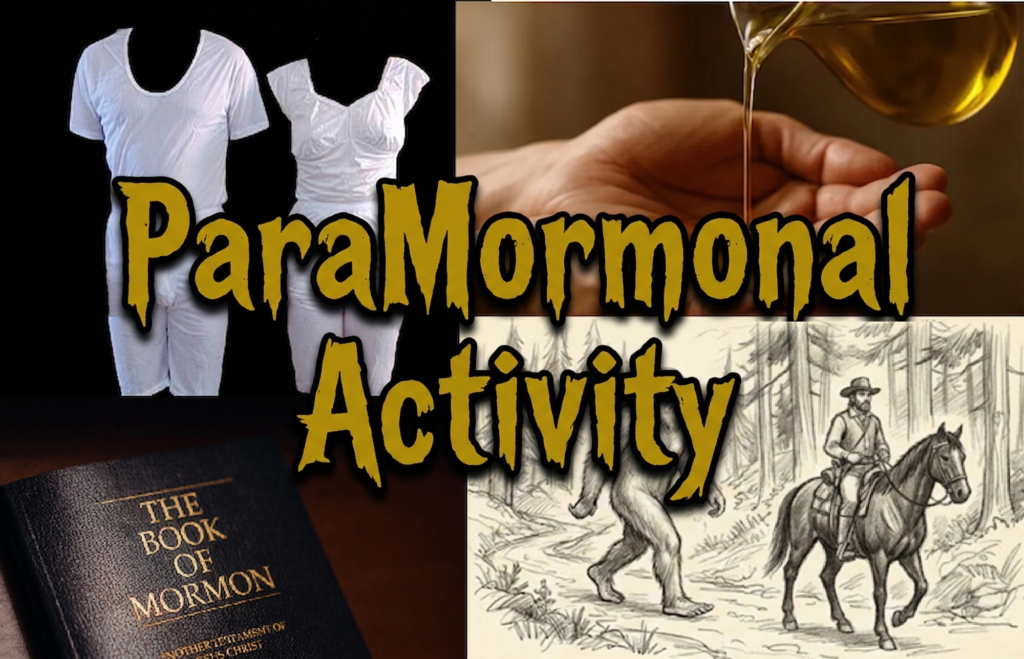
S05E24 – ParaMormonal Activity with Steve Cuno
We talk with Karen’s friend, author and Ex-Mormon Steve Cuno about paranormal ideas in the Mormon religion.
Steve Cuno:
Behind the Mormon Curtain: Selling Sex in America’s Holy City
“It’s Not About the Sex” My Ass: Confessions of an Ex-Mormon, Ex-Polygamist, Ex-Wife
David W. Patten and Mormon Bigfoot:
Between Pulpit and Pew: The Supernatural World in Mormon History and Folklore
SEO Transcript
This is not a fully accurate transcript, and was machine generated. It’s here for helping search engines find the episode but not intended to be a faithful transcript of the episode. (But it’s not AWFUL.) Some of the material in this transcript only exists in the Patreon/Premium edition of the show and was excised for the commercial version.
———————
Monster House presents…
This is the ad-supported version of Monster Talk.
We’re dependent upon the revenue from these ads and from the support of our patrons at patreon.com forward slash monster talk to continue making this show.
As a disclaimer, your hosts are unable to control what ads you will hear, and while we have done what we can to avoid ads that are divisive, the system that injects them sometimes ignores our preferences and always seems to ignore our efforts to not interrupt the conversational flow.
While we understand this can be disruptive, we’re trying our best.
Patreon remains the best way to enjoy commercial-free listening to our content.
Plus, you generally get extended coverage of the subject.
We’re working on other ways to consume our content as well, so please stay tuned.
It’s actually quite unlike anything we’ve ever seen before.
A giant, hairy creature.
Part ape, part man.
In Loch Ness, a 24 mile long bottomless lake in the highlands of Scotland.
It’s a creature known as the Loch Ness Monster.
Monster Talk.
Welcome to Monster Talk, the science show about monsters.
I’m Blake Smith.
And I’m Karen Stollznow.
Sometimes things work out in unexpected ways.
The story behind this episode is that Karen wanted to interview her good friend Steve Kuno on the topic of Mormonism, but I’m always reluctant to do episodes that potentially sound like we’re hammering on religious belief.
While I’m not a believer in the supernatural, I don’t find much value in the religion is pure poison narrative.
To me, religion is a complex human phenomena.
It has cultural and personal value, even if I don’t subscribe to the mythos.
That binary approach just doesn’t work for me.
So I’m not going to be doing an episode where we would just be bashing religions wholesale, even if I don’t believe in them.
But at the same time, acknowledging that they have cultural and personal value to people doesn’t mean they should be beyond critique.
Every religion I’ve ever looked at has aspects that are troubling to me.
I tend to view religions through a historical lens, as human institutions.
And like any human institution, they’re as prone to brilliance and beauty as they are to deep flaws and contradictions.
Anyway, I could yak a long time about that, but the bottom line is that Karen convinced me to do this episode by framing it as a way to look at how Mormons deal with paranormal claims like exorcism and miracles.
And of course, we will talk about the interesting role of Bigfoot in some Mormon theology.
But as it happens, I just got back from Texas State University’s Monster Conference, Gods and Monsters 2026, which was organized by my friends and Monster Talk alums, Natasha Michaels and Joe Laycock.
One of the talks that I attended was Monstrous Religions in 19th Century U.S.
Political Cartoons by historian Josh Patterson, who’s an associate professor at TSU.
He showed and discussed about a dozen examples, but of course there’s hundreds, of 19th century political cartoons that literally monsterized religions to make their points.
Mormon examples abounded as did Catholic.
It highlights the historical tension where freedom of religion often felt like code for Protestantism is our state religion.
Looking at that history of monsterization was a reminder of how easily we turned the other into something scary.
It made me realize that avoiding the topic of religion out of a desire not to offend might actually be missing a chance to understand that process and explore the nuance at play.
So I’m really glad that Karen pushed for this because our guest, Steve Kuno, provides such a fascinating human perspective on the subject.
We’ll be discussing several books during the talk, and I’ll have links to those ready in the show notes.
Monster Talk
Well, our guest tonight, Steve Kuno, is a Portland-based author, columnist, and the award-winning mind behind books like Behind the Mormon Curtain, Selling Sex in America’s Holy City.
And I think this is one of the best book titles ever.
It’s not about the sex, my ass.
Confessions of an Ex-Mormon, Ex-Polygamist, Ex-Wife, a memoir which was as told to Steve.
And Steve holds a degree in journalism and mass communication from the University of Utah.
He’s a former Salt Lake City marketing executive and also a former member of the Church of Jesus Christ of Latter-day Saints, which is why we’ve brought him on to Monster Talk today to talk about the paranormal side of Mormon beliefs.
So welcome to the show, Steve.
Thank you.
That was a delightful and thorough introduction.
Well, I’m glad that it was all accurate then.
Yeah, I didn’t know I had a stalker.
This is very nice.
Thank you.
AI has come so far.
Well, Steve is a man of many talents.
And in talking about Mormons, I don’t even know where to begin.
Now, Steve, you provided us with a long list of possible.
topics.
And I think we should just kind of dive into some of these and get you to chit chat a bit about the stranger side of the LDS.
And yeah, I think I’d like to begin with something that you told me about years ago when we first met.
And that was your brief stint as a faith healer of sorts.
Do you want to tell us a little bit about that?
Sure.
I’d probably be overstating to claim to have been a faith healer, but I did participate in a faith healing.
And so I can tell you about that.
So, yes, I was a missionary for the Mormons.
The Mormons send young men out on two year missions.
It’s unpaid service.
In fact, you shell out your own money to pay your way there.
And so I was sent to the province of Quebec.
And the church put me through a two-year course to learn to speak French so that I could tell French Canadians in French that they darn well ought to be Mormons.
And so there I was.
Mormons believe that the men should be ordained to the priesthood.
At age 12, you get ordained to the priesthood, but you don’t get to do very much.
But by the time you’re 18, they ordain you to the higher priesthood, and you get to go around doing blessings and that sort of thing.
So there we are.
We’re Mormon missionaries.
We’re pounding on doors.
And we were working with a family where the mom told us that she had a tumor in her neck and that she could only move her head so far to one side before the excruciating pain stopped her from further movement.
And she explained that she had a tumor and that the doctor wanted to do surgery, but she’d said, no, I’m going to have the missionaries give me a blessing.
Oh, boy.
It’s kind of every missionary’s worst nightmare to be stuck in that situation because I think deep down inside you don’t think it’s going to work.
You don’t admit that, but you’ve got all kinds of outs when you’re a religious person of this sort.
Like, well, someone didn’t have enough faith or wasn’t in accordance with the will of the Lord.
So you’ve got all these excuses.
But we went through the ritual.
Mormons, before they give a blessing for the sick, they’ll pull out a little bottle of olive oil.
They’ll remove the cap and, through prayer, consecrate the oil for the blessing of the sick.
And you have to remove the cap.
That’s very important.
Otherwise, you’re blessing the bottle, not the oil.
And that’s not going to do anybody any good.
I never thought about that.
That’s funny.
How many times, Blake, have you forgotten to take off the lid?
Never, but I’ve, in the evangelical community, they do a similar kind of, well, I say similar, I haven’t heard the whole ceremony, but oil and laying on the hands for healing and blessing.
Yeah, so yeah.
Olive oil too?
Olive oil as well?
Yeah, yeah, absolutely, yeah.
I guess you could just olive oil.
Yep.
And the motor oil just doesn’t go over.
It doesn’t.
Right.
Yeah.
So I just think if you left the lid on, think how many people needlessly died because someone left the lid on.
It’s very sad.
Inexcusable.
So anyhow, the Mormons do the laying on of hands thing to the first person.
There are two of you.
So the first will anoint.
That is put a drop of oil on the crown of the head of your subject.
Essentially, you lay your hands on this person and say, I anoint you with this oil in the name of Jesus.
And then you both put your hands on the person’s head and the other one pronounces a blessing.
And so we always ask the person, who would you like to do what?
And for some reason, the woman asked my companion to do the anointing and asked me to pronounce the blessing.
I’d been a missionary for about six months at this point, and I did not want to do this blessing, but I’d been asked.
Now, I do have to tell you, I did believe.
I was a Mormon missionary because I believed the whole thing about Klein and Sinker.
I was a convert.
I wasn’t there under family pressure.
I was there because I was motivated and thought I was bringing the truth to these poor French Catholics.
So I did believe and I did have faith, but I knew I wasn’t a healer.
So anyhow…
My hands are on her head and all of a sudden I overhear myself telling her that she’s going to be well.
I mean, not just going to be well, commanding her to be well.
And we removed our heads, our hands from her head.
And she looked this way and that way and twisted her head right and left and all motion had returned to her neck.
And we were blown away.
And I remember, you know, as we were leaving thinking, I.
believe, but I don’t have the faith to heal.
She obviously had the faith to be healed.
And then years later, when I decided that the Mormon church was hooey, I had to deal with this.
And I know there’s such a thing as spontaneous healing, but that would be one dilly of a coincidence if it happened in that moment.
And I do not believe that positive thinking accounts for it.
But then I got to thinking and realized, oh, and I will tell you that the next time we saw her, she said her doctor was absolutely amazed because the tumor was gone.
But then I began to think back and realize, you know, there was never mention of x-rays.
It could well be that she had simply decided she had a tumor.
Much like we see, speaking of Australia, when we see Richard Saunders doing his thing with that little…
plastic ring people wear around their wrists and suddenly they think they’re stronger because they put it on.
Like a live strong type thing.
Applied kinesiology.
Yeah.
And I’m thinking, okay, maybe she woke up with a stiff neck and it had been stiff for a few weeks and maybe with the blessing it was, what was it called, Karen?
Applied what?
Apply kinesiology.
They’ve got lots of little tests where they do arm movements and after you say whether you prefer the Beatles or the Rolling Stones or something like that, then your arm can move more freely.
Lots of very spurious stuff.
Is there any chance that the joint needed lubrication and the olive oil did the trick?
Maybe it seeped down.
That test you just cited, though, is obviously silly because anybody knows it’s the Beatles.
Agreed.
Agreed.
I know Karen’s very serious about that answer.
From the heart, yeah.
Well, that’s why we’re still friends.
So I figure that’s probably, I don’t know what happened, but my best guess is that there probably was no tumor, just a stiff back, and she tried to move her head a little harder after the blessing.
And so you met her twice, and there were no further meetings after that?
Oh, no, we met them lots and lots and lots of times.
And they actually joined the church.
And it was very quite a trial for them because this was pre 1978.
And her husband was black.
She was white, French, Canadian.
And so unusual that they were a couple at the time.
In fact, when they bought their house, the neighbors took up a collection to buy it from them and get them to move because they didn’t want a mixed couple on their street.
Horrible.
Yeah, that’s.
So I don’t think there’s a lot of not a wide public understanding of that sort of baked in racism that sort of inherent in the idea.
And I don’t know if this I my understanding is this has changed in the formal guidance from the church.
But wasn’t there a time when.
people who weren’t white were considered to be subject to the Mark of Cain or something like that?
Oh, yes, yeah.
Pretty close, and I’m glad you brought that up because to follow up on my earlier observation, this was pre-1978.
Pre-1978, Black men in the Mormon church were not allowed to hold the priesthood.
That meant a couple of things.
They could not marry in the temple, and all good Mormons are under obligation to get married in a Mormon temple.
but black people weren’t even allowed in because they couldn’t hold priesthood.
And that also meant that the Mormon church has several divisions in heaven.
It also meant black people couldn’t get to the highest degree of heaven.
Now, when the church had been, until 1978, black people couldn’t hold the priesthood.
Maoris could, Native Americans could, but people of black African descent, even who dropped the drop of blood down there.
could not hold priesthood.
That changed in 1978 when the then president of the Mormon Church, President and Prophet Spencer W. Kimball, suddenly announced to the world that, okay, the time has finally come when everybody, all worthy men, that is, tough luck, Karen, all worthy men can hold the priesthood.
Yeah, yeah.
And what is the priesthood exactly?
Can you refresh?
It is the authority to act in the name of God.
So you can do baptisms and ordinances, blessing the water and the bread, which Mormons use water instead of wine, and giving blessings like my missionary companion and I did.
So we had dropped an article.
We had not addressed this issue with this particular couple when we were teaching them.
And they had five daughters, by the way.
And so none of the daughters could go to the temple either.
They couldn’t hold fish in any way because they exercised the poor planning and judgment to be female instead of male.
But also, if they had married a white guy, they still couldn’t have married him in the temple because they had black in their heritage.
So anyhow, we had dropped off an article at their house.
We hadn’t addressed the topic with them yet.
The article was on how Mormons are so darn healthy because they don’t smoke and drink.
We had failed to notice a little paragraph at the end of the article that alluded to the priesthood ban.
So next time we showed up at their house, here was this furious gentleman.
What do you mean I can’t have priesthood?
And somehow, somehow we got him to.
He was a meek, humble man.
He accepted it and joined the church anyway.
And I look back on it.
Actually, it’s beyond me that any person of color would be a Christian at all, but especially a Mormon.
And so blood of Cain thing, the church, at first when it was banning black people from the priesthood, we’re talking mid-19th century, nobody cared.
But in the 1950s and 60s, when we started having this thing called the civil rights movement in this country, people started caring very much about that.
And so suddenly the church apologetics were getting really kind of strange.
And suddenly it wasn’t a doctrine, it was a policy.
And they danced around it.
But I think the real catalyst, as I look at the history for the change, there was immense pressure on the church to change the policy.
But of course,
you know, God’s in charge and he has to tell the prophet to change it.
People don’t put pressure on prophets.
But I think sports did.
BYU had a football team and suddenly you had colleges around the country refusing to play them because of the priesthood ban.
And I think that tied in mightily with the change because not only was it horrible PR for the church, it also meant a revenue stream was cut off.
priorities yeah exactly well i mean so i i’m i first of all uh do not profess to be a historian nor an expert on mormon history but i seem to recall something about utah’s statehood
requiring the rescinding of polygamy.
And, and then like when they wanted to become a state, suddenly they got a message from God saying, yeah, yeah, yeah.
That was, uh, we’re good with that.
We’re good.
Yeah.
Is that, did you, is that something you’re familiar with enough to talk about?
Oh yeah.
It, uh, it was worse than that.
So, all right.
So you’ve got, we probably, I know this will be weird, but we probably should explain what polygamy is.
Okay, well, polygamy means multiple spouses.
If we really want to get pedantic, the Mormons were practicing polygamy, which is multiple wives.
But we’ll just use the catch-all phrase polygamy.
And so… What would multiple husbands be?
Well, polyandry.
Oh, polyandry.
Okay, gotcha, gotcha.
Yeah.
Sorry, I just, I went blank for a moment, other than thinking, really complicated.
I mean, it’s all complicated.
I mean, anytime you have more than two people in a relationship, it’s complicated.
But yeah, yeah.
So what we have is, you have Joseph Smith, the founder of Mormonism, who was a prophet.
and uh so you know you kind of expect a prophet to be like to behave himself and maybe keep various commandments and so one day he was found in in flagrante delecto with his wife’s 14 year old housekeeper and this was very very early in his prophethood years like within the first couple of years
And he did not confess to adultery.
Instead, he said, well, gee, you know, Moses had lots of wives.
Abraham had lots of wives.
And God is restoring the true church through me.
And so part of the restoration of all things must include prophets having multiple wives.
Well, this was news to the members of his new flock, and it was especially news to his lawful wife, Emma.
who never liked polygamy and, in fact, denied that it happened.
And a lot of his peers in his Quorum of the Twelve Apostles were too.
too fond of this either, until he mentioned to them that God said they had to take multiple wives too, and that went a long way toward mitigating their attitude.
But they practiced it in secret, oddly enough.
They even kept it secret from the members of the church.
And from their wives.
Yes.
And incidentally, he married, quote-unquote,
minor children.
He also married married women.
And what he’d do is send the husbands away on a church mission and then hustle the wives while the husbands were away.
It’s a naughty business trip.
Oh, my gosh.
So he was tarred and feathered for hitting on somebody’s little sister.
And eventually his philandering or his polygamy, whatever you want to call it, is what got him killed because he hit on the wrong fellow’s wife.
That fellow published a tell-all newspaper.
He ordered the destruction of the newspaper because he happened to be mayor of the all-Mormon town, Nauvoo, Illinois.
So he was arrested for destroying the newspaper, and then while he was in jail, a mob stormed the place and shot him.
Interestingly enough, he had a gun on him.
It wasn’t the most secure jail in the world, and he got off three shots at the crowd before they finished him off.
So then the Mormons were in Illinois at this time.
They were under immense pressure to leave.
So Brigham Young led them to Mexico, a territory under the control of Mexico that we now call Utah.
So there were the saints in Mexico.
So Brigham Young could finally bring polygamy out into the open.
Now, the U.S. had no law against polygamy.
It hadn’t needed one.
But it wasn’t terribly popular.
But now that they were in Mexico, no problem, until I think it was seven months later when the United States and Mexico executed the Treaty of Hidalgo.
And lo and behold, the Mormons were back in the United States territory of Utah.
They hadn’t moved the territory.
It had become U.S. soil again.
And now there are shenanigans.
They brought polygamy out into the open.
So there was immense pressure in the United States Congress to outlaw it.
So they did.
And of course, the Mormons said, phooey, we take orders from God, not from you.
And the government started seizing church property, jailing church leaders.
And finally, in 1890, Brigham Young’s successor introduced a statement saying, OK, we’re done with polygamy.
And it was an outright lie.
They just practiced it in secret, but not very well.
And to this day.
Sort of, yeah.
Fundamentalist groups, yeah.
Absolutely.
Like Warren Jeffs and his crowd.
Yes.
So finally, the church did, probably by about 1930, they were officially through with what they called plural marriage.
But yes, Karen, a bunch of little splinter groups decided, well, this means we have a fallen prophet, and we have to return to the original ways.
So they split off and started their own little fundamentalist Mormon churches, and those exist all over.
the country now and in parts of Canada and Mexico.
If I might plug a book called God Bless America by one Karen Stolzno.
Chapter one is all about Mormon polygamy.
And I have to compliment you.
You got your history and doctrine spot on.
It’s an excellent read.
So many people who write about Mormons get the details wrong.
You got them right.
And I don’t know how you did that.
Oh, I really appreciate that.
It was just so interesting and it’s hard to remember everything because the book’s about 10 years old now.
I’ll have to go and revisit it.
Almost Marian age, yeah.
14.
Yeah, honestly.
But, yeah, I really hope our listeners go out and get a copy of It’s Not About the Sex.
That’s a great book.
And you really just talk about the hypocrisy behind this and just the reality behind polygamy and what it’s really like, especially connected to the church and the more fundamentalist groups.
We’ve certainly got a couple of communities out here still in rural parts of Colorado.
And yeah, they’re still around.
And yeah, I don’t know what’s happened to Warren Jeffs.
I guess he’s still in jail.
I think so.
where he belongs.
Exactly.
I’m always hesitant for us to cover religion because there’s so many different religious beliefs and some people hold them very sacred.
But the paranormal side, I think, is fair game.
And I’m also very interested in…
How you can have a mainstream religion and then there’ll be always, always some version of it will split off and become mysticism.
There’ll be some version of the religion that gets involved in esoteric ideas and like, you know, sanctioned magic and that sort of thing.
I noticed that in the list of topics you were willing to talk about, you included exorcism, and that falls right into our purview.
It does, right up our alley.
I don’t think I’ve ever heard of a Mormon exorcism, although it doesn’t surprise me that such things exist.
Can you talk a little bit about how the church handles such things?
Sure.
So, Satan is very real to Mormons.
There was a war in heaven before the world was made where God was…
presenting his plan that he was going to send everybody to earth and we were going to sin and Jesus would save us.
And Satan stood up and said, hey, wait a minute.
You know, some people won’t make it if we do it your way.
How about I go down and force everybody to be good?
And there was a war and Satan lost and was cast out.
Two thirds of the spirits in heaven followed him.
And so their job is to come to earth and try to get us all to be naughty so we won’t be saved.
So very real to Mormons.
And possession is real to them.
They believe the possession stories in the New Testament, for instance.
So I had an experience with an exorcism, sort of.
Oh, my gosh.
This was about a year later.
I was still a Mormon missionary.
And I was in an area in the northern part of the province of Quebec, called Lac-Saint-Jean.
And a fellow called us in because his friend was possessed by a spirit.
And so we walk in and here’s this guy.
And anytime we tried to talk about something sacred, he would burst out laughing.
And at some point or another, he said, my spirit keeps whispering things in my ear.
I’m sorry, I keep laughing.
But he keeps whispering to me and he kept laughing and laughing.
Our mutual acquaintance said, well, you know, we have the priesthood cast out the devil.
And once again, guess who ended up being the spokesman.
So we laid our hands on his head and I told the devil to be gone.
We lifted our hands and the guy looked up very sober faced and said, oh, I felt him exit through my nose and he ran away.
And.
I remember walking out thinking, holy crap, this stuff works.
You thought it was a demon, but it’s not.
Oh, where were you when we needed you?
Anyhow, I look back now, and then it was years later when I worked in mental health circles for a while and learned about schizophrenia.
And the guy sure fit the description.
And I also know that when somebody afflicted with schizophrenia is hearing voices, sometimes putting earplugs in helps, it mitigates.
And I thought, you know, again, this could be another thing where it’s psychosomatic.
We put our hands on our head and he’s temporarily better because I do know that he went back to being quite troubled the very next day.
Of course, in our mind, he went out and got himself repossessed.
And years ago, when I was still an active Mormon, I don’t know if we’re
I’ve been out for, how old am I now?
I’ve been out for a good 30 years, but we had someone in our neighborhood when I was married and had kids who wanted her house cleansed of spirits.
So my friend and I went over and did a little prayer and she wanted us to do every room in the house.
And I said, no, we’ll just do it all from the living room.
But what’s funny is at that point, I did not at all suspect there was a demon in our house.
I just knew that she was a little off kilter.
Yeah, then you’re right.
These things only really help temporarily and they go back exactly the way they were.
Yep, exactly.
Well, we’ve got so many items of interest on this list still, but I don’t think that we can talk about the Mormons without talking about underwear.
Oh, so you’re saying you’re 30, some 30 years out of the church, but you still wear the underwear, right?
Oh, no, I’m 30 years out of the underwear.
I remember I’ve been through Utah a couple of times and you see these Mormon underwear stores and it’s just such a confronting thing to see if you don’t live in the area.
So if you could tell us a little bit about the magic underwear, I think probably a lot of our listeners would be familiar with the concept anyway.
It’s funny because that was something in the early days, the church.
In the early days that I was looking into and eventually joining the church, they did not like to talk about that.
But now we have this thing called the internet and they can’t hide from it.
So they’re trying to turn around and proudly own it.
So I assume we’re talking about Under Armour, is it?
Yes.
So when the Mormons came up with their temple ritual, which is largely ripped off from Masonic rituals,
Part of it was they would put the sacred underwear on you.
Now, in those days, we’re talking back again in the 1840s, 1850s.
Before lycra or spandex.
These are primitive times.
Long before.
And undies in those days were long-sleeved and long-legged and had collars.
And then the Mormons would take marks and sew them into it.
So there’d be…
a mark over each breast and a mark over the navel and a mark over the right knee.
And these related to promises you made in the temple.
In fact, when you go through the temple ceremony, there’s a big, huge veil hanging in front of you that has those very marks in it, large.
And so that’s put on you and you’re supposed to wear that the rest of your life.
Now, as fashions came along, nobody cared that underwear was long, say in 1840.
But eventually hemlines crept up and suddenly we had this thing called short sleeves.
And so they shortened the leg and put these shorter sleeves on the underwear, but it was still one piece.
When I joined the church in 1973, they call them garments, by the way.
When I joined in 1973, the garments were knee length and they had a little cap sleeve and a scoop neck, but they were one piece.
The men’s had a… Onesies.
Onesies, yeah.
The men’s had a little trapdoor in the back and a slit in the front, and the women’s had a slit all the way around.
And you’re supposed to wear these all the time, which… And in a high-demand religion, like Mormonism, people love their rules.
The more they get into it, the more they love their rules.
And so they started multiplying.
Lots of rules.
The thing was, you wear them day and night.
That was the instruction.
You were allowed to remove them to bathe or to have sex.
But a lot of Mormons were just thrilled with the concept of always keeping them on.
You could go to open mic day at church and somebody would stand up and…
and brag about how I always keep at least one arm through my garments when I’m showering.
And this is where I will try to get some sympathy because I am long-legged and my height is in my legs, not so much in my torso.
So when I got my first set of garments that I wore for a few years, they looked at my T-shirt size, which meant I had the cleanest rear end of all the missionaries because the things were just too darn small for me.
Anyhow, I remember when I joined the church, a friend of mine talking about how part of the purpose of these things is to keep you from illicit sex because, you know, they’re kind of inconvenient.
And if you’re with a non-Mormon woman, you sure as heck don’t want her to see these things.
And they’ll never, ever come out with two-piece because that would just be too easy to remove.
A few years later, they came out with two-piece.
And I suspect it’s because the octogenarian prophet was having trouble getting in and out of his garments by that time.
But there are all kinds of stories.
When you receive the garment, it’s officially placed on you when you’re in a temple ceremony.
And you’re told it will be a shield and a protection unto you.
They don’t elucidate.
And that leaves room for lots and lots of stories and rumors.
You know, stories about people who…
Yeah, whose garments protected them.
Somebody stabbed him with a knife and it bent when it hit the garment.
But you get all these faith-promoting rumors.
So I had assumed it was explicitly a spiritual defense, but you’re saying that no, no, no.
There’s or at least there’s some sort of metatextual like it.
There’s at least folklore that it gives you much more than merely spiritual defense.
Yeah, that’s a fair summary.
Yeah.
Yeah.
Metaphorically.
And so, yeah, you’ve got you’ve got the faith promoting rumors that it’s a physical protection, but really it’s supposed to be a spiritual one.
And the church tries to emphasize that.
You know, don’t go standing in front of a bullet.
Right, right, right, right.
I mean, Mitt Romney, I mean, I guess if he’s following the rules.
So if you’re following the rules, everybody’s supposed to wear this if they’re Mormon, right?
Mitt Romney wears them.
Yeah, okay.
And so did, oh, what was his name?
Harry Reid.
Oh, really?
I didn’t know that.
Okay.
Oh, yeah.
Yeah.
So I joined the church when I lived in Reno, Nevada, and I was 19.
At the time, Harry Reid was lieutenant governor, and he was running for either, I can’t remember if it was Congress or Senate or what, but part of his campaign was to go visit every Sunday school session in Mormondom throughout Nevada and get somebody to introduce him.
He was clearly trying to carry the Mormon vote by just showing up.
And in those days, you know, the Mormons were fewer in number and was, ooh, one of ours is running, we’ll vote for him.
He very much used that.
Well, I feel dumb for not knowing this because Harry Reid was very much tied into Robert Bigelow and the UAP, Art Bell.
sort of ufo culture and the skinwalker ranch uh yeah so yeah i’m not saying that bigelow owned reed but bigelow heavily donated to reed and all that relationship helped mainstream a lot of ufo culture stuff
Oh, I wasn’t aware of that.
Oh, yeah.
No, it’s really interesting how that sort of cash slash Nevada slash now I know Mormon.
I really I’m surprised I didn’t know that.
Yeah.
Are you implying a relationship between politics and cash?
Yeah, a bit, a bit.
Well, I’m since we’re talking famous Mormons, I’m wondering about the Osmonds.
Oh, yeah, they were.
They were.
I think that stretches my knowledge of famous Mormon people.
Well, I mean, they’re a little bit country, but they’re also a little bit rock and roll.
So there was a development in Mormon underwear in the last year.
Like literally in the past year?
Yes.
This is exciting.
Breaking news, folks.
Stand by.
What’s the news?
What’s the news?
Now you can get them sleeveless if you happen to be female.
It’s hot in here.
This was on the heels of lots of research where they were finding a lot of Mormon women were finding excuses not to wear their garments because they’re hot and they’re uncomfortable.
And they like to go sleeveless.
And so they had more and more women saying, well, I’m dressing to go to the gym all day.
Yeah.
I think the church found out they had to compromise.
And so they introduced…
Last year, a sleeveless garment in Africa and other warm climes.
And that was the rationale was it’s just too hot for the cap sleeves.
And what it did was it spawned a bootlegging enterprise over here.
We had people stateside buying the garments overseas, marking them up and selling them here to Mormon women who wanted to go sleeveless.
Wow.
Now they’re available stateside.
And you also have a number of women who are furious because when they wanted to wear tank tops, they were called whores.
They were told they were showing their porn shoulders, and now it’s okay.
Oh, boy.
Yeah, well, I’m going to direct listeners to check out your book, Behind the Mormon Curtain, again, Selling Sex in America’s Holy City.
Oh, thank you.
And just think of the hypocrisy that you uncovered with this book.
I mean, it’s subject for another interview.
But yeah, it’s a fantastic book, Blake.
You’ll have to check it out too.
Steve goes undercover and really exposes so much that’s going on behind the scenes.
It sounds like a lot of stuff’s going on under the covers.
Must you say undercover?
Yeah.
Well, Steve, I don’t know how much you know about this, but I’ve done a lot of reading around this strange, and I don’t think this is a mainstream idea from what I understand, but Mormon…
what would you call it?
I’m not really sure what the right word is.
Extended Mormon lore.
I don’t know.
It’s not from the mainstream stuff.
I don’t know if it’s what you, I don’t really know what the right term is here.
I don’t think it’s exactly folklore, but whatever you would call it when a religion has adjacent material that’s not canonical, but is widely known.
Yeah, it’s fringy.
I guess, let me, Steve, what do you know about Bigfoot in the Mormon religion?
Because there’s some things going on.
Oh, this is wonderful.
Especially now that I live in Oregon.
Bigfoot country.
Yeah, Bigfoot’s my neighbor.
Or at least so I’m told.
We have a Bigfoot museum an hour’s drive from my house.
Well, I mean, don’t we all?
Everybody on this call does.
That’s right.
So there was an early Mormon apostle named, I think,
Patton.
I can’t remember his first name.
David Patton.
David W. Patton.
And he told a story that somebody wrote down in a journal somewhere about how he was riding someplace in his mule.
We’re talking mid 19th century.
He’s running somewhere on his mule.
And suddenly this large hairy man appears next to him so tall that he’s walking alongside Patton on his mule and their heads are at the same height.
And the guy wasn’t wearing any clothes, but he was completely covered in fur.
And he said he had been cursed to wander the earth.
And his job was to try and lead souls to hell.
That was the story as reported.
Okay, now we back up, and again, black people couldn’t hold priesthood, and when the church was casting about for reasons to explain it, they said, oh, well, black people are descended from Cain, because in the Bible, Cain gets a mark placed upon him for killing his brother, and Brigham Young said the mark was the broad nose and the dark skin.
It’s about as cruel as you can get, and so…
People started putting two and two together and decided that that hairy guy, oh, and Cain was cursed to wander the earth.
You may remember the mark was put on him lest anyone who encountered him kill him.
So the idea is that maybe Cain never died.
Ergo, that big hairy guy walking next to David Patton must have been Cain.
And he was also Bigfoot.
So there you have a Mormon…
I don’t know too many Mormons who believe that, but it has been a popular Mormon folklore tale that Cain became Bigfoot.
Yeah, that’s…
There are…
I believe it’s in religious studies.
There’s some journal articles I can link to.
I’ve been curious about this for a while.
I think one of our listeners and a colleague and a friend, Justin Mullis, sent me some links that I can put into the show notes for that.
But yeah, it’s something that’s intrigued me for a long time because one of…
The most prominent, I’m not going to air quote it, but scientist who is interested in Bigfoot and is a proponent of Bigfoot and recently passed away was Jeff Meldrum.
And he was a Mormon.
And I think I’ve always.
Oh, yeah.
Yeah.
And I was very curious to what extent his fascination with Bigfoot might have come from this sort of Bigfoot slash Mormon perspective.
folklore that was like kind of bopping around in the in the air but yeah yeah and i’m not saying in any way that jeff promoted this idea at all i think he was aware of it though and so i i it’s it’s definitely something i’ve been interested in would like to know more about and there is again i’ll put some links in the show notes about that
We should start to wrap things up pretty soon, I think, unfortunately, even though we could just talk for hours about all these interesting topics.
But I’d like to finish with one more that I’d like to ask you about.
We hear, I guess, those of us who are non-Mormons, we hear about things like if you’re a…
If you become a Mormon, you will, or men in particular, will own their own planet.
I’ve heard that.
A fundamentalist belief.
But one of the topics that you raised was that we can become gods.
So can you tell us, Steve, a bit about how we can all, is this just for white men or is this for all Mormons?
Now it’s all Mormons.
Well, asterisk, there’s a footnote and restrictions apply.
So it is a Mormon doctrine that you can become gods, that we are children of God and we’re here to learn and grow.
And in the hereafter, eventually we become gods ourselves and we populate our own planets and become gods under those people.
That is a Mormon doctrine.
The church is doing its best to distance itself from that, which I’m finding very curious because, yes, it’s quite scriptural.
Read the Doctrine and Covenants, which is a book of Mormon scripture besides the Book of Mormon, and it’s pretty clear.
So, but it sounds so ridiculous when you say we’re going to get our own planet.
So the church, you know, church members are now saying, well, we don’t believe we’re going to get our own planet.
It is a doctrine.
And that’s the best I can give you.
They’re weaseling.
They’re trying not to emphasize that, but it is very much a doctrine.
Joseph Smith himself in what was called the King Follett discourse said something like, if you could see God as he is, you would see a man sitting on his throne.
And we have got to learn to become gods ourselves because that’s our destiny.
Children of God grow up to be God.
I can remember a talk by one of the Mormon apostles, Boyd K. Packer, where he said, you know, kittens grow up to be cats, puppies grow up to be dogs, humans grow up to be gods.
Now, the caveat to that is only the most righteous and valiant people, meaning Mormons, of course,
We’ll get that privilege.
There are several degrees in heaven, and only those who attain the top degree will attain unto godhood.
And the men will be gods, and the women will be goddesses and priestesses to their husbands.
It’s the husbands who are the gods.
The women may be godlike, but they’re kind of like, you know, assistant gods in a way.
And this brings us around to polygamy again.
If you’re a Mormon woman and you’re valiant and your husband is not in the hereafter, you’ll be reassigned as a plural wife to somebody who was valiant up there in the hereafter.
Ah, phew.
Well, these planets don’t claim themselves.
Exactly.
Yeah, gosh, it sounds a lot like Scientology, too.
It appeals to the egotistical and the narcissist.
Oh, yeah.
And that hit home for me in particular because I’m a widower, and I had decided the church was baloney while my wife was still alive.
She declined very quickly in her health.
She knew I no longer believed in the church.
She still had faith.
And somewhere in the back of her mind, I’m sure she was thinking, in the hereafter, I’m going to be a plural wife to somebody else because my husband doesn’t believe anymore.
It was a pretty cruel doctrine.
Yeah.
It’s real-world effects of these kinds of things.
Oh, yeah.
Lots of opportunity for judgmentalism.
Indeed.
Wow.
Well, are you seeing we should go ahead and wind up, Karen?
Yeah, still so many good topics.
I don’t know if you want to…
Bryce, anything else?
Oh, I have so many questions.
I mean, we typically steer away from religion, again, because, I mean, first of all, so many people… All of this is paranormal.
Yeah, but it is quite, quite.
And it’s interesting.
I mean, I don’t think we’re singling out the Mormons because every religion has peculiar ideas.
I mean, that’s…
They just do.
They just do, right?
One of my books looks at the Mormon church’s 13 articles of faith, and one of the things I write in the wrap-up is, look, no matter what church you’re in, if you dig deep enough, you’re going to find stuff that’s weird.
True enough.
True enough.
Can I return to polygamy again real quickly?
Well, I mean, we certainly want to.
Yeah.
You very kindly plugged my book about prostitution in Utah, and I’m grateful because I’m proud of that one.
But the one I wrote before that.
Such a good book.
Thank you.
Well, and you helped with that.
I run my books past Karen before I publish them, and you gave me good feedback.
You called me on being a typical male in a couple of instances when I was writing that thing, and I appreciate that.
Oh, well, it was such an honor, though.
Just a different perspective is what I offered.
And I mentioned earlier, Blake, it was polygamy that brought Karen and me together because I had dated a former polygamist wife.
After my wife died, I met a woman who had been in a polygamist cult for seven years.
Joanna, right?
Joanna, yes.
But by the time Joanna and I met, the murders were pretty well done.
And so we came up with this book, her memoir, and we realized nobody else had done a funny polygamy memoir, so we wrote It’s Not About the Sex of My Ass.
And, you know, I was going to make a point with this besides just plugging the book, but I forgot what it is.
But it’s a good book, and everybody should read it.
And so this is how Karen and I met.
So I read God Bless America, and her first chapter was on…
Mormon polygamy and as I said earlier it was absolutely spot on so I wrote Karen and said hey would you like to read my book and thus we became friends oh yeah and it was I mean it just I did research it was just from a kind of I guess from the outside looking in viewpoint and so to read a story about someone who was actually within the system and to meet Steve and all of his experiences someone who’s
had that lived experience and then come out of the church was just really such a different perspective for me.
But yeah, just Steve has been a good friend all of these years.
And yeah, we’ve got an interesting connection.
Well, Steve, if you’ve checked out a few episodes of Monster Talk, you have to know what the next question is going to be.
My favorite monster.
Yeah, exactly.
Steve Kuno.
Kuno, I say.
Well done.
What is your favorite monster?
I would have to say my favorite monster is that thing that was under my bed when I was like three or four.
And it came out and made faces at me every time the lights went out.
Classic.
You know, it often brings up, this is a monster I believe has been with us for a long time, but where did it live before we invented beds?
That’s what has been haunting me.
In cupboards and yeah.
Yeah.
It lived in caves.
Yeah, I agree.
I really do think it was like the monster that’s always just in the shadow, just outside.
But see, when I was that age, we lived in upstate New York.
And I think it’s still, I don’t know if the bed is still there, but the monster is still there.
Almost certainly.
After he moved west, he didn’t bother me.
I love that answer, though.
I mean, we often talk about…
Yeah.
About the monster under the bed and just shining the light on that, that monster.
And so, yeah, that’s, and we’ve never had that answer before.
I don’t think so.
And it is, it is the most primal.
It’s the, it is the, it’s the one I don’t, I’ve never met anyone who didn’t think that when they were a child, there was a monster either under the bed or in their closet.
Well, Steve, it was really nice to meet you.
Thank you so much for taking time to talk with us tonight.
The pleasure has been mine.
Thank you both so much.
Well, yeah, really good to hear your voice and I’m still hoping that we can do lunch someday.
We’ll see what happens.
My travel is kind of limited, but Portland is here and please come.
Yeah, we will see.
Of course, we’ll keep in touch.
Very good.
And I hope I haven’t lost you too many listeners today.
Yeah.
No, I’m sure you gained readers.
Exactly.
All right.
But when’s this coming out then?
Like about, is this going to be next week or two weeks?
No, no, no, no.
It’ll probably be like four weeks.
We’re ahead of the game here.
So yeah, I’ll send you an email, but probably about four weeks.
So early April.
Okay.
I will look for it and then I will go hide in shame.
It was really nice to meet you, Steve.
Thanks so much.
Thank you both.
All right.
Good night, everybody.
Bye.
Bye.
Monster Talk.
You’ve been listening to Monster Talk, the science show about monsters.
I’m Blake Smith.
And I’m Karen Stollznow.
You just heard an interview with our guest author Steve Kuno about paranormal beliefs and practices in the Mormon religion.
Check out the show notes that link to Steve’s books and to some of the ideas that we talked about, including the Mormon conception of Bigfoot.
We hope you’ve enjoyed this episode of Monster Talk.
Each episode, we strive to bring you the very best in monster-related content with a focus on bringing scientific skepticism into the conversation.
If you enjoy Monster Talk, we now have a variety of ways to support the show, all with convenient links at monstertalk.org forward slash support.
That’s monstertalk.org forward slash support.
We have links there to our Patreon page as well as a donation button.
Thank you.
Thank you.
Thank you.
And please share our show on your favorite social media platforms.
Monster Talks theme music is by Pete Stealing Monkeys.
Thank you for letting us be a part of your listening life.
This has been a Monster House presentation