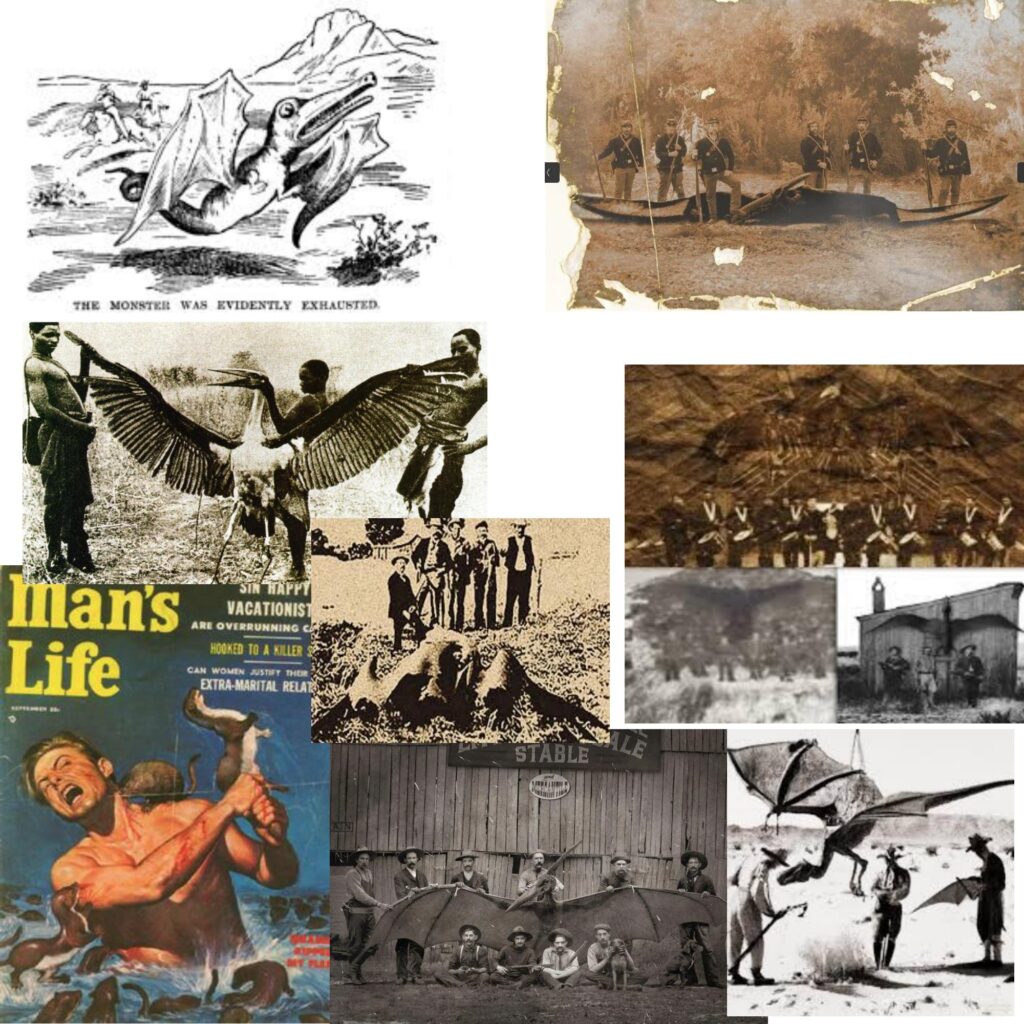
S05E14 – The Case of the Missing Thunderbird Photo
Blake and Karen discuss the legendary photo said to capture 19th century cowboys or soldiers with a giant bird or pterosaur.
SHOW NOTE LINKS:
The original Tombstone Epitaph article about the winged creature
Karl Shuker’s blogged several times on the Thunderbird Photo and wrote a eulogy for Mark Chovinsky, author of a thorough Strange Magazine article about the Thunderbird photo.
Ivan T. Sanderson figures into the story prominently. Kevin J. Guhl has written an extensive article about this.
I think all the researchers – the serious researchers – are converging on the “False Memory” hypothesis to explain this story.
However, debates about the photo continue.
Promotional photos for Freaky Links TV show.
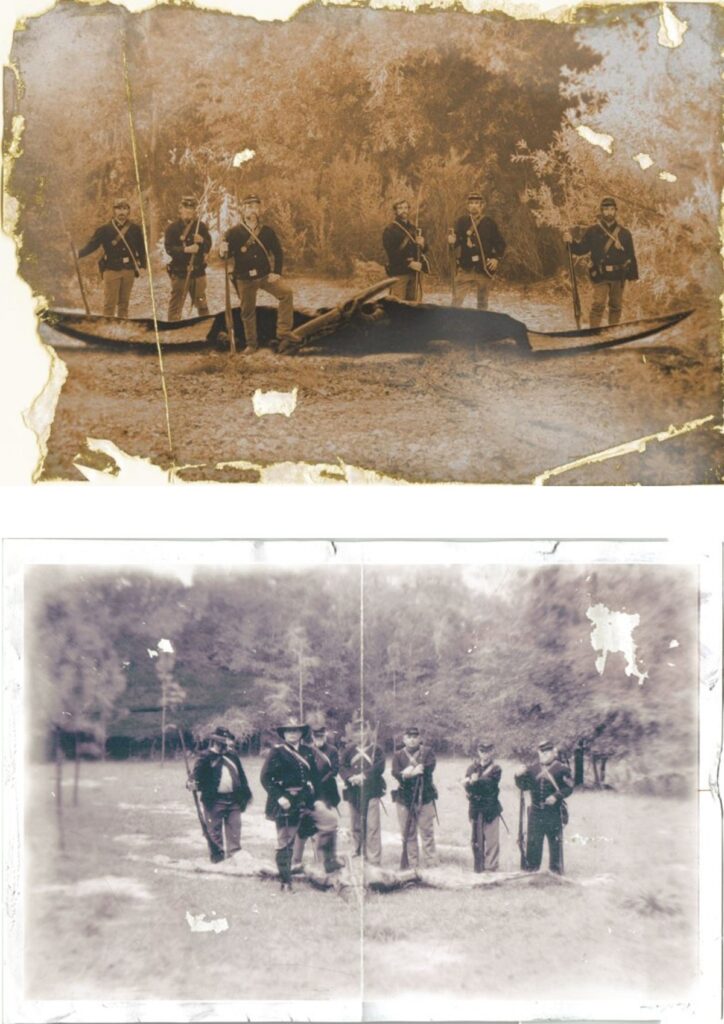
Conceptual digital art by Christopher Smith
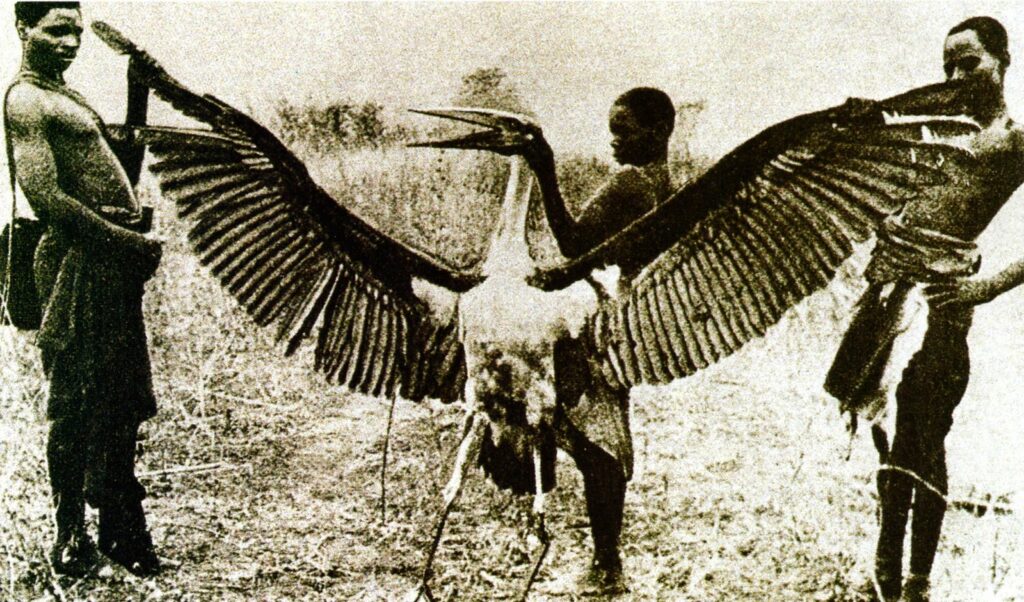
Famous photo of Maribou Stork some think inspired the story.
SEO Transcript
This is not a fully accurate transcript, and was machine generated. It’s here for helping search engines find the episode but not intended to be a faithful transcript of the episode. (But it’s not AWFUL.) Some of the material in this transcript only exists in the Patreon/Premium edition of the show and was excised for the commercial version.
———————
Monster House presents…
This is the ad-supported version of Monster Talk.
We’re dependent upon the revenue from these ads and from the support of our patrons at patreon.com forward slash monster talk to continue making this show.
As a disclaimer, your hosts are unable to control what ads you will hear, and while we have done what we can to avoid ads that are divisive, the system that injects them sometimes ignores our preferences and always seems to ignore our efforts to not interrupt the conversational flow.
While we understand this can be disruptive, we’re trying our best.
Patreon remains the best way to enjoy commercial-free listening to our content.
Plus, you generally get extended coverage of the subject.
We’re working on other ways to consume our content as well, so please stay tuned.
Memory is a funny thing.
We all rely on it to get by in the world.
Our memories help us build the library of narratives that we use to define ourselves to the world.
Our ability to recall past events help us navigate the present and plan for the future.
But memory is incredibly fallible and malleable, and our brains are prone to remember stuff that simply never happened.
Recently, you may recall the idea of the Mandela Effect, which highlighted how perplexed average people were to find out that some of their precious recollections were simply wrong.
Rather than chuckle at the realization, many people instead postulated that something caused the world to change and that their own personal incorrect memories are the only record of this reality fracture.
Now this is, on the face of it, incredibly self-aggrandizing.
We can’t be wrong, brother.
It’s the universe that’s messed up.
Yeah, that’s probably what it is, but who am I kidding?
There’s people out there who think that the entire universe fractures every time they make a decision, spinning off new universes with every precious act of will.
But does the universe fracture when a goldfish makes a decision too?
Are we really to believe that while the world runs low on resources, the cosmos can somehow afford to sprout entire new universes just because we flipped a coin?
Brains are great, but they’re often wrong and apparently willing to accept limitless special explanations rather than admit to the more disappointing and humbling reality that sometimes we’re just wrong about what we recall.
This episode is about a famous photo of an amazing creature.
Some would call it a thunderbird.
Or maybe it was a pterosaur.
Or maybe it’s about the fallibility of memory and the hubris of the human ego.
Either way, there’s monsters and there’s old newspapers and there’s internet feuds.
And to me, that’s the making of a good conversation.
It’s actually quite unlike anything we’ve ever seen before.
A giant hairy creature.
Part ape, part man.
In Loch Ness, a 24 mile long bottomless lake in the highlands of Scotland.
It’s a creature known as the Loch Ness Monster.
Monster Talk.
Welcome to Monster Talk, the science show about monsters.
I’m Blake Smith.
And I’m Karen Stollznow.
Hey there, Monster Talkers.
This week, Karen and I are digging into the strange tale of the missing Thunderbird photo.
If this story catches your imagination and you want to go questing yourself, check the show notes for links.
That will be a good signpost to start your journey.
Do this one thing for me, though.
When we get to the newspaper story that kicks this whole thing off, pay close attention to the way the critters described and ask yourself, does this description match any of the photos people claim were printed along with the tale?
Does it matter that we can look at the original news story and there’s no such photo?
Does it matter that none of the claimants can put their hands on even a halftone reproduction?
Maybe of most interest to me, does it matter that almost universally the people claiming to have seen the photo are unaware of the details of the original story?
It ends up reminding me about that joke about arguments on the internet that begin with…
I don’t know nothing about underwater basket weaving, but here’s what I think.
Just a few things to think about as we investigate the case of the missing Thunderbird photo.
Monster Talk
Yeah, so I thought this would be a fun one to talk about because I just came off doing a whole bunch of research on the Van Meter Visitor for Skeptoid, which was really fun research.
And we’ll look at it later.
So I’ve sort of sequestered that content.
But while going through that, I was reminded of this amazing…
research that had been done um about this mystery photo and uh so i thought it would be fun to sort of talk through that so yeah this this is we’re talking about thunderbirds and that is this is a highly requested topic so we’ve had uh quite a few listeners say can you you talk about thunderbirds and i have to admit
Coming from Australia, when I think of Thunderbirds, and I don’t know if you’ve ever seen this before, but it was a 1960s British sci-fi cartoon series.
I’m not sure if you got it here.
I’m sorry, don’t you mean Supermarionation?
You’re talking about the one with the puppets?
Yes, the puppets, yes.
So I guess not technically a cartoon, but yeah.
Five, four…
Three, two, one.
Thunderbirds are go.
The strange, creepy.
puppets with the barely moving mouths.
Yes.
The sort of inspiration for the South Park guys did a mock-up of it.
Team America, World Police Force.
They were influenced by that?
I did not know that.
That explains a lot.
Yeah, that’s basically their version of the Thunderbirds.
America!
America!
I love that stupid-ass movie.
But this is not the Thunderbird that you’re talking about, right?
Nor is it the car, right?
The car, yeah.
This is a day to remember.
For today, there is a new Thunderbird.
That was the sound of it.
This is the shape of it.
This is how it can be for you in the Thunderbird for 1961.
Lots of Thunderbirds.
The Thunderbird’s really interesting.
So in indigenous mythology, I don’t want to call it folklore.
It’s not really folklore.
It’s mythology.
It’s these stories about…
A bird that…
It does a lot of things.
First of all, in some versions…
Massive bird, right?
Really, really big.
And it’s tied to storms, you know, like a storm bringer sort of thing.
But it also has…
some cultures and some tribe stories, I’m not sure that’s the right word, but I think it is, and some people’s stories.
It’s different colors for different cardinal directions.
There’s a lot of folklore around this thing.
It brings storms or it appears during storms.
It does a lot of different things.
Clearly…
clearly a mythological supernatural entity in in some versions it’s a shape changer it turns into a human being or a man-like person uh or uh so not an animal but uh with the creation of cryptozoology in the 1950s and 60s
there was a whole lot of repurposing or cultural appropriation or colonization, all kinds of terms for it.
But basically, world mythology was being repurposed into cryptozoological fodder.
If there’s a myth about it, maybe…
So this is a kind of…
uh, massive euhemerism.
Euhemerism is the idea that behind any myth or legend, there’s probably a kernel of truth, right?
And so, uh, with, uh, Ivan T. Sanderson, Bernard Havelmans, uh, Bernard Havelmans, and, uh,
There’s a German guy, too.
Willie Lay.
Willie Lay, the German writer.
Also, he talked about exotic animals.
Same idea.
This idea of mystery animals.
But they basically went through all the folklore of the world and decided that, you know, the Yeti is really a real animal.
And the Thunderbird’s really a real animal.
All these mythical creatures.
But that’s not specifically what we’re talking about today either, but a specific component or core of this mystery.
Yeah.
Yeah, this is something that you’ve talked about before and I’d kind of heard about and thought that there was some, that kernel of truth was there, but apparently the story is a lot more complicated than that.
So tell us, what exactly are we talking about?
What we’re talking about today is a missing photo.
There was a story in the Tombstone Epitaph, which, by the way, great name for a newspaper.
I love that so much.
That is so perfect for that town, that city.
Within cryptozoology, there’s a rather famous story.
of uh this this hold on just a second i closed my show notes that was ridiculous i don’t know how to uh there’s a famous story from the tombstone epitaph about the these cowboy characters uh in 1890 they find this flying i mean it’s clearly
a dinosaur of, well, Mesozoic flying reptile.
It’s not a dinosaur, but it’s a flying reptile that they’re describing.
But what they’re describing is huge.
like uh 160 let’s see 160 feet wingspan uh live or yeah yeah when they find it it’s like it’s it’s clearly tired and shagged out after a long flight and it’s kind of like trying to get away from them but they’re carrying winchester rifles and they shoot it you know what i should do is not a very long news story let me just do an insert here
From the Tombstone Epitaph, April 26, 1890.
Found on the Desert.
A strange winged monster discovered and killed on the Huachuca Desert.
A winged monster, resembling a huge alligator with an extremely elongated tail and an immense pair of wings, was found on the desert between Whetstone and Huachuca Mountains last Sunday by two ranchers who were returning home from the Huachucas.
The creature was evidently greatly exhausted by a long flight, and when discovered, was able to fly but a short distance at a time.
After the first shock of wild amazement passed, the two men, who were on horseback and armed with Winchester rifles, regained sufficient courage to pursue the monster and after an exciting chase of several miles, succeeded in getting near enough to open fire with their rifles and wounding it.
The creature then turned on the men, but owing to its exhausted condition, they were able to keep out of its way and after a few well-directed shots, the monster partly rolled over and remained motionless.
The men cautiously approached, their horses snorting with terror, and found that the creature was dead.
They then proceeded to make an examination and found that it measured about 92 feet in length and the greatest diameter was about 50 inches.
The monster had only two feet, these being situated a short distance in front of where the wings were joined to the body.
The head, as near as they could judge, was about eight feet long, the jaws being thickly set with strong, sharp teeth.
Its eyes were as large as dinner plates and protruded about halfway from the head.
They had some difficulty in measuring the wings as they were partly folded under the body, but finally got one straightened out sufficiently to get a measurement of 78 feet, making the total length from tip to tip about 160 feet.
The wings were composed of a thick and nearly transparent membrane and were devoid of feathers or hair, as was the entire body.
The skin of the body was comparatively smooth and easily penetrated by a bullet.
The men cut off a small portion of the tip of one wing and took it home with them.
Late last night, one of them arrived in this city for supplies and to make the necessary preparations to skin the creature when the hide will be sent east for examination by the eminent scientists of the day.
The finder returned early this morning accompanied by several prominent men who will endeavor to bring the strange creature to this city before it is mutilated.
Okay, so that was the news story, a strange winged monster discovered and killed in the Huachuca Desert.
But they call it alligator-like, 160-foot wingspan, 92 feet long.
Remarkable.
Huge diameter, sort of a flying reptile slash flying snake, flying dinosaur, whatever you want to call it.
So interesting when I just think about other creatures like the yaoi, how they seem to encompass so many different animals, not just the main creature is a bird, but lizards and snakes and other things.
It seems to be something found across Indigenous cultures, these hybrid creatures.
Yeah, and…
In 1890, the world was just really still in the middle of coming to a reckoning with the fact that there were extinctions, right?
It could have been real.
Yeah.
It’s kind of hard to imagine now because I think the world’s pretty comfortable, like generally speaking, with the idea that the world is quite old and lots and lots of species have gone extinct.
Among…
skeptics and circles that we move in i mean any kind of pro-science sort of thing but back then it was still novel and they you know the dinosaurs were shocking discoveries right it was like it was really weird to find out there was this ancient world out there so uh that that path from sort of acknowledging the
these ancient creatures to understanding where they came from, fitting it into the world of biology, coming to a reckoning with scriptural-based approaches to things.
It was a big journey.
But this story in the Tombstone Epitaph is…
actually part of a trend.
It doesn’t stand alone.
That’s how people often present it.
But there’s actually this sort of, and I hate to use it in this context, but it’s sort of a flap of flying reptiles in the media.
No pun intended.
Well, not pun intended, but pun acknowledged.
How about that?
I see you.
I’ve seen it described, and I like the phrasing, this news period, which is kind of parallel to the great airship mystery of the late 1800s, another topic I really like.
But this is called the American Dragon’s Flap.
And so from like…
Really from the 1860s to the early 1900s.
If I remember, calling them my own research, I think the Van Meter Visitor was sort of the tail end of this.
And he persist.
Again, I have a problem.
I have a condition.
But like from 1868, there was the Chile Camara in Santiago, Chile.
In 1873 in Texas, there were sky serpents.
In 1882, in California, there was a flying crocodile.
1885, a king snake flying over Illinois.
Wow.
The Lake Elizabeth monster was seen for decades from 1830 to 1887.
Do you think that these are related or do you think that they sort of…
uh individually arose i believe these fit into a narrative ecosystem so i think these are the sort of things people would stick into newspapers not necessarily based on real eyewitness accounts if you’ll if you look at the tombstone thunderbird there’s
two cowboys who find it who are they what happened to the right yeah these are these we it’s important to remember that newspapers back then were not just sort of a message board of politics and
you know, breaking news and local stuff.
But they were also a place where fiction was- Storytelling.
Storytelling, fiction.
It was entertainment.
Not like today with the rigorous control of journalism and fact, you know, like fact-based journalism.
No, I guess the point is what I’ve realized after doing this for-
decades now is that newspapers have always been primarily about generating revenue from ads and ads means keep people entertained.
It’s infotainment.
Yeah, it’s always been like that.
There was this brief period of time, maybe after Watergate, when suddenly investigative reporting helped give newspapers a whole lot of social cachet and like credibility and prestige.
That’s gone.
That’s gone.
Still vestiges of that, but it’s not the norm, unfortunately.
Well, I don’t want to turn this into a lament at the state of journalism, but I mean, it is driven by revenue.
Revenue comes from ads and the ad ecosystem has turned into crap.
So…
And a lot of the newspapers have been purchased because they were in debt by investment companies who don’t care about the news at all.
They only care about subscriptions and ad revenue.
So anything that will get eyes is fine.
Consumer reports where it’s entirely subscription supported, like there aren’t ads, that kind of place is the rare exception.
Most places you have to contend with lots and lots of slop and crap.
to get your news.
So I think certainly for this time period you’re talking about, that would have really been a lot of people believing in this kind of thing and just not knowing whether this could be real or not.
Possibly, or audiences were more savvy.
and understood that a lot of this stuff was BS.
I think that’s actually something we should consider, that the readership at the time would have been accustomed to seeing late-breaking news from Washington coming over the wire, literally, but also with colorful, creative stuff to fill up the pages, right?
Yeah, how do you know the difference?
You know, it turns out that maybe the best skill back then and now is still understanding critical thinking and how to do a little research to figure out whether things are plausible or not.
So ask questions and think for yourself.
And yeah, certainly useful tools then and now.
Yeah, absolutely.
And when I say that, I mean, use your logical and critical thinking skills.
I’m not saying go watch a YouTube video.
Think it through.
Does this story make any sense?
Is this biologically plausible?
Is it time-wise plausible?
All those sort of things.
But anyway, this story, like the Tombstone Epitaph in particular, very visually interesting story, as our listeners will have just heard.
But sometime in the 1950s and 60s,
the people who were the sort of foundations of modern cryptozoology, started to say that they remember seeing a photo from that news story.
Like they remember seeing a picture of this, I’m air quoting here, bird, but it was more like a pterosaur.
Some people describe it as being…
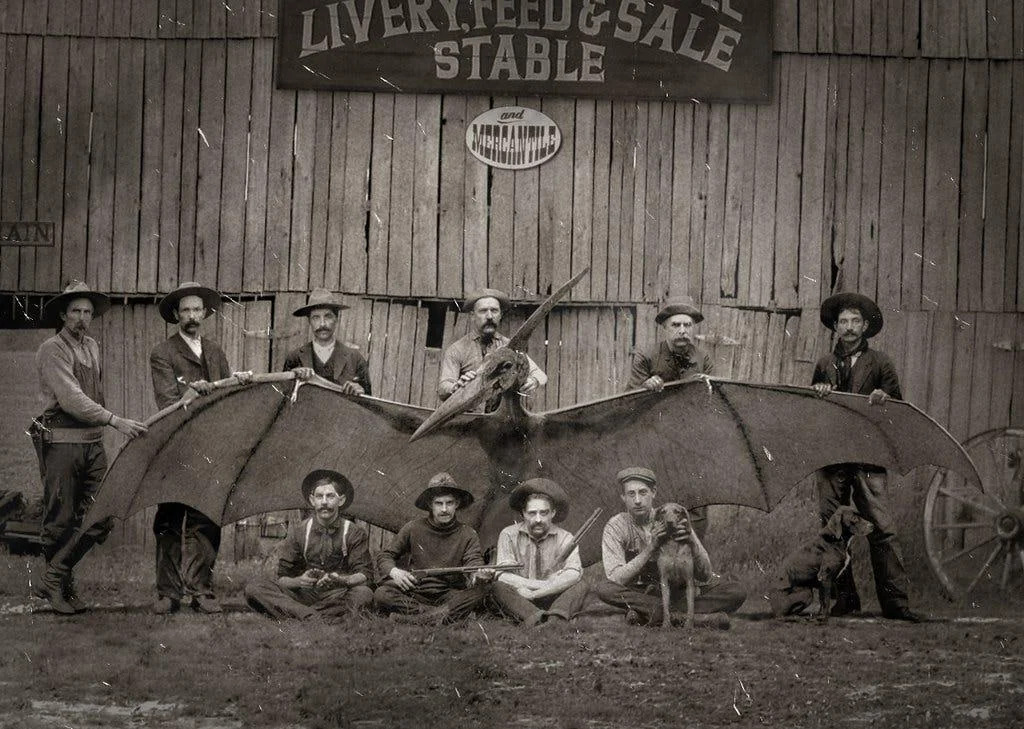
hung up in front of a barn.
Some people think it was with Civil War soldiers.
There’s all kinds of different stories about this.
Right.
And I have seen illustrations of this kind of thing, but not necessarily a photograph.
In 1963, the first known mention of the Thunderbird photograph was in print in Saga magazine in an article by a guy named Jack Pearl.
and so so was that a um what kind of i believe i believe
This is what my colleague Jeb Card calls the sweats.
It’s not exactly porn.
It’s not exactly mainstream journalism.
It’s somewhere like an adventure mag.
It’s got saucy.
What is it?
What’s the famous cover?
It’s not, is it Weasels Ate My Flesh or something like that?
There’s a famous, there’s a whole lot of adventure stories kind of like highly, I mean, to be fair, these sort of men’s magazines very much targeted at men in search of virility and masculinity.
That’s right, proper masculinity.
Yeah.
That’s where Bigfoot sort of makes his appearance.
I’m not surprised at all.
Yeah, I mean, that’s really kind of the first place Ivan T. Sanders is able to get published.
So yeah, there’s not anything quite like it today, but…
David Coleman has put together an anthology called Cryptozoology Anthology, Strange and Mysterious Creatures in Men’s Adventure Mags.
And no relation to Lauren.
No relation.
No relation.
Just a small world.
But yeah, he’s put together this.
It’s all these amazing articles about cryptozoology pulled out of these magazines.
And they’re spicy.
They’re spicy.
So, yeah.
So so the idea, though, was people in those magazines are talking about having seen the photo.
Right.
And Ivan T. Sanders says he saw a friend kind of thing.
Yes.
Well, that’s what they really are.
Right.
Exactly.
So.
A guy named Terry Matheson, who was a professor, said he saw this TV episode of the Pierre Bertrand show in the 60s with I.V.T.
Sanderson.
And Sanderson came on and talked about this photo.
But people think they saw the photo on TV, but they didn’t.
It was never shown.
So kind of like a Nelson Mandela effect kind of thing.
It’s very much like the Mandela effect where a lot of people remember seeing it.
That is exactly what’s going on here.
So interesting.
Yeah, it is.
I mean, you’ll see it mentioned.
in lots and lots of articles.
You’ll see it mentioned online.
And here’s where it gets really interesting.
So in folklore, there’s this idea of extension, right?
The idea of like trying to recreate or go experience folklore.
So I don’t know, but it feels to me like what happens is a lot of people want to see this photo.
So I don’t maybe it’s more like a pious hoax or a pious fraud, but people try to recreate the photo as it was described.
And so there’s various versions of this all over the Internet and have been for decades now.
Are people saying that they’ve seen it and they’re recreating it or that they are just reproducing the idea of this?
People saying, here’s the photo.
And then they show a photo with farmers in front of a barn or Civil War people standing out in the field.
Now there’s that.
Lauren Coleman did some work on this because there was one particular photo that was getting a lot of rounds.
And it turned out that it was from…
The creators of the Blair Witch Project, after the success of that movie, they created a TV show called Freaky Links, which I actually quite liked.
It was it didn’t run very long, but it was basically the story was an Internet blogger.
And I think it actually even predates blogging.
But they had a Web site and they would go investigate mysteries.
And one of the things they had on there was this Civil War photo of the pterosaur.
There were a couple of different versions they shot with a giant pterosaur model.
It makes me think of the Hodag photographs as well, a little bit maybe inspired by that.
Well, the Hodag was, you know, that’s like a community-built folklore and people made a real model of it.
And there’s some good photos of that too.
You know, but this is more like the legend exists.
Let me show you.
I’ll prove it with Photoshop, right?
You know?
Yeah, probably a real mix of, as you say, pious fraud with people saying, well, I believe in this, so I’m going to do this to prove this to other people.
But still…
believing in it and then others it’s a pure hoax yeah a lot of my research is coming from an article called unraveling the mystery of the thunderbird photograph by a guy named mark chorvinsky uh from he did a magazine online called strange mag and
He he passed away at a not very old age.
And I have to say, I’m bummed because after reading his research and reading about him, dude, sounds like he was a guy I would have really gotten along with.
He was he was he was.
extremely into monsters but just wanted it to be true right so uh he needed the proof and was tenacious uh in his ability to hunt stuff down so i’ll link to this in the show notes but he did a great job of running this to ground and figuring out what was really going on unravel the mystery then
Absolutely.
And the mystery, unfortunately, as you’ve alluded to, is there is no photo.
So that’s the joke that I’m here.
I am texting you this morning and saying, well, can you send me the photograph?
I don’t know how we’re going to talk about this without the photograph.
Where’s the photograph?
Well, there is no photograph.
There is no photograph.
Yeah, it’s quite sad.
I mean, on the other hand, I think… Unsurprising.
Well, you’re right.
It shouldn’t be surprising, especially if you actually go back and read the article, because that article screams BS, to be blunt.
I mean, this is bullshit.
When you read the article, yeah.
But that’s the thing.
A lot of these stories are told, and we’ve…
had these kinds of topics time and time again, and you go back to the original articles, no one has read that.
Everyone’s read the articles about the article or the photographs of the photograph.
But no one’s gone back to the original source, the primary documents.
And that’s how we get to where we are.
That’s when it becomes folklore.
Yeah, and because all the fake photos are of…
pterosaurs, like pretty obviously pterosaurs based on real reconstructions by, you know, paleontologists, that sort of thing, except for the Freaky Leak ones.
Freaky Leak’s photo was, I believe, just a movie prop.
So as skeptics, we’ve run into this before.
As you said, it reminds one of the Mandela effect, but it really comes down to the idea that
false memory, like the idea that with enough suggestion and reading this material, you can begin to believe that you saw something that wasn’t there.
If you read this story 30 years ago and you’ve seen other drawings and other material, it’s easy to imagine because it’s a very visual description, especially what Sanderson apparently said on TV.
Oh, when you read that story, you immediately visualize what this must have looked like.
And yeah, just and certainly being influenced by other people’s illustrations and depictions.
But yeah, it’s and the color as well.
It’s very graphic.
It is.
And I guess maybe one of the most disappointing things, but maybe one of the most important.
from becoming a sort of skeptical researcher is finding out just how malleable and flawed human memory is.
And it’s disappointing because it’s scary.
It’s a lot of things.
It’s like, it’s memory’s great.
It’s what it makes us who we are, but it also is not perfect.
And it’s constantly being rewritten.
And I it’s funny, my kids in college and taking classes where they talk about, you know, biases and you can’t trust your memory.
And my kids, like one of the only people that already knows this stuff.
Right.
I mean, in the class, because they’re raised in a skeptical, critical thinking family.
Yeah, these are the things I think that should be taught in elementary school.
All the way through.
But what does it do, though?
It undermines your confidence in the justice system because so much of legal work is based on the reliability of human memory.
And human memory, I mean, it can be amazing, but it ain’t perfect.
And it’s certainly fallible.
And as we’ve talked about, it’s a legal system, not a justice system.
Fair enough.
Fair enough.
Yeah, that’s really interesting to hear about that.
And so is that the conclusion that’s drawn in this article?
It is.
Okay, well, that’s very honest then.
If he was a believer and he wanted to believe in this, and that’s the conclusion that he’s arrived at, I think we can have pretty high confidence in that.
Yeah.
No, I mean, obviously he’s he’s made these assertions.
Other people looked into it.
And Carl Shuker was friends with him.
And he’s also done the same kind of research and come to the same conclusions.
So, yeah, exactly.
Even in the cryptozoology community, it’s it’s this is a.
A reliable conclusion.
I feel very confident.
Obviously, just like with Bigfoot, produce the authentic photo and we can change our views, but… Oh, yeah, yeah.
dependent upon what evidence might come to light, if any.
Yeah, I’m very confident this photo is never going to really appear because the source material is bullshit.
We can reevaluate things if that time comes.
Exactly.
But I think this is a great…
And I’ll put some there’s some I really love looking at the photos.
Now, obviously, I don’t have the same view of them now as I did in the 90s and 2000s.
You know, you know, it’s just a new kind of wonder, I guess, then.
It becomes more about, I guess, people and folklore than necessarily thinking, oh, this is real.
Right.
And now with AI, you can send a prompt and get 30 different versions in just a few minutes.
But, you know, it just isn’t.
It isn’t what was described at all.
And what was described is clearly nonsense in the news story.
So nothing to see here, folks.
Move along.
Except as you’re moving along, take with you the lesson.
that human memory is fallible.
We’re subject to bias.
And there’s always somebody out there who gets a kick out of doing a hoax or make them up.
And they make the world more interesting, but you don’t necessarily have to believe it to enjoy it.
Yeah, no, it’s a good takeaway message.
I think one that we’re familiar with as well.
And I think what we need to do is to come back to this topic.
I would say I should, I guess, mention that there are some people out there who think that maybe there’s a famous photo of the Marabu stork.
I don’t think you need to have a real photo to be conflated with this.
nonsense one because Ivan T. Sanderson appearing on a TV show talking about having seen it when you’re a child and you grow up fascinated with cryptozoology it’s really easy to imagine that he showed the photo because back then that would have happened right I mean if it had existed it would have happened and just conflating that small difference between a story and an actual photo on a TV show that you don’t have a recording of
It’s not a big jump.
But from there, it goes a long way.
The story’s got legs, even if it doesn’t have wings.
Nice.
But do we have a copy of this interview with Ivan Sanderson, or is that just not around?
No, that’s not around, unfortunately.
So too bad.
It is a really interesting story.
And it’s just amazing how it’s grown over the years and developed a life of its own, as you say.
Yeah.
So check the show notes.
I’ll have lots of examples of this.
But just remember, they’re all examples and none of them are real.
They’re all make-em-ups.
So, all right.
Monster Talk.
You’ve been listening to Monster Talk, the science show about monsters.
I’m Blake Smith.
And I’m Karen Stollznow.
You just heard me and Karen discussing the story of the missing Thunderbird photo.
Thanks to the late Mark Chorvinsky and Dr. Carl Shuker for their work digging through this material.
Carl has continued to investigate and tidily explain new attempts at hoaxing that original photo.
His work and Mark’s work and this episode will likely do nothing to stop the quest of those who just love a good story too much to let little things like reality get in the way.
After all, we have the original news story and there’s no photo.
And we know that newspaper photo reproduction didn’t really kick off in a big way until a decade after this story.
And we know that the thing described in the story is not biologically plausible.
And we know that the photos that have been put forward as candidates for the original have all been hoaxes and had nothing to do with the original creature description.
To me, that’s enough.
It doesn’t matter how many people remember seeing such a photo back in the 1960s.
It’s just not a real thing and it never was.
It’s just a really good story.
And that has to be enough.
If you want to argue about it, there’s plenty of folks doing just that in the cryptozoology forums out there.
But as for me, I’ll be by the fire.
Enjoy your quest.
I’ll be here with my glass of port when you have something to show us all.
Monster Talk’s theme music is by Peach Stealing Monkeys.
It’s little music provided by Artlist.io.
This has been a Monster House presentation.
Perhaps the readers of the Epitaph would like to know in what respect Chamberlain’s cough remedy is better than any other.
We will tell you.
When this remedy is taken as directed, as soon as a cold has been contracted and before it has become settled in the system, it will counteract the effects of the cold and greatly lessen its severity if not effectively cure the cold in two days’ time.
And it is the only remedy that will do this.
It acts in perfect harmony with nature and aids nature in relieving the lungs, opening the secretions, liquefying the mucus, and causing its expulsion from the air cells of the lungs and restoring the system to a strong and healthy condition.
No other remedy in the market possesses these remarkable properties.
No other will cure a cold as quickly or leave the system in as sound a condition.
50 cent and $1 bottles for sale by H.J.
Pitot.
If this story catches your imagination and you want to go questing yourself, check the show notes for links.
Woo, big old thunder.
That’s funny, Thunderbird Thunder.