Regular Episode
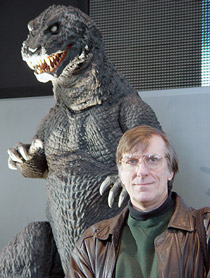
#124 – CRUSH, CRUMBLE AND CHOMP
The episode title comes from Crush, Crumble and Chomp! 💵, the 1981 Epyx computer game in which players control a giant monster stomping a city — a fitting banner for an episode that ranges across the full sweep of kaiju cinema, from the shadowy origins of the first Godzilla to the nationalist subtext of Shin Godzilla.
🦕 What Is a Kaiju — and Where Did It All Begin?
The word kaiju translates roughly as “strange creature” or “weird beast,” and daikaiju adds the modifier for “giant.” Ed flags a companion term less familiar to Western fans: kaijin (怪人), used for human-scale monsters in tokusatsu television franchises like Kamen Rider. The broader umbrella term tokusatsu (特撮) covers all live-action Japanese genre filmmaking built around practical special effects.
The Western lineage of the giant-monster film runs from 🎬 The Lost World 💵 (1925) through the landmark 🎬 King Kong 💵 (1933) — both cited by the guests as the genre’s foundation stones — and on to The Beast from 20,000 Fathoms (1953), itself rooted in a Ray Bradbury short story and brought to the screen by stop-motion pioneer Ray Harryhausen. Harryhausen apparently resented Godzilla — not so much as a competitor, Ed clarifies, but because he considered the man-in-a-suit technique a cheap shortcut compared to his own painstaking stop-motion work.
☢️ The Birth of Godzilla — Origins and the Lucky Dragon Incident
The standard creation myth credits Tomoyuki Tanaka, a top producer at Toho, with conceiving the project on a plane flight home from Indonesia in 1953 after a co-production deal collapsed. Ed frames this as a polished origin legend: what’s more certain is that The Beast from 20,000 Fathoms had just been a box-office success, and a reissue of King Kong was performing well in Japan.
What gave the project its distinctive weight was the Lucky Dragon No. 5 incident: a Japanese fishing trawler that strayed into the fallout zone of a U.S. hydrogen bomb test at Bikini Atoll in March 1954, irradiating its crew. The incident reopened raw national wounds from Hiroshima and Nagasaki and gave Tanaka an urgent topical hook.
Director Ishirō Honda was not the first choice — colleague Kichi Taniguchi turned the project down, fearing career pigeonholing. Honda, by contrast, saw it as an opportunity to say something serious about nuclear energy. Special effects supervisor Eiji Tsuburaya, a lifelong admirer of King Kong, had been waiting years for exactly this kind of project.
The name Gojira (ゴジラ) itself is a portmanteau of gorira (gorilla) and kujira (whale) — making Godzilla, etymologically, a gorilla-whale. Ed notes the stress falls on the first syllable: GO-jira, not go-JI-ra.
🎬 The American Version — Raymond Burr and the Art of the Exploitation Cut
The 1956 American release, retitled Godzilla, King of the Monsters!, inserted Raymond Burr as reporter Steve Martin using carefully staged reaction shots with stand-in actors photographed from behind. Blake calls the original Japanese version a genuinely dark, serious film — nothing like the campy reputation the franchise later acquired — and the American cut a “watered-down mess.”
Ed pushes back gently: without the Americanized version, the film likely would never have reached Western audiences at all. In an era of exploitation double features, producers needed a recognizable face and a relatable frame. Crucially, he argues, it was Honda’s monster films — not prestige art-house releases like Rashomon — that introduced Japanese cinema to mass Western audiences and opened the door for everything that followed.
A related misconception: the long-circulated claim (popularized in Famous Monsters of Filmland) that King Kong vs. Godzilla had two different endings — one where Kong wins for American audiences and one where Godzilla wins for Japanese audiences. Ed, who once asked Forrest J Ackerman about it directly, says it is simply not true. There is only one ending. (Some Toho films do have alternate endings — Frankenstein Conquers the World being a notable example, with its infamous late-arriving mountain octopus — but not that one.)
📅 Eras, Rogues Galleries, and the Shared Universe Nobody Planned
Western fans typically divide the Toho Godzilla series into three periods: the Showa era (1954–1975, ending with Terror of Mechagodzilla), the Heisei era (roughly 1984–1995), and the Millennium era (1999–2004). Ed points out these labels are borrowed from the reigns of Japanese emperors and carry little meaning for non-Japanese audiences — a mild pet peeve he shares with how insider jargon can inadvertently exclude new fans.
The monster “rogues gallery” — Rodan, Mothra, King Ghidorah, Anguirus and company — wasn’t the product of a master plan. Separate one-off films gradually got folded together once crossover pictures like King Kong vs. Godzilla (1962) proved they could make money. The guests compare the process to Universal’s monster crossovers of the 1940s and the shared fictional universe of Edgar Rice Burroughs — both precedents for what Marvel would later systematize.
🐢 Gamera, Gappa, and the Kaiju Boom of the 1960s
Gamera began in 1965 as Daiei‘s deliberate attempt to grab a share of Toho’s kaiju box office. Director Noriaki Yuasa aimed his films squarely at young children — hence Gamera’s billing as “friend of all children” — yet packed them with surprisingly gory imagery that stood in stark contrast to Tsuburaya’s policy at Toho of keeping Godzilla’s violence bloodless.
The kaiju boom of the mid-1960s drew in multiple studios simultaneously: Gappa from Nikkatsu, Guilala from Shochiku, and — on television — Tsuburaya’s own Ultra Q and Ultraman. Television ultimately undercut theatrical attendance: once kids could watch monsters at home for free, the case for dragging parents to the cinema weakened. Toho’s response to Daiei — the low-budget, child-focused Godzilla’s Revenge (1969) — is seen by the guests as a sign that the boom had already begun to deflate.
A notable rehabilitation: the 1990s Gamera trilogy, produced while the Heisei Godzilla series was also running, is widely regarded by fans as not only superior to its contemporary Godzilla films but among the finest giant-monster films ever made.
🏙️ Shin Godzilla, the Legendary Monsterverse, and What Comes Next
Shin Godzilla (2016, international title Godzilla Resurgence), co-directed by Hideaki Anno, won the Japan Academy Prize for Picture of the Year and was a major domestic hit. Ed offers a candid dissent: while the film’s satire of bureaucratic paralysis is skillful, he finds its underlying nationalism — a push for Japanese military autonomy in defiance of the post-war constitution — a distortion of Honda’s original humanist, anti-nuclear vision. His read on the film’s popularity: it was “Godzilla for people who don’t care about Godzilla,” drawing non-fans who latched onto the political satire and the fantasy of national self-determination while remaining largely indifferent to the monster himself.
On the Legendary MonsterVerse — Godzilla (2014) and Kong: Skull Island (2017) — the guests are cautiously positive, while flagging the narrative risk of introducing Rodan, Mothra, and King Ghidorah all at once in the announced Godzilla: King of the Monsters. The concern: escalating spectacle leaves the franchise nowhere to go, a problem the MCU has already run into. The acronym MUTO (Massive Unidentified Terrestrial Organism) gets a gentle ribbing as a classification term for unknown creatures — semantically closer to “UFO” than to an actual name — that will eventually need to be replaced once the creatures are identified.
Also discussed: a then-upcoming Polygon Pictures animated Godzilla feature for Netflix (later released as Godzilla: Planet of the Monsters), and the guests’ shared preference for animation that resembles traditional cel work over full photorealistic 3D rendering.
📚 Further Reading
– 📚 Ishiro Honda: A Life in Film, from Godzilla to Kurosawa 💵 by Ed Godziszewski and Steve Ryfle
– 📚 Would You Believe It? Mysterious Tales from People You Would Least Expect 💵 by Karen Stollznow
🔗 Related Links
– Godzilla (1954 film) — Wikipedia
–
This MonsterTalk is another special literary/pop-culture episode as we take on the biggest topic in monsters: Giant City-Destroying Kaiju! Guests are Ed Godziszewski author of Ishiro Honda: A Life in Film, from Godzilla to Kurosawa (Oct 2017) and Michael Keller, co-author (with Edward Holland) of the magazine Monster Attack Team and the upcoming podcast Area 42.
Special thanks to Darren Naish. His piece on the biology of Godzilla is well worth a read.
Artist (and MonsterTalk fan) Jeff Zornow has some fantastic Godzilla art including his work on the Godzilla Ruler of Earth comic. Find Jeff on Instagram (@Zornowmustbedestroyed) and Twitter (@Zornow13).
Music
- Monstertalk Theme: Monster by Peach Stealing Monkeys
MTArchivist
0