#118 – SCIENCE & SEA MONSTERS
His day job involves estimating and modeling whale populations from survey data to inform conservation efforts. His hobby — funded, as he cheerfully notes, by “Big Monster” — involves applying those same statistical tools to one of the oldest genres of natural history: the sea monster report.
🐙 The Sea Monk and the Bishop Fish
The most famous Sea Monk is a creature reported in 1546 off the coast of Denmark, presented to the Danish king (who promptly ordered it buried “lest it produce foolish talk”), and subsequently immortalized in drawings that circulated across Renaissance Europe — reaching the courts of Navarre and the Holy Roman Emperor. Mary Queen of Scots, while under house arrest in England, even embroidered one.
Paxton and his colleague Robert Holland approached the Sea Monk methodically: collecting all extant descriptions and drawings, tabulating the creature’s reported features point by point, and cross-referencing them against candidate species. Paxton’s best current hypothesis is the angel shark — still called “monkfish” in both Norwegian and British English — though he’s grown increasingly open to the possibility that the specimen was a “gaffed” (artificially assembled) creature, a Renaissance-era Fiji Mermaid-style fabrication. (Such constructions were not uncommon: Conrad Gessner‘s Historiae Animalium illustrates “dragons” made from manipulated skates.)
He also teases an upcoming paper on the Bishop Fish — a mitre-wearing sea creature reportedly shown alive to the King of Poland around 1420 or 1521 — which he believes can be identified down to a specific manipulated species. Details, he insists, must wait for peer review.
🦑 The Kraken: From Island-Fish to Giant Squid
The word Kraken first appears in the early 17th century describing a creature so vast that sailors mistake it for an island — directly linked, via the term hafgufa, to the island-fish of the medieval Icelandic Speculum Regale. The tentacled, squid-like Kraken of popular imagination is largely an 18th–19th century development; Norwegian clergyman Erik Pontoppidan wasn’t even sure what it was — he speculated it might be a giant brittle star.
Paxton warns against what he calls the “Dungeons and Dragons Monster Manual fallacy” — the assumption that historical monster terms map neatly onto single species. During the 1817 New England sea serpent flap, some witnesses described what they’d seen as a “Norwegian Kraken.” In Canada, “Kraken” was occasionally applied to what sounds like a large polar bear. Terminology drifts — as it did, closer to our own time, with the Chupacabra.
📏 How Big Does a Giant Squid Actually Get?
The question of Architeuthis maximum size turns out to be a case study in statistical reasoning. Some teuthologists, drawing on a survey of around 450 specimens (mostly from New Zealand waters), had argued that older accounts of 55–57-foot squid were exaggerations. Paxton is unconvinced: with a population estimated at over 100,000 individuals, the probability that the 450 examined specimens include the largest ever is, as he puts it, “pretty negligible.”
Examining the relationship between mantle length and total length across known specimens, and accounting for natural variation, Paxton argues that giant squid could plausibly reach 20 metres (~66 feet) in total length. He was willing to back this up: he and Blake made a on-air wager — a bottle of Kraken Rum — that within ten years, physical evidence of a squid exceeding 15 metres total length (or a mantle length greater than 2.75 metres) would be found.
🐋 The Hans Egede Sighting and the Whale Penis Problem
One of the more memorable papers Paxton discusses concerns a famous 1734 sea serpent sighting by Hans Egede (or more precisely his son Paul Egede), made off the coast of Greenland. The creature’s underside was described as serpentine, and its “tail” notably lacked flukes. The research team — working under the internal code name “Moby Dick” — concluded that several features pointed toward a whale, and that the flukeless tail was most likely a cetacean penis (which, in large whales, can reach six feet in length). The paper also flags a South American account in which sperm whales described as “frantic with excitement” are attended by a large white serpentine object — which, on reflection, may not have required a cryptozoological explanation at all.
The broader point, Paxton emphasizes, is that sincere witnesses can observe genuinely unusual things — anatomy rarely depicted in books or (at the time) on television — and interpret them entirely reasonably within their available reference framework. The problem isn’t deception; it’s an incomplete zoological vocabulary.
📊 Statistics, Eyewitness Testimony, and 4,000 Reports
Paxton takes gentle issue with the skeptical mantra that “the plural of anecdotes is not data.” Anecdotes can be data, he argues — provided the collection method is unbiased relative to the hypothesis under test. Using reports to characterize the population of reports is legitimate; using reports to directly infer what monsters exist is a much larger extrapolation.
Drawing on a database of over 4,000 sea monster reports, Paxton and collaborator Adrian Shine examined cases where the same witness gave two accounts of the same event, and cases where multiple witnesses described the same sighting. Key findings:
– Witnesses were surprisingly consistent with themselves and with each other — more so than Paxton had expected.
– Second-hand reports appear less reliable than first-hand ones (as assumed, but now tested).
– Anonymous reports show a hint of being more exaggerated than signed ones (again, as assumed, but now tested).
He also mentions a forthcoming statistical analysis of 85 years of Loch Ness sightings — co-authored with Adrian Shine — examining temporal patterns in what witnesses have reported.
🦈 Pseudoplesiosaurs and Basking Sharks
In a brief aside, Paxton mentions that he experimentally decayed a small shark carcass to see whether it would produce the classic pseudoplesiosaur silhouette associated with decomposing basking sharks (as in the famous 1977 Zuiyo-maru carcass). It does. He recommends conducting this experiment outdoors.
📚 Further Reading
– Junior Skeptic #40: The Kraken! (Daniel Loxton)
– Paxton, C.G.M. & Holland, R. (2005). Could Moby Dick have been a real Sea Monk? Archives of Natural History — see show notes at monstertalk.org for link
– Paxton, C.G.M. et al. — Hans Egede whale penis paper — see show notes for link
– Paxton, C.G.M. & Shine, A. — Eyewitness consistency paper — see show notes for link
– Paxton, C.G.M. — How big do giant squid get? — see show notes for link
🔗 Related Links
– Sea Monk (Wikipedia)
– Bishop Fish (Wikipedia)
– Kraken (Wikipedia)
– Giant Squid / Architeuthis (Wikipedia)
– Hans Egede (Wikipedia)
– Zuiyo-maru Carcass / Pseudoplesiosaur (Wikipedia)
– Adrian Shine, Loch Ness researcher (Wikipedia)
– Ig Nobel Prize (Wikipedia)
Note: ads inserted into the distributed audio alter the timestamps in unpredictable ways, so timing references in these notes are approximate.
What do you get when you combine a love for statistics, a love for biological maritime mysteries and a relentless curiosity? Dr. Charles Paxton has applied biology and math work to produce several papers on the mysterious creatures called “sea monsters.” In this episode of MonsterTalk, we discuss sea monsters, math and naughty ostriches.
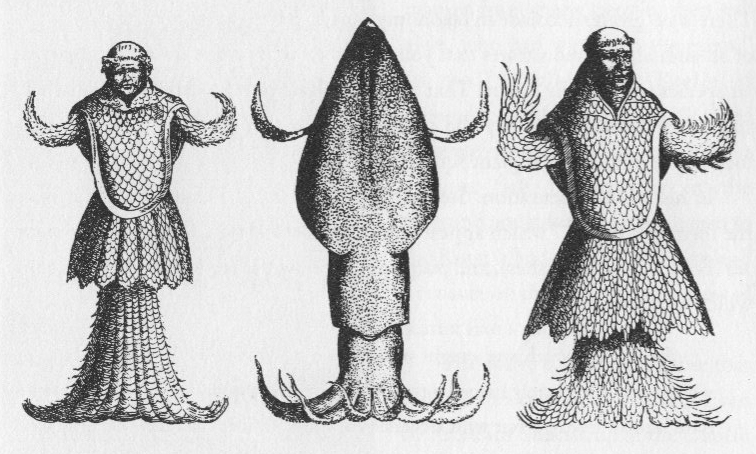
Illustration from Japetus Steenstrup’s 1854 presentation [Public domain] via Wikimedia Commons. The illustration on the left is by professor Guillaume Rondelet, and on the right by naturalist Pierre Belon, both from the 16th century. At center is an illustration of a squid caught in 1854. “Could we, given these bits of information of how the Monk was conceived at that time, come so near to it that we could recognize to which of nature’s creatures it should most probably be assigned? The Sea Monk is firstly a cephalopod.” —Japetus Steenstrup, 1854.

Related Links
- Junior Skeptic #40: The Kraken!
- Seamonk paper
- Hans Egede whale penis paper (behind paywall)
- Eyewitness consistency paper (behind paywall)
- How big do giant squid get?
Music
- Monstertalk Theme: Monster by Peach Stealing Monkeys