Regular Episode
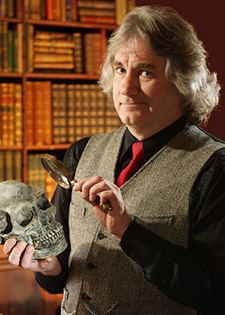
#110 – TELL ME STRANGE THINGS
If you’ve ever picked up The Werewolf in Lore and Legend or Summers’ translations of the Malleus Maleficarum, you already know the experience: a mountain of scholarship in Latin and Greek, an authorial voice that not only takes werewolves seriously but chides the reader for not doing the same. Blake describes Summers as “a real-life walking character from an H.P. Lovecraft story,” and it’s hard to argue.
🎭 The Performance Artist of the Occult
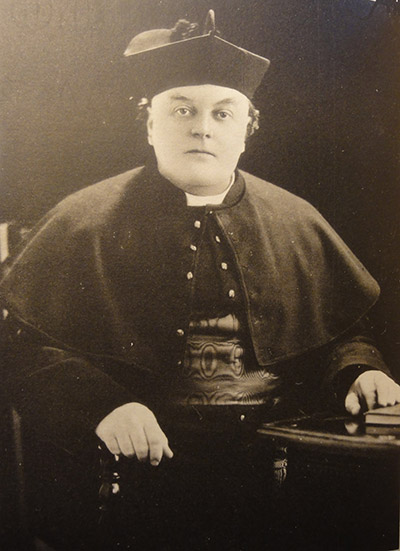
Summers was raised Anglican, earned a decidedly undistinguished fourth-class degree from Trinity College, Oxford (roughly equivalent to the American “gentleman’s C”), and was made an Anglican deacon in 1908 before becoming embroiled in some sort of sexual impropriety — the paperwork, like so much surrounding Summers, has gone missing. He subsequently converted to Catholicism, sought ordination as a priest, was refused by the diocese in Bristol, reportedly found a willing (and rather shady) cardinal in Italy, and thereafter simply called himself a priest regardless of whether the ordination was canonically valid.
His appearance matched the role: robes loosely suggestive of an unspecified religious denomination, hair curled in a style he imagined to be 17th-century, an affected manner of speaking. Brian’s characterization — “a kind of British Truman Capote” — captures it well. Brian’s central argument is that Summers was a performance artist who committed fully to a character: the magician-priest-thaumaturge. Despite his reputation for moving in occult circles, Brian could find no hard evidence that Summers ever engaged in any actual operative occult practice. The costume, the persona, and the nudge-nudge ambiguity about his sexuality and his beliefs all appear to have been maintained for their own sake — and possibly for the secret amusement of their author.
📖 The Scholar Behind the Costume
Whatever Summers was or wasn’t doing ceremonially, he was doing something genuine in the libraries. His occult publishing career began late — he didn’t produce his first book in that vein until 1926, when editor C.K. Ogden at Routledge invited him to write on witchcraft. After that the floodgates opened:
– The History of Witchcraft and Demonology (1926)
– The Geography of Witchcraft (1927)
– His English translation of the Malleus Maleficarum — the first such translation into English
– The Werewolf in Lore and Legend (1933)
– A Popular History of Witchcraft (1935)
Brian notes that Summers’ non-paranormal output — editions of Restoration playwrights, studies of early British theater, translations of European drama, writings on Shakespeare and the Marquis de Sade — actually dwarfs his monster books in volume. He was an expert on early British theater first and a werewolf authority second, even if that’s not how posterity remembers him.
He also refused to use a typewriter, insisting on sending publishers dense reams of handwritten manuscript that had to be typeset before anyone knew how long the book actually was — invariably far longer than contracted.
💰 A Writer Who Needed to Be Paid
The most revealing documents Brian tracked down were not occult diaries but publisher correspondence — and they paint a portrait of a man perpetually juggling advances. Summers would pitch a book, collect an advance, pitch another book to a second publisher, collect another advance, then return to the first publisher asking for more money to cover “research expenses.” At one point he held half a dozen open contracts with Routledge and had not delivered a single manuscript.
The letters from publishers, Brian says, develop “an edge” over the years as they wait for books that keep expanding past their agreed word counts. When Routledge asked Summers to write a popular (shorter, jargon-free) version of his witchcraft scholarship, he agreed, took the advance — and then quietly converted the manuscript back into a dense scholarly tome partway through. The resulting standoff, with Summers “stomping his foot” at what he considered disrespect for his craft, is, as Brian puts it, “really quite humorous but in a way a little sad.”
He also suspected that filmmakers were borrowing from his research for horror pictures and pestered his publishers to capitalize on those films to sell more books. The publishers said “yes, yes, whatever” and never followed up — which, Blake notes, is basically standard practice now.
🕯️ Summers and Aleister Crowley
Aleister Crowley — self-proclaimed “wickedest man in the world,” practitioner of Thelema, drug addict, and tabloid fixture — is frequently cited as a close associate of Summers. Brian went looking for the evidence in Crowley’s voluminous archives and found almost nothing: a single diary entry in which Crowley notes having had dinner with “this very interesting guy, Montague Summers,” and a passage in an early Crowley biography describing one sophisticated dinner party at which the two men sat by a fire, sipped cognac, and tried to impress each other. That appears to be the extent of it.
The two men did live near each other in the Richmond neighborhood of London, and Brian speculates they recognized kindred spirits — fellow “flaunters of convention” who enjoyed being talked about. But where Crowley actually performed his rituals, used drugs, and held his infamous gatherings, Summers seems to have simply implied that he could do such things and left the rest to his audience’s imagination.
The one time Summers writes about Crowley directly, it’s not flattering: when Gilles de Rais talk that had been canceled by Oxford authorities was published as a pamphlet, Summers got hold of a copy and pronounced it “incredibly dull.” The Great Beast, in Summers’ estimation, had underdelivered.
🔍 The Problem of Missing Archives
A recurring theme of the conversation is the frustrating elusiveness of primary sources for figures at the margins of intellectual history. Brian found Summers correspondence largely in publishers’ archives rather than any personal collection, and notes that Georgetown University had recently acquired a Summers collection that was still being catalogued at the time of the interview — including what may be ordination papers.
This leads to a broader discussion of historiography: the gap between the folklore that accumulates around colorful figures and the documented record. Brian draws a parallel to his work on Daniel Leeds for his forthcoming Jersey Devil book — Leeds was a publisher and central figure in colonial New Jersey, yet not a single personal letter survives. The same problem dogs the history of cryptozoology and the paranormal more broadly: crucial documents are in private hands, held by enthusiasts who won’t share them with professional historians for fear of how they’ll be treated.
Brian also raises the long-term archival problem posed by the shift to digital communication — he can read a letter from the 16th century but cannot access files on floppy disks from five years prior — a dilemma increasingly familiar to historians of the recent past.
🐜 Giant Bugs and the Best Monster Movie Ever Made
The episode closes with a wide-ranging discussion of 1950s monster films. Brian’s top picks:
– 🎬 Them! 💵 (1954) — Brian calls it “simply the best monster movie ever made,” praising its film-noir detective structure, documentary realism, and the chilling scene from which the title derives. He delivered an academic paper arguing that Them! is structurally a film noir in which the gangsters are replaced by ants. Blake adds that James Arness appears in an early role, and notes the original screenplay reportedly set the climax in the sewers of Newark rather than Los Angeles.
– 🎬 The Beast from 20,000 Fathoms 💵 (1953)
– 🎬 Reptilicus 💵 (1961) — “the only Danish monster movie ever made,” and therefore definitionally the best Danish monster movie ever made.
– 🎬 The Beginning of the End 💵 (1957), featuring Peter Graves and giant grasshoppers
Blake’s postscript observation: the sound effects used for the ants in Them! bear a striking resemblance to the demon’s arrival sound in 🎬 Night of the Demon 💵 (1957, also released as Curse of the Demon).
📚 Further Reading
– 📚 Searching for Sasquatch 💵 by Brian Regal
– 📚 Pseudoscience: A Critical Encyclopedia 💵 by Brian Regal
– 📚 The History of Witchcraft and Demonology 💵 by Montague Summers
– 📚 The Werewolf in Lore and Legend 💵 by Montague Summers
– 📚 Vampires and Vampirism 💵 by Montague Summers
– 📚 A Popular History of Witchcraft 💵 by Montague Summers
🔗 Related Links
– Montague Summers — Wikipedia
– Malleus Maleficarum — Wikipedia
– Aleister Crowley — Wikipedia
– The Hermetic Order of the Golden Dawn — Wikipedia
– Gilles de Rais — Wikipedia
– Them! (1954 film) — Wikipedia
– Night of the Demon (1957 film) — Wikipedia
Note: ads inserted into the distributed audio alter the timestamps in unpredictable ways, so timing references in these notes are approximate.
This episode of MonsterTalk explores the life of author and research Montague Summers, a researcher of dogged determination whose own life is shrouded in mystery and occluded by the theatrical. Brian Regal discusses his research into this fascinating and controversial figure of occult studies.
Books by Brian Regal
Books by Montague Summers
- See all
- The Werewolf in Lore and Legend
- Vampires and Vampirism
- A Popular History of Witches
- The Compendium Maleficarum
Music
- Introduction music included segment from Dark Castle by Peter B. Helland.
- Monstertalk Theme: Monster by Peach Stealing Monkeys
MTArchivist
0