Regular Episode
#080 – A WOLF IN THE FOLD
The episode grew directly out of MonsterTalk’s earlier interviews with historian Jay M. Smith (author of 📚 Monsters of the Gévaudan: The Making of a Beast 💵) and wildlife biologist Valerius Geist, whose research on wolf behavior provided a prosaic but compelling explanation for the killings: starved wolves, not supernatural beasts. Smith’s interviews also revealed that contemporary accounts of the Gévaudan attacks contain no mention of silver bullets whatsoever — sending Blake down an archival rabbit hole that spans three centuries of folklore, fiction, and paranormal embellishment.
🐺 The Beast of Gévaudan: What Actually Happened
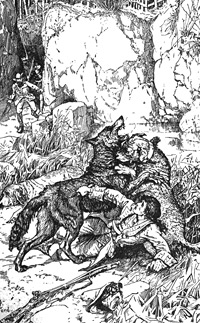
From 1764 to 1767, the Gévaudan region of France suffered scores of brutal killings attributed to a single mysterious creature — La Bête du Gévaudan. The episode traces how normal, if horrific, wolf attacks were amplified and transformed by France’s nascent tabloid press into something supernatural. Two peculiar animals were eventually killed: the first by a hunter known as Antoine (a notably large wolf), and the second by Jean Chastel. J. Smith’s research argues that the killings likely wound down through a combination of factors, chiefly the widespread slaughter of wolves across the region — which also allowed small-game populations to recover — rather than any single heroic kill. The narrative demand for a lone mysterious beast, Blake notes, was driven by a media hungry for a monster.
🔮 A Timeline of Silver’s Folkloric Power
Blake presents a chronological survey of primary-source references to silver’s alleged efficacy against supernatural creatures — carefully distinguished from pop-culture confabulation:
– 1678 / 1688–1719: The Popish Plot fabricated by Titus Oates includes a claim that a silver bullet was prepared to assassinate King Charles II, because silver could harm those “musket-proofed against lead.” The poet Thomas Ward versified this in England’s Reformation (1719). Silver bullets are already extant English folklore — but not yet linked to werewolves.
– 1836: The novel Clan Alban, reprinted in Waldi’s Secret Circulating Library, describes silver buttons used against shape-shifting witches (commonly hares or cats in this period — not wolves).
– 1862: The first Gévaudan fiction to mention silver (Éliberté’s La Bête du Gévaudan) appears — roughly 100 years after the events. Even here, the silver is ineffective; the beast shrugs it off. This is a novel, not a historical account.
– 1865: Sabine Baring-Gould‘s 📖 The Book of Were-Wolves recounts a tale of a silver button fired over were-dogs causing them to resume human form — but conspicuously makes no special case for silver as a werewolf-killer.
– 1877: Testimony recorded in the Bulletin of the Society of Archaeology mentions iron, lead, and silver all being ineffective against La Bête — again, the silver doesn’t work.
– 1882–1883: German and Luxembourgish folklore texts begin specifically connecting silver bullets to werewolves. The 1883 piece “The Werewolf of Dahlheim” is the earliest specific instance Blake found of a silver bullet actually killing a werewolf.
– 1884: A Detroit legend features a silver bullet wounding a loup-garou — but only severing its tail. The stuffed tail becomes a local fetish object.
– 1889: Abbé Pochure’s The Beast of Gévaudan, God’s Real Plague documents Chastel’s religious preparations (blessed musket balls, masses, prayers to the Virgin) but contains zero mention of silver bullets.
– 1920: Eugene O’Neill‘s play The Emperor Jones — the first performing arts reference Blake found to a silver bullet killing a magically protected person.
– 1933: Guy Endore‘s novel 📚 The Werewolf of Paris 💵 includes an elaborately cast silver bullet (melted from a holy crucifix, blessed by an archbishop). The book also introduces the detail of a werewolf born on Christmas Day with joined eyebrows. Endore and screenwriter Curt Siodmak were reportedly friends — though the source for that claim proved undocumentable.
– 1933: Montague Summers‘ 📚 The Werewolf in Lore and Legend 💵 — exhaustive but untranslated from Latin and Greek in its primary sources — mentions silver only as effective against shape-changing witches, not werewolves specifically.
🎬 The Wolfman and the Myths Siodmak Didn’t Actually Create
Universal Pictures’ 🎬 The Wolf Man 💵 (1941, often dated to its release cycle around 1944 in some prints) is frequently credited with originating the core werewolf tropes. Blake carefully untangles what Siodmak actually invented versus what he inherited:
– Silver as a werewolf weakness predates the film by decades — as the timeline above demonstrates.
– The Wolfman is not dispatched with a silver bullet. He is killed with a silver-handled cane.
– The famous quatrain — “Even a man who is pure in heart / and says his prayers by night / may become a wolf when the wolfbane blooms / and the autumn moon is bright” — is Siodmak’s own invention, not ancient folklore, despite being widely repeated as if it were.
– The requirement of a full moon to trigger transformation does not appear in the 1941 film. It was introduced in the 1943 sequel 🎬 Frankenstein Meets the Wolf Man 💵, where the poem’s final line is altered to read “and the moon is full and bright.”
– Robert E. Howard was already weaving together the curse-transmission idea and the full-moon transformation in his 1925–1926 Conan-era weird fiction, well before the Universal films.
🔍 Who Put the Silver Bullet into Chastel’s Gun?
Blake identifies two likely suspects for the myth’s modern proliferation:
– Joan Grant, a writer best known for past-life-regression memoirs, briefly recounted the Gévaudan story in her 1962 book A Lot to Remember, casually attributing the kill to a silver bullet. Blake considers this a weak vector — her account is vague and the book had limited influence.
– John Keel, author of 📚 Strange Creatures from Time and Space 💵 (1970), is the more likely culprit. Keel’s version is vivid and cinematically detailed: Chastel loads silver bullets, calmly reads a prayer book as the beast emerges from the woods, and shoots it point-blank in the chest. It contains multiple invented or unsubstantiated elements — and Keel had previous form for embellishment, including his role in perpetuating the Men in Black mythos. After Keel’s book, citations of Chastel’s silver bullet multiply rapidly in paranormal literature. The echo chamber does the rest.
📚 Further Reading
– 📚 Monsters of the Gévaudan: The Making of a Beast 💵 by Jay M. Smith
– 📚 The Werewolf in Lore and Legend 💵 by Montague Summers
– 📖 The Book of Were-Wolves by Sabine Baring-Gould
– 📚 Strange Creatures from Time and Space 💵 by John Keel
– 📚 The Werewolf of Paris 💵 by Guy Endore
– 📚 The Curse of the Werewolf: Fantasy, Horror and the Beast Within 💵 by Chantal Bourgault du Coudray
– 📚 The Werewolf Book 💵 by Brad Steiger
– 🎬 The Wolf Man 💵 (1941), screenplay by Curt Siodmak
– 🎬 The Curse of the Werewolf 💵 (1961, Hammer Studios; based on Endore’s novel)
🔗 Related Links
– Beast of Gévaudan — Wikipedia
– King Lycaon — Wikipedia
– Clinical Lycanthropy — Wikipedia
– Loup-garou — Wikipedia
– Malleus Maleficarum — Wikipedia
– Titus Oates and the Popish Plot — Wikipedia
– Curt Siodmak — Wikipedia
– Montague Summers — Wikipedia
Note: ads inserted into the distributed audio alter the timestamps in unpredictable ways, so timing references in these notes are approximate.
DID IT TAKE A SILVER BULLET to kill the beast of Gévaudan? Is that where Curt Siodmak got the idea for his film The Wolfman? Host Blake Smith reveals his findings from more than two years of werewolf research.
Books mentioned in this episode
- Monsters of the Gévaudan
- The Werewolf in Legend and Lore
- The Book of Werewolves
- Strange Creatures from Space and Time
- The Beast of Gévaudan
- The Werewolf Book
- The Curse of the Werewolf:
Fantasy, Horror and the Beast Within - Additional resources
Music
- Monstertalk Theme: Monster by Peach Stealing Monkeys
MTArchivist
0