Regular Episode
#079 – PLESIOSAUR PARENTING
The conversation ranges well beyond picture books, touching on scientific literacy as a parenting philosophy, the legacy of Carl Sagan in skeptical activism, the freshly aired reboot of Cosmos hosted by Neil deGrasse Tyson, and the stubborn persistence of cognitive bias — even among people who really ought to know better.
🦕 Building the Trilogy — Science Under 1,000 Words
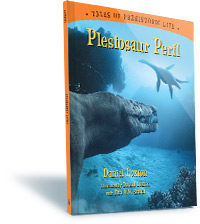
📚 Plesiosaur Peril 💵 follows a young female plesiosaur who strays too far from her family pod and attracts something very large and very hungry. The book clocks in at roughly 1,000 words of narrative plus about 200 words of nonfiction back-matter explaining the scientific reasoning behind the story’s choices — which behaviors are plausible, which animals coexisted, why the animals swallow gastroliths (rocks, kids — they just eat rocks). Paleozoologist Darren Naish, a previous MonsterTalk guest, served as science consultant on Plesiosaur Peril as he did on its predecessor, 📚 Pterosaur Trouble 💵.
Daniel is explicit about the tonal tightrope: the animals don’t talk, internal mental states are avoided wherever possible, and action carries the drama rather than anthropomorphic narration. The goal is something closer to a nature documentary than to the chatty dinosaurs of the Walking with Dinosaurs theatrical release — high jeopardy, low gore, morphologically accurate creatures that nevertheless make you root for the plucky little protagonist.
The illustrations are a genuine family project. Daniel’s then-eight-year-old son spent hours throwing rocks into water so that the resulting splashes could be photographed and composited into scenes of prehistoric animals surfacing and diving. Real physics, real water, real kid.
📚 Writing for Children Is the Hardest Writing
Daniel has now written across a remarkably wide age range: 📚 Plesiosaur Peril 💵 and its siblings target ages four to seven; 📚 Evolution 💵, his nonfiction children’s book, is aimed at roughly ages eight to twelve; Junior Skeptic pitches itself at an imagined twelve-year-old; and 📚 Abominable Science! 💵 (co-authored with Donald Prothero, discussed in an earlier MonsterTalk episode) is for adults. His verdict: the younger the audience, the harder the writing. You cannot assume readers know that France exists, or that mammals are different from reptiles. Jargon and name-drops must be ruthlessly pruned. Every word is load-bearing.
🔭 Raising Scientifically Literate Humans
Blake and Daniel dig into what it actually means to raise children with scientific literacy — and both agree it’s less about cramming in facts and more about instilling the tools to evaluate claims. Daniel notes that his own kids are encountering the same kinds of mysteries he grew up obsessing over (Loch Ness Monster, UFOs, the works), but now the delivery mechanism is YouTube and video-game folklore: Herobrine, Slender Man, the usual suspects in a new skin.
The parenting philosophy both hosts articulate is less “here is the answer” and more “here is how we figure out whether there could be an answer.” Daniel quotes Carl Sagan‘s observation that children can handle surprisingly deep ideas — and argues that the core lesson of scientific skepticism (that we are fundamentally limited in our ability to know, and that this limitation calls for humility) is fully accessible to a five-year-old. Humility, though, ultimately requires experience to internalize, not just instruction.
🌌 Cosmos, Sagan, and the Line Between Science and Religion
The episode was recorded the night after the premiere of Cosmos: A Spacetime Odyssey on Fox — Daniel watched it with his son the night it aired. Both hosts are enthusiastic: the reboot is visually stunning, emotionally resonant, and makes a credible case for picking up Sagan’s mantle. Daniel notes that the premiere threads the science-and-religion needle carefully, framing the conflict not as science versus faith broadly, but as the freedom to inquire versus the impulse to suppress inquiry — a distinction that matters when you’re broadcasting to the Fox audience.
🪐 The Carl Sagan Issue of Junior Skeptic
Timed to the Cosmos reboot, issue 50 of Junior Skeptic — bound into Skeptic Vol. 19, No. 1 — is devoted entirely to Sagan’s life in skepticism. Daniel argues that this thread of Sagan’s career has been consistently downplayed by biographers who treat it as a footnote, when in fact it runs from his childhood through his death in 1996.
Some highlights from Daniel’s research:
– As a young UFO enthusiast, Sagan discovered Martin Gardner and Charles Mackay — the same skeptical literature that later redirected both Blake and Daniel — and it changed his intellectual trajectory.
– Through the 1960s, Sagan evaluated Project Blue Book, was involved in hearings on UFO fraud, and testified before Congress on the subject.
– Sagan was personally arrested alongside John Mack — the Harvard psychiatrist who became central to the alien abduction literature — at a protest against nuclear testing. When Mack later embraced abduction research, Sagan staged a personal intervention. It didn’t take.
– Sagan famously refused to sign the “Objections to Astrology” petition — despite its supporters including Nobel laureates and close colleagues — because he found it authoritarian and intellectually shallow. His first act in organized skepticism was, essentially, a tone note.
⚗️ Bias, the File Drawer, and Why Scientists Are Human Too
A digression on scientific reform produces some of the episode’s most candid moments. Both hosts push back gently on the idea that simply being aware of cognitive bias inoculates you against it — drawing on behavioral economics to argue that awareness is not proof against bias, only a starting point for working with it. They also touch on the file drawer problem and express cautious optimism that evolving publication norms might eventually reduce the incentive to bury null results. The conversation lands, characteristically, on a note of epistemic humility: science is roughly 400 years old, it will keep breaking and fixing itself, and at the end of the process we will know more than we did.
📚 Further Reading
– 📚 Plesiosaur Peril 💵 by Daniel Loxton (Kids Can Press)
– 📚 Pterosaur Trouble 💵 by Daniel Loxton (Kids Can Press)
– 📚 Ankylosaur Attack 💵 by Daniel Loxton (Kids Can Press)
– 📚 Evolution: How We and All Living Things Came to Be 💵 by Daniel Loxton (Kids Can Press)
– 📚 Abominable Science! 💵 by Daniel Loxton and Donald Prothero
– 📚 The Master Switch: The Rise and Fall of Information Empires 💵 by Tim Wu (mentioned in passing during the discussion of monopoly, innovation, and suppressed ideas)
🔗 Related Links
– Junior Skeptic — Skeptic Magazine
– Cosmos: A Spacetime Odyssey (2014) — Wikipedia
– Cosmos: A Personal Voyage (1980, original Carl Sagan series) — Wikipedia
– Plesiosauria — Wikipedia
– Gastroliths — Wikipedia
– Objections to Astrology petition — Wikipedia
– Publication bias (the “file drawer problem”) — Wikipedia
Note: ads inserted into the distributed audio alter the timestamps in unpredictable ways, so timing references in these notes are approximate.
IN THIS EPISODE of MonsterTalk, Blake interviews Junior Skeptic author/artist Daniel Loxton on the final book in his prehistoric animal thrillogy, Plesiosaur Peril. We talk about dinosaur names, raising kids with science literacy, and the reboot of Cosmos.
Mentioned in this episode
Books by Daniel Loxton
About Plesiosaur Peril
A group of plesiosaurs—ocean-dwelling cousins of the dinosaurs—keeps safe by swimming in a family pod. But then one baby plesiosaur swims too far from its mother and attracts the attention of something very large and very hungry, and the struggle for survival is on. A unique blend of digital artwork and landscape photography illustrates this thrilling encounter.
- Reading level: Ages 4 and up
- Hardcover: 32 pages
- Publisher: Kids Can Press
Music
- Monstertalk Theme: Monster by Peach Stealing Monkeys
MTArchivist
0