Regular Episode
062 – WITCH YOU TALKIN’ ABOUT?
The case is often billed as one of the best-documented hauntings in American history. As the hosts discover, that claim rests almost entirely on a single book published roughly 75 years after the alleged events — and none of the primary sources that book cites appear to actually exist.
🏚️ The Site Visit
Blake and Ben made the roughly 35-mile detour from Nashville to the Bell Witch historical site, where a replica log cabin (with modern pressure-treated floors and pre-recorded audio narration) now stands on the property. Their first encounter on arrival: a psychic in a tow-behind trailer who took one look at the two skeptics and retreated inside. The site also features Bell Witch Cave — accessible for $12 — which figures in one of the legend’s stranger subplots involving a boy stuck in a hole, a helpful witch, and a lecture on cave safety.
In an amusing bit of apparent synchronicity, Joe Nickell and Yvonne Reese pulled up in a car just as Blake and Ben stopped at the state historical marker — having already visited the cave themselves.
📖 The Only Source That Matters (and Its Problems)
The foundational document for the entire Bell Witch legend is 📚 An Authenticated History of the Bell Witch and Other Stories of the World’s Greatest Unexplained Phenomena 💵 by M.V. Ingram, published in 1894. Its preface boldly declares the story is supported by a “powerful array of incontrovertible evidence” — a claim the book then conspicuously fails to deliver on.
The chain of sourcing is a classic friend-of-a-friend structure: Ingram claims to be retelling what he read in a handwritten diary by Richard Bell (one of John Bell‘s sons), written decades after the events. The diary itself does not exist. Letters from alleged eyewitnesses, cited within the text, do not exist independently of the book. No contemporaneous written accounts from any other source have ever been found. As Ben notes, folklorists identified the Bell Witch story as legend as early as 1934, including a discussion in the Journal of American Folklore — a fact apparently lost on several generations of ghost-hunting writers who simply repeated Ingram’s account as fact.
🎩 The Andrew Jackson Problem
One of the most dramatic episodes in Ingram’s book has Andrew Jackson visiting the Bell farm — his wagon mysteriously halted by an invisible force, a disembodied voice granting him permission to proceed, a terrible night of banging and clattering, and Jackson departing the next morning declaring he’d rather face the British than face the witch again. The story is given several pages of vivid, direct-quoted dialogue.
The problem: Jackson’s movements during this period were well documented, and he wasn’t in the area. Ben also points out that Jackson’s presidential campaigns were notoriously mudslinging affairs — if he had genuinely been bested by a ghost, his political opponents would almost certainly have made use of that. The hosts identify this as a broader pattern: attaching the name of a famous, credible figure (a president, a future president) to a ghost story to lend it unearned authority. Similar examples discussed include the Winchester Mystery House and Teddy Roosevelt, and the Brookdale Lodge in Santa Cruz and Herbert Hoover.
🧙 Folklore in Sheep’s Clothing
Ben’s central argument is that Ingram’s book is best understood not as a historical account but as fiction presented as fact — a technique with a long pedigree. The entity in the story is variously called a witch, a ghost, a goblin, a gnome, and a gremlin (Blake counts about half a dozen labels), which handily ensures that any reader’s preferred supernatural framework can accommodate it.
The Bell Witch’s behavior also maps neatly onto older European witch-lore: the strange animal that can’t be killed (part rabbit, part dog — reminiscent of the witch-hare motif), the affliction of a family patriarch, vomiting of pins and needles by a young woman. Karen notes that the events, if real, would have occurred right at the tail end of the European witch craze, making “witch” a plausible folk interpretation of unusual phenomena. The story’s moralistic elements — the witch punishing a lazy farmhand, rescuing a child from a cave, delivering biblical messages — parallel the social-control function of legends like La Llorona. Meanwhile, the book itself, with its extended dramatic dialogue, literary set pieces, and cave-adventure sequences, reads structurally as a novella rather than a deposition.
The cave on the property contains what’s described as a stone box formation claimed to be a Cherokee burial. Blake is skeptical — Cherokee burial practices, as he understands them, emphasized returning the body to nature rather than enclosure in stone — and notes he reached out to friend of the show Ken Feder for comment. Joe Nickell also reportedly had thoughts on the box.
🎬 From Bell Witch to Blair Witch
The hosts trace a direct line from Ingram’s 1894 book to modern found-footage horror. The makers of 🎬 The Blair Witch Project 💵 have acknowledged drawing inspiration from the Bell Witch legend, and its presentation as a genuine documentary record fooled enough viewers — including, reportedly, some police departments — that the filmmakers still receive inquiries about the “case.” Karen recalls seeing it at a midnight screening in Sydney where it was marketed as a true story.
The 2005 film 🎬 An American Haunting 💵, starring Donald Sutherland and Sissy Spacek, brought the Bell Witch to mainstream cinema audiences. Blake notes it was directed by the same filmmaker responsible for the 🎬 Dungeons & Dragons 💵 movie — a film perhaps best remembered for Jeremy Irons delivering what can only be described as a maximalist performance.
The story has since generated a cottage industry in Adams, Tennessee: cave tours, canoe tours, t-shirts, and assorted Bell Witch merchandise — a phenomenon the hosts compare to the Bigfoot tourism economy Karen has noted in other episodes.
🔬 The Skeptical Takeaway
Ben draws on Ray Hyman‘s categorical imperative: before attempting to explain a phenomenon, first establish that the phenomenon actually occurred. He cites a passage from 📚 The Haunting of America 💵 by William Burns and Joel Martin that earnestly debates whether Betsy Bell was the poltergeist agent responsible for the phenomena through unconscious telekinetic energy — a question that rather presupposes the events happened at all. As Ben puts it, arguing about Betsy’s culpability is like debating whether Huckleberry Finn’s father really beat him: it treats a fictional character as though she exists outside the text that created her.
Ben’s Skeptical Inquirer article on the Bell Witch case is also referenced as background reading.
📚 Further Reading
– 📚 An Authenticated History of the Bell Witch and Other Stories of the World’s Greatest Unexplained Phenomena 💵 by M.V. Ingram (the original 1894 source text; available as an inexpensive e-book edition)
– 📚 The Haunting of America 💵 by Joel Martin and William J. Birnes
– 🎬 An American Haunting 💵 (2005), dir. Courtney Solomon
– 🎬 The Blair Witch Project 💵 (1999), dir. Daniel Myrick and Eduardo Sánchez
🔗 Related Links
– Bell Witch – Wikipedia
– Robertson County, Tennessee
– Poltergeist – Wikipedia
– Ray Hyman and the categorical imperative
– La Llorona – Wikipedia
– Winchester Mystery House – Wikipedia
– Skeptical Inquirer (Ben Radford’s Bell Witch article appears in its archives)
Note: ads inserted into the distributed audio alter the timestamps in unpredictable ways, so timing references in these notes are approximate.
ACCORDING TO LEGEND, in the early 1800s the farm of John Bell of Tennessee was terrorized by a supernatural assailant who came to be known as The Bell Witch. MonsterTalk hosts Blake Smith, Ben Radford and Dr. Karen Stollznow discuss the case, following a visit to the site of the haunting by Ben and Blake.
Topics in this episode
- The Bell Witch historical website
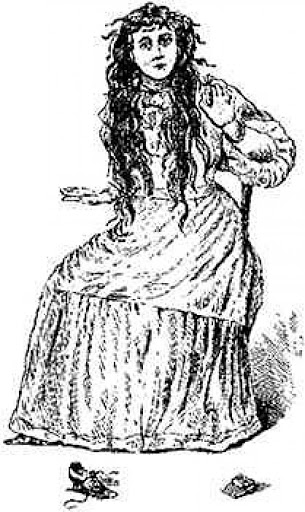
- Betsy Bell etching from 1894
- Full text of the original source book: An Authenticated History of the Bell Witch
Music
- Monstertalk Theme: Monster by Peach Stealing Monkeys
MTArchivist
0