Regular Episode
056 – ASSAULT & GIANT BATTERY
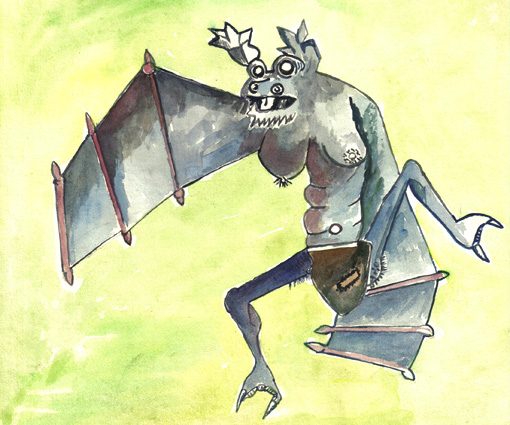
Popobawa illustration (above) by Zanzibari Chande (commissioned by Benjamin Radford)
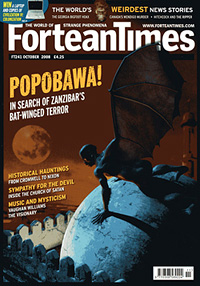
Radford first encountered the story in 1995 in a clipping reprinted from The Guardian — headlined “The Evil Spirit That Rapes Men in Zanzibar” — while living in Bolivia. As luck would have it, he was about to travel to Zanzibar anyway, which gave him the rare opportunity to do actual fieldwork rather than armchair research. His investigation was later published as a cover article in Fortean Times (November 2008), and remains one of the very few in-depth critical analyses of the creature in print.
🦇 What Is the Popobawa?
Popobawa means “bat wing” in Kiswahili, named for the shadow it supposedly casts when swooping down. But pinning down a physical description is nearly impossible — believers variously describe it as a demon, an evil spirit, a genie escaped from its master, a bat demon, a one-eyed ogre, or something inherently invisible and imperceivable. Some say any description is a category error, since the Popobawa is supernatural and therefore not constrained to a single form. There are no photographs. Radford did commission a painting from a Zanzibari artist who believed in the creature, and that illustration appears in the show notes.
Sightings are geographically concentrated: primarily Zanzibar (including the smaller island of Pemba), plus Dar es Salaam and parts of Kenya. Reports date back only to around 1965, with a major wave in the 1970s–80s and a dramatic peak in 1995. Unlike Bigfoot or the Loch Ness Monster, the Popobawa is conceived as a singular entity — one specific creature, not a species.
😨 The 1995 Panic
The 1995 flap produced genuine mass hysteria across Zanzibar. The creature’s primary attack is sodomy; it also reportedly communicates telepathically and threatens to repeat its assault the following night unless victims publicly announce what happened to them. This self-perpetuating “tell others or suffer again” mechanism functions much like the narrative hook in a classic urban legend — it is built into the story’s structure.
Protective measures circulating during the panic included coating oneself in pig oil, sleeping somewhere other than one’s own bed, and simply staying awake through the night (an approach that echoes folklore around succubi, incubi, and even A Nightmare on Elm Street‘s Freddy Krueger). Many villagers chose to sleep along unlit roadsides rather than in their own beds. One mentally disturbed man who claimed to be the Popobawa was lynched — a grim reminder that moral panics have real-world consequences.
🔬 Investigating the Claims
Radford’s fieldwork took direct aim at the most concrete claim in the literature: Michael Newton‘s The Encyclopedia of Cryptozoology asserted that Zanzibar’s main hospital had treated numerous Popobawa victims. Radford tracked down Dr. Omar Saleh Omar at the Zanzibar Medical Group and asked directly. The doctor laughed. No such victims had ever been treated there. As Radford notes, this is a recurring pattern in paranormal research: ostensibly credible secondary sources make vivid claims that simply evaporate on contact with primary sources.
Radford also found no first-person victims during his time on the island — only friend-of-a-friend chains. He notes the additional methodological challenge of being a white Western researcher asking locals about deeply culturally embedded beliefs, acknowledging he couldn’t entirely rule out being told what visitors were expected to hear.
🧠 Explanations: Sleep Paralysis, Folklore, and Social Control
Joe Nickell, in 📚 Tracking the Man-Beasts 💵, briefly examined the Popobawa and declared it essentially solved as a variant of sleep paralysis — the well-documented phenomenon in which a person waking from or entering sleep feels pressure, immobility, and a malevolent presence, experiences also linked to reports of alien abduction and the “old hag” tradition. Radford agrees this is a plausible contributing factor but argues it’s insufficient on its own. Sleep paralysis doesn’t explain why attacks cluster so strongly around election periods, nor does it explain the creature’s demand that victims publicize their experience.
The hosts use this as a jumping-off point for a broader methodological discussion: offering a plausible alternative explanation is not the same as actually investigating a claim. Armchair debunking — “it was probably sleep paralysis” — is a useful starting point, not a conclusion. The hosts recommend folklorist David Hufford‘s 📚 The Terror That Comes in the Night 💵 as a rigorous treatment of sleep paralysis across cultures, and urban legend scholar Jan Harold Brunvand as essential reading for any skeptical investigator who wants to recognize recurring folkloric motifs when they appear in fresh guise.
🗳️ Monsters and Politics: The Popobawa as a Tool of Social Control
The most striking finding of Radford’s investigation is the Popobawa’s entanglement with Zanzibari electoral politics. Attacks cluster before, during, and after elections — a pattern wholly inconsistent with random sleep paralysis events. Rival political factions have reportedly used the Popobawa as leverage: warning voters that election fraud, or voting for the wrong party, would bring the creature down on them. This works, Radford argues, because the belief infrastructure is already in place — Zanzibar and Tanzania exist within a broader East African context of deep, widespread belief in witchcraft and magic, including the practice of muti. If politicians can be assumed to employ warlocks, and warlocks can control genies, then a politically directed Popobawa is entirely coherent within that worldview.
The hosts draw parallels to the Chupacabra‘s political co-optation in Puerto Rico, and more pointedly to American political boogeymen — from Willie Horton to Sarah Palin’s “death panels” to the weapons-of-mass-destruction justification for the Iraq War. Monsters, the episode argues, are never just monsters.
🕌 Islamic Cosmology and the Genie Origin
By far the most common explanation Radford encountered among Zanzibaris themselves was that the Popobawa is a jinn (genie) that escaped from the warlock who summoned it — a theme with deep roots in Islamic cosmology and one that Radford connects to Robert Lebling’s 📚 Legends of the Fire Spirits: Jinn and Genies from Arabia to Zanzibar 💵 (the subject of an earlier MonsterTalk episode). The escaped-creation motif also appears in the Jewish golem tradition and, of course, in Frankenstein’s monster. Notably, the Popobawa is said to specifically target skeptics and non-believers — a detail that makes considerable sense, Radford observes, if the creature is understood as an expression of Quranic values rather than as a cryptozoological animal.
📚 Further Reading
– 📚 Tracking the Man-Beasts 💵 by Joe Nickell
– 📚 The Terror That Comes in the Night 💵 by David J. Hufford
– 📚 Legends of the Fire Spirits: Jinn and Genies from Arabia to Zanzibar 💵 by Robert Lebling
– 📚 The Encyclopedia of Cryptozoology 💵 by Michael Newton
🔗 Related Links
– Popobawa — Wikipedia
– Jinn in Islamic cosmology — Wikipedia
– Sleep Paralysis — Wikipedia
– Spring-Heeled Jack — Wikipedia
– The Delhi Monkey Man — Wikipedia
– Jan Harold Brunvand (urban legend scholarship) — Wikipedia
– Muti (ritual medicine and associated violence in sub-Saharan Africa) — Wikipedia
Note: ads inserted into the distributed audio alter the timestamps in unpredictable ways, so timing references in these notes are approximate.
FOR DECADES, legends of a giant sexually-assaulting bat-creature have trickled out of Zanzibar. In this episode of MonsterTalk we interview Ben Radford about his investigation of the creature and the role that the monster called Popabawa has played in culture and politics in the United States.
Music
- Monstertalk Theme: Monster by Peach Stealing Monkeys
MTArchivist
0