Regular Episode
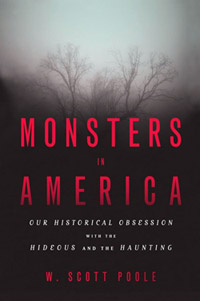
048 – MONSTERS IN AMERICA
The conversation ranges across 300 years of American monster culture — from Puritan sea serpents to Universal Studios creature features, from freak shows to torture-porn cinema — with Poole making a consistent and provocative argument that monsters are not reflections of history but active participants in it.
🐍 Monsters as Historical Actors
Poole resists giving a fixed definition of “monster,” arguing that pinning one down would flatten the very historical variation he wants to examine. Instead he tracks what gets called monstrous in a given era and why. His clearest illustration: a sea serpent sighting off Gloucester Harbor in the early 19th century drew crowds of fishermen who chased the thing in boats and debated it in quasi-scientific and political terms — while a nearly identical sighting off Massachusetts in 1638 was interpreted by a Puritan layman as a manifestation of the serpent from Eden. Same creature, same coastline, entirely different monster.
Poole draws on Karl Popper‘s idea that theory guides observation to explain why mass sightings cluster: people who are culturally primed to see something often do. He also traces the sea serpent’s indirect role in the professionalization of American science — the New England Linnaean Society famously staked its reputation on what turned out to be a water snake with a skin condition, and Louis Agassiz‘s debunking helped shift the definition of empirical evidence away from eyewitness testimony toward physical specimens.
💀 Race, Science, and the Monstrous Body
One of the book’s most sustained arguments concerns the entanglement of race and monstrosity in American history. Poole notes that the first European explorers arrived in the New World already culturally prepared to find monstrous races — and promptly projected those expectations onto Native Americans and Africans. Newspaper accounts of slave rebellions reached for the symbolism of Frankenstein’s monster; an Atlanta editorial responding to the Scopes Trial argued that evolution was unacceptable in part because it implied white Americans were more closely related to Black Americans than white supremacy could tolerate.
The Universal Studios Frankenstein (1931) gets a particularly sharp reading: the monster’s “criminal brain” lands in a cultural moment saturated by pseudoscientific theories of innate criminality, and Poole notes the dark irony that audiences in the American South — some of whom may have personally participated in lynch mobs — were watching a mob chase a monster to a windmill. A British review of the film at the time reportedly made the comparison explicit.
🧛 Sexy Monsters and the Erotic Uncanny
Monsters, Poole argues, are creatures of excess — too big, too hungry, too much — and that excess maps naturally onto sexuality. The book traces a throughline from colonial-era sexual folklore about Africa, to Béla Lugosi‘s Dracula (1931) arriving as a genuine sex symbol during a moral panic about Eastern European immigrants and “white slavery,” to the contactee movement of the 1950s, where public discussion of sexual encounters with aliens emerged just ahead of the sexual revolution. George Adamski‘s “Space Brothers” — benevolent aliens bearing messages of cosmic peace — represent one pole; abduction and violation narratives represent the other. Poole even quotes Billy Graham on flying saucers: the evangelist folded UFO sightings into a narrative of angels and spiritual warfare, another example of the monster as meaning machine absorbing whatever cultural charge surrounds it.
🎪 Freaks, Freak Shows, and the Subversive Gaze
Poole opens Monsters in America with a discussion of Tod Browning‘s 🎬 Freaks 💵 (1932) and the apparent paradox that Depression-era Americans flocked to freak shows by the millions while walking out of the film that featured many of the same performers. His explanation: the freak show offered a safe, objectifying experience — viewers confirmed their own normalcy by gazing at the other. Freaks subverted that transaction entirely. Browning’s camera repeatedly has the performers look back — directly into the lens, directly at the audience — and the film’s moral universe places sympathy with the “freaks” and villainy with the “normals.”
Poole notes that sideshow performers’ own memoirs describe deliberately making eye contact with audience members as an act of quiet resistance, delighting in the discomfort it caused. He also highlights the Hilton Sisters — the conjoined twins prominent in Freaks — whose long careers before and after the film were accompanied by considerable public fascination with their romantic lives. MGM eventually sold the film off; it only found its appreciative audience on the arthouse circuit in the 1960s, by which point Browning had just died.
🔪 Torture Cinema and the Captivity Tradition
The hosts ask Poole about the rise of so-called “torture porn” — 🎬 Saw 💵, 🎬 Hostel 💵, 🎬 The Human Centipede 💵 — and he places it in two overlapping contexts. The first is the post-9/11 national conversation about the ethics of torture; the second, and more historically deep, is the captivity narrative tradition stretching back to the Puritan period, in which innocent people (usually women) are seized by savage outsiders, subjected to implied horrors, and eventually redeemed — sometimes through rescue, sometimes through violent vengeance. Films like The Hills Have Eyes and I Spit on Your Grave fit the same structural template. What distinguishes contemporary torture cinema, Poole suggests, is that the evil is no longer supernatural or even individual — it’s institutional, networked, bureaucratic. The horror is impersonal, which feels distinctly contemporary.
On censorship more broadly, Poole argues that moral panics around horror films, heavy metal, and role-playing games during the 1980s served as a rhetorical substitute for grappling with the actual social crises of that era — the crack epidemic, urban poverty, the consequences of the war on drugs. Banning a film is easier than fixing structural inequality. (He has personal experience with this: a public library in a small Southern town cancelled his book tour appearance on the grounds that Monsters in America contained “bad language and ideas we would rather not have to deal with.”)
🎬 Gods, Monsters, and James Whale
The episode closes with a discussion of 🎬 Gods and Monsters 💵 (1998) and the 📚 Father of Frankenstein 💵 novel by Christopher Bram on which it is based. Poole — who was about to appear on a panel with Bram at the time of recording — praises both for exploring the relationship between the experience of war and the genesis of horror, noting that director James Whale‘s service in World War I and the loss of his first lover in that war haunts both works. He also points out that David J. Skal — author of 📚 The Monster Show 💵, which Blake references during the freak show discussion — has a brief on-screen cameo at the opening of the film.
📚 Further Reading
– 📚 Monsters in America 💵 by W. Scott Poole
– 📚 The Monster Show: A Cultural History of Horror 💵 by David J. Skal
– 📚 Father of Frankenstein 💵 by Christopher Bram (basis for Gods and Monsters)
– 🎬 Freaks 💵 (1932), directed by Tod Browning
– 🎬 Gods and Monsters 💵 (1998), directed by Bill Condon
🔗 Related Links
– Hilton Sisters (conjoined twins and sideshow performers)
– Gloucester Sea Serpent (1817 sightings)
– Captivity Narrative (Puritan literary tradition)
– Satanic Panic (1980s moral panic)
– James Whale (director, Frankenstein and Bride of Frankenstein)
– Video Nasties (UK censorship controversy)
Note: ads inserted into the distributed audio alter the timestamps in unpredictable ways, so timing references in these notes are approximate.
IN THIS EPISODE of MonsterTalk, the hosts talk with the author of Monsters In America, Dr. Scott Poole. His book chronicles the history of monsters from colonial America to modern times—and tries to tackle the issue of meaning in a world where monsters are “meaning machines.”
Further Reading
- The Hilton Sisters (conjoined twins)
- Freaks (Todd Browning’s
controversial film) - Gods & Monsters (Novel)
- Gods & Monsters (Film)
VISIT MONSTERTALK ON FACEBOOK!
Music
- Monstertalk Theme: Monster
by Peach Stealing Monkeys
T-Shirt Contest Winners
Congratulations to the winners of our MonsterTalk 2012 t-shirt design contest!
- First Place winner is Rick Stromoski.
- Second Place goes to Chris Barela.
- Third Place goes to Sean Steele.
MTArchivist
0