Regular Episode
047 – SOMETHING WICCAN THIS WAY COMES
Emily holds a B.A. in philosophy from Wellesley College and a J.D. from Seattle University School of Law, and serves as Dean of the Dark Arts at the Grey School of Wizardry, an online magical school open to students ages eight and up. The conversation is — against all reasonable odds — collegial, funny, and occasionally even philosophically interesting.
🧹 Who Is Emily Carlin?
Emily describes getting into defensive magic after a childhood full of experiences she couldn’t explain — ghosts she says she could hear, and that began seeking her out once they realized she could perceive them. She eventually found that learning the folklore and practice around these experiences was the best antidote to fear. Her path from that childhood unease to teaching hundreds of students at an online school of wizardry is, at minimum, an interesting one.
The Grey School itself is non-religious and multinational, covering everything from herbalism and tarot to ceremonial magic in the tradition of Aleister Crowley (whose spelling of “magick” with a k Emily’s book also adopts). Emily notes that her oldest student was 74 at the time of this recording.
📖 The Book: A Practical Field Guide to the Monstrous
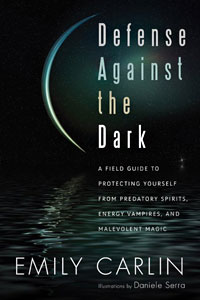
Defense Against the Dark is structured in two halves: the first catalogs a wide range of malevolent entities drawn from world folklore — spirits, vampires, djinn, goblins, fairies, ghouls, golems, and more — and the second lays out practical magical countermeasures. Emily’s stated goal was to write the book she wished had existed when she was a frightened college student: something a panicking person could pick up, match their symptoms to a creature type, and find two or three concrete things to do immediately.
Blake notes that the spells lean heavily on visualization and intention — “envision” and “imagine” appear far more often than “eye of newt.” Emily confirms this is deliberate: physical ingredients are props that can amplify intent, but aren’t necessary. The whole book is designed to be workable with whatever a person already has at home. She also includes, in an appendix, an index of symptoms that could indicate a supernatural attack — a list Ben points out overlaps substantially with “just having a bad week.”
🧄 Folklore vs. Field Guide: Where’s the Line?
One of the more substantive threads of the conversation is how Emily separates folklore she finds credible from folklore she includes purely for completeness. She draws a distinction between the lore sections of the book — where she documents traditional beliefs without necessarily endorsing them — and the practical tools sections, where she only includes techniques she considers field-tested.
The example that gets the most mileage: the old belief that vampires are compelled to count scattered grains of rice before they can proceed. Emily doesn’t vouch for it — but notes it appears consistently across Eastern and Western vampire folklore, and figures if you’re genuinely convinced you’re facing a vampire and you have rice handy, the downside risk is low. Ben responds that throwing rice and watching what happens is, technically, hypothesis testing. The conversation briefly becomes a seminar on experimental design.
The hosts also press Emily on how folk protections like iron and salt against fairies and djinn were ever established. Emily concedes she finds the iron-versus-djinn connection logically murky — if djinn were made from smokeless fire, why would an earthly mineral bother them? — while allowing that iron worked by human hands carries connotations of craft and civilization that might plausibly repel nature spirits.
🧛 Vampires: A Taxonomy
Emily’s vampire chapter breaks the category into three types: psychic vampires (who drain psychic or emotional energy), sanguinarians (people who drink blood, consensually, as a genuine practice), and “lifestylers” (goths who identify as vampires but don’t drink blood and are, per Emily, basically harmless). Her advice for a sanguinarian coming at you with a knife: run, scream, call the police — just as you would for any person with a knife. The magical defenses are for things that don’t have a physical form to arrest.
👻 Ghosts, Evidence, and the Null Shield
Ben brings his ghost-investigation experience to a longer exchange about how one actually distinguishes a paranormal event from a mundane one. Emily’s Chapter 5 gets some credit for its relatively skeptical approach — she lists misidentification of natural phenomena as the first thing to rule out, ahead of hallucinations, psychosomatic constructs, energetic memories, and actual deceased humans.
The most memorable moment in this section: Blake observes that many of Emily’s protective spells begin with words like “envision” or “imagine,” which is functionally what a skeptic does when they tell themselves “that creaking is just the house settling.” Emily immediately agrees and names it: a null shield. Rational explanation as a form of magical protection. She adds that her skeptic husband seems to repel paranormal phenomena through sheer force of disbelief — which she appears to mean at least semi-literally.
The conversation also touches on the limits of ghost-hunting equipment, the problems with using mediums as evidence, and Ben’s suggestion that a proper double-blind test of mediums across haunted and non-haunted locations would tell you a great deal about the mediums and very little about the locations. Emily agrees, and adds her own reservation: she suspects some mediums may be summoning entities rather than detecting pre-existing ones — Bring Your Own Ghost, as it were.
⚖️ Magic, Law, and the Scientific Temperament
One of the odder pleasures of the episode is watching Emily navigate the tension between her legal training, her scientific self-description (she cites MythBusters as her favorite TV show), and her sincere belief in entities that can’t be measured. Her position: the absence of independently verifiable, repeatable tests doesn’t mean the phenomena don’t exist — it means the technology to test them doesn’t exist yet. Ben pushes back on this by pointing out that existing ghost hunters already claim their equipment detects spirits, which makes the “we haven’t evolved the tools yet” argument harder to sustain.
Emily is candid that most of what she believes she could never prove to anyone else, and says she’s made her peace with that. She also clarifies that invoking Kali for protection — one of the rituals tucked at the very back of the book — is strictly a break-glass-in-emergency option, not an everyday defensive measure.
📚 Further Reading
– 📚 Defense Against the Dark: A Field Guide to Protecting Yourself from Predatory Spirits, Energy Vampires, and Malevolent Magic 💵 by Emily Carlin
🔗 Related Links
– Grey School of Wizardry (Wikipedia)
– Wicca
– Smudging (ceremonial smoke cleansing)
– Sleep paralysis
– Djinn (Jinn) in Islamic mythology
– The Wild Hunt
– Will-o’-the-wisp
– Psychic vampire
– Golem
– Ogma (Celtic deity, invoked here as informal patron of technology)
Note: ads inserted into the distributed audio alter the timestamps in unpredictable ways, so timing references in these notes are approximate.
IN THIS EPISODE of MonsterTalk, two skeptics interview a witch about how to battle evil with magic. Emily Carlin is a magical instructor at The Grey School—an online magical university and the author of Defense Against the Dark: A Field Guide to Protecting Yourself from Predatory Spirits, Energy Vampires and Malevolent Magic. Is magic the best defense against evil monsters? Or is skepticism? Pull up a chair and
sit a spell to find out.
Music
- Monstertalk Theme: Monster
by Peach Stealing Monkeys
MTArchivist
0