Regular Episode
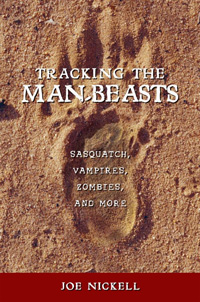
034 – TRACKING THE MAN-BEASTS
The book is an eclectic survey of humanoid monsters — from Sasquatch to vampires to zombies — unified by a single thread: they all look like us. Joe drew on decades of field investigations, carnival work, and travels around the world to assemble a book that is equal parts cultural analysis and on-the-ground monster tracking.
🧬 Why Do Our Monsters Look Like Us?
Joe argues that anthropocentrism is the root of it — human beings have always placed themselves at the center of the universe, and our monsters reflect that. Bigfoot, he suggests, is a kind of symbolic cousin from our evolutionary past: “so endangered, I joke, that he may not actually exist.” At the other end of the timeline sits the classic grey alien — big-headed, large-eyed, body vestigial — a popular-culture projection of what a hyper-evolved future human might look like. Werewolves and vampires, meanwhile, are “us with an attitude,” giving form to the predatory or transgressive sides of human nature. The monsters aren’t arbitrary; they’re mirrors.
🦉 Mothman and the Art of Reading Eyewitness Accounts
Joe’s analysis of Mothman gets extended treatment here. He details his methodology: go back to the earliest written accounts, identify which details are likely accurate, which are likely distorted by fear or darkness, and then ask what real creature best fits the residue. For Mothman, the answer he lands on is the barred owl — a large owl with striking crimson-reflecting eye shine, no visible neck, and a body silhouette that closely matches the original descriptions. He distinguishes this from his earlier, hastily published hypothesis pointing to a barn owl, noting that crimson eye shine is a differentiating factor and that the sightings occurred in a wildlife preserve known to harbor barred owls.
Joe also discusses the late Linda Scarberry, one of the original Mothman eyewitnesses, who wrote at the time that the creature had no arms — yet decades later recalled “big muscular arms.” He treats this not as dishonesty but as a textbook example of how memory conforms over time to culturally dominant imagery. The Mothman statue in downtown Point Pleasant, West Virginia — which now sports arms, a vaguely chupacabra-ish head, and alien eyes — is itself evidence of this iconographic drift in real time.
He also addresses Loren Coleman‘s “Mothman curse” with characteristic wit, noting that he once drafted a rebuttal piece — tracing a “Coleman curse” through every city Loren has ever lived in — which he admits he never published, out of affection for Coleman and the acknowledgment that they are, as investigators, closer to each other than either is to the loudest voices in their respective camps.
🧜 Mermaids, Sea Monsters, and the Misperception Problem
On mermaids, Joe argues that many historical sightings were genuine encounters with real animals — misperceived, not fabricated. He draws a parallel to modern sea-monster reports near Cadboro Bay off Vancouver Island, where multiple witnesses have reported a long-necked, serpentine creature (Cadborosaurus) that turned out to be sea otters swimming in a line. The witnesses weren’t hallucinating — they were genuinely misidentifying a real animal under difficult observing conditions. His broader point: the most productive question isn’t “hoax or not?” but “what real thing might they have seen, and how much of their description can we trust?”
Carnival Fiji mermaids also come up in the context of Joe’s sideshow research — gaffs that were “not really real, but really good,” as old showmen Bobby Reynolds and Ward Hall used to say.
👽 Alien Iconography and the Feedback Loop
Joe explains the convergence of alien appearance toward the grey humanoid template using a timeline he drew for the book. Before the Betty and Barney Hill abduction case in 1961 — and especially after its made-for-TV adaptation — alien descriptions in UFO reports were genuinely diverse: blobs, robotic figures, insectoids, giants. After Hill, the big-headed, large-eyed humanoid became dominant in subsequent reports, abduction accounts (Betty Andreessen, Travis Walton), and eventually mass-market toys and merchandise. Joe’s hypothesis: the grey humanoid won out because it was the alien type that looked most like us — specifically, like a futuristic evolved version of us — triggering the same anthropocentric resonance that makes all man-beasts compelling. A similar dynamic applies to Bigfoot: the Patterson–Gimlin film effectively set the visual template, narrowing the imaginative range of subsequent sightings.
🎪 Sideshows, Media, and the Responsibility Question
Joe reflects warmly on the era of traveling carnival sideshows — a time when exotic curiosities were otherwise inaccessible to people in small towns. His fieldwork with Ben Radford visiting surviving shows, including one featuring a latex Sasquatch “safely frozen in ice,” feeds directly into the book’s treatment of constructed man-beasts.
He is considerably less warm toward cable television’s handling of monster topics. Having appeared on MonsterQuest, Animal Planet, and National Geographic productions, Joe describes the standard editorial pattern: skeptical content lands on the cutting room floor while on-screen “researchers” — whose credentials amount to a library card and a shelf of credulous books — fill the airtime. His advice to anyone who challenges him with something they saw on a cable show: “Don’t get your facts from a television show.”
He also recounts a falling-out with the University Press of Kentucky, which had published many of his books before proposing to release an equipment-based ghost-hunting title that Joe considered academically indefensible. After submitting a detailed critical report that went unanswered, he took Tracking the Man-Beasts back to Prometheus Books.
📚 Further Reading
– 📚 Tracking the Man-Beasts: Sasquatch, Vampires, Zombies, and More 💵 by Joe Nickell
– 📚 Secrets of the Sideshows 💵 by Joe Nickell
🔗 Related Links
– Mothman – Wikipedia
– Barred Owl – Wikipedia
– Flatwoods Monster – Wikipedia
– Betty and Barney Hill Incident – Wikipedia
– Patterson–Gimlin Film – Wikipedia
– Fiji Mermaid – Wikipedia
– Cadborosaurus – Wikipedia
– Skeptical Inquirer – Committee for Skeptical Inquiry
Note: ads inserted into the distributed audio alter the timestamps in unpredictable ways, so timing references in these notes are approximate.
Renowned investigator Joe Nickell returns to MonsterTalk to discuss his latest book Tracking the Man-beasts: Sasquatch, Vampires, Zombies, and More—a survey of a human-like monsters that runs the gamut from Almas to Zombie. The book covers scores of monsters from legend and lore, and many entries include insights from Joe’s personal investigations.
In this episode
- possible reasons why there are so many anthropomorphic monsters
- the evolution of man-beasts
- the iconography of aliens
- mermaids in history and pop-culture
- werewolves
- plus much, much more!
Music
- Monstertalk Theme: Monster by Peach Stealing Monkeys
MTArchivist
0