033 – RESURRECTING THE EXTINCT
The thylacine — also known as the Tasmanian tiger or Tasmanian wolf — was the largest known carnivorous marsupial of modern times. Its last confirmed specimen, a female housed at the Hobart Zoo in Tasmania, died on September 7, 1936. Despite a million-dollar reward for proof of a living animal, none has ever been produced — though reported sightings have continued for decades.
🦘 What Was the Thylacine?
Dr. Pask explains that the thylacine was a uniquely marsupial lineage that diverged from eutherian (placental) mammals over 130 million years ago. Its original range encompassed Papua New Guinea, mainland Australia, and Tasmania. It vanished from the mainland and New Guinea roughly 2,000 years ago — likely due to pressure from arriving humans and the dingo — and survived only in Tasmania until the colonial-era bounty hunting drove it to extinction.
The thylacine’s most closely related living relative is not the Tasmanian devil but the numbat, a small, striped insectivorous marsupial. It was nocturnal, solitary, covered large home ranges, and fed primarily on small marsupials — not, as the colonial government claimed, on sheep and livestock. Dr. Pask notes that the famous photograph of a thylacine with a dead chicken in its mouth was later shown to have been staged using a taxidermied specimen, part of a deliberate propaganda campaign to build public support for the bounty.
🧬 Resurrecting a Gene from an Extinct Species
Museum collections worldwide — including Museum Victoria, the Tasmanian Museum, and the Smithsonian — hold ethanol-preserved specimens and tanned pelts from which surprisingly high yields of DNA can be extracted. The DNA is highly fragmented (a normal feature of ancient specimens, caused by oxidation and environmental stress over time), but the relative recency of the thylacine’s extinction means the material is far better preserved than, say, mammoth or dinosaur tissue.
Dr. Pask’s landmark experiment worked as follows:
– DNA was extracted from museum specimens and the target gene was reconstructed by amplifying many small overlapping fragments and stitching them together.
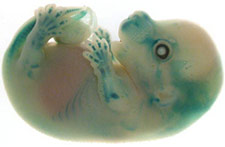
– The reconstructed thylacine DNA was coupled to a reporter sequence — a piece of DNA that produces a blue pigment when switched on — creating what geneticists call a construct.
– That construct was injected into early mouse embryos. In some embryos, it incorporated into the genome.
– When the mouse embryo would normally activate the equivalent gene, the thylacine copy also switched on — causing specific tissues to turn blue and revealing precisely when and where that gene functions during development.
This was the first time DNA from an extinct species had been shown to retain and express its original developmental function inside a whole living organism — going beyond earlier work (such as putting Neanderthal DNA fragments into cells in culture) to demonstrate actual in-vivo gene activity.
🐘 Could We Actually Bring One Back?
This is where Dr. Pask pumps the brakes on the Mike Archer-style optimism. The thylacine genome is broken into millions of fragments, and roughly 50% of any mammalian genome consists of repetitive sequences — essentially identical stretches that are impossible to correctly reassemble without a complete reference. Dr. Pask likens it to a million-piece jigsaw puzzle where half the pieces are solid blue sky.
The mammoth, he notes, is a slightly better candidate for revival because researchers understand elephant reproductive biology well enough to perform in vitro fertilization and embryo transfer — meaning a “mammothized” elephant embryo is at least theoretically transplantable. Marsupial reproductive biology is less well-characterized, making a comparable pathway for the thylacine much further off. The strategy would involve:
– Sequencing the full thylacine genome using next-generation short-read sequencing platforms well suited to fragmented ancient DNA.
– Comparing that genome to a close living relative (such as the numbat) to scaffold the repetitive regions.
– Identifying all positions where the thylacine differs from the surrogate species’ genome.
– Editing those differences into a living surrogate embryo — effectively “thylacine-izing” a numbat embryo — and implanting it into a surrogate mother.
The technology to do this does not yet exist at the required scale. (A 2021 update in the existing show notes notes that costs and technical hurdles remain substantial, though the science has continued to improve.)
🔬 Why Bother? The Science of Convergent Evolution
Dr. Pask is candid that reviving the thylacine as a living animal is not a sound use of research funding. The real scientific prize is the thylacine’s status as arguably the finest known example of convergent evolution among mammals. Despite sharing a common ancestor with dogs over 130 million years ago, the thylacine’s skeleton — including its jaw and dentition — is nearly indistinguishable from that of a placental canid. Even a skilled paleontologist needs to look hard to spot the marsupial tell-tale features.
Because the dog genome is already fully sequenced and well-annotated (dog breeding has given researchers a rich catalog of genes controlling morphology), researchers can directly compare the two genomes to identify which specific genetic changes — particularly in promoter regions that control when and where genes switch on — drove such similar body plans to evolve independently. The thylacine’s genome could help illuminate fundamental principles of how evolution works at the molecular level.
🐾 Sightings and the Ghost of the Thylacine
Hundreds of reported sightings have accumulated since 1936, catalogued by researchers such as Stephen Smith, who documented hundreds of Tasmanian sightings between 1936 and 1980. The thylacine’s resemblance to a tan, medium-sized dog makes misidentification of feral dogs plausible — especially in low light or at distance. Dr. Pask points out that Tasmania, while rugged, is not so vast or inaccessible that a breeding population of large predators could have gone undetected for nearly a century, particularly given the level of motivated searching following high-profile reward offers. He notes that a viable population would require at minimum tens to roughly a hundred individuals — a group that would almost certainly have left physical evidence by now.
📚 Further Reading
– 📚 Carnivorous Nights: On the Trail of the Tasmanian Tiger 💵 by Margaret Mittelbach and Michael Crewdson
– 📚 The Last Tasmanian Tiger: The History and Extinction of the Thylacine 💵 by Robert Paddle
🔗 Related Links
– Thylacine (Wikipedia)
– Thylacoleo — the “marsupial lion,” Dr. Pask’s favorite monster
– Convergent Evolution (Wikipedia)
– Ancient DNA (Wikipedia)
– Numbat — the thylacine’s closest living relative
– De-extinction (Wikipedia)
– Woolly Mammoth Revival (Wikipedia)
Note: ads inserted into the distributed audio alter the timestamps in unpredictable ways, so timing references in these notes are approximate.
PLENTY OF PEOPLE HAVE HYPOTHESIZED about being able to bring back an extinct animal, but (so far as the MonsterTalk team knows) the only person who has successfully brought an extinct animal’s gene back to be able to express itself in a living organism is Dr. Andrew Pask and his team of genetics experts. Tasmania’s marsupial tiger, the Thylacine, appears to be extinct. But today MonsterTalk interviews Dr. Pask about his experiments, the best chances of resurrecting dead species, and what makes the Thylacine so interesting to evolutionary science.
(2021 update on Pask’s efforts. Spoiler: It’s still going to be a while before this could even be attempted. The science has improved but the monetary costs are still quite high, disregarding the challenging ethical questions.)
In this episode
- what is a Thylacine?
- how marsupials differ from eutherian mammals
- how to resurrect extinct DNA in a living animal
- how to bring an extinct animal back through genetics?
- could Thylacines still be extant?
- some misconceptions about Thylacines
- why Thylacines are important to evolutionary scientists
- also: check out Dr. Pask’s favorite monster: The terrifying Thylacoleo!
Music
- Monstertalk Theme: Monster by Peach Stealing Monkeys