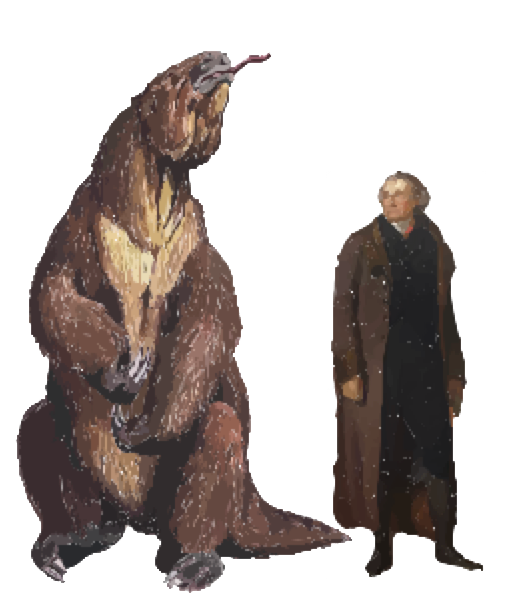
#195 – Thomas Jefferson: Monster Hunter
🇫🇷 The Insult That Started It All: Buffon’s Theory of American Degeneracy
To understand Jefferson the monster hunter, Justin explains, you have to start with Georges-Louis Leclerc, Comte de Buffon — the celebrity scientist of 18th-century France. Born in 1707, Buffon rose from naval engineering (via an interest in ships → trees → botany) to become curator of the Royal Botanical Gardens for King Louis XV. His magnum opus, the 36-volume Histoire Naturelle, Générale et Particulière, sold out in its first six weeks and was translated into multiple languages — the Cosmos of its day.
Among its more provocative claims was Buffon’s theory of American degeneracy: the Americas were, in his telling, one vast cold, wet swamp producing only sad, inferior animals and people. Colonists raised in such an environment would themselves degenerate. Buffon never visited the Americas, a detail Jefferson found telling. Historian Philipe Roger has documented that Buffon’s theories gave a significant faction of French intellectuals reason to oppose intervention in the Revolutionary War — why expend blood and treasure on a swamp full of weaklings?
Hamilton and Madison wrote counter-statements; Benjamin Franklin made wisecracks about the stature of American men while serving as ambassador in Paris. But Jefferson, Justin argues, was the founding father who grasped the full scientific and geopolitical scale of the problem — and decided to fight Buffon on his own terms, in the arena of natural history.
🦴 The Incognitum: America’s First Cryptid
Jefferson’s monster hunt began while researching his book Notes on the State of Virginia (published 1785). He learned that in 1739 a French explorer traveling down the Ohio River had discovered a salt lick in what is now Kentucky — Big Bone Lick — where enormous bones eroded out of the ground. When Jefferson consulted Ezra Stiles, president of Yale University, he was told the bones were the remains of biblical giants. Jefferson was, in Justin’s words, “gobsmacked.”
Jefferson dispatched Daniel Boone and later General George Rogers Clark to collect specimens. Clark succeeded, and Jefferson examined the bones himself — measuring, comparing, and concluding that the tusks and unusual grinding molars belonged to a single unknown animal. Buffon had argued the tusks were from an elephant and the molars from a hippopotamus. Jefferson’s rebuttal in Notes on the State of Virginia was characteristically dry: he pointed out that elephants and hippoterms apparently had an arrangement whereby the elephant deposited its skeleton but never its teeth, and the hippopotamus its teeth but never its skeleton.
Scottish anatomist William Hunter, personal physician to Queen Charlotte, was also studying the bones and gave the creature a temporary designation: the incognitum — literally, the unknown animal. Hunter concluded it must be carnivorous (grinding teeth, he reasoned, were for crushing bones). Jefferson enthusiastically agreed: here at last was the monstrous American predator he needed. In Notes on the State of Virginia he listed the incognitum among the extant fauna of North America — because Jefferson did not believe the creature was extinct. He believed it was out there somewhere, waiting to be found.
⚙️ Deism, Extinction, and the Watchmaker Argument
Jefferson’s refusal to accept extinction was not mere wishful thinking — it was theologically coherent for a deist. Deism held that God set the universe in motion but did not intervene further; for Jefferson, creation was a finely tuned machine in which every species was a necessary cog. Remove one cog and the whole mechanism fails. Extinction was therefore impossible — a position that, Justin notes, was also congenial to orthodox Christians, who could not accept that a benevolent God would allow any part of His creation to be permanently erased.
Buffon, meanwhile, had his own religiously awkward ideas: his Histoire Naturelle proposed a secular origin for the Earth — chunks of burning metal flung off from the sun that gradually cooled into planets. He even tested this experimentally, heating iron balls to white heat and timing their cooling rate, then extrapolating the Earth’s age to something far greater than 6,000 years. It got him into trouble with French ecclesiastical authorities. Jefferson and Buffon were thus both operating on the theological fringes of their era — and neither was willing to follow the logic of fossils all the way to extinction.
🦷 A Short History of Not Knowing What Fossils Are
Justin recommends 📚 The Meaning of Fossils 💵 by Martin Rudwick for the full story, but sketches the key moments here. In Jefferson’s time, the bones he was examining were simply understood as bones — the science of fossilization was barely established. The conceptual groundwork had only recently been laid:
– In 1613 a pamphlet (published anonymously) was the first to argue that large bones found in southeast France resembled elephant bones, not giant human remains — kicking off what historian Claudine Cohen calls a “six-year intellectual war” over the existence of giants.
– In 1616 Italian lawyer Fabio Colonna published a painstaking investigation of Glossopetra (“tongue stones” — fossilized shark teeth long thought to fall from the sky or to have medicinal anti-poison properties) and concluded — with some exasperation — that they were obviously teeth.
– In 1666 Danish scientist Nicolas Steno dissected a great white shark, confirmed Colonna’s identification, and spent much of the rest of his career trying to understand how organic remains turned to stone.
By Jefferson’s day the nature of fossilization was still not fully understood, and fossilization emphatically did not imply extinction in most scientific minds.
🦁 Megalonyx, Giant Moose, and the Diplomatic Offensive
Jefferson’s monster-hunting career had several fronts simultaneously:
– The Megalonyx. In 1796, while serving as president of the American Philosophical Society, Jefferson received a crate of bones from Greenbrier, West Virginia. He concluded they were the remains of a giant lion — naming the creature Megalonyx (“giant claw”) — and presented a paper to the Society. He published it in 1799, but appended a note acknowledging that Georges Cuvier — father of comparative anatomy and of paleontology — had identified similar bones from Argentina as belonging to a giant sloth, Megatherium. Cuvier would also eventually identify the incognitum bones as those of an unknown extinct proboscidean, which he named the mastodon. Both of Jefferson’s monsters were thus disproven within his lifetime — though he continued to believe living populations might persist in the unexplored interior.
– The Giant Moose. While serving as ambassador to France, Jefferson tried to arrange a dinner with Buffon and bring the most impressive possible American specimen. He wrote furiously to contacts back home begging them to secure a moose standing twelve feet at the shoulder. What arrived — in 1788, a year after it was shot — was a seven-foot specimen, badly taxidermied, possibly already decomposing. Jefferson sent it to Buffon with a note apologizing for its modest size. Whether Buffon ever saw it is disputed; he died six months later, having never publicly recanted his degeneracy theory. Jefferson had earlier given Buffon a cougar skin purchased from a haberdasher hours before departing for France, and reportedly that impression was more favorable.
– Native American Legend. Jefferson also compiled Indigenous accounts he believed referred to the incognitum — particularly a Delaware legend about the “Big Buffalo,” a monstrous creature that ravaged the land until slain by a supreme deity, with a single survivor fleeing into the American interior. Jefferson cherry-picked the parts that suited his argument (abundant giant creatures) while setting aside the supernatural elements (divine mass slaughter). Justin notes this is a methodology still common in contemporary cryptozoology: unexplored territory plus Indigenous legend equals plausible evidence.
🚀 Lewis and Clark: The Cryptozoological Mission
After the Louisiana Purchase in 1803, Jefferson dispatched the Lewis and Clark Expedition with explicit instructions to search the American interior for living mastodons and Megatherium. Finding prehistoric megafauna was, Justin notes, one of Jefferson’s top-five directives for the expedition. They found none — though their journals do record what we now recognize as mosasaur vertebrae eroding out of the ground in the West, which the explorers logged as the backbones of giant fish. A satirical poem of the era (quoted at the episode’s opening) mocked Captain Lewis specifically for his failure to produce a mammoth — suggesting that Jefferson’s cryptozoological priorities were public knowledge and a source of political embarrassment.
Indeed, as Jefferson prepared to leave office in 1809, the opposing Federalists circulated a political poem — the 19th-century attack ad — urging him to retire to his true calling: digging around in swamps for giant frogs and big bones, rather than running a government. The room Jefferson kept in the White House, filled with taxidermied animals and fossil bones, had not gone unnoticed.
The episode also touches on Jefferson’s Embargo Act of 1807 and its possible — if speculative — connection to the famous Gloucester sea serpent sightings that erupted shortly after Jefferson’s death. Cartoons in Gloucester newspapers during the embargo depicted sea monsters as preferable to Jefferson’s trade policy; scholar W. Scott Poole has noted the rhetorical connection without claiming causation. Justin is less certain the priming effect can be dismissed. Marine biologist R. L. France has separately argued that many of the Gloucester sightings may reflect animals — turtles, whales — entangled in fishing nets, a reading Justin connects to Jefferson-era blindness to human-caused extinction: the Steller’s sea cow, the dodo, and others were disappearing in real time while Jefferson insisted extinction was philosophically impossible.
Buffon’s degeneracy theory was ultimately demolished not by Jefferson’s monster hunting but by the meticulous field work of Alexander von Humboldt, a friend of Jefferson’s who spent a week with him in Washington in 1804 and whose comprehensive documentation of American flora and fauna made the strongest empirical case. Jefferson’s cryptozoological detour, for all its energy, arguably distracted him from the real animals — grizzly bears, cougars, bison — that could have made his argument far more efficiently.
📚 Further Reading
– 📚 The Meaning of Fossils 💵 by Martin Rudwick
– 📚 Mr. Jefferson and the Giant Moose 💵 by Lee Alan Dugatkin
– 📚 Notes on the State of Virginia 💵 by Thomas Jefferson
– 📚 Big Bone Lick: The Cradle of American Paleontology 💵 by Stanley Hedeen
– 📚 American Monster: How the Nation’s First Prehistoric Creature Became a Symbol of National Identity 💵 by Paul Semonin
– 📚 Monsters of Massachusetts 💵 by Loren Coleman
–
Note: ads inserted into the distributed audio alter the timestamps in unpredictable ways, so timing references in these notes are approximate.
If you thought Abraham Lincoln, Vampire Hunter was fun – wait till you hear the shocking true story of Thomas Jefferson, Monster Hunter! We’re joined by Justin Mullis who presented his paper on Jefferson’s work in Cryptozoology at the Of Gods and Monsters conference at Texas State in San Marcos, in April 2019.
Links of interest:
Martin Rudwick – The Meaning of Fossils
Glossopetrae – an outdated theory about fossilized shark teeth
Lee Alan Dugatkin’s Mr. Jefferson and the Giant Moose
Georges-Louis Leclerc, Comte de Buffon – “the father of all thought in natural history in the second half of the 18th century “
The full poem about Lewis & Clark’s pursuit of Mammoth is on Page 11 of this digitized document.
Some additional reading suggested by listeners:
Big Bone Lick: The Cradle of American Paleontology
American Monster: How the Nation’s First Prehistoric Creature Became a Symbol of National Identity