#194 – The Mapinguari is Not the Territory
This episode also marks MonsterTalk’s transition away from its decade-long partnership with Skeptic Magazine and the Skeptics Society, as the show relaunches as an independent, for-profit podcast under Monster House LLC. Details on the new Patreon tiers and what comes next are covered after the interview segment.
🦥 Mapinguari: Bigfoot, Ground Sloth, or Pure Folklore?
Blake opens with a brisk inventory of Mapinguari traits: massive size (up to two meters), thick hair, a foul odor — and then the details that don’t map onto any living animal. It’s reportedly a cyclops. It has backwards-facing feet. It has a second mouth on its belly.
The backwards-feet motif turns out to be a recurring global folkloric device. Blake notes it also appears in the Curupira of Brazilian legend, the Charel and Bahut of Indian folklore, and La Ciguapa of the Dominican Republic — creatures that share no geographic or cultural ancestry but share the same practical narrative logic: reversed footprints confound anyone trying to track you down. The presence of this trait in the Mapinguari legend is, Blake argues, a strong signal that we’re dealing with mythology, not zoology.
The show Finding Bigfoot famously went to South America and treated the Mapinguari as essentially an Amazonian Sasquatch — an approach Blake characterizes as a euhemerist fallacy: stripping away every implausible folkloric element until what’s left conveniently resembles the creature you already believe in.
The competing hypothesis, championed since the 1990s by ornithologist Dr. David C. Oren of Harvard, is that the Mapinguari represents a living relict giant ground sloth. A clip from the TV show Sightings captures Oren’s fieldwork and his conviction — based on witness descriptions of an enormous, slow-moving, foul-smelling, clawed creature — that something very real is out there. Dr. Fariña’s verdict: deeply unlikely, but he’d love to be wrong.
🦴 What Science Actually Knows About Giant Ground Sloths
Dr. Fariña walks through the basics of Xenarthra — the superorder that includes modern sloths, armadillos, and anteaters, and whose fossil members include the giant ground sloths and the armored glyptodonts. Key points from the conversation:
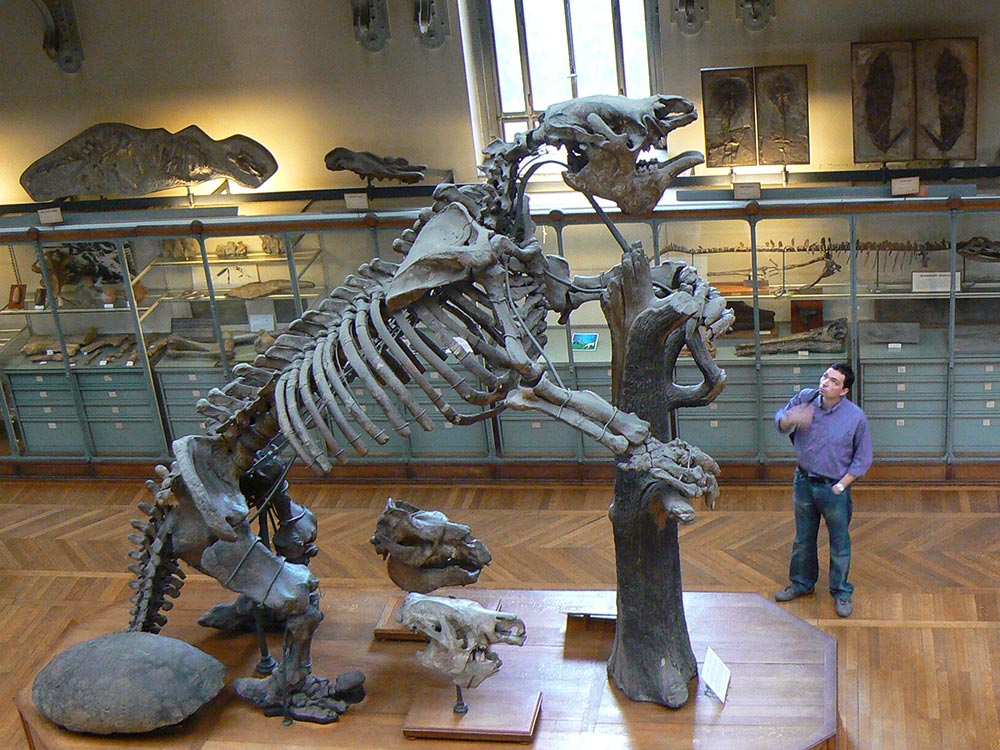
– Megatherium americanum, the largest known species, weighed up to four or five tons — roughly elephant-sized — and lived in open, prairie-like environments in what is now Argentina, Uruguay, and southern Brazil during the late Pleistocene.
– Trackways from the Buenos Aires province show hind footprints roughly 90 cm long and 45 cm wide, pressed 20 cm deep. A separate North American trackway appears to show a human actively pursuing a sloth — a remarkable narrative preserved in stone.
– The animals were likely capable of bipedal locomotion — more gorilla than tortoise — and their heavily muscled forearms suggest they were far less “slothful” than their modern relatives.
– Two living sloth genera, Bradypus and Choloepus, are distantly related to each other and to the giant fossil forms; the convergent evolution of their shared upside-down, slow-moving lifestyle appears to represent the only viable niche left for a sloth after the Pleistocene extinctions.
– The Mylodon — a smaller, cave-dwelling ground sloth from southern Chile — is known from mummified remains (hide, dung, and all), preserved by the cold of Patagonian caves. In the late 19th century it was briefly considered possibly still living and was even assigned a new species name before that hope faded.
– The Shasta ground sloth of North America similarly left desiccated remains in dry cave environments.
🥩 Was Megatherium a Predator?
The most provocative section of the interview concerns Dr. Fariña’s hypothesis that Megatherium may not have been a strict herbivore. His reasoning:
– Thermodynamic modeling of the late Pleistocene ecosystem in the Río de la Plata region suggests there was far too much large-animal biomass for the available grass to support — but too few apex predators to account for it either.
– Megatherium‘s claws were laterally flattened like daggers (around 20 cm long) and its forearm anatomy featured a short olecranon process — a configuration favoring fast, sweeping movement over brute digging force.
– Its largest known predator, Smilodon, was roughly one-tenth its mass — not a plausible threat to a four-ton animal, which makes a purely defensive explanation for those anatomical features less convincing.
– The proposed victims: glyptodonts, whose armored shells Megatherium may have been able to flip and breach. Glyptodonts had brains the size of a large dog’s relative to a body weighing up to two tons — not enough cognitive horsepower, Dr. Fariña notes with some relish, to be effective hunters themselves. They did, however, wield tail clubs capable of delivering roughly 3,000 joules of impact force — equivalent to a 30-kg object dropped from 10 meters.
Dr. Fariña is candid that there is no smoking gun for this hypothesis and probably never will be — and that this is simply how science works. Hypotheses are, as he puts it, “little candles: you light them and they eventually disappear, but they orient you on your way.”
⚰️ Extinction and the Arroyo del Vizcaíno Site
The end-Pleistocene megafauna extinctions wiped out giant ground sloths, glyptodonts, gomphotheres (elephant-like proboscideans), and dozens of other large species across the Americas, Australia, and beyond. Dr. Fariña notes that the surviving megafauna — African elephants, rhinos, hippos — are found almost exclusively in regions where large animals co-evolved with hominins over millions of years and had time to develop wariness of human hunters.
Direct evidence of human predation on South American megafauna has historically been elusive, but Dr. Fariña’s team found it at Arroyo del Vizcaíno, a site near Sauce, Uruguay. The site came to light during a severe drought in 1997, when thousands of giant bones were exposed on a dried lakebed. By the time of this recording, 1,700 bones had been recovered — with thousands more still buried — and 60–70 of those show cut marks consistent with human tool use. The dating places the site at approximately 30,000 years ago, roughly double the conventional estimate for human arrival in the Americas (around 15,000 years ago), making it a genuinely controversial and significant find.
🥑 Sloths, Avocados, and the Ghosts of Dispersal Past
In a charming postscript prompted by a question from Blake’s daughter Sophia, Dr. Fariña discusses the concept of “evolutionary anachronism” — the idea that some large-seeded fruits like avocados evolved to be dispersed by megafauna (including giant ground sloths, glyptodonts, and gomphotheres) that have since gone extinct. Without their original dispersers, these plants are effectively ecological orphans, now dependent on humans.
One researcher, Dr. Fariña notes with obvious appreciation, went so far as to personally consume and pass the relevant seeds to test whether gut passage improved germination rates. It did. Blake describes this as “an uncomfortable way to test a hypothesis” while admiring the scientist’s dedication — and declines to make the obvious academic puns, mostly.
📚 Further Reading
– 📚 Megafauna: Giant Beasts of Pleistocene South America 💵 by Richard A. Fariña, Sergio F. Vizcaíno, and Gerry De Iuliis
🔗 Related Links
– Mapinguari — Wikipedia
– Megatherium — Wikipedia
– Ground sloth — Wikipedia
– Glyptodont — Wikipedia
– Gomphothere — Wikipedia
– Mylodon — Wikipedia
– Shasta Ground Sloth — Wikipedia
– Curupira — Wikipedia
– La Ciguapa — Wikipedia
– Euhemerism — Wikipedia
– Evolutionary Anachronism (fruit dispersal) — Wikipedia
– Arroyo del Vizcaíno site paper — Proceedings of the Royal Society B
– Arroyo del Vizcaíno project website (English/Spanish) — Dr. Fariña’s team
Note: ads inserted into the distributed audio alter the timestamps in unpredictable ways, so timing references in these notes are approximate.
THE MAPINGUARI IS NOT THE TERRITORY
Editor’s Note: We’ve officially hit a decade of MonsterTalk. Our first episode aired in July of 2009. With this episode, we’re announcing the end our decade-long partnership with Skeptic Magazine and the Skeptics Society. This was a difficult decision, but we are proud of the work we did together and are very happy with the support that Skeptic has given us during our relationship. Details about the future of MonsterTalk are provided after the interview segment in this show. Thanks again to all the people at Skeptic for their support in the growth of our audience, and our continued shared mission of promoting critical thinking and scientific skepticism.
In this episode we get “old school” and talk about the legendary Mapinguari, and how cryptozoologists have tried to explain the folklore of this massive South American animal by claiming it to be a kind of Bigfoot creature, or even a Giant Ground Sloth. We take a deep dive into what Paleontology can tell us about the real historical records of Giant Ground Sloths (Megatherium) and see how well these creatures line up with the legend of the Mapinguari. Our guest is Uruguayan paleontologist Dr. Richard A. Fariña.
Listen to MonsterTalk via iTunes, Spotify, Google Play Music, TuneIn, and Stitcher. Get the MonsterTalk Podcast App for iOS, Android, and Windows.
Links
- Dr. Fariña’s Giant Sloth website (English / Spanish)
- Paper describing the site of the Arroyo del Vizcaíno site near Sauce, Uruguay
- The Shasta Giant Sloth site
- David C. Oren’s theory of Sloths as possible explanation of Mapinguari has been covered in The New York Times and Discovery Magazine.
- Apparently, Behemoth from Godzilla: King of the Monsters 2019 is a Mapinguari! Who knew?
We also discussed a few megafauna in this episode. Here’s our Who’s Who for those names:
- Gomphothere — similar to an elephant or mammoth
- Glyptodon — similar to an enormous armadillo
- Megatherium — a giant ground sloth that is the main paleontological subject of the episode
- And don’t forget the question of Sloths and Avocados! The paper for that research is here.
Music
- Monstertalk Theme: Monster by Peach Stealing Monkeys