Regular Episode
#015 – Historical Ghost Investigations Part 1: Kimo/Therapy
🏚️ Waverly Hills Sanatorium: Death Counts and Dubious Histories
Waverly Hills Sanatorium operated for nearly 50 years, first as a tuberculosis facility and later as a geriatric hospital known as Woodhaven. The central claim floating around ghost tours and television programs like Ghost Hunters (TAPS) is that 63,000 people died there — with a tour “historian” asserting that between one and three patients perished every single hour. Karen tracked down a more credible estimate: a doctor’s autobiography cited by an independent historical researcher puts the figure closer to 7,500 deaths over the facility’s operational lifetime, with a peak of roughly 152 deaths in a single year (elevated by returning World War II veterans carrying disease).
A fire destroyed many of the institution’s official records, which conveniently leaves the inflated figure difficult to definitively disprove — a circumstance the ghost-tour industry has not been reluctant to exploit. Other claims Karen examined include tales of a “body chute” used to shuttle hundreds of corpses (it was actually a general-purpose laundry and supply tunnel), a room doubling as both slaughterhouse and autopsy suite, rampant electroconvulsive therapy on elderly patients, and the ghost of “Little Timmy,” said to roll red inflatable balls across the floors. The most elaborate legend concerns the Nurse of Room 502 — an unmarried woman who allegedly aborted herself and then hanged herself in shame, her dates of death fluctuating between 1926, 1930, and 1935 depending on who’s telling the story. The vagueness and narrative convenience are, as Ben observes, textbook hallmarks of an urban legend — echoing archetypes like La Llorona and the blood-soaked wailing woman of gothic tradition. Hard evidence amounted to some EVPs that sound like background chatter from concurrent tour groups, a handful of orb photographs, and a couple of snapshots of a ball that may have moved.
🎭 The Kimo Theater Ghost: Little Bobby and the Donut Shrine
The Kimo Theatre is a 1927 Pueblo Deco-style landmark in downtown Albuquerque that, according to local legend, is haunted by a six-year-old boy named Bobby Darnell. Bobby’s death is real and documented: on August 2, 1951, a water boiler exploded in the theater lobby while Bobby and friends were waiting to see an Abbott and Costello film. Bobby died en route to the hospital — not, as ghost hunters later claimed, on the theater stairs where they photographed a telltale orb.
The ghost legend centers on a single pivotal event: a production of A Christmas Carol during which the director, one Andrew Shea, reportedly removed the donuts left as a peace offering at Bobby’s backstage shrine. According to Dennis Potter, the theater’s long-serving technical director, Bobby’s wrathful spirit then proceeded to ruin the entire performance — actors forgot lines, scenery flew through the air, lights exploded. Ben’s investigation, published in the Skeptical Inquirer (May–June 2009), dismantled this account methodically.
🔍 Tracking the Story to Its Source
The most commonly cited version of the Christmas Carol disaster placed it in 1974 — which Ben quickly ruled out: the Kimo was operating as an adult cinema that year, screening a film called Teenage Fantasies. Pushing the date into the mid-1980s, Ben tracked down multiple first-person witnesses, beginning with Potter himself (who remained adamant) and then the director Shea and actor Steve Schwartz, who played Bob Cratchit. Both Shea and Schwartz independently recalled a perfectly fine performance. Reviews in the Albuquerque Journal and Albuquerque Tribune confirmed it: the show went well. No reviewer mentioned a supernaturally catastrophic evening.
Ben’s conclusion was not that Potter was lying, but that he had likely confabulated — compressing small, unrelated incidents from across years of theater work into a single dramatic evening. The story then propagated through annual Halloween media cycles and local ghost-hunting groups (one of which Ben caught lifting text wholesale from a previously published book on the subject — “ghost writing,” as Blake put it).
🧠 Hyman’s Categorical Imperative and Investigation Methodology
Ben invokes Ray Hyman‘s categorical imperative — a principle articulated by the CSI psychologist and statistician — as the essential first step: before trying to explain a claimed phenomenon, establish that the phenomenon actually occurred. In the Kimo case, this saved considerable time. Rather than staging a recreation of the Christmas Carol production or conducting an overnight vigil, Ben simply asked the people who were there. There was nothing to explain because, as far as anyone else recalled, nothing unusual had happened.
The episode sketches a general methodology for historical ghost investigations that the hosts suggest is well within reach of any interested skeptic:
– Identifying what phenomena are actually being reported
– Locating case zero — the originating incident from which all other claims flow
– Finding and interviewing witnesses, or locating primary written testimony
– Checking whether independent accounts corroborate or contradict each other
– Seeking parallel evidence sources (newspaper archives, official records, published reviews)
– Looking for evidence that could falsify the entire claim outright
👻 Rose Hall and the Ghost Who Never Existed
Ben briefly previews a third case — the White Witch of Rose Hall in Montego Bay, Jamaica — as a particularly clean example of falsifying evidence: the central figure, Annie Palmer, turns out to be a fictional character from a novel by H.G. de Lisser, The White Witch of Rose Hall. The psychics and ghost hunters who claim to channel her are, in effect, communing with a bodice-ripper’s invention. Full treatment of this case appears as chapter 13 in Ben’s forthcoming book.
Part two of this series will cover Blake’s investigation of the ghosts of the S.S. Watertown and go deeper into the methodology of scientific paranormal investigation.
📚 Further Reading
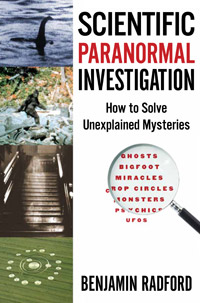
– 📚 Scientific Paranormal Investigation: How to Solve Unexplained Mysteries 💵 by Benjamin Radford
– 📚 The White Witch of Rosehall 💵 by H.G. de Lisser
🔗 Related Links
– Waverly Hills Sanatorium (Wikipedia)
– KiMo Theatre, Albuquerque (Wikipedia)
– Ray Hyman — psychologist, statistician, CSI Fellow
– Electronic Voice Phenomenon (EVP)
– Confabulation — the psychology of false memory construction
– Tuberculosis — historical treatments and sanatorium care
– Urban legend — narrative structure and propagation
– Rose Hall Great House, Jamaica
Note: ads inserted into the distributed audio alter the timestamps in unpredictable ways, so timing references in these notes are approximate.
Ghost investigations often feature in television shows and other media. Typically, these amount to people wandering around at night with EMF detectors, talking into the darkness and jumping at shadows and noises.
But how does one do a scientific paranormal investigation? On this first half of a two-part MonsterTalk, the hosts review two past ghost investigations (Ben Radford’s “Kimo Theater Ghost” and Dr. Karen Stollznow’s “Waverly Hills Sanatorium” investigations) and discuss some of the techniques that can help solve such cases. What steps are common to this type of research? Learn more this week on MonsterTalk.
In this episode
- Picking what case to investigate
- Finding case-zero
- What phenomena is being reported
- How many witnesses
- Identifying and contacting witnesses, or getting primary research
- Corroborative evidence
- Evidence which falsifies
- Research, research, research
Music
- Monstertalk Theme: Monster
by Peach Stealing Monkeys - Intro Music: Vampire Organ
by Jeff Rosiana
Episode Transcript
Read a complete transcript of this episode
Blake Smith
0