Regular Episode
#009 – I’M GONNA GET YOU, GOAT SUCKER!
🐐 What Is the Chupacabra, Exactly?
The name — Spanish for “goat sucker” — is itself revealing. Ben notes there’s a minor but surprisingly passionate debate over the correct form: chupacabra or chupacabras. A Puerto Rican comedian has even claimed credit for coining the word, though that claim is disputed.
The creature has no meaningful precedent in pre-1995 folklore. Unlike Bigfoot or the Loch Ness Monster, which boosters can retroactively attach to indigenous legends, the chupacabra simply appeared more or less out of nowhere in 1995 in Canóvanas, just outside San Juan, Puerto Rico. The closest precursor Ben could find was the “Vampire of Moca,” a cluster of dead animals reported in the town of Moca in the late 1970s — and then nothing for roughly twenty years.
Popular origin theories run the gamut: top-secret U.S. government genetic experiments (carrying a strong undercurrent of anti-American sentiment), escaped extraterrestrial pets left behind by alien visitors, and, for some evangelical Christians, a literal fulfillment of end-times prophecy. As Ben puts it, the chupacabra gets “corralled into people’s personal agendas.”
👁️ Case Zero: Madelyne Tolentino
The single most important sighting in chupacabra history belongs to Madelyne Tolentino, who claimed she watched the creature for ten to fifteen minutes outside her mother’s house in Puerto Rico. Her account — described at exhaustive length in Scott Corrales‘ book 📚 Chupacabras and Other Mysteries 💵 — provided the canonical description: four to five feet tall, long limbs, red wrap-around eyes, pronounced dorsal spines, and, notably, no visible genitalia. Investigator Jorge Martín produced a sketch from her account that went worldwide and became the default image whenever anyone searches for the creature today.
The UFO investigators who collected her testimony apparently never interviewed the other witnesses she mentioned — including a teenager who allegedly grabbed the creature, forced its mouth open, inspected its teeth, and then let it hop away. Ben’s tone on this point speaks for itself. He also teases that he found “a really remarkable piece of evidence” about that original sighting that he was saving for the book.
🐕 The Creature That Came in Two Forms
One of the central puzzles Ben addresses is the bizarre morphological split in chupacabra reports. The original Puerto Rican creature is bipedal, alien-looking, and sometimes winged. Every physical carcass ever recovered and tested has turned out to be a canid — dogs, coyotes, foxes — typically suffering from severe mange. The two forms look nothing alike.
Ben’s explanation is sociological as much as zoological: “chupacabra” has become a placeholder word for “unexplained animal death,” particularly in Spanish-speaking communities. Whatever dead or disfigured creature a farmer finds, if the explanation isn’t obvious and the observer has a cultural framework that includes the chupacabra, that label gets applied. He even encountered a Jenny Haniver — a dried, carved skate fish, a classic carnival gaffe — being presented as a chupacabra specimen.
Key carcass cases discussed:
– Nicaragua, August 2000: Farmer Jorge Talavera shot at creatures he believed were attacking his livestock near Managua, and later recovered a skeleton. A local university identified it as a common dog. Talavera responded that the bones had been switched in a conspiracy.
– Cuero, Texas, 2007: Phyllis Canion found a roadkilled animal and froze the head. DNA testing came back as coyote. She disputed the result and has since embraced the notoriety wholeheartedly — selling chupacabra T-shirts and beer cozies out of what Ben describes with bemused admiration as pure American entrepreneurial spirit.
– Turner, Maine: Another alleged carcass with a distinctive bluish tinge, also identified as a domestic dog.
🩸 Do the Victims Actually Have No Blood?
The defining claim — that chupacabra victims are found completely exsanguinated — turns out to be surprisingly difficult to verify. Ben interviewed a forensic pathologist at a local university who walked him through post-mortem physiology: blood pressure drops rapidly after death, livor mortis sets in, and it is genuinely non-obvious to an untrained observer whether an animal carcass has been drained of blood or simply died and begun to decompose normally.
In practice, Ben found that most “exsanguinated” victims were declared bloodless by eyewitnesses who simply looked at a dead animal lying in a field and assumed the worst. He also highlights footage from a television program in which a narrator describes an animal “clearly drained of all blood” while the on-screen image shows blood plainly visible on the carcass — a contradiction apparently unnoticed by the producers.
Ben also connects this to the broader cattle mutilation phenomenon, noting that the same ambiguous carcass evidence has been attributed — depending on decade and geography — to extraterrestrials, satanic cults, or the chupacabra. Same evidence; different cultural template.
🌎 Fieldwork: Nicaragua and Vampire Bats
Ben and a companion traveled deep into Nicaragua along the San Juan River — no electricity, no running water, howler monkeys, jaguars, and tapirs — in search of chupacabra evidence. They found no chupacabras, but they did find two vampire bats roosting in their thatched hut, silently circling overhead in the dark for much of the expedition. Ben had previously encountered vampire bat predation on dogs and horses in Ecuador — a distinctive circular patch of worn fur with crosshatch scratch marks — and notes, perhaps reassuringly, that the bats are “actually not that dangerous” and “kind of cute.”
His broader observation from on-the-ground interviews: locals are far less frightened than outside coverage suggests. Where foreign journalists write about communities “terrorized” by the creature, Ben found people who shrugged and said, more or less, “yeah, people talk.” The exception is the United States, where the chupacabra has been enthusiastically merchandised.
🔬 Can the Mystery Be Solved?
Ben argues that the chupacabra’s relative novelty — existing only since 1995, anchored to a specific time, place, and cluster of original reports — makes it uniquely tractable compared to creatures like Bigfoot or lake monsters, which have been accumulating folklore for generations. He claims to have identified the key piece of evidence explaining why the creature appeared so suddenly in Puerto Rico in 1995, and expresses confidence that his book addresses every significant counter-argument believers could raise.
He is careful to add that solving the mystery won’t make the sightings stop. People will continue to find animals they think are bloodless, and the chupacabra label will continue to be applied. “It’s like the rubber duck syndrome in skepticism,” he says: explaining something doesn’t make it go away.
📚 Further Reading
– 📚 Chupacabra Road Trip: In Search of the Elusive Beast 💵 by Benjamin Radford
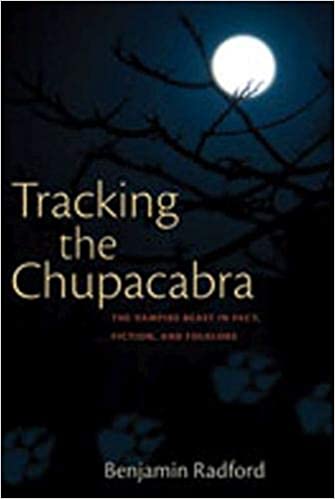
– 📚 Tracking the Chupacabra: The Vampire Beast in Fact, Fiction, and Folklore 💵 by Benjamin Radford
– 📚 Chupacabras and Other Mysteries 💵 by Scott Corrales
🔗 Related Links
– Chupacabra (Wikipedia)
– Cattle Mutilation (Wikipedia)
– Vampire Bat (Wikipedia)
– Jenny Haniver — the classic carnival gaffe animal
– Livor Mortis — post-mortem physiology relevant to “bloodless” carcass claims
– Mange — the condition behind most “Texas chupacabra” carcasses
– Centre for Fortean Zoology — John Downes‘ organization, which proposed mongoose predation as a partial explanation for early Puerto Rico cases
Note: ads inserted into the distributed audio alter the timestamps in unpredictable ways, so timing references in these notes are approximate.
Benjamin Radford shares his findings on completion of his manuscript for his Chupacabra book. An article about his findings will be in the next issue of Fortean Times. Topics include:
- What is a Chupacabra according to lore?
- What is the history of the creature?
- How does it tie in with livestock mutilations?
- Why does it appear to have two different body types (alien / canid)?
- Does it really leave bloodless corpses?
- Does it appear in other countries or cultures?
- Will Ben’s book be able to definitively solve the mystery of the Chupacabra?
Music
- Chupacabra by The Fn A Holes
- MonsterTalk theme by Peach Stealing Monkeys
Blake Smith
0