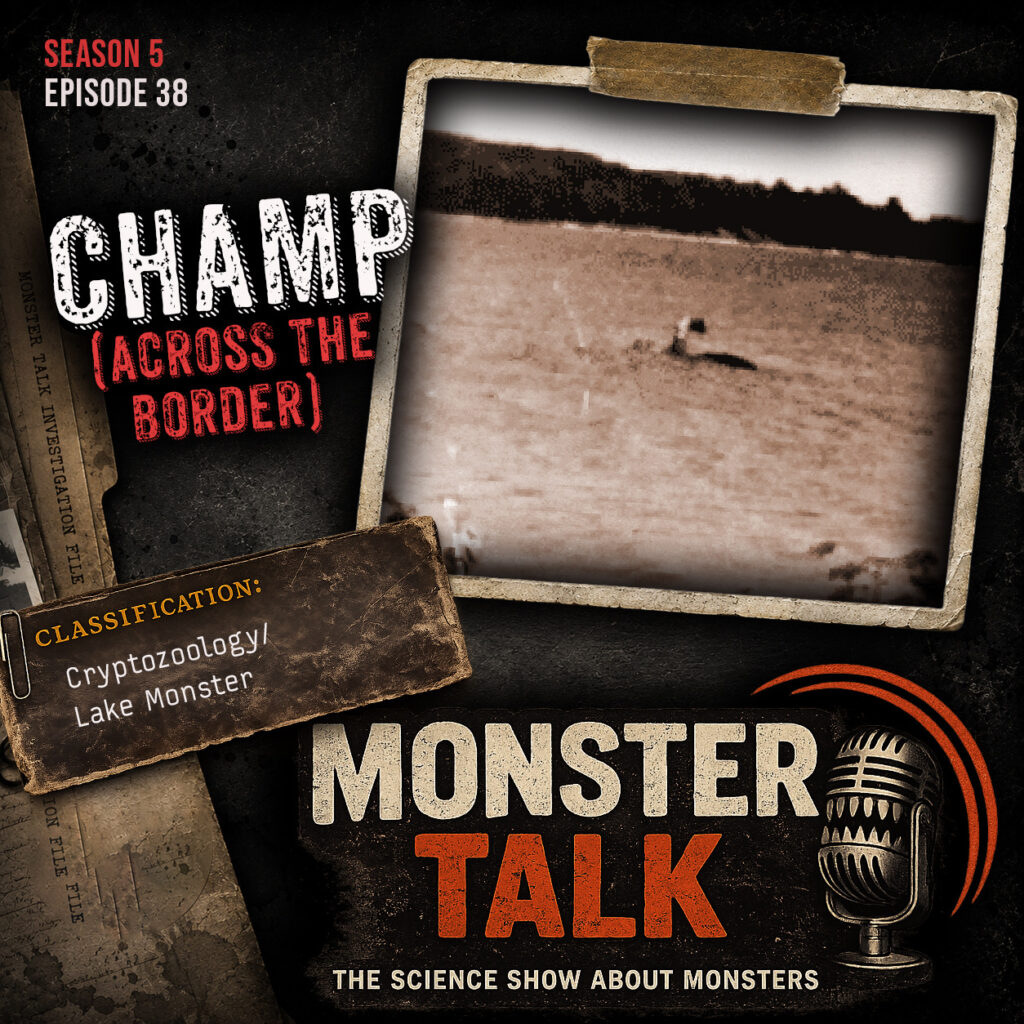
🦕 S05E38 – Champ Across the Border
Blake and Karen welcome back historian Dr. Joseph Gagné, a specialist in New France and the French colonial period of North America, to talk about Champ – the famous monster of Lake Champlain. Most of the lake sits between New York and Vermont, but about 7% of it lies in Quebec, and Joseph’s upcoming paper in the ethnology journal Rabaska asks a question almost nobody else has: how does the French-speaking side of the border see this most American of lake monsters?
The answer involves a fabricated Samuel de Champlain quote, a five-foot fish that really was a monster in its own way, nearly 300 years of digitized Quebec newspapers, and a curious case of cross-border monster pride – because why borrow Champ when you already have Ponik and Memphré? Plus hoax serpents, colonial werewolf panics, and how Nessie taught every lake monster what a lake monster is supposed to look like.
🔎 Episode Links
Champ – the alleged monster of Lake Champlain, which borders New York, Vermont, and Quebec
Samuel de Champlain – the French explorer who named the lake in 1609 and described a fish now generally identified as a longnose gar – though his Indigenous allies described far bigger specimens, more in line with the alligator gar
The famous 1977 Champ photograph was taken by Sandra Mansi
Mary Anning‘s discovery of the plesiosaur helped transform sea dragons into prehistoric survivors – a template later locked in by the Loch Ness Monster
Quebec’s own lake monsters: Ponik of Lake Pohénégamook and Memphré of Lake Memphremagog – plus British Columbia’s tourist-magnet Ogopogo
The Beast of Gévaudan – and its Quebec contemporary, a werewolf reported prowling between Quebec City and Kamouraska in the same era
Monster tourism along the lake: Port Henry, New York and its Champ festival, and the annual Sasquatch Calling Festival in Whitehall, New York
Joseph’s next project: Le Griffon – the first ship to sail west of Niagara Falls, and the first to sink on its maiden voyage in the Great Lakes
📚 Joseph’s Research Links
Joseph’s paper on Champ will be published in issue 24 of Rabaska: revue d’ethnologie de l’Amérique française. You can order a copy from the Société québécoise d’ethnologie, and issues are eventually posted for free on Érudit.
Want to do your own research? Bibliothèque et Archives nationales du Québec’s digital collections hold over 950 digitized periodicals spanning from 1764 to today – many in English!
Follow Joseph’s shenanigans at his site, Curieuse Nouvelle France.
🎧 Joseph’s Previous MonsterTalk Appearances
The Legend of La Corriveau (episode 181)
The Ghost of Ticonderoga (S04E17)
BOOKS discussed in this episode:
The Untold Story of Champ: A Social History of America’s Loch Ness Monster [Affiliate Link]
Lake Monster Mysteries: Investigating the World’s Most Elusive Creatures [Affiliate Link]
Champ: Beyond the Legend [Affiliate Link]
Lake Monster Traditions: A Cross-Cultural Analysis [Out of Print – Price WAY TOO high] – But you’re in luck! The Internet Archive has it! and please support them – they’re doing important things for researchers around the world.
🛒 Promotions
Joseph’s second book, Voix de guerre: Le renseignement au sein de l’armée française lors de la guerre de Sept Ans en Amérique du Nord, is coming this fall from Presses de l’Université Laval – with a co-edition in France!
Its final chapter covers rumors and superstition during the French and Indian War – very on brand for this show.
Karen’s book Beyond Words is available now. (affiliate link)
🎵 Credits
MonsterTalk theme by Peach Stealing Monkeys.
Support the show at monstertalk.org/support – Patreon supporters get extended, commercial-free episodes (including the extended version of this very interview).
SEO Transcript
This is not a fully accurate transcript, and was machine generated. It’s here for helping search engines find the episode but not intended to be a faithful transcript of the episode. (But it’s not AWFUL.) Some of the material in this transcript only exists in the Patreon/Premium edition of the show and was excised for the commercial version.
Monster House presents…
This is the ad-supported version of Monster Talk.
We’re dependent upon the revenue from these ads and from the support of our patrons at patreon.com forward slash monster talk to continue making this show.
As a disclaimer, your hosts are unable to control what ads you will hear, and while we have done what we can to avoid ads that are divisive, the system that injects them sometimes ignores our preferences and always seems to ignore our efforts to not interrupt the conversational flow.
While we understand this can be disruptive, we’re trying our best.
Patreon remains the best way to enjoy commercial-free listening to our content.
Plus, you generally get extended coverage of the subject.
We’re working on other ways to consume our content as well, so please stay tuned.
It’s actually quite unlike anything we’ve ever seen before.
A giant hairy creature, part ape, part man.
In Loch Ness, a 24-mile-long bottomless lake in the highlands of Scotland, it’s a creature known as the Loch Ness Monster.
Monster Talk.
Welcome to Monster Talk, the science show about monsters.
I’m Blake Smith.
And I’m Karen Stollznow.
When we first started Monster Talk, I was hoping to speak to fact-based academics and use monsters as a framework to talk about stuff like biology and physics.
And what about psychology?
Sure, witnesses are people, and surely that has a bearing on what and how they see things, right?
And
We ended up bringing religious studies folk in because what people believe and how they engage with belief through ritual and dogma and faith and pragmatism, that seemed relevant.
And, of course, archaeology.
And we’ve always had monsters for as long as we’ve had language and minds compelled to classify our experiences across a spectrum of normal to highly unusual.
And we enshrine our monsters as embodiments of our fierceness and as…
apotropaics against other monsters.
That’ll be written in stone.
So folklorists helped us understand the transmissibility and mutability of stories.
And we even started bringing in literature and art experts to speak on how we use fiction and creativity to model and to inspire.
These fields of study all hinted different perspectives and different approaches.
And every discipline and academic expertise has brought us a little bit closer to understanding what a monster is.
Historians bring a critical lens to the historiography of monsters, analyzing how primary sources and media and print culture construct, perpetuate, and transform these narratives over time.
Where other disciplines hunt for physical proof, historians investigate why these stories persisted and what they reveal about the specific societal and cultural anxieties of the people who recorded them.
A funny thing I noticed when thinking about this intro, though, the historians we’ve had on sure seem to like werewolves.
I guess our first was Brian Riegel, who argued that it wasn’t silver bullets that took out the werewolf, but rather Darwin’s theory of natural selection.
And historian Jay Smith taught us about the role of tabloid journalism on the metaphysical power to turn mundane but awful packs of wolves into the magical beasts of Gévaudan.
And today’s guest, Dr. Joseph Gagne, also loves werewolves, which is why we’ve brought him on again to talk about lake monsters.
Well, you may think I’m just subverting expectations, but in fact, there is some actual truth there because while not every monster is a werewolf, I am becoming more and more convinced that every monster is a shape changer.
As we transmit stories, both the sender and the receiver change the information and shape it within their own imagination.
And this is true for werewolves and Sasquatch and Thunderbirds and the actual subject of today’s discussion, lake monsters.
In a lake that lies nestled between Vermont, New York, and Quebec, it is said that there is a monster.
If you go look in monster books, you’ll read about French explorer Samuel de Champlain reporting seeing a 20-foot serpent thick as a barrel with a head like a horse.
Of course, that quote doesn’t come from 1609.
It comes from 1970.
It was in the summer 1970 issue of Vermont Life magazine and an article by Marjorie Porter titled The Champlain Monster.
In 1977, lake visitor Sandra Mancy would log her sighting with a famous monster photo.
Champ is many things.
The monster was like a serpent.
It was like a plesiosaur.
It had many humps.
It had one hump.
It was just a head.
It was just awake moving through the water.
You can check our show notes on this episode and learn more about the different ways this monster has been reported and depicted.
But our guest…
Dr. Gagné has an upcoming paper that’s looking back at the original report by Champlain and also examining a really interesting question.
Most of the sightings happen on the parts of the lake that are in the United States.
But how is Champ viewed on the other side of that border in the land of poutine, maple syrup, and Mounties?
Let’s find out.
Monster Talk
Welcome back to the show.
And correct me if I’m wrong, but isn’t this now Dr. Joseph Gagne?
Yes, it is.
Awesome.
Yes, it is.
Congratulations.
I’m still proud of that.
Thank you.
That’s so cool.
You should be proud.
And it also is, once again, something that overlaps with audience interest, I think.
Absolutely.
You’re talking about CHAMP.
And you’re bringing an interesting perspective here because usually we hear about CHAMP from the American side of the lakes.
And I think that’s actually an interesting part of the research you’ve done here.
So I don’t.
want to spoil it, but what we’re going to try to do is guide you through the sort of Reader’s Digest version of your essay.
And then for listeners, they can go to a URL that we’ll put in into the show notes and find the essay this fall.
So what are we talking about with Champ?
I guess we should just pretend that someone has never listened to this show and they’ve never heard of Champ.
What is Champ?
Where is Champ?
Why is Champ?
Champ is the name of the mysterious denizen of the underwater world of Lake Champlain, which happens to be, yes, mostly in the U.S., right between the borders of New York and Vermont.
But a 7% portion of it is in the French-speaking province of Quebec.
If you don’t get it from the Champlain region, then it’s merely sparkling lake water.
I was going to say sparkling lake monster.
That’s a good one.
That’s a good one.
And that’s what got me interested was the fact, well, I am a New France specialist.
And so this is the French colonial period of most of North America.
And Lake Champlain bears the name of the explorer, Samuel de Champlain.
I kept reading about this story that Champlain was the first to see Champ, the lake monster of Lake Champlain.
So the question is, is this true?
Yeah.
Now, I’m not the first to have thought, well, you just got to read the original document to find out.
And so many people have done so, namely Robert Bartholomew.
You have Joe Nickel and Ben Radford.
Also, Michel Meuget also read the original document.
How do you say that?
Because I always say Meuget or Meuget.
That’s what I thought.
And then I asked someone who was Belgian, and he’s like, oh, I don’t know.
I would have said Mergie.
I was like, oh, okay.
Well, I can put it like that.
I just presumed you have to pronounce it.
Yeah, yeah.
Because I didn’t know if I had to pronounce it the French way or like a German way, so I wasn’t sure.
No, no, that’s good.
That’s good to know.
So one more time.
Mergie.
Mergie.
Neat.
Yeah, Mergie.
Yeah.
Mergie.
And don’t knock the Belgians because, sure, they’re terrible colonialists, but they also gave us palm frits.
And for that, we’re thankful.
Also, if there are Belgians that want to correct me, please do so.
Sure.
Yeah.
Different across regions.
Then came the question, well, who is writing about Champ?
And when you look through the historiography, that is like the history of the history, basically they’re all American authors.
And so you always get an American view of the legend.
But my question was…
Or also the fact that, like, more than 90% of the lake is on your side.
Sure, whatever.
We’re number one is all I’m saying.
Yeah.
But, see, that’s why I kept wondering, though.
I thought, well, I mean, there is a tiny portion of the lake that’s on our side of the border, so surely we must talk about it.
Yeah.
Which is really, I joke a lot, but that’s a really solid insight, right?
So, yeah.
It is.
It certainly is.
And what I thought was curious was every time you hear about sightings, it’s always Americans.
And I started wondering, well, are there any sightings on the Quebec side?
And so…
When you do research, you want to find proper sources.
And in Quebec, we are very lucky because the National Archives of Quebec, and my bosses will insist that I do mention Bibliothèque et Archives Nationales du Québec.
On our website, we have digitized over 950 Quebec periodicals.
And if anyone is interested, not all in French, we do have a handful of titles that are in English as well.
And so I was able to keyword search through nearly 300 years worth of newspapers on our side of the border for Sea Serpent, Lake Champlain Monster, Champlain Dragon, or whatever I thought might have been used.
And I ended up with about 50 mentions of the monster throughout the years.
And…
My grand conclusion, funnily enough, is that clearly Quebec is paying attention to the monster.
But strangely, it’s always reporting what Americans say they saw.
Are we Quebec’s Florida man?
Is that what we are?
I think what’s interesting is that in the early 1980s, I believe he was an archaeologist, Joseph Zarzynski compiled a list of about 224 counts of sightings between…
1609 which is the day that champlain probably saw the monster if he did see it because that was the year he named the the lake after first exploring it uh and sightings all the way to 1984.
But what’s interesting is that he only had a single eyewitness from the Quebec side.
And he had literally written to French newspapers on the Canadian side asking, has anyone seen the Lake Champlain monster?
Because he realized that the weird thing, there is no French Canadian eyewitnesses to the monster.
And Robert Bartholomew…
barely found more.
He found about three people.
And so you see there’s really this disconnect between Americans seeing the monster and French Canadians seeing the monster.
Now, geographically, once again, it does make sense when you realize that most of Lake Champlain is on the American side.
Also, the cooler, deep waters are on the American side.
So, you know, it just kind of fits with the whole Loch Ness vibe with the mountains and so on.
Meanwhile, the average depth of the water on the Canadian side is about 14 feet.
So not quite impressive.
And so, oh, look, there’s a monster.
Oh, never mind, it’s a seaweed.
I can clearly see it within 14 feet of water.
But what I think happens is that there’s a kind of national pride going on because a theme that seems to be brought up every once in a while by journalists is this weird scoffing of…
We have our own critters like that.
And sure enough, Quebec does have many lake monsters.
The two most famous being Poinic, the lake monster from Lake Poinigamook.
And you also have Memphrey from the Lake Memphremangog.
And what’s interesting is that the…
When you read the papers, people seem really proud of these monsters going, these are ours and only ours.
And so there’s this weird national pride, even though part of Lake Champlain is on the Canadian side.
Apparently, Quebecers just decided, yep, nope, we’re better than that.
We have our own lake monsters.
What’s also very interesting, Ben and Joe, in their book on Lake Monsters, had described these two monsters basically as Champ Light.
Oh, you’re talking about Lake Monster Mysteries?
Yes.
They had basically said that they’re a diet version of Champ, and so there’s many parallels.
And sure enough, you see, just like…
you have a lot of tourism based around, uh, uh, champ on, on the, uh, especially on the New York side with, uh, Port Henry and crown point and so on, but also on the Vermont side, uh, these monsters on the Canadian side also have, uh, have a lot to do with, with tourism.
And in fact, I thought I found this really damning, uh, editorial from 1957, uh, with, uh, this was, uh,
with memfray where someone literally wrote hey you know it’s kind of cool how tourists like flock to see ogopogo in bc we should have our own monster wink wink and see what happens well i want to step in at this point and and ask you why this is the case i mean you’re addressing it
in in some ways but why did champ become popular in the united states but never really catch on in in quebec or in canada in general so i hear you’re talking about is it panic and uh memphrey uh but but why why didn’t champ really catch on there
I think it’s because there is a first claim.
Early on, you start having these festivals in Port Henry, for example, and they’re very lucrative.
And so what happens is if you’re thinking economically, and this is, of course, just a working hypothesis, but if you’re thinking economically, we don’t really want to compete.
so you want to have your own thing and maybe have a monster tourism.
So maybe someone after seeing that festival will say, uh, might not want to go to another champ theme festival, but might say, Oh, well let’s go check out this other monster.
That’s different.
Uh, so that could be an idea, but all in all, I think it’s, it’s also the fact that, uh,
In general, Champ seems to be a lot more present in the American media.
And so in Canada, it’s more like a secondary story where they’re always just reporting, oh, by the way, Americans are talking about this monster.
And so it’s not organically within the culture and it’s more in the print culture whenever they’re trying to fill blanks by inspiring themselves with American print.
I see.
Which is really something we’ve been honing back in on again and again around here.
And you’ve brought it up.
I really need to read Michel Merget.
I need to read his book because multiple people have talked to me about how important the concepts are there.
But one of the ideas he talks about is this idea that lake monsters are sort of paper tigers.
But he doesn’t mean it in the sort of…
way that that’s sort of colloquially used.
He’s talking about the role of media in growing and perpetuating monster concepts.
And I think I first hit on this with the Beast of Gévaudan, where… Jay Smith’s book.
Jay Smith came on and was talking about how that the broadsheet newspapers were really looking for content and they would publish any kind of crazy story if it perpetuated the idea there’s a monster ravaging…
The landscape.
Do you want an anecdote in parentheses here?
Sure, hop in.
Quebec does the same thing.
Well, that’s exactly what I was wondering.
Exactly the same period as the Beast of Gévaudan.
Oh, it’s the same time period, okay.
It’s the same time period, and literally they’re saying, hey, careful, there’s a werewolf that’s traveling between Quebec and Kamouraska further downriver.
And they say it’s just as dangerous as the one in Givaudan.
Wow.
And this is exactly the same period as there are no ships coming in or out because winter’s coming up and so on.
And so it’s a low point for news.
And so clearly that’s what’s going on.
Wow.
That is interesting.
I mean, obviously, in my heart, I feel like maybe the role of the media is underplayed because it is the mechanism by which we hear monster stories more often than not.
Very few, I mean, maybe this is more common back in the past to be sitting around at a party and someone tells you, here, what happened to so-and-so.
I mean, obviously, urban legends are called that for a reason.
But the media is definitely…
I don’t necessarily blame the one who used the word complicit, but I mean, it’s more than that because don’t forget today, you know, when you want to read your news or what, what do you do?
First thing is you go on the internet and sadly, social media is now becoming the number one source of news.
But back in the day, they were.
It was directly through newspapers.
It’s in the name, newspapers.
And so you could literally have manufacturing areas where you would literally have someone hired just to read the newspaper to the workers as they’re working.
So everyone is getting exactly the same news.
Yeah, interesting.
And so this is why newspapers are so central for spreading these rumors, these stories, and so on.
Yeah, I think of them as sort of nodes or like within a network.
You know, they’re a special kind of node because they’ll spread it to anyone who’ll read it or listen to it.
But yeah, so there’s an editorial component where whoever is putting out what deciding what’s in the paper.
And maybe that doesn’t exist as much or now it’s an algorithm instead.
But but the parallels are strong that that what makes the story I’m going to air quote go viral because I don’t really like.
the idea of virality but i don’t really have a better mech you know analog but it people refer to it yeah it is and uh thanks richard dawkins but anyway the the media has a huge role here i mean they’re they’re an important part uh maybe the only parallel i could think of is the person
who collects monster stories and puts them into books because those people also become nodes.
And I think maybe Jeb Card came up with this idea, but the idea that maybe a window area, maybe it was him, but a window area is not where monsters happen.
It’s where a person who cares enough to share the stories happens and they make a window area by collecting stories.
I kind of think of those as like the Wi-Fi amplifiers.
It’s just as the signal’s getting weaker and people are about to forget about a monster, someone comes along, creates a compendium of monster tales, and then throws it back into the wild.
Well, what about tourism then?
So we’re talking about social media.
What role does tourism play in keeping…
these lake monster legends alive today oh a lot uh case in point uh port uh port henry and you’ll have to forgive me i’m forgetting the the dates but i i do know they had i believe it was a smelting he who melts it smelts it that’s what they say
And so they were steel manufacturers.
And at some point, the industry died down locally.
And so they were a little desperate to boost up the local economy.
And they came up with the idea for this festival.
And at some point, when you read the 1980s newspapers, they’re complaining that they’re…
The festival is working so well, they don’t know where to put the people coming into town.
So you can see that it is a boon, a seasonal boon to help boost up the area.
And you see that all along the Lake Champlain corridor.
Oh, what’s that little town?
There’s a little town.
And it’s funny because…
I think this started just before the pandemic, and just as I was like, oh, I’ve got to do this, they have a Bigfoot calling contest every September.
Oh, you know what?
I think I’ve heard people hollering for Bigfoot.
Whitehall, but something like that.
I have a vague recollection of watching a video of people stepping up to a microphone and making their best Bigfoot call.
Whitehall is an epicenter of Bigfoot sightings.
in the Northeast.
We’re here for the calling contest and it should be a lot of fun.
you see that it is becoming something.
And in fact, on the Quebec side, like I said, I, I’m hypothesizing that they don’t want to compete with another monster.
They’d rather just create their own.
And in the case of, even I have a hard time pronouncing this, like the city chose the monster as their logo.
And it kind of looks like a literal water dragon.
It really has like a dragon head.
Yeah.
And so they encourage people.
And it’s really funny because their promotional material, when you look for ads for their town, the vibe is basically come for the monster, but stay for the summer sports and the food and the so on.
That is so interesting.
A couple of times you’ve mentioned sightings as dragons instead of necessarily like monsters.
Yeah, in colonial days, yes.
Yeah, so is there a kind of difference?
Do you get those dragon sightings today, or is that colonial only?
That is very colonial talk.
In fact, it’s funny, when you’re researching these topics, you see the evolution of terms.
For example…
I’ve never really seen dragon for champ, but the term sea serpent or just serpent tended to disappear after the 19th century, replaced by monster.
Interesting.
And during colonial times, what’s interesting is, again, the power of media.
Because, as I explain in the paper, to try to explain, well, is it plausible that Champlain thinks he saw a lake monster?
Does his French colonial culture allow for the existence of sea monsters?
And it’s yes and no, where cartography, even by 1609,
european cartography is starting to get rid of monsters on the on the maps we all know the here here be monsters trope uh yeah yeah yeah because cartographers want to be as accurate as possible and they’re now willing to just say you know what we have no idea what’s over here and they will literally spell it out no idea what’s here yeah
But even though the educated portion of society is now backing away from monsters, that doesn’t mean that the average person stopped believing in these.
And so every once in a while, you do have these glimpses of tales of sea monsters.
But again, the fact that they are rare in the written record…
is more indicative of fewer people knowing how to write in French colonial society than people not believing in them.
Because we do have indications.
Every once in a while, it’s like looking for, it’s like a whack-a-mole.
Every once in a while, you know that belief is there and it pops up once in a while.
But again, I got to remind the listeners that contrary to New England and all the other British colonies, New France was nowhere near as literate.
We’re talking about 10% of people in the countryside knowing how to at least sign their name and about 40% in the city.
And not only that, but when they did, it was in French.
And who understands that?
No idea what you’re talking about.
So the naming is kind of in line with people’s beliefs at the time, what’s plausible, whether it’s a dragon or a serpent or an undiscovered creature.
Is that what you want to say?
It’s relevant because what I wanted to say was we see…
dragons continuing to appear in American newspapers all through the last half of the 19th century.
It becomes like a big thing.
We talked about the tombstone episode where the tombstone epitaph flying lizard, but what happened in the early part of the 1800s that transformed sea monsters.
Mary Anning discovers the plesiosaur.
And suddenly the idea of sea dragons is not as interesting or popular as the idea of plesiosaurs and the idea that maybe these prehistoric, mesozoic marine reptiles, right?
I think this matters like a lot.
Absolutely.
Yeah.
And in fact, you’re seeing that also with sea serpents, just the term serpent.
What really caught me off guard was I was trying to illustrate at some point also, well, you know, do hoaxes exist?
They obviously do.
Do we have examples of hoaxes throughout Quebec’s history?
And there are plenty.
And one of my favorite ones was in the 1800s, there were four young gentlemen who claimed to have found a sea serpent.
And while all this speculation is going on in the newspaper, is it real?
Is it not?
I was surprised when one newspaper went as far as saying, oh, this serpent might actually be of a plesiosaur kind.
Nice.
I was really surprised.
I was like, whoa, this is way before Nessie.
Because…
Champ, as Robert Bartholomew had really masterfully demonstrated, Champ is like this amorphous creature where at some point it looks like a giant slug, at some point it’s an alligator, at some point it just keeps changing until…
there’s this comparison with Nessie and then it just kind of solidifies and stays in the shape of a plesiosaur.
And so it’s interesting seeing how Nessie really…
influenced all lake monsters, because all of a sudden, there’s this kind of consensus, okay, this is what a lake monster is supposed to look like.
But until then, I mean, people are constantly…
They’re constantly…
changing what the monster looks like according to the eyewitness, which also brings up the question, well, what did Champlain actually see?
Did he see something?
It does.
As we like to say in question number seven, what did he actually see?
What did he write?
What did he write?
Well, this is the fascinating part.
So just to, the story is kind of funny to begin with, because when he arrives in Quebec, he befriends passing Indigenous people, namely the Wendats that are traditionally lived in…
rather than Ontario, but they did regularly travel through the St. Lawrence.
And he also befriended the local Algonquins, including the Innu.
And…
as he was having arrangements with them going like, well, can I set up a little fur trading post in what is now Quebec City?
They said, oh, absolutely.
And in exchange, well, do you want to help us if ever we’re at war with an enemy?
And Sean Plain’s like, sure, hoping that will never happen.
Not realizing, no, no, they’re currently at war.
with the five Iroquois nations.
It’s not as hypothetical as he thought.
It’s not as hypothetical.
So you can imagine Sean playing a year later when his indigenous friends are like, hey, about that promise, you want to come with?
And he’s like, wait a minute.
And what’s hilarious is that he initially had a…
a lot of men that were supposed to follow him and they all chickened out except for two so you got three three Frenchmen along with about 60 indigenous people also on their side the only ones who didn’t chicken out going to Lake Champlain to confront a war party of Iroquois and Champlain was hoping that
his firearm would suffice to terrorize the enemy, which it did.
This is right before the Iroquois start trading with the…
Were we talking, like, rifles?
Or, like, he had a small cannon?
Because, I mean, that makes…
It’s crazy how much… How do you translate an arquebuse?
How do you pronounce that?
It’s a wheel lock.
Yeah, yeah, yeah.
Yeah, wheel lock.
There we go.
Yeah, so all the old school…
In high school, I was fascinated with all kinds of early guns and weapon books all the time.
Like I was a nerd.
It was so embarrassing.
That’s reassuring.
But that’s the thing, right?
Champlain was lucky because unlike you, the Iroquois did not know much about firearms yet.
Right, right.
Although this is just before the…
It’s like the one guy showing up with a laser pistol, right?
It matters.
It’s a big deal.
Exactly.
Right, yeah.
So years later, the Dutch will supply them with weapons.
For a fee.
But as Champlain is traveling, what’s fascinating when you read him, he is really interested in everything.
So he’s literally writing as he’s in enemy territory, he’s looking like, oh, look at the mountains.
These are the most beautiful trees I’ve ever seen.
And he starts talking about fish and so on.
And at some point, he talks about this creature that he sees.
Now, ever since the 1970s,
Most works on Champ will say, oh, he saw basically a plesiosaur, this horse-like head just craning over the water and then diving again.
But in reality…
What he actually described is a fish about five feet long, which when you look at his sketch and the way he described it is clearly a long-nosed gar.
Now, I’m not innovating by describing the fish.
Many people have already said it was a long-nosed gar.
What’s interesting, however, is that even ichthyologists…
that red Champlain were very dubious about Champlain’s indigenous allies telling him, oh yeah, we’ve seen some that were like 12 feet long.
Because they’re clearly talking about something way bigger than a long-nosed gar.
And since the only gar that gets that size is the alligator gar, which does not go further up north than, I think, the Illinois River.
well people just dismissed it as oh they don’t know what they’re talking about but as a french colonial historian i got to remind i got to remind people indigenous people as well as fur traders traveled really really far and so champlain’s indigenous allies are either talking about what they’ve heard from other
allies further out west or they themselves have traveled far enough and they probably did into the interior of the continent that they’ve seen them and so they might be conflagrating both species but to them they clearly recognize there’s bigger fish out there and so in a certain way uh even a five foot gar is a five foot long nose gar is still pretty impressive
I like to say, well, he did, in a way, see a monster.
I mean, I love fishing, and I would love catching one of those.
But, I mean, alligator gar, even today, I think alligator gar and catfish are both nodes for folklore.
I mean, like, I grew up in a small southern town, and we had legendary alligator gar in lakes and rivers that I don’t even think were there.
But there’s such a monstrous fish.
And they’re plausible because they’re real animals.
They still today, people like a giant catfish, a giant alligator gar, even now are in.
Let me also add that I maybe this is groundbreaking revelation, but fish people sometimes lie.
You know, one of my favorite, favorite fishing jokes is, yeah, my uncle used to brag about his six inch fishes.
And then the friend goes, six inches, that’s not big.
Oh, I forgot to mention, he measures between the eyes.
Nice.
That’s the kind of same phenomenon you see in the media, because what’s interesting is that around in the 1920s is the first time someone mentions a link between Champlain and the Lake Champlain monster.
Now, Robert Bartholomew had really identified the first store on the American side as being from the 1970s with, what was it, Vermont Life, I think.
And I forget the name of the author who had described basically Champlain seeing a plesiosaur type creature.
But in the 1920s, French Canadian newspapers were already talking about, oh, is the Lake Champlain monster a big fish?
And so the first…
mentions of the story are fairly accurate.
You know, they’re more paraphrasing what, what Champlain said, but every retelling, the fish gets bigger and scarier and with more teeth.
And so you see the mutation into a monster fish until finally it’s just a monster.
Absolutely.
Yeah.
And I think that’s, I mean, in the things that you shared with us and what we’ve seen of the pre-publication, it’s very compelling.
It’s not shocking, and it still happens today.
The human need to turn mundane, natural things.
They’re not mundane.
They’re interesting and outstanding, but they’re natural.
Into something more than that is very understandable.
It happens all the time right now, but you’ve done a great job of bringing that fact with the historicity of the materials that you’ve pulled together.
I know there’s a barrier here around the language, but I really would encourage people to…
when this is published to look it up and read it.
And we will certainly share that with our listeners when that goes live.
Yeah.
I think that there’s so much that has been written from the U.S. angle that it’s really important to have this Quebec perspective.
So I think it’s wonderful work that you’ve done.
And fun.
It’s cool.
I don’t know.
But I’m curious now, Joseph, what are you working on now?
Right now, I have two projects right now because I have my second book coming out also this fall.
And I’m super excited to say that not only will it be published in North America, I just found out it’s going to be a co-edition with France.
So I’m actually surprised, like, my God, I’m going to be published in France.
So again, a French book.
That book is on military intelligence during the French and Indian War on the French side.
There’s actually a whole chapter.
My last chapter is all about rumors and superstition where people are like, oh, we’ve seen the Virgin Mary in the sky.
Clearly we’ve won.
And so opposition between like what French officers believe and what indigenous people believe and then the clash of beliefs and so on.
So it’s very apropos with what we’re talking about today with like…
beliefs and and and media and so on uh and my second project is the same one as the last time i was on the show uh uh i’m i’m trying to finally finish uh a paper slash possibly short book on the search for the giddy phone or the griffin the first ship to sail uh west of
niagara falls and also the first ship to sink during its maiden voyage in the great lakes wow that’s and it’s such an interesting idea uh in in under reported so that’ll be really cool
It sounds like a future Monster Talk episode.
It does.
Yeah, especially this one is fascinating because…
Does it become a ghost ship?
It does become a ghost ship.
Oh, like the Mary Celeste.
There you go.
It does become a ghost ship.
I actually do discuss the folklore of it very shortly.
But what’s fascinating is you have over 20 shipwrecks that were told, aha, this is the Griffin, even though there’s never any proof.
So the paper slash possibly book is in two halves.
The first half is what do we really know?
I’m really trying to go through all the primary sources.
And then the second part is, well, here’s basically the history of the three most famous cases, including one I will not name for now, but I know people will be very, very disappointed on the Canadian side when I poke holes in their theory that their shipwreck is the Griffin
When it is clearly not in a weird feedback loop.
I have to thank you guys because I’ve also added a reference from your show on the episode on Griffins.
Oh, nice.
Oh, good stuff.
I added that book.
I forgot the name of the author, but I added, I added the author’s book in the list when discussing what is a Griffin?
Exactly.
Exactly.
So fascinating.
Well, as always, every time we talk, I think we can just keep talking.
But obviously, we can’t really just keep talking because you have to come back for another episode.
You can always come back.
That’s exactly right.
So just this is really cool.
And thank you for giving us a sneak peek at what’s coming up.
And we will definitely share this.
We can go in and put a link out to the magazine or the journal.
And when it goes live, we’ll share that with the listeners and remind them.
Be sure to remind us, but we’ll be keeping an eye out for it.
We will.
Sounds good.
Thank you so much.
Thank you.
Anything else, Karen?
No, I think that’s it.
Joseph, thank you so much.
Have a great night.
Please keep up the good work.
I know it’s hard, but you’re doing good stuff, man.
Oh, you are.
Yeah, so nice to chat.
Have a good night.
Monster Talk.
You’ve been listening to Monster Talk, the science show about monsters.
I’m Blake Smith.
And I’m Karen Stollznow.
You just heard an interview with Joseph Gagné discussing his upcoming article on the Lake Champlain Monster, which will be published soon in Rabosca, a journal of French-American ethnology.
Links to that magazine, Joseph’s new book, and all sorts of research goodies, especially for the French speakers and readers out there, are in the show notes.
This has been the extended version of this show, exclusive for our premium subscribers.
Your support is vital for keeping the AC running here at Monster Talk Manor, and that’s not an exaggeration.
Normally I say we can’t do this show without your help, and that’s always true, but it is so hot right now.
We couldn’t do much of anything if you weren’t helping us keep the cool air flowing as the temps reach shocking new Fahrenheit’s this summer.
Thanks from me and my family for all of your support.
We hope you’ve enjoyed this episode of Monster Talk.
Each episode, we strive to bring you the very best in monster-related content with a focus on bringing scientific skepticism into the conversation.
If you enjoy Monster Talk, we now have a variety of ways to support the show, all with convenient links at monstertalk.org forward slash support.
That’s monstertalk.org forward slash support.
We have links there to our Patreon page as well as a donation button.
Another great way to support the show is to buy books from our Amazon Monster Talk wishlist, which directly helps us with our research.
We love used books very much, so don’t feel compelled to buy new ones.
And we love Kindle so we can share our digital libraries with each other.
And finally, without spending any money at all, you can support us by leaving a positive review at iTunes or wherever you get your podcasts.
Positive reviews help keep us visible in iTunes, which is a great way to help us find new listeners.
And please share our show on your favorite social media platforms.
How do skeptics stay hydrated in droughts?
They have their own well, actually.
This has been a Monster House presentation.