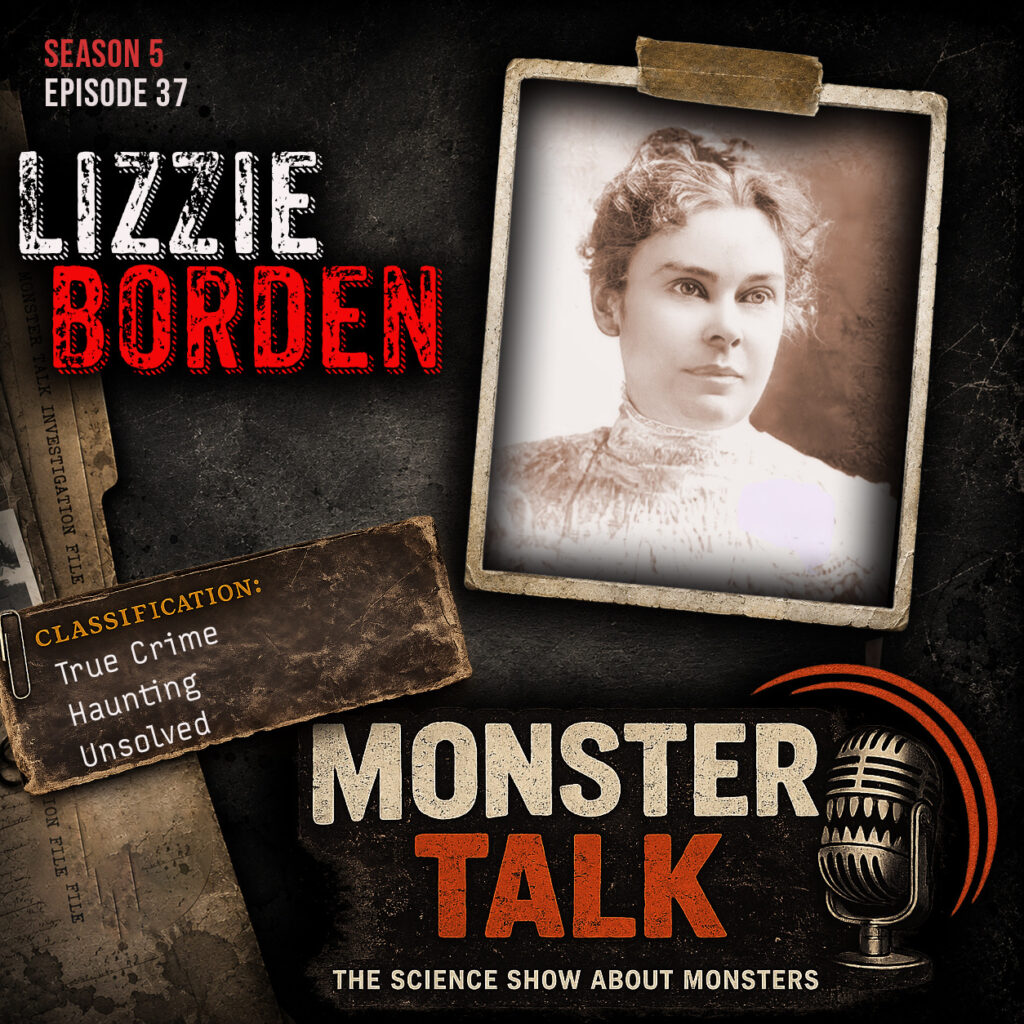
🪓 S05E37 – The Lizzie Borden Murders
Note: This episode deals with murder and goes into some detail, so we’re putting the “explicit tag” for the mature content, perhaps not suitable for all audiences.
MonsterTalk steps outside its usual territory for a true-crime case with a paranormal afterlife. Blake and Karen welcome Hallie, host of The Morbid Curiosity Podcast, to revisit one of the most notorious unsolved crimes in American history: the August 1892 axe murders of Andrew and Abby Borden in Fall River, Massachusetts, and the trial that acquitted Andrew’s daughter Lizzie while leaving much of the public convinced she did it.
Drawing on Hallie’s background in anthropology and skeletal analysis, the conversation lays out the timeline, the forensic evidence, and the tangle of rumor and theory that has kept the case alive for more than a century – before turning to the crime scene itself, now run as “America’s most haunted” bed-and-breakfast, and asking what, if anything, still lingers there.
🩸 The murders themselves
Hallie walks the timeline: Abby killed first (roughly 9:30 to 10:30 am), Andrew shortly before his body was found around 11:15. The famous “forty whacks” is folklore – Abby suffered about 18 hatchet wounds and Andrew 10 to 11, with one of Andrew’s eyes cut clean in two. Not forty, but gruesome overkill all the same.
📸 Forensics on the frontier
Crime-scene photography was brand new in 1892. Right around this moment, French researcher Alphonse Bertillon was standardizing forensic photography – the dual-pose mugshot, the top-down crime-scene shot with a measurement grid in frame. The Borden bodies were photographed where they fell and the images were used at the 1893 trial, and a sensation-hungry press turned them into grisly woodcut illustrations for readers across the country.
👗 Blood, dresses, and the “naked murderess”
Karen raises the wardrobe puzzle: the dress Lizzie wore that morning had no blood on it, a second dress she said was paint-stained got burned, and a blood-spotted bucket she attributed to menstruation. Hallie, who knows her historic clothing, explains why a quick change would have been tough – layers, corsets, buttons, ribbons – and why the “she did it naked and changed after” theory runs into the problem that two murders meant two changes. (Also home to the finest accidental pun of the episode, courtesy of Karen: “clothing of the period.”)
☠️ The cyanide question
The detail that pushes Blake off the fence: the day before the murders, Lizzie reportedly tried to buy prussic acid – cyanide – at a local pharmacy, claiming she needed it to clean a sealskin cape. The druggist refused, and that testimony was ultimately kept from the jury as too far removed from the crime. Blake notes a competing moth-fumigation version, Hallie flags that both Abby and Lizzie had voiced fears of being poisoned days earlier, and Karen adds that Lizzie was medicated on morphine during the inquest – which may help explain her famously muddled testimony.
⚖️ Acquittal and aftermath
Part of the “how did she walk?” answer is her defense – a former governor of Massachusetts with a silver tongue and a gift for getting damaging evidence (like the cyanide trip) excluded. Blake and Karen connect it to money and the courts, with a nod to the JonBenet Ramsey case. Public opinion swung too: sympathetic during the trial, then sharply against Lizzie afterward as she moved to a Hill mansion, dropped her charities, befriended actresses, and became permanently estranged from her sister Emma, who left and never returned.
👻 America’s most haunted dead-and-breakfast
On the paranormal side, the house now runs as a bed-and-breakfast under paranormal-tourism company US Ghost Adventures, with ghost tours and overnight hunts. The crew stays skeptical: the original Sci-Fi Channel Ghost Hunters came away empty in 2006, the official ghost tours only began in 2004, and – as Joe Nickell has argued – the “haunting” is largely people primed by a spooky setting and a true story imagining what happened there. Blake ties it to work by Chris French and Richard Wiseman on the real drivers of ghost experiences, and his own rule of thumb: a true-crime site literally owned by a company called US Ghost Adventures is naturally selecting for a good ghost story.
🦌 Hallie’s favorite monster: the Leshen
For our signature closing question, Hallie picks the Leshen – the antlered, deer-skulled forest guardian from The Witcher 3, a darker spin on the gentler tree-spirit of Slavic folklore. It launches Blake into one of his favorite themes: how games, art, and online image-making quietly rewrite what a monster “is” – the same drift that gave the Wendigo its now-ubiquitous antlered look and changed what people report when they say they’ve seen one.
🔗 Links and further reading
- Lizzie Borden – Wikipedia overview of the case
- The Lizzie Borden House – history of the crime scene and its life as a tourist site
- The Trial of Lizzie Borden: An Account – UMKC Famous Trials archive (transcripts, exhibits, timeline)
- Prussic acid (hydrogen cyanide) – the poison Lizzie allegedly tried to buy
- Alphonse Bertillon – the figure behind early scientific crime-scene photography
- Joe Nickell, “Lizzie Borden’s Eighty-One Whacks” – Skeptical Inquirer, March/April 2020
- The Leshy – the Slavic forest spirit behind Hallie’s pick
- Andrzej Sapkowski – Polish author of The Witcher
📚 Books
- The Trial of Lizzie Borden by Cara Robertson – the definitive modern account, drawn from the court record
- The Witcher series by Andrzej Sapkowski – start with The Last Wish, then Blood of Elves
📣 Promotions
Karen’s latest: Beyond Words by Karen Stollznow – a deep dive into the science of psycholinguistics, from animal communication to AI, wild children to word slips, and first words to last. (Blake is reliably informed it counts as a grown-up book that he is still allowed to enjoy.)
From our guest, Hallie: catch her show, the Morbid Curiosity podcast, including her two-part Lizzie Borden coverage – Morbid Curiosity – Lizzie Borden (remastered).
🎵 Credits
MonsterTalk theme music is by Peach Stealing Monkeys.
Got a theory about who really did it? Bring it to our Facebook group or our Patreon – and, as always, keep it polite, wontcha?
SEO Transcript
This is not a fully accurate transcript, and was machine generated. It’s here for helping search engines find the episode but not intended to be a faithful transcript of the episode. (But it’s not AWFUL.) Some of the material in this transcript only exists in the Patreon/Premium edition of the show and was excised for the commercial version.
———————
Monster House presents…
This is the ad-supported version of Monster Talk.
We’re dependent upon the revenue from these ads and from the support of our patrons at patreon.com forward slash monster talk to continue making this show.
As a disclaimer, your hosts are unable to control what ads you will hear, and while we have done what we can to avoid ads that are divisive, the system that injects them sometimes ignores our preferences and always seems to ignore our efforts to not interrupt the conversational flow.
While we understand this can be disruptive, we’re trying our best.
Patreon remains the best way to enjoy commercial-free listening to our content.
Plus, you generally get extended coverage of the subject.
We’re working on other ways to consume our content as well, so please stay tuned.
Lizzie Borden took an ax and gave her mother 40 whacks.
When she realized what she’d done, she gave her father 41 whacks.
It’s actually quite unlike anything we’ve ever seen before.
A giant hairy creature.
Part ape, part man.
In Loch Ness, a 24 mile long bottomless lake in the highlands of Scotland.
It’s a creature known as the Loch Ness Monster.
Monster Talk.
Welcome to Monster Talk, the science show about monsters.
I’m Blake Smith.
And I’m Karen Stollznow.
We generally eschew true crime here at Monster Talk due to a variety of reasons, not the least of which is my apparent abiding need to avoid financial success.
I’m joking, but true crime continues to be a financial juggernaut fueled by what many would characterize as morbid curiosity.
So, it does feel a bit apropos that our Virgil for this trek outside of our normal domain is the host of a podcast literally called Morbid Curiosity.
Her name is Hallie, and our topic is the sensational 19th century crime often referred to as the Lizzie Borden murders.
But our journey is not so far outside the monster adjacent as to keep us from discussing the paranormal aspects of the aftermath to this famous crime.
I can see why this story fascinated people at the time and why it still does.
The crime was violent and shocked the community and the nation.
but I will hold any further ruminations back until after the interview.
So let’s now join Hallie from the Morbid Curiosity podcast as we travel back to New England in 1892.
Monster Talk
Welcome to the show, Hallie.
Can you tell us a little bit about yourself?
Yeah.
I have a background in anthropology and archaeology.
I did an undergraduate in those.
And then I did a postgrad in human skeletal analysis.
So my main work has been with skeletons.
I previously worked in museums and libraries, mostly in the archives.
where research was the main goal of the job.
And I really loved it.
I loved hanging out in rooms full of old books.
And while I was doing that work, I would always be listening to podcasts.
So I’ve loved podcasts for a long time.
I’ve been listening to Monster Talk since 2015 or so.
Oh, wow.
So it’s really awesome to be on the show.
Oh, it’s good to have you here.
As I said, a lot of mutual interests, I think.
Yeah, definitely.
Well, that’s definitely how I found you guys.
Well, thanks for joining us.
I think Karen did a pretty good job of setting up how we picked this topic out of all the topics that your show covers.
But I’ll be honest, I went through a phase where I was really into true crime, but I’ve sort of burned out on it.
And so we don’t cover it very often, even though I’m still interested and very familiar with a lot of these stories.
um in fact especially the paranormal angles for sure but there’s like right now there’s a big serial killer exhibition in atlanta and my wife and i went because kathleen loves this stuff um and uh well like a lot of people i mean in fact i mean if you think about podcasting podcasting was just chugging along just fine until the first super hit came along with serial
True Crime is absolutely what really catapulted podcasting out of the, what do you want to call it?
The slums?
I don’t know.
Into the solid suburbs.
The nerdy niches of all the corners of the internet.
There’s a lot of people who love True Crime.
I guess my point is I’ve read a lot about various horrific murders, but we haven’t covered a lot of them here.
And I’m making assumptions that everybody knows who Lizzie Borden is, but maybe not.
So let’s assume that some of our audience doesn’t know anything about this crime and the many hypotheses about it.
And maybe you can give us a 101 on who’s Lizzie Borden, who got murdered, what she got to do with it.
Where are the bodies?
What’s the evidence?
You know, the basics.
Definitely.
Well, Lizzie Borden is an alleged axe murderer who allegedly killed her father and stepmother in 1892, allegedly.
We’re saying because we don’t want to get sued, right?
No, it’s all, everybody thinks she did it, basically, but she was acquitted of this murder.
A lot of people at the time still believed she was the one who killed them.
And it’s still an unsolved murder and a pretty gruesome one at that.
And people are very fascinated by it, including me, which is why she’s famous.
Why wasn’t she convicted?
Because everyone in the jury was a quitter.
All right.
Sorry.
So she was acquitted, but she’s still famous.
Yeah.
The reason that the trial got so much attention was because it was a very, very violent crime.
Basically, there wasn’t a lot of evidence to prove that anyone did it.
Like it was there was blood everywhere, but they couldn’t find the killer.
Who died?
I guess we should.
Her father and her stepmother.
Her evil stepmother?
Possibly.
We don’t know.
Gotcha.
I just always have to assume that, right?
Yeah, always.
We know that she and her sister didn’t like her stepmother very much.
And we know that there was some pretty intense tension in the house between Lizzie and her older sister, Emma.
And their stepmother, whose name is Abby, Abby Borden.
And their father, Andrew Borden, was kind of a character in that he was quite a rich guy.
He had a lot of money.
He ran several textile mills and owned a lot of real estate.
But he didn’t like to spend any money.
So there was some resentment that had been noted by other friends and family that Lizzie and Emma thought perhaps he could shell out a little bit more.
Like they lived in the industrial part of town next to his textile mills instead of in the more affluent area of town called The Hill.
So…
They never really had people over.
They didn’t do any entertaining because they were embarrassed of their living situation.
They lived at 92 2nd Street is the address of the house where the murders took place.
And it was a duplex that had been pretty roughly converted into a single family home.
which is important later.
I was just going to ask you just regarding the relationship between Lizzie and her father, that it was further strained because he’d actually given some money to Abby’s family or purchased a house for them and yet wouldn’t purchase mod cons for them or buy a house for them.
So is there truth to that, that he was giving money to…
To her and her family, but not to his girls?
Well, sort of.
So Abby had, I think it was her sister, was living in a house with her mother and her mother wanted to leave her share of the house.
And…
I believe Abby asked Andrew to buy that share so that her sister could keep living there without paying any rent.
And when he did this, he agreed.
When he agreed…
Lizzie and Emma both got quite offended and said, well, anything she gets, we should also have.
He tried to sort of mullify the situation by buying them each a piece of property.
He bought one house for them both to have in their names.
Okay.
He was trying to fix the situation by giving them property.
And it kind of worked, but after this incident…
they would no longer eat breakfast with either of their parents.
Like, it caused a great offense.
And I’m not quite sure why.
Like, I don’t really understand what the offense was, but they also all got the same allowance.
Like, each of them received a certain amount of money every week, and it was the same.
Whereas Emma and Lizzie’s, they could use for whatever they wanted, and Abby had to use hers for the house.
So it was kind of, it was really like…
the girls sort of ran things.
You know what I mean?
Like he, he was very, while he was quite strict, I think, especially with money, he definitely had a soft spot for his girls more than his wife.
It seems.
Okay.
That’s interesting.
I’ve heard so many different versions of these stories and stories that maybe he had molested the girls, his daughters at some point.
And,
stories that he didn’t ever give them any money and that, again, this is probably going off the rails, but it just seems like different sources would tell you different things, that Lizzie was a kleptomaniac, that Lizzie was a lesbian.
So it’s really hard to find out what’s true and what’s not because there are so many different stories and claims out there.
Yeah, when you have a mystery like this, people tend to wonder about it and then theorize about it and then publish books about it.
So we’ve got lots of different theories.
And having immersed myself in this pretty often, because I find it so interesting, you can see where they’re coming from for each theory.
It’s hard to write…
a lot of them off just because we don’t have a killer we don’t know how it happened and it’s it’s a complete mystery like either um either lizzie was a criminal genius and planned the murder so well that she got away with it or someone else was a criminal mastermind and got away with it and um
Yeah, everybody loves a murder mystery.
So lots of theories are out there.
I guess we should back up just a little bit and talk about the actual murders.
What happened?
So what was the circumstance of the murders?
Not to initially get to who was home, who wasn’t, but what do we know about the timing?
And I guess…
famously the method of killing yeah what we know for certain we do know the timeline and we know the most likely murder weapon and we know and we know how complicated it would have been to pull it off and not be caught um so the timeline abby the stepmother was killed at some time
Abby was killed sometime between 9.30 and 10.30 a.m. on August 4th.
And Andrew was killed the same day, sometime shortly after 11.30, is what they think.
And there’d been, like, Lizzie’s uncle, John, had been in the house previously.
It was the first time he’d stayed over in a long time.
So, like, he’s also suspect.
I can give you I mean, we all know the rhyme, right?
Lizzie Borden took an axe and gave her mother 40 whacks.
And when she saw what she had done, she gave her father 41.
She didn’t actually give them that many whacks if she did it.
Abby Borden had 18 sharp force trauma injuries to her head and neck, mainly the back of her head and neck.
And Andrew Borden had 10 to 11 similar injuries, mostly to his face.
And everyone always remarks on the detail that one of his eyes was cut completely in two.
So that means it was definitely a very sharp instrument that was used.
And the amount of violence was what shocked everyone.
It was complete overkill in the truest sense of the word.
And this is one of those crimes where there are horrific crime scene photos.
Indeed.
I think crime scene photography was pretty new at the time.
And they were able to get photos of both Andrew and Abby.
Hallie is right.
It was brand new.
In fact, right around the time of the murders in 1892, a French police researcher named Alphonse Bertillon was completely revolutionizing forensics.
Before Bertillon,
Crime scene photos were just random chaotic snapshots.
He introduced a rigorous scientific system of biometrics, standardizing everything from the dual pose mugshot to top-down crime scene photography taken from heavy tripods with metric measurement grids placed right in the frame.
For the first time, photography wasn’t just a visual aid, it was a measurable objective scientific record.
The Borden investigation caught the very early crest of this forensic wave.
Investigators extensively photographed the bodies of Andrew and Abby exactly where they fell, and the prosecution actually used these graphic images during the 1893 trial to map out the tight physical constraints of the house for the jury.
But these photos didn’t just stay in the courtroom.
The 1890s marked the birth of sensational yellow journalism, and while the technology didn’t yet allow newspapers to print high-resolution photos directly on the front page, the press eagerly transformed the police photographs into detailed, grisly woodcut illustrations and sketches.
The public didn’t just read about the brutal scene at Fall River.
Thanks to this new era of forensic photography, they could see it.
One of my lovely listeners sent me a great postcard with the one of Andrew on it not that long ago.
Yeah, they’re very haunting images and pretty graphic too.
But at the same time, a little tricky to see some aspects of them.
But you were…
Talking about a little earlier you mentioned the blood situation and from what I’ve read, part of Lizzie’s belief that she was innocent was that the dress that she was wearing that morning didn’t have any blood on it.
And yet apparently there was a second dress that she claimed had paint on it and that she had burnt it for that reason and that that possibly could have been the smoking gun, might have had blood on it.
And I’d also heard that there was a bucket that had some blood in it and Lizzie claimed she was menstruating at the time.
So what do we know about that particular aspect?
I believe there’s a particularly scandalous claim, too, that she was naked when she performed these murders and then had gotten changed afterwards.
And I think about the clothing of the period, too, and just how long it would take a woman to… Ooh, clothing of the period.
LAUGHTER
We picked up on that one.
I didn’t intend that one.
But well done.
But the clothing of the era, let’s put it that way, that, you know, corsets and multiple layers and just how long it would take to disrobe or to get changed.
So, yeah, in all of your research, what have you uncovered that might point to her?
having been involved as regards the blood and clothing and things like that.
Well, with the, as you said about the clothing, knowing a little bit about historic clothing, there were, yeah, there was a lot of layers, but if she needed to quick change, she could have just taken the outer layer off unless the blood spatter penetrated beneath it.
Cause usually like listening to the types of fabrics that these dresses were made of, it’s like corduroy and calico.
These are all, I mean, corduroy especially is not particularly,
absorbent to my knowledge calico would be so you might have problems with blood seeping beneath the top layer unless you changed very quickly but again it would have taken time because like there’s lots of buttons there’s lots of ribbons there’s things to tie up there’s collars like corsets under corsets there’s lots of things that you’d have to put on and off so i’m not sure if she
If she killed Andrew Borden, because she was seen between the murders as well, so there would have had to be two changes of clothes.
So it doesn’t seem probable to me personally, but unless, you know, maybe he skipped some of the undergarments that day, I’m not sure.
Yeah.
Well, there’s another point, too.
How accurate do you think they were with the timing?
Because it seems like quite a big chunk of time in between the two murders.
Do you think that they were correct or do you think in those days they didn’t really ascertain that accurately?
Yeah, the accuracy is also suspect because.
They know that Abby was killed first because her blood was coagulated and her body was cold when they went up and found her.
She was actually discovered after Andrew.
And he was still bleeding freely when they found him, which means Lizzie would have had to change very quickly.
And it was Lizzie who screamed for the maid, Bridget, to come down.
like just screaming bloody murder, basically.
So they know Abby was killed first and then Andrew, but the timing in between, it’s hard to say.
There was something in the court documents that I was reading.
No, it wasn’t the court documents.
It’s this awesome book by Kara Roberts called The Trial of Lizzie Borden, where she made a comment that the police officers…
didn’t quite understand how Lizzie and many of the other witnesses couldn’t have been paying attention to the time.
Like they just, because, you know, police officers have regimented schedules.
They’re constantly checking the clock to make sure they’re on time for whatever they’re doing, or they know that you need to be paying attention to the time.
Whereas a lady of leisure, which is…
Lizzie was at the time.
She wasn’t married.
She didn’t work.
She lived at home.
She didn’t pay attention to the clock.
So a lot of the statements from the inquest, which was the first thing that was performed before the trial, they did an inquest, was the officer who was interrogating her just getting frustrated that she didn’t pay attention to the time.
And so there’s definitely some
some room there for doubt as to what happened and when.
So it sounds like that the police pretty quickly pinned their suspicions on Lizzie.
Is that just because they knew she was at home?
Was she at home at the time of the murders?
Did they confirm that?
Why was she always the primary suspect?
Yeah, so it was just her and the maid, Bridget, who were at home.
So they assume Abby was killed sometime between 9.30 and 10.30.
During that time…
In the morning?
In the morning, yep.
A brunch murder.
Brunch murder, definitely.
Let’s all do brunch murder.
Have a Bloody Mary and then… Bloody Lizzie.
A Bloody Lizzie.
I like that better, yeah.
Just have a little, a little ax.
An umbrella.
Yeah, that’s good.
Tasteful.
Yeah.
On the day, everyone had been sick the night before.
So a lot of people had been in and out of the house vomiting.
Then Andrew left at like nine o’clock to go see about his businesses.
The uncle who’d stayed the night, he also left.
So it was just Abby, Lizzie and Bridget.
Abby sent Bridget outside to clean the house windows.
And then she went to go change the sheets in the guest bedroom.
So then it’s just Lizzie.
And Lizzie gave several accounts of where she was and what she was doing during the inquest.
And a lot of it didn’t add up.
But again, she wasn’t really paying attention to the time.
So she may have done all of these things that she said in that time, but she couldn’t give a very good account of the order in which she did things.
Andrew came home about, I think, just a little before 11.
And Bridget had to come back inside to do the windows on the inside.
And the front door was locked, so she had to let Andrew in.
And during her testimony, she said when she let Andrew in, she heard Lizzie laugh from upstairs, which is where Abby’s body was found in the guest bedroom.
creepy but it is and the lizzie said that she was i think ironing in the kitchen or something or she said she was ironing she said she um she was in the barn later um
Well, she said she was in the barn during the time that her father was killed.
I don’t actually remember what she said she was doing when her mother, her stepmother.
Sorry, Lizzie would be very angry if I said her mother.
She was constantly correcting people to say, no, that’s my stepmother, which is when suspicion actually fell on her.
Because the police were like, you should be crying and upset and you are so calm and you are correcting me that this is your stepmother.
not answering our questions at the scene of the crime.
So she had suspicion on her quite early just for because of her behavior.
But so her mom was killed sometime pretty soon after Andrew Borden left is the assumption.
Um, so Bridget is outside.
Bridget comes back in.
Bridget hears Lizzie laugh from upstairs and then come down and speak to her father.
So between murders, she did come downstairs and talk to her father and no one noticed anything amiss about her clothes or how she was acting.
Her dad comes home.
She tells him, Lizzie tells Andrew that Abby received a note from a friend and went out to go visit her friend.
And then Andrew goes to take a nap on the couch.
Bridget, who’s still not feeling very well, goes up to her room, which is in the attic, to have a nap.
And Lizzie is the only one awake in the house at this point.
She told the police she went out into the barn to look for some fishing sinkers.
She said she’s looking for irons to put on her fishing rod because she was going for a fishing trip in a few days, I think.
And then I think that was just 11-ish.
And then at about 11, sometime between 11 and 11.15, she starts screaming, calling for Bridget to come downstairs and telling her someone’s killed father.
And the doors had all been locked.
There’s there wasn’t really any way that someone could have come and gone without running into either of the ladies, really, which is why everything sort of came down quickly to Lizzie.
Right.
Yeah.
It’s just such a complicated case.
And it seems like there are so many loose ends and it’s missing information.
And you mentioned, Hallie, earlier that the family were feeling sick.
So I don’t know if Lizzie was sick as well, but that the stepmother and the father were sick.
And so was Bridget.
And wasn’t…
Didn’t it come to light that Lizzie had gone to a local pharmacist, chemist, and tried to purchase prussic acid?
I don’t know exactly what that is, so perhaps you can tell us about that.
But that she tried to get some kind of poison.
What do we know about that?
Was that true?
It is true that she went into a chemist.
The day before the murder, she went to the chemist and asked to buy prussic acid, which is cyanide.
And she told the pharmacist on duty that it was to clean her seal skin cape, which was a very expensive gift that her father had given her, possibly to mullify other tense feelings that were happening in the house, because it seems like it was wave after wave of tension in this house.
When he testified at the trial, that testimony was thrown out.
So it didn’t actually, it wasn’t presented to the jury because they thought it was too far away from the incident or didn’t have anything to do with the incident.
Was that traditionally used for cleaning, the cyanide used for cleaning clothing?
That sounds odd.
It is odd.
It’s not what it was used for.
And I don’t think anybody used it for that.
Yeah, the chemist wouldn’t sell it to her because he said, that’s poison.
I’m not giving you that.
And she left.
And that was his testimony.
She said she was never there.
Strange.
Yeah, it’s it’s everything is very confusing, like reading through Lizzie’s inquest testimony, which is the only time she ever spoke on record.
Just reading it is very confusing because she seemed in general.
confused by everything that she was asked and she wouldn’t directly answer any questions and um the go ahead sorry to interrupt i’d heard that she’d uh she’d been medicated so i was yes she was put on something uh morphine yeah yeah yeah that’s yeah that’s what i was gonna just about to say yeah she was medicated beforehand
And I wouldn’t be surprised if she was very confused.
I have no claims to deep knowledge on this case, but I did read that the prussic acid was allegedly being used to fumigate to stop moths.
Uh, so that was, that was at least one version of this I heard.
So not as a cleaning agent, but as a, uh, anti moth agent, maybe I don’t, but again, uh, it’s sketchy.
It’s sketchy stuff.
Yeah.
It’s, and it, and her saying she wasn’t there and he said she was, it was a controlled substance, the kind of the same way you can’t buy certain cough medicine now because it’s got other uses everybody knows about and they don’t want it.
So, yeah.
Yeah.
Yeah.
And like I think a week before, Abby Borden had gone to her doctor and said she thought she was being poisoned.
Yikes.
And then again, the day before the murders, Lizzie thought she was being poisoned or she told a friend that she thought she was going to be poisoned.
Boy, that sounds such, doesn’t it?
Like maybe poison yourself just a little bit.
So everybody gets poisoned, but you don’t die.
That kind of thing.
Exactly.
That was my thought.
Maybe it’s too slow.
So maybe she came up with a better method.
That’s one of the theories.
Yeah.
She just went, okay, well, this isn’t working.
Yeah.
Time for plan B. I’ve read that they’d gotten sick on bad mutton.
So it was they used to the father wouldn’t shell out for good quality food and they used to eat mutton all the time and it was rotting or something.
And that’s what made them sick.
But yeah.
Again, so many versions, it’s really hard to piece together the truth.
Yeah, it’s not surprising it stayed a mystery because of all the contradicting statements that were made, both during the trial and the inquest.
It’s very confusing.
I get the impression that if this crime happened now…
it would be solved really fast because of DNA and other stuff.
Like it wouldn’t be that big of a mystery, but maybe I’m wrong on that.
So I don’t know.
Sorry to interrupt.
I was thinking about that and I was reading Blake, you sent Joe Nichols article on this.
Oh yeah, that’s right.
Skeptical inquirer.
And he spoke about how all nowadays for all of these reasons, we.
DNA evidence, we would find the answers.
And then I just thought about the JonBenet Ramsey case here in Boulder, Colorado.
Oh, yeah.
And just how the cops kind of stuffed that one up.
And so I thought, well, I could see today, you know, things going awry and not being able to get to the bottom of something just with…
things not being contained properly.
So, I mean, the kind of thing still happens today.
Well, it does.
And I think one of the biggest challenges is that if the victims of the crime, or if the participants in the sort of crime ecosystem, I’m not sure what you call that whole thing there with all the potential suspects and the victims.
If there’s money, lots and lots of money,
it turns out that complicates things in the courts quite a bit.
In the JonBenet Ramsey case, it’s like the evidence…
It was like the whole thing was complicated by how much money was at play, it seems like to me.
And it seems like maybe this too, that wealthy people or people who potentially might inherit a big pile of money suddenly have legal means available that aren’t there for…
Poor schlubs like me who just can’t get away with murder.
No matter how hard I try.
You’re definitely right there.
She had an amazing lawyer.
Like she, her lawyer was like an ex governor of Massachusetts who had a silver tongue and he was able to make any witness that came up on the stand feel very comfortable before tearing them apart.
Like he was good.
And she, like, with the inquest that was held for her, she was interviewed, but she wasn’t allowed to have her attorney present.
And so they had to throw that out.
So they couldn’t use her only statements in court.
This big shot lawyer that she had was really good at getting certain evidence excluded, like the prussic acid incident.
Well, I’m curious about something else.
It seems like during the trial that Lizzie had the public on her side, that they were very sympathetic to her losses and what had happened to her, and they thought she was this kind of socialite and this religious…
character went to church every week and it was just well known in the community she couldn’t have possibly done it and then afterwards it seems like the the public and the community really turned against her uh do we we know why do you think it’s just she was stigmatized afterwards or uh do you think that the community might have known more than we know today
Well, her behavior changed after she was acquitted.
Her behavior changed dramatically.
Beforehand, she went to church a lot.
She supported lots of charities.
She taught Sunday school.
She lived quite an ascetic lifestyle, I think mostly because her father had his hand on the purse strings, you know, so she couldn’t spend.
And afterwards,
She and her sister moved into a mansion in the biggest, like the biggest mansion in the affluent area of town.
She stopped supporting her charities.
She started throwing parties.
She made friends with actresses, which like at the time was like a scandal.
And she just started behaving very differently.
And she wouldn’t speak about the trial.
And…
It’s not…
I think what happened was the people doing the newspaper reporting who were in the courtroom were very supportive of her.
And they couldn’t believe that a well-bred Christian woman like Lizzie could have killed her father and stepmother.
Because they were all kind of from that upper echelon.
But the regular folks…
were like, if that was me and I was on trial, I would have been, you know, condemned.
So there was a lot of like a class division between who supported her and who thought she did it.
And the newspapers were just spitting out story after story, like trying to both support and tear her down.
There was, I think, one
newspaper story that was a complete hoax that was talking about how Lizzie was pregnant and her father and mother were threatening to turn her out of the house if she didn’t reveal the man who got her in trouble and then she killed them to get the money and then there was another one that was like talking about how her uncle and her planned together to get rid of them and
It was just story after story, just really smearing her character.
And then afterwards, with the change of behavior, all of her friends and her sister, in fact, just left.
She’d moved into that big house with her sister.
And then eventually her sister completely abandoned her and they never saw each other again.
Was that because they got an inheritance and she was of independent means?
I’m not sure what… Well, they got the inheritance because…
They actually got an extensive inheritance because when… Because of the order of the murders, Abby was killed first and she left everything to Andrew.
Then Andrew was killed.
So everything went to Emma and Lizzie.
So both of their, I mean, I’m not sure that Abby had much, but everything went to Lizzie and Emma.
And nothing went to Abby’s family, though Lizzie and Emma did pay them something, like, eventually.
But they got a lot of money.
They moved to this big house.
And then…
Suddenly they fell out and Emma just left.
And they never spoke about why, neither of them.
And it was like this big public secret.
Wow.
Yeah, again, it just really seems like there’s so much that we don’t know.
Lots of missing information, but certainly ample motivation for Lizzie to have committed these crimes.
But at the same time, I think that the idea of the uncle being a suspect is interesting because he hadn’t been on the scene for a long time and suddenly…
Out of the blue, he comes back into their lives.
And I’d heard claims of an illegitimate son as well.
So I just don’t know.
Lizzie missed out because she could have written a book called If I Did It, and that would have really cleaned up.
That would have been smart.
I wish she had because that would answer so many questions.
I just wonder if we can turn to the paranormal side of this just for, I guess, in closing because –
I mean, this is certainly one of those true crime stories, cold case that a lot of people have discussed, you know, ad nauseum before us.
And so being monster talk, I think it’d be fun to just kind of delve or interesting to delve into just some of the paranormal claims because I believe nowadays the house has been turned into a B&B and that they have ghost tours.
Yeah, D&B is the dead and breakfast, so.
Yeah.
Pretty gruesome, but, yeah, what do you know about the claims that people make about paranormal sightings and things that take place in the house today, supposedly?
Well, it is a dead-end breakfast, and they do have tours.
They have…
murder history dinners now uh i think the house was bought recently by a ghost hunting company i think um i’ve heard that yeah
The Borden house has worn a lot of hats since 1892. After Lizzie and Emma sold it in 1918, it passed through a string of owners and spent decades as a working business address – from 1948 to 1995 it was home to Smart Advertising, a local printing company. When the family behind that company died in 1996, the property was inherited by granddaughter Martha McGinn and a longtime employee, Ron Evans, and that same year they opened it to the public for the first time as a bed-and-breakfast and museum. For a long stretch Fall River regarded the Borden legacy with a kind of quiet civic embarrassment, but the house leaned into it, and tourism gradually turned the murder site into one of the city’s signature draws.
Then in May of 2021, the place entered its current era when it sold for two million dollars to Lance Zaal, founder of the nationwide paranormal-tourism company US Ghost Adventures. Under that ownership the house has gone all-in on the paranormal marketplace – overnight stays, historical tours, nightly ghost tours, murder-history dinners, and overnight ghost hunts – and yes, you can book the very guest room where Abby was killed.
That corporate approach has also rubbed up against the neighbors. When a coffee shop called Miss Lizzie’s Coffee opened next door in 2023, US Ghost Adventures sued over its name and bloody-hatchet logo and asked a federal court to make them stop. On that question, the courts sided with the coffee shop – twice. A judge declined to block the shop in 2023, finding little real risk that anyone would confuse a coffee counter with an overnight ghost tour, and pointing out that nobody gets to own the historical Lizzie Borden story itself. A federal appeals court upheld that in November of 2024. So the company couldn’t force a name change.
Where it went sideways for the cafe was everything that came after. The owner parted ways with his lawyers, started representing himself, missed a pile of court deadlines, and by early 2026 had been found in default – which now has US Ghost Adventures asking a judge for something like a quarter of a million dollars. And then, in a twist that has nothing to do with the ghost company at all, the cafe’s own landlord moved to evict it. So the shop has announced it’s leaving Second Street – relocating, fittingly, to a former church where Lizzie Borden herself once taught Sunday school. The turf war is ending, just not for the reason you’d expect.
Like it’s still operating as a bed and breakfast, which is sounds like a lot.
That’s a lot going on in the house.
And I have this thing about people ghost hunting in hotels is you’re never going to catch anything because there’s always so many other people around.
Any evidence that you collect is going to be suspect because someone else could have moved something or coughed or pushed something or turned on water that made plumbing Creek.
Like there’s no way to properly like scientific method ghost hunt in any type of hotel.
And this is a small house with, I think they’ve added two rooms in the basement and three rooms in the attic.
And it’s,
you’re not getting a suite either.
There’s like shared bathrooms, which is great, I guess.
It seems a bit crowded to me.
Was that a Jack and Jill type thing, right?
I think that’s what they call it in America when you have two bedrooms that are joined together with a bathroom in the middle.
Yeah.
Sorry, that was something I learned recently while watching a movie with my wife.
That’s interesting.
That’s cool, yeah.
That’s what that was called.
That’s neat.
But the website for the Lizzie Borden house says it’s America’s most haunted house located in Fall River, Massachusetts.
That’s very specific.
I don’t know many other houses in Fall River that would be haunted.
So I don’t know.
Yeah, I mean, that makes me wonder if the house that Lizzie purchased afterwards, if there aren’t claims associated with that, too.
Yeah, I haven’t heard anything about – I think it’s called Maplecroft is the house that they bought up on the hill.
And I haven’t been to either.
Have either of you been?
No.
I haven’t.
You know, I’ve had a lot of people ask me over the years, why haven’t you investigated this house?
And I think because I just didn’t view it as being a very kind of, I guess, salient –
paranormal claim um yeah that certainly people say uh oh there there are ghosts in in the place and i haven’t been there myself but yeah it’s just not kind of canonical paranormal for me
Yeah, I haven’t been either.
And I actually haven’t heard like any similar to the actual case.
I haven’t heard any consistent claims of specific ghost activity either.
I know the ghost hunters, the original sci-fi channel ghost hunters, Jason and Grant, went there in like 2006 and they didn’t catch anything.
They didn’t see anything.
They said it’s not haunted.
And I think a lot of people assume that the house was haunted because of the horrible things that happened there.
And I feel like… Like Amityville?
Yeah, like the incident ends up haunting the place and the ghost stories come after that.
I feel.
Yeah.
Then the, the tour, the ghost tours, like official ghost tours weren’t actually offered until 2004.
The ghost hunters visit in 2006.
And I think.
I think I read Joe Nichols’ article as well, and he said that the ghostly presence is mostly due to personal feelings of people who visit and learn about it and then are actually in the space and can better imagine what happened, and so people get haunted by the incident.
I think that’s what he said.
I think…
There’s been, we’ve talked about this a lot recently because we’ve been kind of revisiting some ghost cases.
And we have psychologists like Chris French and Richard Wiseman looking into the root causes.
Like, is it the environment?
Is it infrasound?
Is it electromagnetic waves?
Like all these different things.
And it…
at the end of the day, if you have an inclination to the paranormal and someone primes you with a setting that is spooky, creepy, based on a true story, those things, I think that has more to do than anything else than any external, you know,
The kind of place that would be haunted if places would be haunted.
I agree.
And it’s like, I just, that’s such a more powerful impactor on this stuff, I think.
And so if you go to a place that is a true crime place, literally owned by a company called U.S. Ghost Adventures.
Yeah.
It seems like that you’re naturally selecting for a higher propensity of incident or story.
Definitely.
But I am a stinking dirty skeptical person and a known fun ruiner.
But don’t you want to believe I would love to see a ghost?
I just haven’t.
I’ve tried and I haven’t.
Yes, absolutely.
We’ve tried.
Yeah.
When I thought I was being haunted in those times, except for in the immediate terrifying phase, it was fascinating.
If you’re not literally scared out of your mind, it’s really cool to contemplate and try to figure out how to get to the bottom of it.
So, yeah, absolutely.
We’ve just always found natural explanations for these claims and phenomena.
Yeah.
So, yeah, nothing yet.
We’re keeping open minds, aren’t we?
Absolutely.
And, of course, you can’t exclude maybe it’s not a ghost, maybe it’s a demon, you know.
Exactly.
Poltergeist.
Yeah, definitely a poltergeist.
But but this is a leprechaun.
Well, this is this reminds me this time of like photography is coming into play.
And the media is really big into this.
This is not too long after the the the Whitechapel murders with Jack the Ripper.
Yeah, they actually did think Jack the Ripper had come to America was one of the headlines, I think, that I read.
Oh, that’s interesting.
Yeah, I just I feel like.
And even this goes back to the Beast of Chez Vidal, and we talked about that, the rise of tabloid newspapers, broadsheets.
When there’s media to carry the story, then there’s an ecosystem there that will feed back on itself.
So I think…
it was almost destined to become a big news story for a lot of, I mean, this would play big now.
I mean, it’s, it’s not, I mean, it’s got affluent, you know, upper middle-class people with crimes and suspicions and rumors.
It’s got everything we need, you know?
That’s basically why it’s just such a popular case.
Yeah.
That it’s just got everything.
Yeah.
Yeah.
I mean, just so long afterwards, it’s still, but people are just fascinated with this case.
Yeah, it’s got scandal.
It’s super violent.
It’s unsolved.
And everything was very public.
So like, what more do you need to create lasting public interest?
Yeah.
Do we know which PR firm came up with the rhyme about Lizzie Borden took an ax?
Because that was brilliant, right?
Kids started singing it as like a jump roping rhyme.
Oh, golly.
Yeah.
And then the papers printed it and it went like national.
I mean, I would say that like the Freddy Krueger rhyme is clearly homage to this rhyme, you know?
For sure.
Well, we didn’t grow up with it in Australia.
I don’t remember hearing it until I came here.
To the US.
Okay.
But it might have migrated to Australia.
But did you jump rope, Karen?
Did you jump rope?
Not very much, I’ll be honest.
I’m not a rope jumper.
But, yeah, well, gee, do you have any other questions, Blake, before we wrap up?
No, I mean, this was a really nice introduction to a really nasty story.
So we appreciate you coming on the show, Hallie, and talking with us about it.
Yeah, it is.
It’s such an interesting case, but we do want to be sensitive to this kind of story.
We don’t really tend to talk about true crime because we tend to…
to have our sensitivity with the victims uh and we do and and and you know it’s like a lot of these cases it’s the murderer or the suspect that gets all the fame and then who remembers andrew and abby you know that’s um but uh that that’s i i at least their names are preserved and you know that it’s just it’s um
They may not have been terribly nice people.
Maybe.
Yeah, I don’t know.
All right.
Well, Hallie, you said you’ve listened to the show before, so you should know what’s coming next.
As a first-time guest, we’d like to finish up with our signature question, which is, and this is how you define it, but what is your favorite monster?
I had to think pretty hard because I love folklore.
It’s one of my favorite things to read about.
And I decided to go with the Leshen.
Go on.
The Witcher version of the Leshen.
It’s a big, hulking forest spirit with a deer’s skull for a face.
And it guards the forest.
It controls plants.
It can call on wolves.
And if you’ve played The Witcher, it’s quite a formidable enemy in The Witcher 3, the game.
And it combines two of my favorite things, which are skeletons and plants.
Where is it found?
I’m not, I think the original…
folklore is um well the author’s polish yeah i think it’s kind of in that area the polish uh german uh sort of uh eastern european type folklore and i know the the regular non-witcher version of the lesson it’s just kind of a little tree spirit that plants trees and
looks out for the forest.
It’s not this big, hulking, spooky creature.
But I like the big, hulking, spooky creature.
I was going to say, the Witcher series…
We’ve discussed on the show before, Perlmutter, David Perlmutter talked about it.
It was one of his favorites.
And I’ve actually read the first couple of books and really liked the way he does twists on the folklore.
Yeah, I love the books.
But the games are their own thing.
I mean, like the games are extraordinarily popular and they really do play a lot in this folklore space.
And that is a very creepy looking monster.
Well, I’m wondering, is it male, female, both, neither, genderless?
I’m not sure.
I’ll put a link in the show notes.
You can check that out for an image, Karen.
Well, a funny thing.
The the Wendigo is also sometimes depicted in a similar way to the election.
Yeah, that’s a new thing.
But yeah, you’re right.
I don’t know where that comes from, because the Wendigo is like kind of a cannibal zombie type.
It is.
There is an entire I don’t know what you would call it exactly, but it’s a.
I’m really I ought to have a good term for this, but there’s an ecosystem that happens online and social media, specifically in art spaces where people are redefining what monsters are by their representation of these monsters in art.
And it’s it’s having such a big impact, which, again, that’s one of my go to themes is how.
pop culture and fiction and movies change the way people experience monsters in real life.
Yeah, the exorcist effect type thing.
Yeah, exactly, exactly.
And the way these monsters are being redefined changes what people actually experience when they encounter them.
So now people who report a Mothman sighting are not reporting an armless, you know, owl, bird-looking thing.
They’re seeing a humanoid with arms and legs, you know,
And that probably has more to do with the artwork on the original book and in the statue that’s in Point Pleasant now.
So I think this is another one of those cases where you have the folklore of the Wendigo, which is a spirit of a cannibal.
It’s a possession story about how doing a taboo action can lead you to a really bad place and losing your humanity.
But now it’s also a sort of boneheaded antlered humanoid monster in, you know, in art spaces online.
It’s like I we you can’t control.
the evolution you can’t right exactly you can’t you can’t all you can do is observe it right i mean you could try to have an impact but you can’t you can’t know what’s going to take off and what’s not and and that whole image of the wendigo has become a huge pop culture uh it’s changed the iconography of the monster for sure yeah yeah it’s it’s fascinating to watch how these things change
Yeah, I think, whoops, you pressed one of my buttons.
I was like, rant unleashed, rant unleashed.
Sorry, but I do think about this all the time.
So, yeah.
He’s strange like that.
But this is a very cool monster.
Thank you, Hallie, for joining us.
And we have so much in common, so we’re going to have to keep in contact and bring you back on the show to talk about something else.
Yes, please.
Well, Hallie, thanks so much.
Thank you for having me.
This has been awesome.
Very, very cool.
Well, it’s been really fun.
Yeah, thank you so much.
Yeah, you take care.
We’ll chat soon.
Monster Talk.
You’ve been listening to Monster Talk, the science show about monsters.
I’m Blake Smith.
And I’m Karen Stollznow.
You just heard an interview with Hallie, the host of the Morbid Curiosity podcast, discussing with us the sensational 1892 Borden murders.
I hope you’ll forgive me, but when I was putting the show together, I started to get frustrated.
This is one of the rare cases where I have a really strong feeling that despite the uncertainty often expressed by the true crime community, I personally could not stop feeling that Lizzie Borden was guilty.
In particular, it was her extremely suspicious attempt to buy cyanide that knocked me off the fence.
This was the stuff they kept locked up, and it certainly was not a common household item for taking care of moths.
It was so dangerous that the druggist balked at the very idea of selling it to her because it would have been easy for her to accidentally cause her own and others’ demise.
But her lawyer managed to get the whole incident removed from consideration so the jury did not have that critical evidence to weigh when they made their decision.
Combined with the clear motive and the means, it’s just too much for me.
But I’m not here to say everyone should agree with me.
It’s just my take on a mystery that lots of people have very strong opinions about.
And mulling this stuff over is one of the reasons true crime is such a popular genre.
I told Karen about this that I felt compelled to comment and asked her if she wanted to add her own thoughts.
And she replied with the following and said that I should read it verbatim.
She did not give me permission to read her words in my barely adequate Steve Irwin impression.
But if it amuses you to do so, please feel free to hear it that way in your head.
My position is that I’m not entirely convinced Lizzie was the perpetrator, at least not beyond reasonable doubt.
The circumstantial case against her is certainly compelling, but I think there are still enough unanswered questions that I’m hesitant to treat it as settled.
If she was involved, I’ve sometimes wondered whether she may have had help from an accomplice, perhaps her sister Emma, the maid Bridget Sullivan, or even her uncle John Morris.
Morris especially has always struck me as an interesting figure given the timing of his visit.
his somewhat loose alibi, and the family financial tensions.
And he was, by trade, a butcher.
That said, none of the alternative theories is particularly conclusive either.
Ultimately, I think it’s one of those cases where we’ll probably never know for certain.
Lizzie remains the most likely suspect in many people’s eyes, but I’m not convinced the evidence completely excludes other possibilities.
And I think Hallie made her own thoughts about this uncertainty quite clear.
Plus, she has her own well-produced show, and I will put a link to that remastered episode of Morbid Curiosity in the show notes.
Have a listen.
You probably have your own opinions, so please feel free to discuss your theories at our Facebook group or over at our Patreon site.
We’d love to see and participate in such discussions.
Just, as always, try to keep those conversations polite.
We hope you’ve enjoyed this episode of Monster Talk.
Each episode, we strive to bring you the very best in monster-related content with a focus on bringing scientific skepticism into the conversation.
If you enjoy Monster Talk, we now have a variety of ways to support the show, all with convenient links at monstertalk.org forward slash support.
That’s monstertalk.org forward slash support.
We have links there to our Patreon page as well as a donation button.
Another great way to support the show is to buy books from our Amazon Monster Talk wishlist, which directly helps us with our research.
We love used books very much, so don’t feel compelled to buy new ones.
And we love Kindle, so we can share our digital libraries with each other.
And finally, without spending any money at all, you can support us by leaving a positive review at iTunes or wherever you get your podcasts.
Positive reviews help keep us visible in iTunes, which is a great way to help us find new listeners.
And please share our show on your favorite social media platforms.
Monster Talk theme music is by Peach Stealing Monkeys.
I forgot to ask Hallie if it was possible that maybe Bigfoot was behind these murders.
Sure, it may sound a little bit silly, but the big guy really does not have a good alibi.
So that is something to think about.
As you said, something silly to think about.
This has been a Monster House presentation.