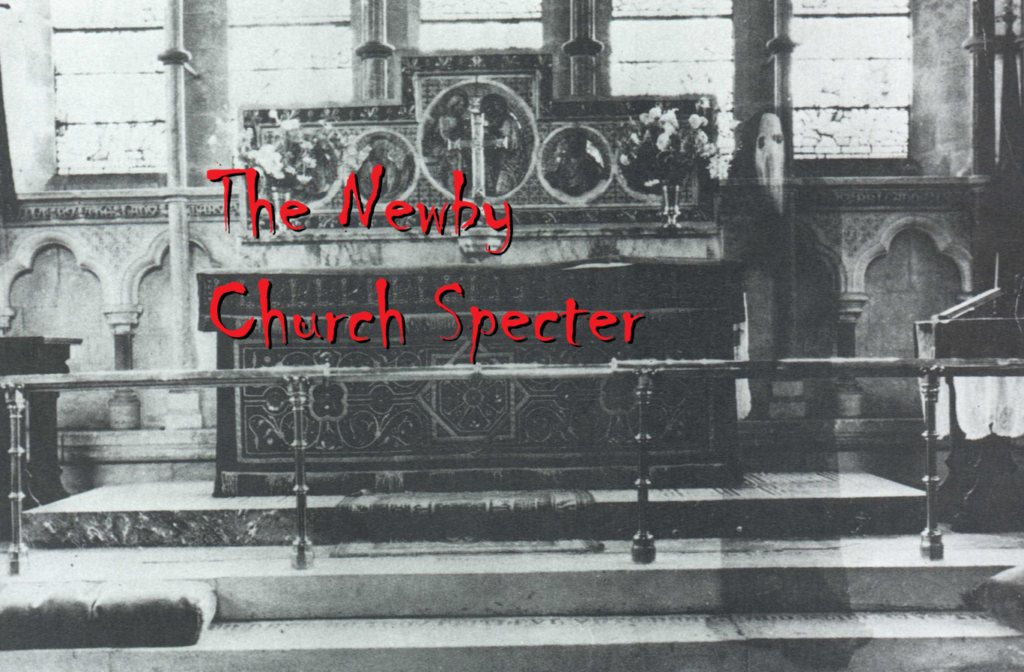
S05E35 The Newby Church Specter
Blake, Karen and Matt discover that this famous ghost photo isn’t as old as they expected, and perhaps not as mysterious either. Do we get it right? Do you have a different explanation? Let us know what you think.
The picture was taken by the Reverend Kenneth F. Lord inside the Church of Christ the Consoler, a Victorian Gothic Revival church on the grounds of Newby Hallin North Yorkshire, England. Despite the “medieval monk” legend that grew up around it – complete with claims that the shrouded figure stands some nine feet tall – the church itself was less than a hundred years old when the photo was made. It was built in the 1870s as a memorial to Frederick Vyner, a young heir murdered by Greek bandits, and designed by the architect William Burges.
🗓️ When Was the Photo Actually Taken?
One of the first things we ran into when researching this case is that nobody agrees on when the picture was made. You will see 1954, 1960, and 1963 all stated as plain fact in different places.
As of this recording,Wikipedia says the image was taken in 1963 and cites a 2012 source – which, as far as we can tell, is just repeating later paranormal-echo-chamber retellings rather than anything from the Lords themselves.
Two dates actually trace back to a primary source:
Around 1960.The earliest publication we have found is the August 13, 1967 article in The Sunday People (“Did the vicar snap a GHOST?” by Patrick Kent), which presents itself as the first publication of the photo. It gives no exact date but states the picture was taken “seven years ago” by Rev. Kenneth Lord – which points to roughly 1960.
1954.The 1954 date that keeps turning up traces to Arthur C. Clarke’s World of Strange Powers (1984), the companion book to the television series. On pages 122 and 123 the story is retold with details that clearly come from an interview with Rev. Lord and his wife.
So we have two candidate dates – 1954 and around 1960 – both apparently rooted in the family’s own account, plus a more recent 1963 date that does not seem to come from the Lords at all. We can’t say for certain which is correct, but it is worth noting that any date other than those two does not appear to come from the primary witnesses.
📰 “Even Experts Admit – We’re Baffled”
The 1967 Sunday People piece is worth reading in full. The paper’s own photographic department took the negative to the film’s manufacturer, who reported no signs of tampering or double exposure in the emulsion. The magazine Amateur Photographer was also consulted, and its expert admitted he was simply puzzled.
But the same experts also explained, on the record, how you could fake a very similar picture. Their do-it-yourself recipe: stop the camera down to a very small aperture, place a cloaked figure in position, expose for a few seconds, cap the lens, remove the figure, then uncap the lens and finish the exposure. The result, they said, should be a convincing “ghost.”
📷 The Camera: A Rolleicord
The make and model come from the Clarke book retelling, where Mrs. Lord describes the camera used; notably, the 1967 article also reaches for “a Rolleicord” as its example camera when explaining how the effect could be faked. You can read a detailed enthusiast write-up of the Rolleicord IV here.
One detail jumps out: the Rolleicord IV was one of the few twin-lens reflex cameras that allowed deliberate double exposures– a feature most TLRs of the era specifically prevented. That does not prove anything about this particular photograph, but it is a relevant fact to keep in mind when weighing the skeptical explanations.
📖 Book Mentioned
Arthur C. Clarke’s World of Strange Powers[affiliate] by John Fairley and Simon Welfare, with a foreword and epilogue by Arthur C. Clarke (1984). The retelling of the Newby case – and the source of the 1954 date – appears on pages 122 and 123.
🔗 References and Further Reading
- Spectre of Newby Church (Wikipedia)
- Church of Christ the Consoler (Wikipedia)
- Newby Hall (Wikipedia)
- William Burges, the church’s architect (Wikipedia)
- Arthur C. Clarke’s World of Strange Powers (Wikipedia)
- “Did the vicar snap a GHOST?” – The Sunday People, August 13, 1967 (Newspapers.com)
- Rolleicord IV camera reference
- Multiple exposure (Wikipedia)
SEO Transcript
This is not a fully accurate transcript, and was machine generated. It’s here for helping search engines find the episode but not intended to be a faithful transcript of the episode. (But it’s not AWFUL.) Some of the material in this transcript only exists in the Patreon/Premium edition of the show and was excised for the commercial version.
———————
Monster House presents…
This is the ad-supported version of Monster Talk.
We’re dependent upon the revenue from these ads and from the support of our patrons at patreon.com forward slash monster talk to continue making this show.
As a disclaimer, your hosts are unable to control what ads you will hear, and while we have done what we can to avoid ads that are divisive, the system that injects them sometimes ignores our preferences and always seems to ignore our efforts to not interrupt the conversational flow.
While we understand this can be disruptive, we’re trying our best.
Patreon remains the best way to enjoy commercial-free listening to our content.
Plus, you generally get extended coverage of the subject.
We’re working on other ways to consume our content as well, so please stay tuned.
Here’s a famous example made by a respected solicitor in a church in Arendelle, Sussex in 1940.
It shows a weird luminous figure standing in front of the altar.
And here’s another church ghost made by the Reverend Kenneth Lord in his church in Newby, Yorkshire.
And it shows a hooded figure with a ghastly skull-like face standing beside the altar rail.
Well, do these pictures really prove the existence of ghosts?
Or can it be that even when photographers are honest, cameras can lie?
It’s actually quite unlike anything we’ve ever seen before.
A giant hairy creature, part ape, part man.
In Loch Ness, a 24 mile long bottomless lake in the highlands of Scotland, it’s a creature known as the Loch Ness Monster.
Monster Talk.
Welcome to Monster Talk, the science show about monsters.
I’m Blake Smith.
And I’m Karen Stollznow.
Well, I can hardly believe it, but we’re finally doing another one of those shows that Karen and I categorize as things that scared the shit out of us when we were kids.
This time is a simple photograph of a church altar in England, only on the right side of the photo there stands a tall, ghostly phantom in the style of a Scooby-Doo cloaked specter.
This translucent figure appears to be wearing a cloth mask with eye holes, and the story behind the photo is as mysterious as the specter it depicts.
This week, we’re covering the newbie church ghosts here on Monster Talk.
Okay, so what are we talking about before we hop in?
What is our topic today?
Okay, so the newbie church specter, newbie, we’re not talking about Roblox or anything like that.
And not nudie, not nudie either.
No, no.
So this is a place in North Yorkshire in England.
Yeah, we’re talking about a very famous photograph that was taken in this church.
Yeah, I’m looking at the Ghost Photographs Caught on Film, which is a book by Dr. Melvin Willen, part of the SPR.
In the book, I’ll just show you this.
For the listeners, I’m holding up a book.
Oh, let’s see.
OK, I see.
Yeah, there you go.
It’s great.
Yeah.
So the it says location Church of Christ the Consoler, Skelton come newbie, Yorkshire, England, Skelton come newbie.
What?
Why is everything named like Lord of the Rings over there?
I swear.
Lord of the Rings is named like everything over there.
Oh, maybe that’s what it is.
Yeah, you’re right.
Maybe that’s what it is.
Yeah, I guess a little Anglo-Saxon naming.
It just, everything sounds so quaint and fun.
And I swear, when I started looking into this stuff, I ran into so many videos of British people doing ghost investigations.
And I, you know…
Unless I win the lottery, that’s not my life.
But man, there’s so many much older places and it seems so much more fun.
You’ll get there.
I’ll get old anyway, right?
When we were there last year, I just didn’t think about this.
particular case because we were in Yorkshire, which is a very large place.
So, yeah, I’m a little disappointed we didn’t manage to get there, but I don’t know.
Next time.
And Blake, I’m sure you’ll get there.
The black monk of Pontefract kind of distracted us a little bit.
Sure, sure.
It’s also in Yorkshire.
So there’s something about Yorkshire and monks.
We used to dream of having a monk.
If you’re interested in ghost photos, which is always ghost photos, great subject matter for podcasts.
But I mean, for real, I know we all three have spent countless hours looking at ghost photos, trying to recreate them and do all sorts of things with them.
This is a classic.
This is one of those scared the crap out of me as a kid.
Yes.
Yep.
One of the famous ones.
And it’s kind of a little newer than I thought it was.
Yes.
Kind of a newbie.
I had no idea it was such a newbie.
Indeed.
Yeah, but we’ll get into all of that because this is, yeah, this is a tough nut to crack, this one.
There’s a lot of, it seems quite simple on the surface.
Yeah.
There’s a lot more behind the scenes.
I would say that I found it interesting that this represents kind of an entire class of specific kind of ghost photo.
There’s a whole lot of photos of church altars with weird…
mysterious figures in them.
I mean, three or four pop right to mind immediately.
And I know there’s got to be more than that.
But people take a lot of photos in churches and sometimes weird things show up.
So yeah, I found that interesting today when I was trying to find more material on this, how many there are like this.
It is like this entire subcategory.
So yeah, we should add too that we have Matt Baxter joining us for this episode too.
Hi, everybody.
Matt did a lot of research into this because, like you said, Blake, this is one of those photographs scared the crap out of me as a kid too, but I don’t think I really thought too much about it.
I just assumed.
It was a hoax, but I didn’t really look into going into this with any great depth.
So Matt has done a lot of work into this, so it’s good to have him join us.
And I think we should talk a little bit about the history of the place too.
So you mentioned, Blake, the Church of Christ the Consoler in North Yorkshire.
Blake said it was the Christ the Counselor, didn’t he?
That too.
But I think what’s interesting about the place is that it’s old, but it’s relatively new in terms of England.
Very.
built between 1871 and 1876, and it was commissioned by someone.
So a lady, Mary Viner, and it was built on the Newby Hall estate.
And so she spent a lot of money.
It was basically money that she had put together as ransom money because her son, 23-year-old Frederick, had been captured by bandits in Greece.
So a very strange story.
And they…
unlived him uh and that didn’t go well unfortunately really really weird story but uh she she took that money and uh she built this church so anglican church what i find is really strange when you look at the photograph to me it looks very orthodox very kind of older catholic it doesn’t look well yeah the whole church is built in a in a neo-gothic style i guess
Yeah, it is.
Victorian Gothic style, but it’s only a couple of hundred years old.
And so when you think of churches and we think about Borley Rectory, the church there, Borley Church, you know, we’re talking 1100.
So old churches seem to range between about 300 to 900 years old and go back to Anglo-Saxon times and medieval Norman times.
So this is considered to be a newer church, but it is very beautiful.
It’s very ornate.
It’s lovely.
It’s lovely.
It’s really lovely.
It is.
I guess it’s the kind of place where you would find a ghost if you were to find a ghost.
Well, one would hope.
I mean, that’s the other thing is…
Those other churches often have their own history.
Some of them predate the schism with England and the Catholic Church.
So ghostly monks and ghostly nuns are de rigueur for that sort of thing.
And a lot of people have sort of applied folklore.
That’s my interpretation, saying that this is a monk or something.
But there’s no deep history for that to come from.
They’re doing a lot of the heavy lifting there with their own interpretations.
Well, yeah, I mean, I think a lot of people think it’s a monk.
And some people say, well, there was a monastery a couple of miles away.
And some people talk about it being an 18th century monk, which wouldn’t have been the case.
So others say, oh, no, correct that.
It’s 16th century.
Other people think it’s a shroud.
So not necessarily robes, vestal robes.
But I guess we’re going to get into that a bit more.
So I would urge readers, readers, readers, listeners, readers and listeners and viewers to go and check out this photograph.
Our hardcore listeners always read the transcripts.
Matt, do you want to give us a little bit of a kind of background on why this photograph was taken?
Do we even know?
Well, and that’s one of the fun parts.
If the standard narrative, if you go on, let’s say YouTube and you look this up, you’ll basically find out that Reverend Kenneth Lord, and how’s that for a great name?
We’re going to be vicar.
He photographs determinism.
Exactly.
Yep.
Yep.
Now.
He’s photographing the interior of the church for several reasons, I guess.
One of those reasons is he was going to make a postcard.
Another one was Christmas cards.
Another one, he wanted to send them to his friends.
So it’s kind of blurry on exactly why he took the photo.
No one was visible in the frame when he took the picture.
And then…
The figure appears only after development.
Spooky.
Now, of course, they immediately send this off to Kodak.
And they examine the photo and they say, you know what?
There’s no double exposure here.
The camera he used was double exposure proof.
It’s impossible for it to be a double exposure.
The image was authenticated right there.
Boom.
And we have instant sort of mythology.
Yeah, this will not be the first time longtime listeners will recognize that the endorsement by Kodak used to be the gold standard for this could not possibly be fake.
Right.
So do we know if it was truly sent to Kodak?
Or not?
Another good question.
Sometimes those stories emerge, you know, years later.
My reading suggests somebody really did do that.
But I guess for me, the question is.
Does it matter?
Because Kodak, basically, their determination would be, does it look like the film was tampered with?
And there’s so many ways to do these kind of photos without tampering with the film.
Yes.
That’s a distinction that I think a lot of people don’t make.
Exactly.
Well, I think we talked about that with the Cottingley Fairies as well.
And the Watertown.
Yeah, yeah.
So, yeah, it is, it’s a recurring, it’s almost, so you know how in folklore they have motifs that are recurring motifs?
This feels like a skeptic motif, like this recurring thing that comes up in skeptical discussions of trying to understand what’s happening in these allegedly paranormal photos.
That’s that that is the Kodak or some photographic agency certified it.
And the other one is private investigator firms were hired to research.
And, you know, that kind of you’re looking for an authority to tell you, look, we can’t say it’s paranormal, but we can 100 percent say that nobody tampered with it.
Right.
So.
Yeah, which is not actually what Kodak is saying, but I think that’s the argument for giving it more endorsement from authority.
Exactly.
Yeah, it is a difficult thing because…
Nobody actually knows.
There’s no documentation that we’ve been able to see.
Nothing’s been sort of presented publicly on exactly what they did, who did it, you know, and there should be documentation and there is none.
So it is hard to say, but they did not say this is a ghost.
That’s the bottom line.
They didn’t say that.
What I think is interesting too, Matt, that you found out with the Cottingley Fairies, we talked about the camera, the model, the make, the history of this, of who owned the camera and what was done with it.
But with you looking into this, it seems like we’re not entirely sure what kind of camera was used and we’re not sure about the skill of the Reverend Lord, whether he was a skilled photographer or whether he was an amateur.
What do we know, if anything?
Go ahead, Blake.
I was going to say, I found a newspaper article where Reverend Lord gives an interview, and it’s the only interview I found with him.
And is this the psychic news retrospective?
It was it was the the Sunday People from August 13th, 1967.
OK. And what I thought there’s a whole but this is the only interview that I found.
And I feel like I should put at least for the patrons, I’m going to put this in the show notes.
But this was from newspapers.com, which we only have a subscription to because of the patrons.
So thank you, patrons.
This article was an interview conducted in 1967.
And it has the photo and I don’t, I have not been able to find a pre 1967 publication of the photo.
So this may be the story that got it out into the wild.
So later.
Okay.
But here’s the really weird part.
Okay.
If you go onto Wikipedia and look up this ghost, which we’ll put a link to in the show notes.
And of course this is subject to change because anyone can edit Wikipedia, but.
Their dates, I believe they gave the 1963 date.
That’s what you hear in terms of the folklore.
That’s whatever it is, it’s 63.
Here’s a little quick insert about the dates.
One of the first things we noticed when we started digging into this case is that there are multiple dates alleged for when this photo was taken.
At the time that I’m recording this, Wikipedia says, This image was taken in 1963 by the Reverend Kenneth F. Lord.
And that date is backed up by a reference to a 2012 source that is from a newspaper.
Now, we can’t know for sure when this photo was taken, but we do have two better references to look at.
First, we have an article in the Sunday People from August 13th, 1967.
This article purports to be the first publication of the newbie photo.
It does not provide a specific date for the photograph being taken, but it does say it was taken seven years ago by the Reverend Kenneth Lord.
which would put the date of the photograph around 1960.
The 1967 article mentions that the newspaper had its own photography department take the negatives to the, quote, makers of the film, quote, who did not see signs of tampering.
Their experts also told the author how to make a convincing photo in the same style by using the long exposure method with a lens cap, which we discuss further on in this episode.
So a 1960 date would be a reasonable candidate.
But when I was doing other research, I kept running into a different date, that being 1954.
Now, where was this number coming from?
I will spare you all the details of the hunt, but it was a very satisfying research project.
And a little bonus delight was that when I ran down the source, which was the 1984 Arthur C. Clarke’s World of Strange Powers companion volume to the TV series, I already had that book on my bookshelf.
It was very exciting.
So sure enough, on pages 122 and 123 is a retelling of the story of the newbie ghost photo.
And it seems obvious from the text that the book
did some kind of interview or interrogation with the Reverend Kenneth Lord and his wife.
They give details about the make and model of the camera used, and while the 1967 newspaper article said that the experts took the negatives to the makers of the film, in this retelling, Mrs. Lord specifies that Kodak itself examined the film and found no tampering.
and that an independent photographer examined it.
Again, this is completely consistent with her recalling the 1967 investigation by the journalists with The People.
So, 1960 or 1954, what we do know is that the Lords were not going to fall for that old trope about how we know they weren’t lying because their story never changes.
But it would appear any other dates besides 1960 or 1954 are not coming from the primary source of either the Reverend Lord or his wife.
So links to those sources will be in the show notes.
Excluding tampering with the film does not mean that the photo was not able to have been faked.
It just means that whatever was being done may have been done in camera without the need for tampering with the actual film.
But the camera’s type is a RolioCord 4, that’s IV, with a 75 millimeter lens, which has a six by six square aspect ratio negative.
Now, this matters because all the discussions about sending the negatives for study and all this research around it.
you will not find a square aspect ratio copy of this photo.
So much like the Watertown ghost, every photo you see has been cropped.
Why?
I don’t know.
Probably for dramatic focus on the part of the image that’s interesting.
But it does cut down on our capability to do a full analysis of the photo if we never get the full photo.
Just a little complaint there.
Well, and that’s absolutely true.
And, you know, you look at the photos being shown online, and they’re so degraded from, you know, reproduction after reproduction.
And the Rollycord 4 was a decent camera.
It’s a…
You know, you got this waist level viewfinder and it’s 120 roll film.
It’s a fairly serious, you know, camera that you’re using here.
So whoever did take this picture wasn’t a newbie when it came to cameras.
You know, they kind of knew what they were doing enough.
So, and yes, that camera also did make it more difficult to accidentally get a double exposure.
But you could absolutely trick the camera into making a double exposure as well.
So it’s…
You know, that whole thing is absolutely impossible to be a double.
No, it’s not true.
It’s not true at all.
But, yeah, that’s a huge thing.
When a picture is cropped like that and you’ve got the way it’s cropped, you’re showing the ghost to be sort of toward the right of the photo.
what part of the picture was cropped because if the picture that would have been taken directly before that or after that, have the guy in costume ready to jump in, you know, and, and, you know, be ready to, to, to take a, a slow shutter picture.
Um,
We would see that in either the one directly before it or the one directly after that.
You could probably see, and that’s why they cropped it.
Now, this is all just guessing at this point.
It’s not even educated guessing.
It’s just guessing.
But there’s too many holes, and the way this story came out, it was so sort of prepackaged.
You know, it was all ready to be a legend immediately out of the box.
And that’s just strange.
And then now we’re finding out that the date we’re being fed is not even accurate.
Yeah, and I found a – this is an old, old, old, old website from back when the internet was people who knew stuff.
It was on GeoCities originally, but it was – Oh, wow.
Isn’t that Geocities?
That’s funny.
People –
People with expertise used to take the time to build sites to share their knowledge.
And I should put a link to this in the show notes.
Here’s a little excerpt.
It says, The Rolio cords aren’t as luxurious to handle as the T or the more expensive 3.5F models.
The shutter release is primitive.
Slide the little lever under the taking lens over to cock the shutter.
Squeeze it to fire.
A little bonus with the 4 is that you can make double exposures, something that’s not possible with most TLRs.
However, they’re a good beginner’s camera and capable of results to match the T. Hmm.
Selling.
Yeah.
Yeah.
I actually found a website that gives instructions on how to do photos like this with that camera.
Okay.
So it can be done.
But I still have so many questions.
And so we’ve talked a little bit about the photograph and how it could have been cropped.
What about the quality?
So, all right, the original wasn’t tampered with, but what about the version that we see everywhere, splashed on the internet today, on YouTube, in books?
It does seem a little bit different to the original one.
And I’ve only seen…
fleeting glimpses of the original one, and it looked different.
It looked a lot darker.
Matt, can you tell us a bit about this?
Well, actually, I want to note, Blake, you’ve got that book there.
How does the picture look in that book in comparison to what you largely see on the internet?
Faded, not nearly as crisp.
And that’s one of the big things right there.
I think that’s the point.
The contrast, I think, has been cranked up on so many of these to bring out detail that actually was never even there.
So I’m doing a lot of this episode.
I’m nodding vigorously in agreement.
I don’t know if you can get a snapshot or something of the photo, the way it looks in that book for the show notes to do a comparison with what you normally see online.
Yeah, I think that that itself would be very telling for it.
I’ve been really working hard on improving the show notes for the show and putting a lot of extra material in.
And in this one in particular, I found a lot of people who went and tried to do recreations because I guess one of the claims we’re about to get to is how tall is the figure in the photo?
Mm-hmm.
and people doing recreations, that kind of stuff.
You’re going to need to go to the webpage at monstertalk.org and look at the show notes to see these.
But I’ll aggregate a lot of material there for you.
Well, I did just want to hearken back to something that Matt said a little while ago, and that was talking about…
that this is the only shot that we have from that series.
Yes.
And that there’s no before shot and no after shot, which could be telling.
And Matt, I just wanted you to tell your little story again about why that’s important.
My little story.
I was just going to say, because you will not believe how much weight that ghost has lost between the before and after.
It’s amazing.
Taking ghost zimpic.
It was stuffing his stomach in.
Exactly.
I think it was all lighting.
But years and years ago, there was a paranormal group that wanted to do an investigation of a local place called the Brook Forest Inn in Evergreen, Colorado.
And they told them, the Brook Forest Inn told this group that you cannot do that unless you involve Matthew Baxter somehow.
And so what was agreed upon was that I would give them a short course on how to do a more skeptical, more critical thinking style of a paranormal investigation.
And one of those things that I told them to do was don’t run around taking pictures in the dark and don’t think you see something in one picture and throw away all the rest.
So they did exactly that.
They ran around and took pictures in the dark.
And then they sent me one picture is like, what is this?
And it was basically a very, very, very, very dark picture that you could barely see.
So I said, well, where’s the pictures before it and after it?
Oh, we threw all those away because there wasn’t anything in them.
Nothing interesting.
Yeah.
Yeah.
But what those photos would have told me is where they were in the building when that picture was taken.
So what I ended up having to do is lighten it and lighten it and lighten it the best I could.
And it started to look like some sort of beast, you know, a demonic beast, like a possessed dog or something.
And so I’m thinking, what the heck is this?
So I had to actually drive up there, up to Evergreen, and walk around until I saw something that sort of matched what it could be, you know, with pareidolia and everything.
And finally, I did find it.
They took a picture of a picture hanging on the wall of a stone lion statue.
I love that story.
Yeah, you’re enlightened.
Yeah.
But I mean, that’s just one reason why having pictures before and after are important.
Yeah, I agree.
Not even just to tell you where you are, you know, in the course of things, but you don’t know what’s happening with the lighting.
You don’t know what’s happening with, you know, whether or not somebody was walking out of frame or you just don’t know a lot of things that can be answered by having pictures.
Pictures taken before and pictures taken after.
So we’re missing information with this case.
Exactly.
So you have this one picture in isolation and it becomes the entire story.
And that’s a problem.
It is.
This photo now is probably, we don’t know the exact date, but we could say more than 70 years old, right?
And it’s been subjected to all sorts of photographic analysis.
People have gone and tried to do recreations.
But there is a, I don’t know, it’s not in some field of study, but there’s a kind of expertise around photography called, oh, Lord, I’m going to mess this up.
I read it all the time.
It’s one of those words I’ve never said before.
Paradigm.
Yeah.
Once I cross this chasm, we’ll be right to the end.
Photogrammetry?
Photogrammetry?
Photogrammetry.
Photogrammetry.
This is studying photos to determine the internal geometry of the photo using reference points.
Because you’re basically trying to get a 3D understanding of an area by using 2D analysis.
Wow.
Does that stem from medical?
I’ve mostly heard about it from anthropology.
But it’s really geometry and trigonometry at play.
But what you can do, what nobody seems to have bothered to have done, which would be useful…
People have done a lot of recreation photos, but you got to remember that the focal length of the lens can affect how things appear.
So one way to sort of remove that as a factor is to actually go to the site, find the distance between the railing.
and the altar, and then measure those elements so that you can actually sort of have a 3D understanding of what the geometry looks like.
And given that information and the ratio change between the background material and the foreground material, it should be possible to get a really accurate understanding of how tall this figure is.
But since the 1970s…
The general ghost literature calls this a nine foot ghost.
Yeah.
Right.
Right.
Which makes me think about parallels to Bigfoot too.
Oh, he’s eight feet tall.
Oh yeah.
Yeah.
He’s Bob Hieronymus tall.
Six foot four.
I’m inclined to think that this ghost is a little more than six feet tall, but that’s exactly how…
I feel like it’s probably possible to determine exactly how tall.
There’s ambiguity around the footing because we can’t quite tell whether the ghost is on the ground or standing on a box because there’s a shadowy robe-like structure…
He’s floating.
…cascading down over the stairs.
But we could get some pretty solid…
I think, well, that’s kind of a funny word, but I think we get some fairly accurate guesses about how tall this figure is.
But I am inclined to think a little over six feet.
Yeah.
Yeah, and I tend to agree.
I know that there have been people there that have kind of tried to recreate it and have shown that, you know, as much shorter people can give that same illusion of being that high.
But then again, we still don’t know, you know, the focal length or anything else.
So it is hard to say.
I absolutely agree with that.
And you have to wonder, did a man measure it or a woman?
Because it would be more accurate if it was a woman.
Or if it was a fisherman that measured it.
We’ve got all these questions.
One got away.
So what I wanted to ask is one of the biggest skeptical theories that I’ve heard about is the vestments theory and using double exposure.
And so the idea is that the image was created using or by draping church robes and vestments over the altar of steps and then combining that with a double exposure.
And apparently there was a common trick in early photography.
So I don’t know if that’s correct or not, but gives that illusion of this hooded, towering, semi-transparent kind of entity.
Do you think that that’s a possibility in terms of explanations for the photograph?
It makes more sense than a ghost.
In a nutshell, yeah.
I mean, if we’re at the point where we want to discuss our hypotheses about what’s really going on here, I, a lot.
of discussion has been about camera artifacts or, you know, accidental things.
I’ll be blunt.
This to me looks entirely like a hoax.
The figure in the photo looks too much like a person wearing a hood and a cowl, uh, cloak kind of combo.
Uh,
And to get around the question of whether it’s a double exposure or not, I don’t even think that’s necessary.
I think a timed exposure.
I agree.
I agree.
What’s the difference then for someone like me?
What’s the difference between timed exposure and double exposure?
If you set a time exposure, it opens the camera to the light for a long period of time, so you get more detail.
But it also means that if something moves through the scene quickly, it pauses and then moves out, it can appear translucent, like it only partially appears on the film.
Or the Cottingley Ferries.
Those were long exposures and timed exposures, I guess you could say.
And the thing with those is that you see the water running in the back is blurred.
Absolutely.
Yep.
And this camera did have a long, it had a very variable exposure setting.
So that is possible with this camera.
I guess the simplest, simplest way to say it is you’re basically taking two pictures on the same piece of film.
over the same, you know, picture area.
So yeah, like you don’t, some of the cameras required you to manually forward to the next frame.
And if you didn’t, you remember that you could take two snaps.
Yeah.
Yeah.
You could take two snapshots on the same area of negative and both would kind of bleed together and make something what most people would call trash.
But every now and then that trash would turn out to be something mysterious.
Yeah.
Yeah.
When I was a kid, I took one accidentally of my box turtle eating the side of our house.
It was a giant turtle.
And that was great.
But yeah, so it’s double exposures are wake perspective.
Yes.
Double exposures are awesome.
But yeah, with the timed exposure, a long exposure.
It is, it’s a lot of times they were done with the lens cap.
So you would take the lens cap off.
I’m clapping in agreement.
Yeah, sorry.
Yeah.
And until, you know, you’ve enough light had got on and you put the lens cap back on.
Well, what they would do if you wanted to do a great timed exposure fraud shot is you would have it all set up with the person there, you know, that you want them to be translucent.
And you take the lens cap off and you get just like a few moments of that.
You put the lens cap back on.
They get out of the shot.
And then you take the lens cap back off and everything else is sharper and brighter.
in the picture except for that anomalous figure.
And the reason you do the lens cap trick is because it keeps you from seeing the sort of motion of them moving through the frame.
One of the other ghost photos they look at is another one in a church.
And in this one, there’s a weird figure.
and there’s an arc of light moving up, and the photo…
It’s an angel.
Well, what happens to the analysis people look at is like, look, you can literally hear them sort of deciphering what’s going on.
The arc of the light, the little arc, is going towards a candle, and they realize what’s happening is a long exposure shot, and someone’s moving through the frame, lighting the candle with tapers.
And so that’s what they’re seeing.
It’s very weird looking until you realize what’s actually going on.
It’s like, oh, of course, right?
It makes perfect sense.
But in this case, by doing a lens cap type thing, you eliminate all that blur.
You just get a nice crisp two shots together.
But what, very importantly, it would pass the Kodak seal of approval.
No sign of a double exposure, right?
It’s like…
In this home office laboratory is the world’s most advanced equipment for the examination of photographs.
Using a computer, forensic experts help the police to snare criminals by enhancing photographic images to bring out hidden detail.
Today, the computer is focused on the phantoms.
The photographs are optically scanned and fed into the computer for analysis.
But what about the sinister figure snapped by the Reverend Kenneth Lord in his church at Newby in Yorkshire?
Even the most rigorous computer analysis cannot provide a simple photographic explanation.
I don’t think at this stage there’s anything unusual about the picture at all.
So I think our conclusions from this is that it’s unlikely to have been built up by a superposition of photographs.
So this could be a candidate for a ghost.
Although a very few photographs are difficult to explain away, not a single one of them offers convincing proof that a ghost has been captured by the camera.
And this, I believe, provides conclusive evidence about the nature of ghosts.
For more than a century, millions of cameras have been clicking all over the world.
By this time, there must be billions of photographs in existence.
If ghosts could be photographed, by now we’d have entire galleries full of portraits.
But we don’t, because these images exist only in the minds of the observers.
I believe that ghosts are at least as real as dreams, and no one has ever photographed a dream.
Yet one day, that might be possible, and then we’d have cameras that could really capture ghosts.
Well, another question.
If we want to give the benefit of the doubt to Lorde, could this be an accident?
In my opinion, no, absolutely not.
This is totally a fraud.
OK, yeah, I said it.
I mean, it’s it’s a guy dressed in a costume with a hood pulled over his eyes, like, you know, with the the eye holes cut out from like a pillowcase or something.
Things happened like whoops.
Well, see, I was I was late to my Klan meeting and ran through the church.
Funny you should say that.
The face does look a little bit like a kind of, you know, sweet ghost boob.
The thing that I’ve noticed nobody has said, they’re saying, oh, it’s a monk.
Oh, you know, but that doesn’t look like a monk’s face.
You know, robes.
And then they say, oh, well, it’s someone that’s got bandages on their face.
Well, it doesn’t look like bandages.
No one has said it looks like death.
It just doesn’t have a sign.
Yeah, it’s just not playing chess or whatever.
Yeah, exactly.
But no, the thing is, hey, scythes don’t matter.
That’s what I’ve heard.
Yeah.
Yeah, yeah, exactly.
But nobody says that.
And I find that interesting because that’s the first thing I think of.
But back to the whole thing of could this be an accident?
Let’s just say that I agree with Blake.
But if we were going to say between it being an actual ghost or it being an accident…
there’s far more accident photos than there are ghost photos.
So, again, it’s more likely to be an accident than it is to be a ghost, but it’s more likely to be a hoax than it is to be an accident.
And do you think it could have been…
Here’s another theory I’ve heard.
Someone playing a trick on the reverend.
I mean, it’s got a long exposure setting, but not that long.
Somebody had to be standing by…
in a costume, ready to hop up on the steps.
But he also said he was taking the photos because he wanted to make a series of postcards as a fundraiser.
Ironic, isn’t it?
What about the Christmas card?
I’ve had so many different theories.
Oh, that’s funny.
I guess my question is, if you’re making postcards for the church to raise funds, surely the ghost photo is the one you want to make into a fundraiser.
I mean, that’s awesome.
Yeah.
Well, didn’t he claim too that he didn’t want it to attract more people to the church or ghost hunters or anything like that?
Yeah, he implied very strongly that he was not a publicity seeker.
And again, there was a big gap between the time the photo or some kind of gap between the time the photo was taken.
Reminding me too, just briefly, you mentioned the interview that he did with the media.
Matt, you mentioned some other…
newsletter or newspaper or something.
Were you being facetious or was this another interview?
No, it was, it was, uh, another story.
It was a retrospective and it might’ve referenced that interview, but it was in the, what I said, the psychic times.
No, that’s actually true.
There was, that’s how I found out.
That’s how I found out it was the, the roller cord, uh, for camera.
Um, but so, you know, Blake and I came to the same conclusion off of a different trail, uh, which is pretty cool, I think.
Um, but, uh,
In that particular story, he says that he had just become the vicar, and we really do need to find out if we can see when he became vicar, because that will also help us find out if he’s telling the truth.
Right, if it was 54 or 67.
Right, yeah.
But he had just become vicar, and he wanted to take some pictures of the church, the inside of the church, for his friends, to send to his friends.
That’s what was said in that particular interview.
Yeah, the story changes a little bit, which is in line with— Another hallmark.
Mm-hmm, mm-hmm.
So I was trying to find information about the Reverend Lord, which doesn’t that sound like some kind of special title?
Anyway.
Oh, it sounds like an email from a Nigerian prince or something.
Dear Reverend Lord.
Yeah.
But aside from that article about the original ghost photo, the only other thing I could find was in 1970, there’s a strange article that says, Anne, the girl with two fiancés,
And it’s about this woman named Ann Collins who wants to marry a guy who is in Brazil.
And because of some problems with timing and trips and immigration and rules, they got permission to do a proxy wedding, which I have never heard of before.
I don’t know what exactly.
Basically to have another guy stand in for the groom so they can do the wedding.
Was he dressed like the Grim Reaper when he stood in?
Well, it says they found that Anne would only be able to get a temporary three-month visa unless you were married.
So John’s father, the Reverend Kenneth Lord, Vicar of Skelton, tried to arrange a proxy wedding with Christopher taking John’s place.
They got permission from the Church of England, but the Brazilian authorities would not accept the plans.
They were trying to save a 400-pound airfare to England, but now John will have to make the journey, said Anne.
So this is the Reverend’s son in Brazil trying to get a friend to cover for him for the wedding.
I’ve never heard of anything like that.
And that’s the only other newspaper article I found concerning the vicar.
So the only thing that we’ve heard about him are two different stories that are slightly suspect.
They’re a little sus.
They are a little sus.
Yeah, but yeah, it just does.
Matt and I were discussing this behind the scenes.
Could the reverend be lying?
And it just made us think about the episode that we just recorded about the devil’s footprints and the reverend in that story or thinking about Reverend Foister in the…
It’s all the kangaroos.
Yeah, that there are precedents for reverends lying.
But I just wonder what was his point?
Because if he goes on record and says, look, I’m not wanting to attract attention, what was his motive if this was a hoax?
Yeah.
Sometimes you do things just to see if you can get away with it.
Bit of fun.
Indeed.
I mean, it’s all super sus to me.
But also, I mean, let’s assume because I kind of agree with Matt that it’s probably a long exposure.
So a little bit of work has to go into play here.
Right.
And two people have to be involved to do the little lens cap trick or he’s an elaborate machine maker, you know, like to build a little device.
But I think the most likely scenario is he has an accomplice.
Right.
And he says in that article, again, from the Sunday People in 1967, that he was going to make photographs to do fundraising postcards.
Fundraising, okay.
Where are those fundraising postcards?
Like, I mean, did they come into existence?
I don’t know, right?
Right, yeah, nothing more came of that.
Yeah, that is strange.
Again, if you’re going to make postcards, the one with the ghost is probably going to be the bestseller, right?
But, you know, I don’t know.
So anyway, it’s an interesting article.
It’s certainly an interesting photograph, but the biggest shock for me looking into this was I had no idea.
that this photo was from the sixties or slash fifties, because I assumed this was from the height of spiritualist photographs in the twenties and thirties.
1920s.
That’s what I thought too.
That’s exactly what I thought.
And I did assume that it was a hoax, but I, I couldn’t explain it.
I don’t have the knowledge of photography that Matt has and that you have.
And, but I still just thought, Oh, that’s a hoax of some kind.
Yeah, well, Nigel Bundy, who sent us this, what he sent was actually a really interesting YouTube video, which we’ll also link to.
But he’s always sending me really cool stuff around ghosts.
It’s just…
This is a classic, this one.
It really is.
But the Ghost Club has been around for ages.
And in many ways, it’s sort of the, I guess, the longest lived sort of…
They’re not professional exactly, but longest lived investigative social group for looking into this kind of material.
And what I like about them is that not only did they look at the allegedly real ghost, but they also love a good ghost story.
So, you know, that doesn’t really matter whether or not it’s…
Potentially real or not.
We should probably talk about them too, with all the connections.
Absolutely.
So Conan Doyle and Charles Dickens.
So many, so many.
So I, I, between them and the SPR, you know, a wealth of material that has shown up on the show originates.
So much appreciated.
Yeah.
Well, I think we’ve kind of given away our perspectives.
As to what we think is behind this.
I do want to send over, Blake, a copy of the PDF of the Psychic Times that actually had this article in it.
And what was said in this particular article was…
He took the photos right after he became vicar.
He did it to send to some friends, and a dozen photographs were reportedly taken, and one other person was present.
I bet they were.
Yes, yes.
So very, very interestingly, supposedly it was like an assistant in taking the pictures and everything.
I mean…
As a child, this photo haunted me, right?
Legit haunted me.
Me too.
As an adult who’s… Oh, my God.
I don’t… Karen, and you too, Matt.
I mean, how many hundreds or thousands of ghost photos have we looked at?
It’s a lot, right?
Yeah, like seven or something.
It’s a lot.
It is.
But now going back to this now, it just…
Looks like distinctively phony to me now in a way that it looked distinctively real or plausible.
When you were five.
Yeah.
Well, you remember the whole thing with, was it the Usborne books?
Oh, yeah.
The Walsingham.
Oh, yeah.
The Walsingham ghost.
Yeah.
That scary blue face.
It was just terrifying.
And then we find out it’s Lon Chaney.
Lon Chaney.
Which is pretty scary.
Yeah, so when you’re a kid, the things that scares you makes you laugh when you’re older.
Yeah, a lot of times.
Except the monster under the bed, obviously.
But I still love the photograph.
It just reminds me of my childhood and just makes me think about all the mysteries in the world.
So I still do love it.
It is beloved.
It’s beloved.
Interesting to take a deeper look at it and take some new perspectives and come up with some possible explanations for it.
Makes it less creepy, but still fun.
I’m sort of imagining that the vicar is Simon Pegg and Nick Frost is his assistant.
And they’re doing they’re faking the photo in the church.
And then it’s like, dude, you know, where did you get the the the pillowcase?
He’s like, oh, I borrowed it from my house.
Your mom’s going to kill you.
It’s like you could definitely go south.
All right.
So but it really not leprosy.
No, well, that’s the other thing.
All these little, the folklore around this stuff is always like, it’s a monk and he had leprosy and these are leprosy bandages.
It’s like, why not syphilis?
I mean, come on.
You go straight to leprosy because of the well-known leprosy problem, right?
No, no, syphilis.
Come on, the nose falls right off.
By that time, it would have been syphilis.
But yeah, it’s…
Again, I’m not too sure.
I thought it looked like a skull almost when I was a child.
As a kid, I agree.
It looked like a skull.
As an adult, it looks like a Klansman.
Which is much more scary.
Very frightening.
Well, I feel like we’ve provided ample, plausible explanations for what’s going on.
I don’t think, unfortunately, all the mystery in this one comes down to how it was faked, honestly.
Exactly how did they fake this?
Exactly.
This is not the Patterson-Gimlin film.
This is…
So it is a shockingly, what is it, retro, I guess would be the right word, considering the way it appears and when it popped up and everything.
But I still love it.
I really do.
Let’s think just for a second, though.
So we’re talking about the new perspectives on the Patterson-Gimlin film, and that’s the same era.
So I think it’s likely that more information could come to light.
There had to be someone helping.
I’m shocked there hasn’t been a deathbed confession or something.
Church lady or something.
I’m getting suspicious.
Yeah.
It’s very sus.
Very sus.
Could the assistant be Satan?
Aha.
Well, again, thank you to Nigel Bundy for sending this in and prompting us to talk about something we’ve known about for decades but never bothered to talk about.
Yeah, no, that definitely motivated us to get this one done, finally.
Indeed, indeed.
And thanks for joining us, Matt.
Thanks, Matt.
Love the new recording equipment.
You sound very mature.
Thank you.
Sound.
All right.
Thanks a lot, guys.
And good night.
Okay.
Good night.
Thank you.
Monster Talk.
You’ve been listening to Monster Talk, the science show about monsters.
I’m Blake Smith.
And I’m Karen Stollznow.
You just heard me, Karen, and guest co-host Matt Baxter discussing the famous ghost photo of a specter in Newby Church.
Check our show notes for links for further reading.
While the producers of Arthur C. Clarke’s show couldn’t definitively prove the photo is fraudulent, we here at Monster Talk are leaning very strongly on its technical and stylistic resemblance to numerous known hoaxes from the history of spirit photography to reach our own skeptical conclusions.
We know how to produce photos like this with the camera used, and such hoaxes look just like this one.
It does remind me a bit of Bob Gimlin allegedly being taken in by Roger Patterson’s Bigfoot setup.
versus being an active participant.
For me, that’s too much of a stretch.
And similarly here, people speculate how the photographer might have been duped by pranksters.
It’s much more parsimonious to conclude that the Reverend Lord was being a bit irreverent when he took this photo with the help of an accomplice.
We hope you’ve enjoyed this episode of Monster Talk.
Each episode, we strive to bring you the very best in monster-related content with a focus on bringing scientific skepticism into the conversation.
If you enjoy Monster Talk, we now have a variety of ways to support the show, all with convenient links at monstertalk.org forward slash support.
That’s monstertalk.org forward slash support.
We have links there to our Patreon page as well as a donation button.
Another great way to support the show is to buy books from our Amazon Monster Talk wishlist, which directly helps us with our research.
We love used books very much, so don’t feel compelled to buy new ones.
And we love Kindle so we can share our digital libraries with each other.
And finally, without spending any money at all, you can support us by leaving a positive review at iTunes or wherever you get your podcasts.
Positive reviews help keep us visible in iTunes, which is a great way to help us find new listeners.
And please share our show on your favorite social media platforms.
Monster Talks theme music is by Pete Stealing Monkeys.
This has been a Monster House presentation.