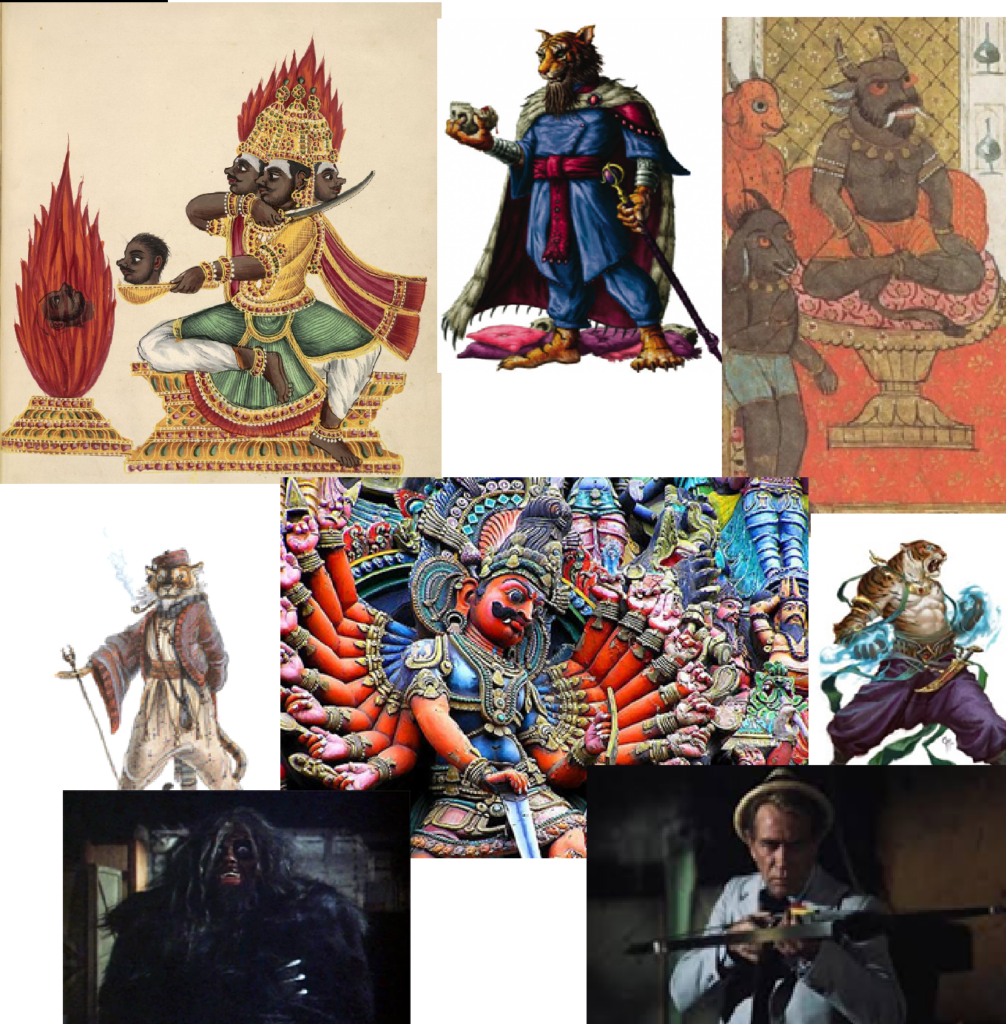
S05E34 – Rakshasas
Most Americans meet the Rakshasa in exactly two places: a 1974 episode of a beloved horror TV series and the pages of the Dungeons & Dragons Monster Manual. Both versions give you a debonair, tiger-faced shape-changer with a taste for human flesh – but neither prepares you for how deep, how old, and how genuinely alive these creatures are. To dig us out of that pop-culture foxhole, we sat down with academic researcher Eric Zsebenyi for a tour that runs from the Rig Veda to the Ramayana, into Buddhism, through present-day Sri Lankan politics, and finishes at the tent-shaped tomb of a very naughty Victorian translator.
🎙️ Our Guest
Eric Zsebenyi holds a master’s degree from Naropa University (2000) and has pursued Buddhist studies as a lifelong avocation alongside a career as a civil servant. His path to the Rakshasas began with a Dharma protector named Vetali in his own meditation practice – which, as you’ll hear, leads straight back to one of India’s stranger monsters. Blake met Eric at the recent Gods & Monsters Conference, where Eric delivered a paper on the Vetala.
You can find Eric’s work here: Eric Zsebenyi on Academia.edu
📺 Where Most Americans First Met the Rakshasa
The audio at the top of the episode comes from Kolchak: The Night Stalker, Season 1, Episode 11, “Horror in the Heights,” which first aired on ABC on December 20, 1974. In it, reporter Carl Kolchak investigates a string of grisly deaths among elderly Jewish residents of a Chicago neighborhood – a story laced with spray-painted swastikas that turns out to be a misdirect. The real culprit is a shape-changing monster that appears to each victim as the person they trust most.
It was the only Kolchak script written by Jimmy Sangster, the prolific Hammer horror veteran. The guest cast is a parade of familiar faces, including Phil Silvers, Herb Vigran, and the always-welcome Murray Matheson as the antiquarian master of exposition. You may also know Matheson as the clown in the classic Twilight Zone episode “Five Characters in Search of an Exit” and from the series Banacek.
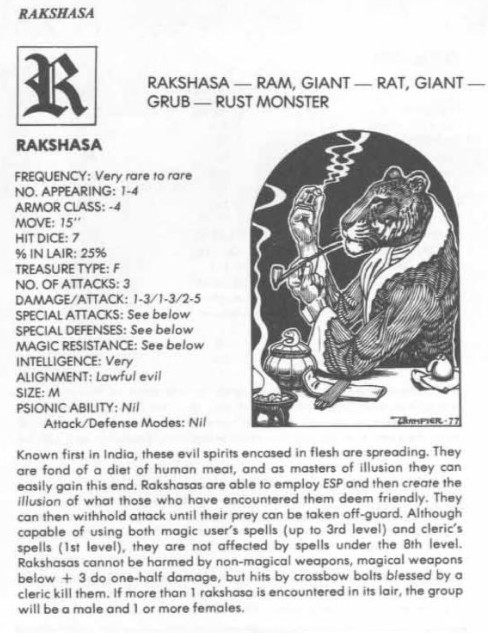
The other great American gateway is the first-edition AD&D Monster Manual (1977), where Gary Gygax gave us a tiger-headed, pipe-smoking humanoid in a fur-trimmed silken robe – a flesh-eating illusionist that can only be reliably put down by a crossbow bolt blessed by a cleric. (Where, you might ask, did a crossbow bolt come from? Listen for Eric’s theory.) The Rakshasa’s now-iconic backward-facing hands didn’t arrive until the 1989 Monstrous Compendium, which added a note that their palms seem to commonly curve backward – a detail artists soon turned into a visual “tell” for players.
📜 Into the Texts: From the Vedas to the Epics
The Rakshasa goes all the way back to the Rig Veda (composed roughly 1500 BCE), with linguistic cousins in the Avestan language of early Iranian religion. In the earliest layers they’re called rakshas, a word that carries a double sense of “one who guards” and “one who injures” – fitting for entities that sorcerers summon to disrupt the Vedic fire sacrifice. Eric walks us through how the Vedas sit at the foundation of a layered literature (Brahmanas, Upanishads, and onward) in which nothing is ever quite superseded.
The Rakshasas reach their peak as antagonists in the great epics, the Mahabharata and especially the Ramayana. Their king is Ravana – originally named Dashagriva, “the ten-necked one,” and renamed (roughly) “the roarer” after Shiva pinned him under a mountain and set him howling. Granted a boon by Brahma that he could not be slain by gods or demons, Ravana dismissed mere humans as beneath his notice – so Vishnu incarnated as the human prince Rama to undo him. (If “no man can slay him” rings a bell, you’re not alone.)
🔥 How to Ward Off (or Outright Kill) a Rakshasa
Because the early Rakshasas attacked the sacrifice, the natural countermeasure was the fire god himself, Agni, who could be invoked to burn them up; Indra and other gods could be called on too. There are protective herbs and amulets, and once the Rakshasas were absorbed into Buddhism, chanting the name of the bodhisattva Avalokiteshvara (as in the Lotus Sutra) became a recognized ward.
As for that Kolchak/D&D crossbow bolt, Eric traces it to the Brahmastra – the celestial weapon of Brahma that Rama affixes to his bow to finally kill Ravana. Each great god has such a weapon; the crossbow appears to be a later screenwriter’s flourish on a much older idea.
👹 A Few Rakshasas Worth Knowing
Rakshasas come in male and female (rakshasi), beautiful and hideous, good and bad – a kind of dark mirror of human society. Some are born to it; others are cursed into the form and stuck that way until the curse is lifted (the Ramayana has some almost comic examples of monsters thanking Rama for hacking their arms off). A few standouts from the episode:
Shurpanakha – Ravana’s sister, whose advances toward Rama end with her nose and ears cut off, setting the epic’s central conflict in motion.
Putana – the rakshasi who tried to murder the infant Krishna with poisoned breast milk, only to be drained dry herself – and who is later resurrected as a devotee and protector of Krishna’s teachings.
For context, the Hindu and Buddhist worlds are crowded with other beings Eric name-checks – pishachas, yakshas, nagas, and the dead who become a preta before (ideally) joining the ancestors. We have promised to slowly snake our way toward a Naga episode in due course.
In the Tantric Buddhist tradition, that fierce Rakshasa energy isn’t only destructive: the wrathful figure Yamantaka, “the ender of death,” has a Rakshasa-headed form, the kind of ferocity said to be necessary to cut through stubborn ego and delusion.
Ravana Reborn: Sri Lanka’s “Ravanisation”
One of the episode’s biggest surprises is how political this monster has become. In Sri Lanka, predominantly Buddhist, Ravana has long been read less as a villain than as a culture hero – the island’s first great king and defender. Since the end of the civil war in 2009, scholars have tracked a surge of Sinhalese-Buddhist interest in him, a phenomenon religious-studies researcher Deborah de Koning has named “Ravanisation”. It has even produced a nationalist organization, the Ravana Balaya.
This dovetails with a strand of ancient-astronaut and lost-civilization speculation – the idea that the epics describe real flying machines (the Pushpaka Vimana, locally “Dandu Monara”) and ancient super-weapons. It’s a full Erich von Däniken move, and we tried to handle it with care: for a great many people, these aren’t dusty myths but a present and lived reality.
🧛 Bonus Round: Vetalas, Vampires, and a Very Strange Tomb
The episode closes on a detour into Eric’s favorite monster, the Vetala – the corpse-animating spirit at the heart of the Baital Pachisi, or “Twenty-Five Tales of the Vetala.” In the frame story, a king must repeatedly carry a Vetala-inhabited body to a sorcerer while the creature tells riddling tales and threatens to split the king’s head if he wrongly stays silent. Depending on the era, a Vetala reads like a zombie, a ghoul, or something closer to a djinn.
The “vampire” label comes from Sir Richard Francis Burton, who rendered the collection as Vikram and the Vampire (1870) – a loose translation that has irritated Sanskritists ever since. Burton famously also translated the Arabian Nights, and moved in a circle that included Bram Stoker; whether there’s any direct line from the Vetala to Dracula remains, as Eric puts it, a smoking gun nobody has found yet. (Burton’s full text is free at Project Gutenberg if you’d like to read the tales for yourself.)
And yes, Burton has one of the great tombs – a stone replica of an Arabic traveling tent, in the churchyard of St Mary Magdalen Roman Catholic Church in Mortlake, in the London Borough of Richmond upon Thames. His wife Isabel famously burned a great deal of his papers after his death. More information and photos here: Mausoleum of Sir Richard and Lady Burton.
Eric first encountered the feminine form, Vetali, through Chögyam Trungpa, the founder of Naropa University, where she appears as a wrathful protector related to Palden Lhamo (Shri Devi).
🏌️ One More Rabbit Hole
For Blake’s “how did I not notice this” moment: the Robert Redford golf film The Legend of Bagger Vance is a retelling of the Bhagavad Gita – “Bagger Vance” is Bhagavan (Krishna), and the troubled golfer “R. Junuh” is Arjuna. Western esotericism has been dipping into Indian religion for well over a century, from Theosophy onward.
SEO Transcript
This is not a fully accurate transcript, and was machine generated. It’s here for helping search engines find the episode but not intended to be a faithful transcript of the episode. (But it’s not AWFUL.) Some of the material in this transcript only exists in the Patreon/Premium edition of the show and was excised for the commercial version.
———————
Monster House presents.
This is the ad-supported version of Monster Talk.
We’re dependent upon the revenue from these ads and from the support of our patrons at patreon.com forward slash monster talk to continue making this show.
As a disclaimer, your hosts are unable to control what ads you will hear.
And while we have done what we can to avoid ads that are divisive, the system that injects them sometimes ignores our preferences and always seems to ignore our efforts to not interrupt the conversational flow.
While we understand this can be disruptive, we’re trying our best.
Patreon remains the best way to enjoy commercial-free listening to our content.
Plus, you generally get extended coverage of the subject.
We’re working on other ways to consume our content as well, so please stay tuned.
Oh, Mr. Marriott Lane.
My name is Carl Kolchak.
I’m with the INS.
And you, sir, are the foremost expert on East Indian arts.
And I have a few questions for you.
Now, I’m trying to find out something about a creature named a raca, raca shootsie, raca lanky, raca something.
I didn’t hear it too well.
That’s it.
That’s it.
Good.
Well, that’s all right.
Don’t worry about me.
I don’t have to be back at the office.
Now, go on.
Give me the proof about this Rakshasa.
Well, the Rakshasa is the disciple of Ravana.
Ravana, whose deeds were so horrible, he stopped the sun and the moon in their course.
Do you know I had a date with a girl in colleges like that once?
Mr. Kolchak, a Rakshasa is an evil spirit who can possess a man’s mind and delights in the consumption of human flesh.
Really?
It’s actually quite unlike anything we’ve ever seen before.
A giant hairy creature, part ape, part man.
In Loch Ness, a 24 mile long bottomless lake in the highlands of Scotland, it’s a creature known as the Loch Ness Monster.
Monster Talk.
Welcome to Monster Talk, the science show about monsters.
I’m Blake Smith.
And I’m Karen Stollznow.
The audio clip at the top of the episode was excerpted from the television show Kolchak the Night Stalker, Season 1, Episode 11, titled Horror in the Heights.
In this episode, our protagonist, the intrepid reporter Carl Kolchak, investigates a string of horrific murders of elderly Jewish community members in a Chicago neighborhood.
The victims, primarily being elderly Jews, is exacerbated by the rampant graffiti of spray painted swastikas around the neighborhood.
But this is not a very special Night Stalker about real monsters of racism and anti-Semitism.
No, screenwriter Jimmy Sangster, famous for his many Hammer horror movies, does a bait and switch on us.
And the person painting the swastikas isn’t a Nazi, but turns out to be a misunderstood immigrant from India who’s trying to protect the community from a very different kind of monster.
One that shape changes into the visage of the person the victim trusts the most.
It’s a great episode with lots of twists, plus a slew of easily recognized character actors like Phil Silvers and Herb Vigran.
And I’m always delighted to see Murray Matheson show up.
Here, he plays an antiquarian master of exposition, but I also love him as the rare book dealer in the TV series Banachek.
You might also recognize him for his role as a clown in the Twilight Zone episode, Five Characters in Search of an Exit.
As we’ll unpack in the interview, the two places most Americans probably learned about Rakshasas are from this episode of the Night Stalker and from the Monster Manual in Dungeons & Dragons.
Way back in the first edition of the Monster Manual, there’s a gorgeous black-and-white illustration of a tiger-headed, pipe-smoking humanoid monster in a fur-trimmed silken robe surrounded by exotic incense and magical accoutrements.
Here’s what the entry says about these potential creature encounters.
Known first in India, these evil spirits encased in flesh are spreading.
They are fond of a diet of human meat and as masters of illusion, they can easily gain this end.
Rakshasas are able to employ ESP and then create the illusion of what those who have encountered them deem friendly.
They can then withhold attack until the prey can be taken off guard.
Although capable of using both magic user spells up to third level and cleric spells first level,
They are not affected by spells under the 8th level.
Rakshasas cannot be harmed by non-magical weapons.
Magical weapons below plus 3 do half damage, but hits by crossbow bolts blessed by a cleric will kill them.
If more than one Rakshasa is in its lair, then the group will be a male and one or more females.
That Night Stalker episode aired in December of 1974, and the first edition of the Monster Manual came out in 1977.
So many details in the Monster Manual entry suggest Gygax is getting his information from that noted monsterologist, Professor Carl Kolchak.
And he could have done worse.
A funny feature of the D&D version of the rickshasa is that in the very first entry, neither the text nor the illustration hint at what would become the distinguishing feature of these feline fraudsters.
In 1989’s Monstrous Compendium, Volume 1, the entry on rickshasa was expanded to include the sentence, Hands whose palms curve backwards, away from the body, seem to be common.
Artists like Jim Holloway started using the visual indicator of the backwards-facing hand as a visual tell, and soon that became a vital clue for players trying to figure out what they were dealing with when a game master wanted to give them hints about any mysterious, powerful, and magical foes not yet revealed in their true form.
The visual language of these mythical shape-changing creatures was being distilled into a specific form, the fancy feline with backwards hands who liked to toy with its food.
So my interest in these creatures has been long gestating, and we’re long past due giving these creatures the Monster Talk introduction.
I met Eric Sabinier at the Gods and Monsters conference a few weeks back and was delighted when he agreed to be our docent through this ancient and mysterious exhibit on Rakshasas.
Eric, I don’t know much about you personally.
Would you like to introduce yourself to the audience?
Just, yeah, briefly, I…
I have a master’s degree from Naropa University that I earned in the year 2000.
And since then, I’ve been working as a civil servant, raising a family, and kind of doing Buddhist studies as a hobby.
And the hobby really kind of ramped up during the COVID time.
I got very interested in a Dharma protector as part of my meditation practice.
started really asking questions about well who who is this person like outside of the lineage that i learned about her and that’s what led me to the monsters because her name is vatali and vatali is the feminine form of vatala which is an indian monster and that got me into the whole you know gods and monsters milus when i saw the advertisement for the conference i thought that’s perfect
I think I told Karen, I know I mentioned to you that I had come across Rakshasa’s primarily first through Kolchak the Night Stalker.
There’s a really great, I think it’s called Horror in the Heights.
I’ll probably put a clip in there for that.
But in that TV show…
it comes across as a very strange, shape-changing monster.
And the way they present it there is it presents itself to you, the victim, as someone you trust the most, and then it eats you, or tears you to shreds.
And then in Dungeons & Dragons, it came up as an occasional higher-level encounter with a magical shape-changer.
So shape-changing’s always in there.
I was unfamiliar with them.
I hadn’t heard of them.
So this is exciting.
New Monster is great.
That’s the funny part, though, Karen, is I thought of it as being an obscure thing.
And then, you know, in the IT world, I work with people from India all the time and happened to mention this.
And as you know, I thought of it as a folkloric kind of thing.
And.
No, no, it’s a very present and real lived experience kind of monster.
And I didn’t know that.
So I was curious about sort of that distinction between the mythic and the perceptually real.
And so I thought, you know, if Eric wants to take a stab at helping us sort of work through these mysteries, I’d really appreciate it.
So, yeah.
Anyway, welcome to Monster Talks, Eric.
Thank you.
Yeah, it’s very, very nice to be here.
Is it Zabinyi?
Yeah, yeah, pretty much.
I mean, there’s a lot of variations when you have all those consonants in there.
So Zabinyi, Zabinyi.
Can you tell us a little bit about these Rakshasas?
And yeah, how do we begin to learn about these creatures?
Well, you know, as Blake said, as Americans, we start off with D&D and Kolchak.
You know, I didn’t I was not familiar with that show, actually, which is really surprising to me, given all the television I watched growing up.
You know, I was born in 1970.
So.
Oh, wow.
Yeah.
Yeah.
So how I missed Kolchak, I don’t know.
But I did watch that episode several times.
And it’s really interesting how how close it is to the to the lore and yet how different the monster appears because it does.
It looks like a kind of like a Sasquatch type.
type monster, and you don’t find that really in the literature.
I’ll kind of get into how they’re described in the literature in a minute, but as far as D&D, I mean, that’s what we talked about at the conference.
You mentioned the Rakshasas, and I said, well, you shouldn’t get your information about Indian myth from the monster man.
I think I said the fiend folio, but yeah.
I certainly remembered that picture of the tiger headed.
My wife and I were kind of going back and forth.
Was it a tiger headed humanoid or was it just a tiger wearing a smoking jacket?
I think we could probably throw a picture in the show notes.
But yeah, the luxurious garb is definitely a part that’s come up in every exposure I’ve had to it in gaming.
Even though it’s a shape changer and often appears to be something else, eventually it comes down to smoking jackets and fez.
Yeah, I wonder where Gygax got that from.
I don’t know.
It makes me think of some representations of Satan.
you know, sometimes he’s this kind of charismatic character and, you know, like the Rolling Stones version.
Oh, yeah.
Yeah, I just, I wonder if it’s not, could potentially be influenced by that.
Yeah, it’s very interesting that you mentioned that, Karen, because, you know, there’s some disagreement in the D&D world about whether, you know, does a Rakshasa fit as a demon?
Because the alignment is lawful evil.
And that’s more typically the alignment of devils, not demons.
Okay.
So I think there is maybe some influence of the debonair devil that made it into that.
Smurf Satan.
Right, yes.
And for real, yeah.
I mean, they are, as a gaming encounter, my experiences with them have been, they’re very dangerous.
They’re very tricky.
They sort of fit that trickster role, which actually is something I wanted to talk about a little bit.
like jinn well like well and then of course jinn another great example of a monster or a creature that the western conception is i dream of genie and aladdin but in the islamic world they’re part of the quran they’re you know they’re made from smokeless fire people people widely believe in them you can find youtube videos of people thinking they’ve encountered them
But again, co-workers have talked to me about folklore.
We should actually talk about where they come from textually as well as mythically.
But I would say within present day folklore, there’s these belief…
The way it was described to me was someone who was alive and has too strong of an attachment to other living people.
When they pass, it might cause them to become a Rakshasa, which was not anything I ever saw in…
any of the writing.
So I thought that was an interesting sort of folk belief that you could end up becoming a rikshasa.
But I don’t know if you’ve run into that, but I am interested in, I guess, let me get to a question, which is what are the documents?
What are the written documents that bring us the story of these creatures?
Yeah, so the Rakshasa goes way back in Indian history to the very earliest text, the Rig Veda, which is about 1500 BC.
And it’s cognate with Avestan language.
So there’s some overlap there with the Zoroastrian.
religion but i think the earliest um recorded um you know that you find it in the literature is in the rig veda and they’re almost like spells that are cast or they’re like entities that are summoned by sorcerers to um to harass the vedic practitioners to disrupt the sacrifice
So it seems pretty clear that they are, you know, as the Aryans were migrating south into India and they were encountering the native Dravidians of the tribal folks who weren’t happy with them coming into their territory, these nomads following their flocks and practicing their Vedic sacrifices to their gods.
So they were.
the sorcerers would send rakshasas.
They were actually called rakshas in the earliest literature.
And the word has a dual meaning.
It can mean a guardian or one that causes damage or injures.
So they’re guarding their stuff and they injure those that are impeding or coming into their territory.
Yeah, that makes me think of early demons in Greek mythology.
as well, that they could be this kind of guardian angel character or demons as well, that demons weren’t necessarily evil.
That’s the Western perception that we have today.
We should probably explain what a Veda is as well for listeners.
Well, that’s the collection of texts.
So Vedic is an adjective that refers to the Vedas.
And these are texts, hymns, chants, mantras, not even more poem than narrative story.
And so the earliest Veda, the Rig Veda, as I said, dates back to about 1500.
And then you have additional Vedas that are composed over the course of the next half a century or so.
And then you start getting commentaries on the Vedas.
The Brahmanas are commentaries on the Vedas.
And then Upanishads are commentaries on the Brahmanas.
And the literature builds and builds.
Nothing really gets superseded.
So the Vedas are kind of the foundation.
So where did these sit?
I think, again, unfortunately, I’m limited to sort of my Western upbringing, but thinking about religious texts.
Are these all considered to be sacred?
I know some of them are for moral instruction, but I also know that it’s a little different from, say, Judeo-Christian world because…
Like, growing up in the South in an evangelical community, my parents thought it was really borderline blasphemous to name your kid Jesus, right?
But yet, in Indian culture, you constantly meet people who have been named after a variety of gods and mythic figures.
Interesting.
There’s something different, substantially different about the way that the people of today engage with this material beyond just a matter of moral guidance and faith.
It’s like, again, a very lived experience.
Can you talk a little bit about that?
Well, yeah, there’s fundamental differences between monotheistic and polytheistic cultures.
And you can’t even really say that India is strictly monotheist because they’re kind of like both end rather than either or.
And that’s why they kind of absorb.
They’re very…
amenable to innovation and to new things but it doesn’t mean that the old go goes away you know so the vedas is still the foundation you kind of like you know how the new testament for christians sort of like okay the old testament’s still there but like the new testament is new it’s the it’s the the it kind of supersedes it almost whereas in in in the hindu worldview and there isn’t just one hindu worldview any more than there’s you know anyone
Christian world or that kind of thing.
But there is that kind of overarching sense that Hinduism has room for all the gods.
Like this is our God that we’re worshiping today or our main God or whatever, but that can change in the course of the calendar.
And again, it’s a very pluralistic world view.
And I think if my reading is correct, that even the very concept that Hinduism is one thing is more of a, this is sort of a colonialist interpretation of the local religions.
Like this is all Hinduism, but that’s not actually necessarily how it was at the time.
And I don’t know how that’s evolved since the hated British have been kicked out, you
yeah but that’s that’s kind of how it is with religion in general you know the religion is a construct of the of the academy you know and it’s it’s a it’s a concept that’s very useful in comparing things that are similar but you know the the danger is to um you know neglect the differences in favor of the similarity
So with the Rakshasas, are they found in some of the sects of Hinduism?
I’m thinking like Krishna consciousness.
Well, yeah, so once you get into the period of the epics, so the Mahabharata and the Ramayana were composed in between like the second century BC through the second century CE.
And they’re kind of like the Iliad and the Odyssey.
They’re foundational texts that have these different characters, Rama and Krishna, the gods kind of come down to take part in human affairs.
And the Ramayana is actually full of rakshasas.
So the episode of Kolchak, when he goes to the museum and the museum curator guy is telling him what a rakshasa is, he says, well, he’s a disciple of Ravana.
The Rakshasa is the disciple of Ravana.
Ravana, whose deeds were so horrible, he stopped the sun and the moon in their course.
And that’s actually in this pronunciation.
It’s Ravana.
And so Ravana is like the king of the Rakshasas.
The whole point of the Ramayana is that Vishnu, one of the great Hindu gods, incarnates on earth as Rama so he can kill Ravana.
because Ravana has received a boon from Brahma, who’s this great creator God that kind of gives out boons to demons that impress him.
He causes a lot of trouble that way because he’s very powerful, but he’s kind of portrayed as not the wisest.
So he gave Ravana a boon that he couldn’t be killed by gods or demons or anything.
But Brahma says, but what about humans?
And Ravana says, humans are beneath contempt.
I don’t have to worry about them.
So Vishnu incarnates as Rama, who is a human.
So kind of like the man God, God incarnate.
And so the whole story is about how Rama overcomes Ravana.
And this is the little Lord of the Rings.
No man can slay him.
Exactly.
Very cool.
It is.
And that story is really interesting.
So in that story, Ravana, he’s an antagonist.
I shouldn’t say he’s a villain.
He’s an antagonist.
And there’s some aspects to him that seem a little tragic.
And this kind of comes to, I guess, much like with the djinn, although…
they’re very different entities.
It’s not always easy to pin down whether a Rakshasa is a bad or good, like, I don’t, do they have an inherent morality?
I don’t know.
It’s like, it seems like it depends on the story that they’re being covered.
Well, it is interesting because initially, so kind of the short answer to what is a raksasa is it’s a malevolent, flesh-eating, shape-changing human.
Always a meat eater.
Yeah, yeah.
Good point.
And not just meat.
I mean, I’m a meat eater too, but they eat humans.
That’s their favorite.
That’s their delicacy.
It’s not cannibalism if you’re not one.
Just bad humans or all humans?
Tasty.
Just humans.
That’s right.
Human bean juice.
Initially, they go after the Brahmin priests that are performing the sacrifice.
But then later on, they’re just kind of, I mean, in a way, they’re a personification of the bad things that can happen.
You know, they bring disease.
They, you know, if a woman has a miscarriage, well, that was because of a rakshasa.
And so then there’s ways to protect against them.
But then they kind of, you know, there’s a lot of demons in the Hindu world.
You know, they have pashachas and yakshas and nagas and all kinds of nasty things.
Well, I’m curious about how you can protect yourself.
So with things like amulets or rituals.
Epitropics.
Yeah, yeah.
Yeah, so early on, because the rakshas, as they were called in the earlier texts, they were interfering with the sacrifice, Agni, the god of fire, who the sacrifice is made to, he was one of the most popular ways of, you’d invoke Agni to burn up the rakshasas, and you might invoke Indra or one of the other gods.
There’s also there are amulets.
There’s an herb that I can never remember the name of it.
I kind of think of it as like Ayurvedic king’s foil.
That’s what I was going to say.
It’s good for anything, right?
And so rakshasas were taken over in Buddhism as well.
And one of the ways of warding them off in the Lotus Sutra is to chant the names of the Bodhisattva Avalokiteshvara.
So, you know, mantras can be effective.
Fire can be effective.
The crossbow, we should probably talk about the crossbow, the blessed crossbow bolt.
because that’s well we should because it shows up in in in the cold shack that’s really funny okay a crossbow is the method prescribed in legend by which one may destroy a rakshasa with arrows blessed by the divine brahma himself when the little man was trying to kill a rakshasa or thought he was
Yeah, and I think another little clue as to where he got that is when the museum curator tells him that the crossbow bolt that’s blessed by Brahma himself, there’s a weapon called the Brahmastra, which Rama uses against Ravana to kill him.
And so you have these celestial weapons.
Each of the gods has their own celestial weapon.
Shiva has a trident.
Vishnu has a discus.
Brahma has this thing.
It’s kind of like a fireball in a way.
You can see why Gary Gygax would love this stuff, because it’s got elevated weapons to deal with elevated dangers.
That’s right, that’s right.
So yeah, I mean, the crossbow just seemed like something that got pulled out of thin air, but because Rama uses a bow, and he affixes the brahmastra, the weapon of Brahma to the bow, and he uses that to kill Ravana.
So that would probably be the most effective way of protecting yourself against the Rakshasa, if you have one of those blessed crossbow bolts or Brahma’s weapon.
Neat.
Go ahead, Karen.
Sorry, go ahead.
I was just going to ask us, or…
Rakshasas, are they invariably male or can they be female or are they genderless?
So when we’re introduced to the Rakshasas in the Ramayana,
They are male and female.
And there’s different classes.
There can be good rakshasas and bad rakshasas.
There’s attractive rakshasas and deformed and hideous rakshasas.
So it really kind of mirrors human society in a lot of ways.
And I think that that’s kind of the point.
It’s like the shadow side or the mirror image, the negative image of human society.
And can they shapeshift like demons?
They can.
So there are Rakshasas by birth.
So there’s a kind of complicated genealogy that’s given.
And both the father and the mother’s side tie back to Brahma eventually, which kind of makes sense because he’s the creator, but in different ways.
And so initially the Rakshasas were, they seemed like they were kind of neutral, but then something got out of balance with…
I hate to say it, but it was on the mother’s side.
Something kind of seemed to have gone wrong.
And so this Rakshasa mother gave birth, but then she abandoned her maternal duties because she was drawn by her libidinous side.
So she basically went to have more sex and left the baby in the mountain.
Apparently the father was fine with it too, because he’s never…
He’s like, where’s Junior, you know?
Anyway, so the baby’s left crying in the mountains.
And Shiva and Parvati, so Shiva, one of the great, you know, one of the three great Hindu gods, he comes by with his wife, Parvati, and they see this crying baby.
And out of pity, they make the baby the same age as its mother.
And then Shiva, not content with that, makes him immortal.
and gives him this flying city.
So it’s like all these boons bestowed out of pity on this little Rakshasa baby.
And then Parvati ups the ante and extends this to the whole Rakshasa race.
All Rakshasas will be born the moment they’re conceived and they’ll be the same age as their mother.
So I came across some stuff when I was researching this episode that surprised me.
And I, I don’t know, this seems like a relatively new thing.
So apparently since about 2009, since the Sri Lankan civil war, there has been something called the Ravana movement in Sri Lanka, which, which is sort of inverting the Raksasa into a heroic figure.
And it specifically of interest to me,
not just because we’re covering Marxist, but because it also seems to be tying into that really popular alt-archaeology idea that the Vedas are talking about, an ancient civilization that had flying cities and nuclear bombs and lots of stuff that I think is just mythology, but everybody wants to do their Erich von Daniken number on it.
But it…
In Sri Lanka right now, this is a really important political movement.
I know that’s a little bit outside of what we normally talk about, but this is a direct monster crossover.
Can you help us unpack that?
Or do you know much about that?
Oh, definitely.
Yeah.
So Sri Lanka is a predominantly Buddhist country.
And Buddhism took over a lot of the demons from Hinduism.
So, you know, the gods of Hinduism were opposed to Buddhism.
And so if you think about it sociologically, like the Shaivites and the Vishnuvites were devotees of Shiva and Vishnu.
They were competing for patronage, for royal patronage and for converts.
And so they kind of wrote polemics against each other.
You know, one of Vishnu’s avatars was the Buddha, and he was sent to teach this false doctrine, so kind of vilifying Buddhism.
And then Buddhism wrote their own, some of the early tantras that shows Buddhist deities trampling on the Hindu deities.
So then you have, so if Ravana is an enemy of the Hindus, then maybe he’s our friend.
So they definitely co-op Ravana early on.
The Lankan Vantara Sutra and early Mahayana Sutra features Ravana.
He’s receiving this teaching from the Buddha.
Like I mentioned, the Lotus Sutra, which has Rakshasas that are Rakshasas and Rakshasis.
So that’s the female form.
And they become protectors in Buddhism.
And so, yeah, Ravana is…
Even in southern India.
So in parts of India, Ravana is burned in effigy every year to celebrate the victory of Rama over Ravana.
But as you go further south, Ravana is more of a culture hero.
And especially in Sri Lanka, he’s the first emperor and he defends the island against the invaders.
So yeah, definitely an inversion there.
There’s a number of inversions that go on as these tales evolve.
That is amazing.
Also, and this is a little irreverent, but I can’t help but think about this sounds like they settled some of their scores with rap battles.
It sounds like, you know, if you like that poem, take this, you know, here’s another one.
Here’s an epic poem for you.
So, yeah, that’s kind of neat.
I mean, obviously.
I’m sure these things probably carried a little bloodshed with them, too.
But it is kind of nifty to leave not just bloodshed, but also an epic poem.
Again, this is people’s lived experience.
I always have thought of these as being mythological creatures, and it was really surprising how present and right now a lot of these experiences and stories are.
So I want to be careful to not diminish this in the midst of mythology.
This is things that people deal with right now.
Speaking of which, I mean, obviously, my co-workers’ stories aside, do you know how…
the Rakshasa plays out in present day culture outside of the religious ecosystem?
Are people, do people have Rakshasa stories the same way people have demonic encounter stories, angelic and, uh, djinn type stories?
Have you, have you seen anything like that in your travels?
Yeah.
Yeah.
So, um, you know, India is obviously a very religious country.
Um, you know, there’s, there’s a, I think, um,
80 to 80, over 80% are, you know, devout in some form or another, and some 40% believe in demons.
So they have similar experiences.
It’s not quite as high as in America, where it’s like, what, like 60 or 70% believe in the devil, definitely something that you hear stories about.
And sometimes they’re kind of interchangeable sometimes, like Rakshasas, Vaitalas, Yakshas, they sort of blend into each other.
You know, there’s a lot of belief in ghosts.
You know, there’s a big
a big belief in the ancestors so when someone dies they become a preta or a ghost and then if they’re properly taken care of after death if you know the proper ceremonies are performed then the praetor eventually becomes a peter or an ancestor and they go to the land of the ancestors but then you also have the doctrine of karma which you know they don’t see a contradiction there
They kind of make it all work.
And like I said earlier, instead of either or, it’s to sort of end both.
But I wanted to get back to something that Karen said.
I didn’t actually finish answering the question in terms of shape-shifting.
So it seems that the born Rakshasa, along with most gods and demons, has the ability to shape-shift.
one can become a rakshasa through a curse.
And I think you mentioned that towards the beginning of the podcast, Blake, being cursed to be a rakshasa.
And this happens quite a lot.
There’s a couple of almost humorous stories in the Ramayana where Rama comes across, Rama and his brother Lakshma come across this horrible, huge, like one looks like a blemy, like a cyclops blemy with the face and the body.
The face and the torso, yeah, yeah.
That’s right.
That’s right.
And so they have this big battle and then they chop off its arms and then suddenly it says, oh, you must be Rama.
I just remembered, you know, when I was cursed, I was told the curse would be lifted when Rama came by and chopped off my arm.
So thank you.
You’ve lifted the curse.
Those ones are stuck with their form.
They don’t get to shape change.
They’re transformed into horrific, you know, man-eating beasts, and they’re stuck that way until their curse is lifted.
But thankfully, there usually is an end to the curse.
Earlier, you had name-dropped Vitaly, and I am on a bit of a female monster kick at the moment for something I’m working on.
I wonder if you can tell us a little bit about her.
Oh, yeah, I could tell you a lot about Vitality.
I first encountered her through Trungpa Rinpoche, the founder of Naropa University.
um he kind of i feel like he sort of discovered a new form of a tally of a forearmed form um you know in the tradition she is um she appears in tantras when a group of yoginis a group of eight yoginis that go back they appear in the tibetan book of the dead they tally kind of
In the course of the development of the religion, she kind of becomes an independent goddess, and she becomes quite wrathful in the tantric version that is presented by Trungpa Rinpoche.
She rides on a donkey.
She’s related to Sri Devi.
Probably if you’re researching monstrous goddesses, you’ve probably heard of Sri Devi, also known as Paldan Lama in her Tibetan name.
Yeah, I don’t know too much at this point.
But, yeah, this is all interesting.
I mean, there’s just many, many female monsters and they do often just seem to have a different flavour to the male monsters, especially when it comes to demons.
And so, yeah, I was just curious to hear more about her.
And, yeah, I mean, there are a lot of, I think, variations on a theme too across different traditions.
You see the same character but just in a different costume, different name.
Yeah, that’s one of the interesting things about the Tibetan protectors is they originate in India.
And for the most part, I mean, there’s worldly protectors and then there’s the kind of super mundane protectors that are typically, they come out of Indian Tantra.
So, you know, and then they have many manifestations.
And I think that’s one of the most fascinating things is how different can a manifestation be and still be considered to be ultimately Tara or Avalokiteshvara or what have you.
Mm-hmm, mm-hmm.
In preparing the episode, I came across the story of Puttana, who is a rickshasa.
And this is amazing to me.
So she’s going to try to kill Krishna when he’s a baby.
And she offers him poisonous breast milk.
But then Krishna drains her dry and kills her, which is just the most wicked…
Cool.
I mean, look, I, you know, I just, I love a good mythology story, but the, I’m going to kill you with my breast milk and then you get sucked dry like a husk.
That’s just, ah, it’s wicked.
So cool.
One thing I really like about stories like that is that that’s not the end of the story for Putana is because then she is resurrected and she becomes a devotee of Krishna and a protector of his teachings.
Well, she knows he’s a badass.
I mean, when we asked you on, I felt like it’s a big pie to bite into, right?
There’s a lot here.
And I feel like the many gods of Hinduism in the many, many stories, I feel so inadequately informed.
Like, it was only fairly recently I heard that, like, I realized that The Legend of Bagger Vance is a retelling of the Bhagavad Gita.
And it’s like, what?
What, a golf movie?
It’s like there’s so much Hindu culture that I’ve run into but not recognized it for what it was.
You know, it’s just kind of… And then…
There was this period in the 60s and 70s when, well, that’s been actually multiple times, I think, going back to theosophy.
And a lot of Western esotericism sort of dips into Indian religions as well.
And I say India, but that whole region.
Excuse me.
But let’s assume that I think it’s a fair assumption that most of our audience here is not well-versed in this material.
contextually, these creatures, the raksasa, fit into this Hindu culture and this Hindu religion, I guess is what I should say.
I’m just trying to figure out where they fit.
And again, analogy-wise, compared to angels and demons and jinn and some of these other not-quite-gods, definitely not-quite-people, that sort of…
magical role i just i’m trying to place them narratively in the context of this mythology i guess that’s what i’m trying to do what what role do they play within most of these narratives my sense is that the ramayana is kind of like the the peak you know it’s it’s where you have you know rakshasas are the main antagonists whether it’s ravana himself
And that’s Ravana.
Right.
Exactly.
OK, cool.
Yeah.
So you’ve got King Ravana and then you’ve got all these other players that are fascinating.
I mean, so many fascinating incidents.
You have Ravana’s sister who, you know, she kind of kicks things off by she sees Rama and she falls in love with them.
And Rama kind of teases her.
And then because she’s.
She’s out of place in her, you know, a woman shouldn’t be so forward.
They actually cut off her nose and her ears and send her away.
And that was like a standard punishment back in medieval times if a woman committed adultery or attempted to.
And then she tells her brother, hey, you know, guess what happened?
But it’s not Ravana’s desire to defend his sister.
It’s because she describes Rama’s wife Sita as like the most beautiful woman in the world.
And Ravana…
And she knew she would excite Ravana’s lust and he would go after and grab Sita.
So this whole story is how the god came to earth, became a man to defeat this undefeatable Rakshasa.
He’s the king of the Rakshasas.
He can’t be defeated.
I have the sense that after he was defeated, that the Rakshasas kind of, they lost a lot of their clout.
I think you just explained the story better than what I had read.
That’s the key there.
It cannot be defeated by anybody, by a god.
So take the form of a man and then suddenly, you know, that’s, of course, that’s a common motif within mythology or within religions.
The god who takes on human form and then through that gets a transcendent power.
So that’s neat.
That’s really cool.
Wow.
It’s such a complicated story.
And earlier, Eric, you mentioned meditation.
Do these creatures come into meditation in any way, shape or form?
Well, they certainly do when they’re incorporated into the Buddhist tradition.
You know, as I said, the Rakshasas kind of become protectors and protectors are important to help the practitioner to maintain their discipline and
know traditionally they um are invoked to destroy obstacles so um you know it gets into kind of esoteric territory where you know one um you know the one of the um
One of the big tantric figures, Yamantaka, the ender of death, one of his forms is rakshasa-headed.
And something about that wrathfulness is necessary in order to cut through our stubborn delusions and egotism.
Well, I want to say you’ve done a fantastic job of answering pretty much every question I had about Rakshasas and giving us a really great context, including the very important information for how to kill them.
That’s obviously…
Yes, very necessary.
We should have, throughout the entire course of this show, always…
Maybe monsters aren’t real, you know, but just in case, here’s how you kill them.
Pascal’s wager.
That would have been really smart.
In the various depictions of Rick Shasa that are out there, and obviously I’ll put some pictures in the show notes and some links in the show notes.
Is there any that you feel like is your favorite?
Where did you find your go-to Rick Shasa story or image?
Yeah, I think that, so Ravana is a 10-headed, originally his name is Dashagriva, the 10-headed or the 10-necked one.
And he’s named Ravana after he, in his haughtiness, he tries to take on Shiva and Shiva kind of like presses him down with his foot and Dashagriva starts just screaming.
And so he’s like, oh, you scream really nice.
I think I’ll call you Ravana, which means the howler, you know, or the…
The ravening one.
But yeah, I think the image of the 10-headed Ravana, because at one point to get his power, he cuts his heads off one by one and offers them into the fire.
And then when he’s about to cut the last head off, then Brahma comes and he says, wow, that was some amazing austerities there.
I’m going to give you a boon.
And thankfully, one of the boons is I’ll restore your heads.
Nice.
Yeah.
It’s like wishing for more wishes at the last thing, right?
You’ve done a great job, Eric.
Thank you for coming to talk to us about this fascinating creature.
Very fun topic.
And yeah, I mean, so much more to learn too, I think.
Eric, you have listened to the show, so you’re familiar with our signature question, but what’s your favorite monster?
Yeah, so yeah, I’ve definitely got a favorite, and it’s related to Vitaly.
It is the Vatala.
Nice.
There you go.
And I do feel, you know, I wish I could have had, you know, I delivered a paper on Vitaly at the Gods and Monsters Conference.
So I should have been able to answer your question a little bit better, Karen.
And I haven’t, I didn’t prepare a, like the elevator version of who is Vitaly.
So, you know.
No worries.
That was a, yeah, that came out of left field.
Now I was just curious, and I’m going to have to look into the character more myself.
But for audience members who may have missed your talk, what is the Vateli?
So Vateli is the feminine form of Vatela.
And so when I started looking into this, I was like, well, why is she called that?
And so Vatela translates as vampire.
And it’s actually a mistranslation by Sir Richard Francis Burton when he translated a number of texts.
He sure did.
He’s 1001 Ravian Nights, famously.
This is the 25 Tales of the Vatala, and he chose vampire.
and um you know it’s kind of been um kind of stuck in the crawl a lot of sanskritists because it’s it’s not a very good translation it doesn’t really represent what the vetala is or does but it got me really interested in trying to find out
you know more about that what what is a vetella what are the tails um you know what what can they do and and they’re pretty fascinating uh creatures um and just like the rakshasa they’re not you can’t really say it’s any one thing because if you look at one period in the literature it looks like this you know it looks maybe like um you know almost like a zombie which is how some scholars prefer to translate vetella so again another monster
You know, what is a zombie?
It’s something that just kind of does manual labor.
You know, a sorcerer can kind of command it to do this or that.
But later in the literature, Vatelas are almost like djinn.
They’re almost like, you know, there’s the 25 stories of the Vatela where this king has to retrieve this body that’s inhabited by a Vatela.
and bring it to the sorcerer because he’s made a contract.
And every time the king says a word to the Vitella, it goes flying back to the tree off the king’s back, and he has to go back and grab it again.
And so the Vitella tells stories to the king.
to pass the time.
And at the end of it, he tells the king that you have to give a true answer to this question if you know the answer.
If you don’t, your head will split in pieces.
But the king also knows that if he says anything, that the hell is going to go back to the tree.
So he’s kind of in this bind.
So I won’t spoil the end of the story, but it’s more than just a zombie.
It’s a very interesting character.
Like I said, more like a jinn.
Wow.
Yeah, I’m wondering about that translation then.
Is it just this fellow thought it was a cognitive vampire by Tali just because of the sounds in the word?
Yeah, it’s actually…
It’s not exactly known.
So Burton was, he knew Bram Stoker.
It seems like there was some cross-pollination there, but there’s no- Right, some influence, yeah.
Yeah, there’s no smoking gun yet.
People have been looking for it, and that’s one of my projects at this point.
I don’t expect to find it, but I do intend to kind of summarize the scholarship on it and see what it looks like.
And does it make sense to even translate this?
Maybe some things shouldn’t be translated.
Yeah.
That’s what Burton’s wife thought.
He has one of the coolest tombs.
His tomb is crafted after the style of an Arabic traveling tent.
It’s really beautiful.
Wow, where is it?
Sir Richard and Lady Burton are buried in the churchyard of St. Mary Magdalene Roman Catholic Church, Mortlake, in the London borough of Richmond-on-Thames.
I’ll put a link in the show notes to give you more information and to give you photos of that amazing tomb.
But I know that his wife was a little annoyed when Burton got around.
He got around and she burned a lot of his stuff and tried to suppress a lot of his writing stuff because there’s a lot of sexual content to his work.
That was not really a little, little.
inappropriate for the victorian times right but uh people people have been getting up to this sex stuff for nearly a hundred years now and uh so anyway that that’s another story but uh yeah yeah very interesting uh beautiful tomb very interesting character and a great answer thank you so much eric
Yes.
Yeah.
And keep in touch with us about the research you’re doing as well.
Yeah, for sure.
Find out more.
Thank you so much indeed for coming to talk to us because you’ve helped erase a big pile of ignorance.
That is a useful thing to do.
And I appreciate it.
This was a lot of fun.
I really appreciate being on the show.
Thank you.
Have a great night.
Have a good weekend.
Take care.
Good night, guys.
Monster Talk.
You’ve been listening to Monster Talk, the science show about monsters.
I’m Blake Smith.
And I’m Karen Stollznow.
You just heard an interview with academic researcher Eric Sabinier introducing us to the fascinating monsters called Rakshasas.
Check the show notes for lots of additional reading if you want to continue your Rakshasa recon.
Hey, a little bit of bookkeeping.
No pun intended.
Karen’s new book has dropped.
It’s called Beyond Words, How We Learn, Use, and Lose Language.
What is language really?
Where did it come from?
And how did we figure it out?
How do babies go from babbling to speaking full sentences?
Why can some people juggle multiple languages while others wrestle with one?
How does language work?
And what happens when it doesn’t?
With sharp insight and a sense of humor, Stolzno dives into the strange and endlessly fascinating world of language and the mind.
From animal communication to AI, wild children to word slips, and first words to last, this book takes you deep into the science of psycholinguistics where nothing is ever simple and everything speaks volumes.
Packed with pop culture, real-life cases, and eye-opening experiments, Beyond Words reveals how we learn, use, and lose language, and what it all says about being human.
If you’ve ever fumbled for a word or feared forgetting your own name, this thoughtful, surprising book is for you.
Check out the new Monster Talk Live, June 13th at 8 p.m. Eastern.
You go to youtube.com forward slash monster talk and watch me and Karen and Matt Baxter tackle the Chinnery Backseat Ghost, a very famous ghost photograph, which we’re going to dig into.
8 p.m. June 13th, youtube.com forward slash monster talk.
Monster Talk’s theme music is by Pete Stealing Monkeys.
I don’t always get to talk about Kolchak and Dungeons & Dragons on this show, but it always cheers me up when it’s appropriate to do so.
This has been a Monster House presentation.
Decadence, moral decline.
I see, in other words, they might be getting their marching orders right now.