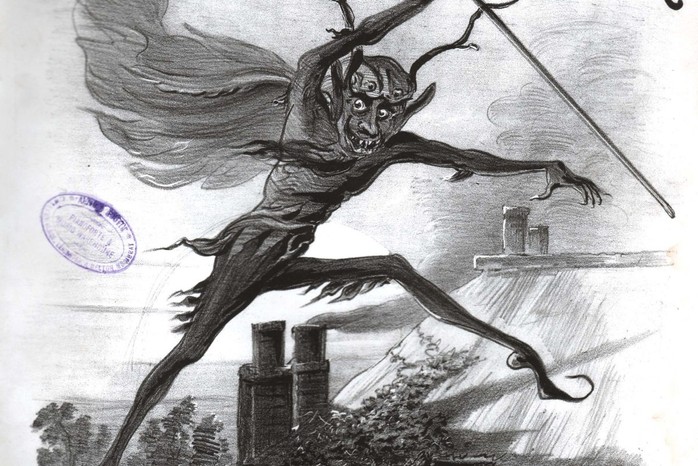
S05E33 – The Devil Went Down to Devon
Hosts: Blake Smith, Karen Stollznow
Special Co-Host: Matt Baxter
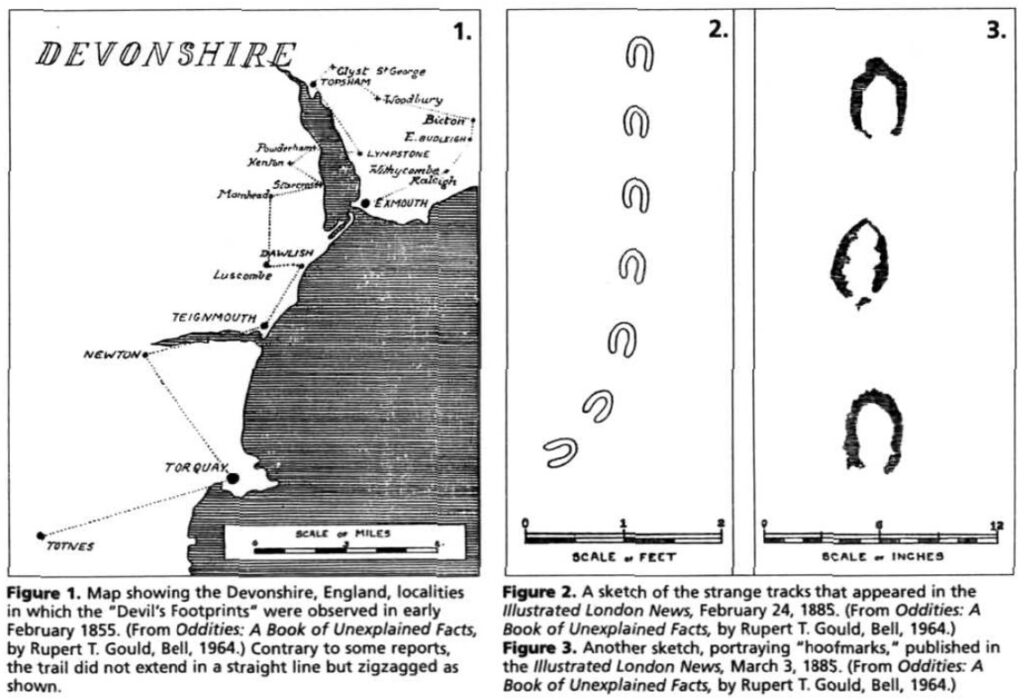
On the morning of February 9, 1855, residents across south Devon, England, discovered strange hoof-shaped tracks in the snow. The prints – about 4 inches long, 3 inches wide, and spaced roughly 8 inches apart in single file – appeared to have been left by a biped with a donkey-like hoof. Reports came in from more than 30 locations across the county. Within days, the Illustrated London News published a letter from a correspondent calling himself “South Devon” that would define the legend for generations: a continuous 100-mile trail, identical prints in every parish, passage over rooftops and through haystacks, a crossing of the two-mile-wide River Exe. The Devil, some locals whispered, had walked through Devon.
In this episode, Blake, Karen, and Matt dig into the original sources, trace how the story was embellished over 170 years of retelling, and examine the many theories – from wood mice to Romani conspiracies – that have been offered to explain the Great Devon Mystery.
📰 The Original Account
Blake reads the full text of the “South Devon” letter to the Illustrated London News (February 24, 1855), the single most influential account of the Devil’s Footprints. The correspondent – later identified as William D’Urban, age 19, of Newport House, Countess Wear – claimed Canadian wilderness tracking experience and dismissed all natural explanations.
Key claims from D’Urban’s letter:
– Prints 4″ x 2.75″, spaced 8″ apart in perfect single file
– “Exactly the same size” in every parish
– Trail exceeded 100 miles
– Crossed rooftops, 14-foot walls, and the Exe estuary
– Snow “removed… clear, as if cut with a diamond or branded with a hot iron”
🔍 What the Primary Record Actually Shows
When you go back to the full range of contemporary sources (Feb 13 – Mar 10, 1855), the picture is considerably less dramatic than the legend:
The prints were NOT uniform. Sizes ranged from 1.5″ to 2.75″ wide and 3.5″ to 4″ long. The stride varied from 8 to 16 inches depending on location.
They did NOT all appear in a single night. The prints at Topsham appeared on February 13 – five days after the main event – and headed straight to the local church vestry door, which Theo Brown interpreted as a possible anti-Puseyite prank.
The trail was NOT straight. The Exeter & Plymouth Gazette (Feb 17, 1855) explicitly describes the prints as “alternate like the steps of a man, and would be included between two parallel lines six inches apart.” Tracks in Lympstone meandered through gardens “with inexpressible activity.”
The prints were NOT identical. Contemporary drawings show considerable variation. Some were cloven, some whole. Some showed claw marks, some didn’t. The Reverend Musgrave immediately wrote to correct D’Urban’s oversimplified drawing.
Nobody tracked the prints for 100 miles. The longest verified continuous trail was about 5 miles (Dawlish churchyard to Oaklands). The “100-mile” figure is D’Urban’s estimate based on aggregating reports from different towns.
The river crossing is unsupported. No witness reported following prints to the shore and finding them continuing on the other side. The Exe was frozen that winter – a party was held on the ice – so any animal could have walked across.
The haystack story is second-hand. The single most dramatic anomaly – prints leading to a haystack with an undisturbed surface and resuming on the other side – comes from Musgrave, who heard it from “a scientific acquaintance.”
📚 How the Story Survived and Grew
1855: Original newspaper flap. Local and national press coverage over about four weeks.
1890:Notes & Queries publishes a retrospective 35 years after the event, collecting increasingly folkloric recollections (baying hounds, crutch-stick marks).
1919: Charles Fort includes the case in The Book of the Damned, producing the memorable line: “My own acceptance is that not less than a thousand one-legged kangaroos, each shod with a very small horseshoe, could have marked the snow of Devonshire.”
1929: Rupert T. Gould covers the case in Oddities, going back to primary sources and adding the Kerguelen Island parallel.
1950s: Theo Brown rediscovers the Ellacombe papers at Clyst St George parish church – the only surviving manuscript collection from the original investigation – and publishes findings in the Transactions of the Devonshire Association.
1959: Frank Edwards includes it in Stranger Than Science.
1990s: Mike Dash compiles the definitive source collection; Joe Nickell publishes a skeptical analysis in Skeptical Inquirer.
With each retelling, certain claims hardened into “facts”: the 100-mile continuous trail, the identical prints, the perfectly straight line. The contemporary record tells a more complicated – and more interesting – story.
🦘 Proposed Explanations
Strong contenders:
– Wood mice and hopping rodents – Zoologist Alfred Leutscher demonstrated that the wood mouse (Apodemus sylvaticus) leaves V-shaped hopping tracks in snow that closely match the Devon prints in size and spacing. Thomas Fox proposed the rat theory as early as March 1855, with detailed drawings.
– Cats – The only person known to have been outside on the night of Feb 8-9 was a Dawlish farmer, who watched his cat’s prints half-melt in rain and refreeze “into the shape of a small hoof, with still the impression of the cat’s claws enclosed.”
– Donkeys and ponies – Theo Brown noted that donkeys “are the only animals that plant their feet in an almost perfect single line.” Several contemporary sources explicitly compare the prints to a donkey’s shoe.
– Thaw and refreeze distortion – Snow fell around midnight, followed by rain and thaw, then a hard frost at dawn. Anthropologist John Napier’s work on how bear and yak prints become “Yeti tracks” through the same process applies here at smaller scale.
– Hoaxes (specifically anti-Puseyite pranks) – Theo Brown proposed that some tracks, particularly those at Topsham (which appeared 5 days late and targeted a controversial High Church vicar’s vestry door), were deliberate provocations in a Low Church vs. High Church feud then raging in Devon.
– Multiple causes collected into a single story – Joe Nickell’s “contagion” theory: once the first weird tracks were noticed and publicized, everyone went looking in their own gardens and found their own odd prints, which were then folded into the narrative.
Weaker contenders:
– Badger (Richard Owen’s theory, based on a drawing, not fieldwork)
– Birds with iced-up feet
– Otters
– Hares and rabbits
– Escaped kangaroo (Rev. Musgrave admitted he invented this to calm his parishioners)
– An escaped balloon dragging a rope or grapnel
– UFO laser measuring device
– A sea creature that came ashore (Gould’s theory)
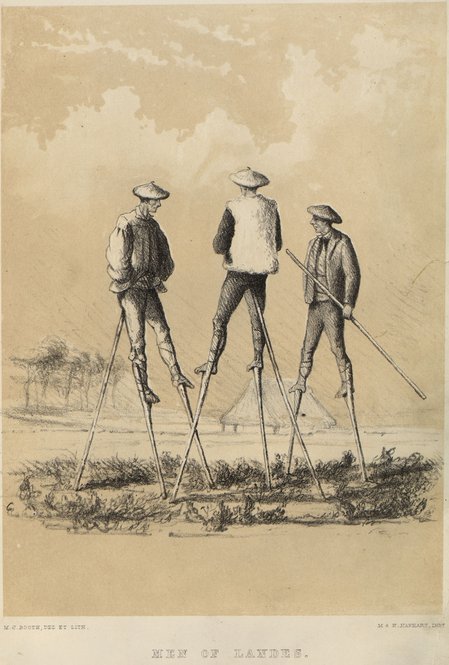
– Romani people on elaborate “measure-stilts” (from Manfri Wood’s 1973 autobiography In the Life of a Romany Gypsy)
🗺️ The 2009 Recurrence
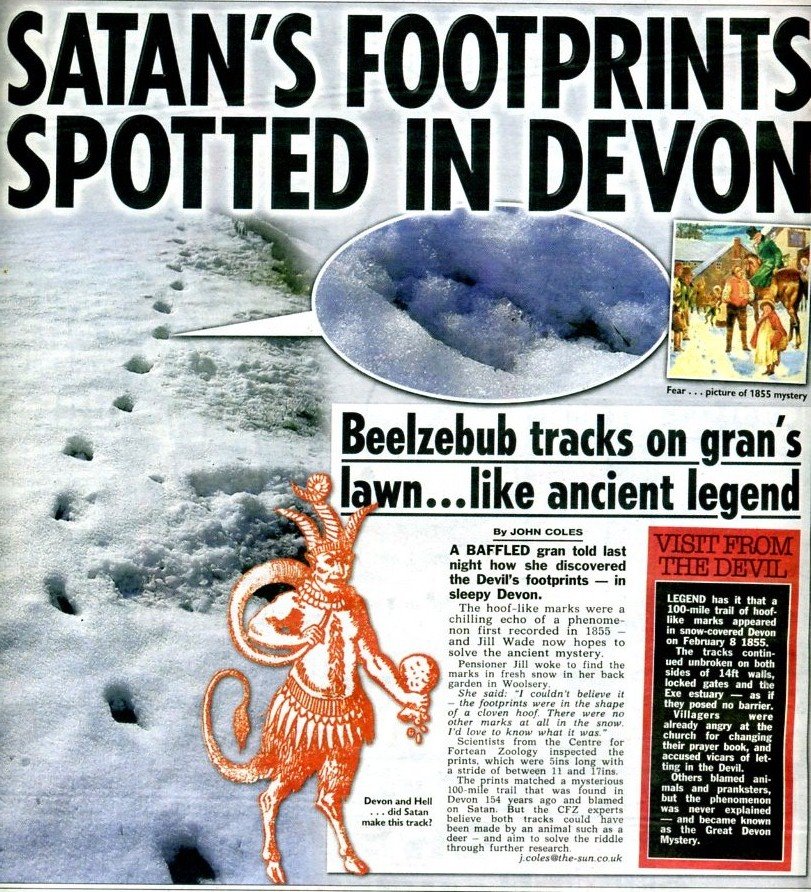
In March 2009, Jill Wade of Woolsery, North Devon, discovered hoof-like tracks in her snow-covered garden. The prints measured about 5 inches long with a stride of 11-17 inches and ran for 60-70 feet in a single line. Biologist Graham Inglis of the Centre for Fortean Zoology examined them and concluded they were likely made by a rabbit or hare, though he acknowledged they matched historical descriptions of the Devil’s Footprints.
🎖️ Key Figures
William D’Urban (1832-1928) – “South Devon.” Wrote the most influential letter about the prints at age 19. Later became first curator of the Royal Albert Memorial Museum in Exeter. His confident, dogmatic account is the source of nearly every dramatic claim associated with the case.
Rev. G.M. Musgrave – Vicar of Exmouth. The most careful first-hand observer – measured prints with a ruler, recorded precise spacing. Promoted the kangaroo theory from his pulpit while privately admitting he didn’t believe it. Immediately corrected D’Urban’s drawing as inaccurate.
Rev. H.T. Ellacombe (1790-1885) – Vicar of Clyst St George. Compiled the only surviving manuscript collection, including drawings, letters, and even samples of excrement found alongside the tracks (which he sent to Richard Owen and never heard back about).
Richard Owen (1804-1892) – Famous naturalist and founder of the Natural History Museum. Diagnosed the prints as badger tracks based entirely on a drawing sent to him. Never visited Devon.
Charles Fort (1874-1932) – Collector of anomalous phenomena. His Book of the Damned (1919) preserved and popularized the story for modern audiences.
Rupert T. Gould (1890-1948) – Naval officer and investigator of curiosities. His Oddities (1929) provides the best early modern analysis, going back to primary sources.
Theo Brown (1914-1993) – Devon folklorist. Rediscovered the Ellacombe papers, demonstrated that the trail was not continuous, and proposed the donkey and anti-Puseyite hoax theories. Also important in the Hairy Hands of Dartmoor legend.
Mike Dash – Contributing editor to Fortean Times. Compiled the definitive 80-page source collection, The Devil’s Hoofmarks: Source Material on the Great Devon Mystery of 1855, published in Fortean Studies. An extraordinary piece of primary research.
Joe Nickell (1944-2024) – Skeptical investigator. Published “The Devil’s Footprints: Solving a Classic Mystery” in Skeptical Inquirer (Jan/Feb 1996), proposing the “contagion” theory of multiple natural causes collected into a single narrative. Matt’s introduction to the case.
🔗 Links & References
Primary & Historical Sources:
– Devil’s Footprints – Wikipedia
– Charles Fort – Wikipedia
– Richard Owen – Wikipedia
– Rupert T. Gould – Wikipedia
– Kerguelen Islands – Wikipedia (site of 1840 parallel case)
Mentioned in the Episode:
– Can You Draw a Bike From Memory? (Wired) – On the unreliability of drawing from memory
– “Footprints in the Sand” poem – origins (NPR)
– “Monkey Christ” restoration by Cecilia Gimenez – Wikipedia
– Puseyism (Oxford Movement) – Wikipedia
– Never Cry Wolf (1983 film) – Wikipedia
Further Reading:
– John Napier – Wikipedia – His work on thaw distortion of Yeti tracks applies directly to this case
– Hairy Hands of Dartmoor – Wikipedia – Another Devon mystery investigated by Theo Brown
🎙️ Episode Credits
This was a collaborative episode – no single primary investigator, though all three hosts researched independently. Major sources were Mike Dash’s extraordinary compendium The Devil’s Hoofmarks (published in Fortean Studies, Vol. 1) and the late Joe Nickell’s article in Skeptical Inquirer.
Special thanks to Mike Dash for compiling 80 pages of primary source material on what might seem like a minor curiosity – and making it possible for anyone to trace exactly how a puzzling local event became an enduring legend.
💜 Support MonsterTalk
If you enjoy the show, please consider supporting us on Patreon. Your support helps keep the lights on and the research flowing. Thank you to all our patrons!
SEO Transcript
This is not a fully accurate transcript, and was machine generated. It’s here for helping search engines find the episode but not intended to be a faithful transcript of the episode. (But it’s not AWFUL.) Some of the material in this transcript only exists in the Patreon/Premium edition of the show and was excised for the commercial version.
———————
Monster House presents…
This is the ad-supported version of Monster Talk.
We’re dependent upon the revenue from these ads and from the support of our patrons at patreon.com forward slash monster talk to continue making this show.
As a disclaimer, your hosts are unable to control what ads you will hear, and while we have done what we can to avoid ads that are divisive, the system that injects them sometimes ignores our preferences and always seems to ignore our efforts to not interrupt the conversational flow.
While we understand this can be disruptive, we’re trying our best.
Patreon remains the best way to enjoy commercial-free listening to our content.
Plus, you generally get extended coverage of the subject.
We’re working on other ways to consume our content as well, so please stay tuned.
From the Western Luminary and Family Newspaper for Devon, Cornwall, Somerset, and Dorset.
13th February, 1855.
Dullish.
Mysterious.
Since the recent snowstorms, some animal has left marks on the snow that have driven a great many inhabitants from their propriety and caused an uproar of commotion among the inhabitants in general.
The markings, to say the least about them, are very singular.
The footprint, if footprint it be, is about three and a half inches long by two and a half inches wide, exactly in shape like a donkey’s hoof.
The length of the stride is about a foot apart, very regular, and is evidently done by some two-footed animal.
What renders the matter more difficult of solution is that gardens with walls 12 feet high have been trodden over without any damage having been done to the shrubs and walks.
The animal must evidently have jumped over the walls.
It has also left marks all over the churchyard and between the graves.
Many parties have traced the print for miles, but as yet without any solution to the mystery.
Several of the very superstitious draw long faces and say it must be the marks of old.
Others conjecture that it must be some monkey which has escaped a traveling menagerie with something on its feet.
But all wish the enigma unraveled.
It’s actually quite unlike anything we’ve ever seen before.
A giant hairy creature.
Part ape, part man.
In Loch Ness, a 24 mile long bottomless lake in the highlands of Scotland.
It’s a creature known as the Loch Ness Monster.
Monster Talk.
Welcome to Monster Talk, the science show about monsters.
I’m Blake Smith.
And I’m Karen Stollznow.
If you’ll forgive me for paraphrasing the great Fortean researcher Charles Daniels, the devil went down to Devon, or so the stories tell, melting tracks in the snow to infernally show his miles-long walk back to hell.
Yep, we’re talking about the 1855 Devil’s Hoofprints in Devon, today on Monster Talk.
We’re going to talk about, I don’t even know, I want to say it’s the Devil’s Footprints.
I keep wanting to call it The Devil Went Down to Devon.
Maybe that’s what the episode will be called, but…
Like, it wasn’t, honestly, I’ve read about this a zillion times, but I don’t think until preparing for this episode, I really realized how peculiar this story is.
Like, the claims, like, I mean, I know on one sense that what are we talking about?
We’re talking about a set of footprints appearing in the snow in 1855.
that allegedly travel 100 miles, right?
So 100 miles of- Uninterrupted.
Uninterrupted, right, yeah.
So the opposite of Betty and Barney Hill is the uninterrupted journey, right?
But then you’ve got other sources saying that it stretched for about 40 miles.
So you’ve got different theories, different-
beliefs different different stories don’t spoil the end okay okay well yeah it’s not 100 it’s 40 it’s exactly 100 you know that it’s it’s 100 and then it’s like a portal opens 100 miles of footprints portal opens they stop that’s probably what happened probably
It was really hard to not give spoilers straight up.
It really is.
You’re taking a critical approach to these kinds of stories.
Indeed.
I mean, and we are, we’re going to look at the whole thing.
So now I forgot what I was saying, but, but I guess the point is, this is, I don’t know when you guys first heard about this story.
It shows up in so many paranormal and Fortean books.
And we’ll talk about what Fortean means too.
I think I heard about it when it was still the devil’s hoof prints.
So it’s now devil’s footprints.
That’s what you see everywhere.
Yeah.
I guess the earlier version, but yeah, I think I was just a kid and, and heard about them.
I think I dismissed them pretty quickly as, as folklore, but there’s a lot more to the story.
So not only is it a 100 mile, a claim of 100 mile contiguous set of prints.
But the peculiarity is it’s just one hoof.
It’s not alternating footprints.
It’s literally like a hopping hoof, right?
That detail, I think I really didn’t understand until this week when we were doing preparation for this episode.
That’s peculiar.
Charles Fort, who we’ll talk about, makes a very funny joke, which I’ve put in the notes.
Or I think it’s very funny.
I think we’ve talked to – well, I don’t really talk to David Anderson.
We’ve talked with David Anderson before here and there.
We’ve done some crossover stuff with archaeological fantasies.
But he loves Charles Fort and has actually read –
Lowe and the Book of the Damned, these ginormous volumes of Charles Fort books.
And he thinks Fort is being very jokey.
And the few times I’ve attempted to read…
I found it very slow going.
I was not able to get through.
And I.
Like trudging through the snow for a hundred miles.
It’s like, okay.
I’ve read the Lord of the Rings.
All three volumes.
But.
You can’t get through Fort.
I couldn’t get through volume one.
Fellowship of the ring.
I think I stopped.
Before brief.
Eight times.
Well, the village, the village.
Oh, okay.
I never got to the Prancing Pony because I just kept giving up on the damn book.
But when I finally did get past that, that book takes off and it just rocks all the way through the rest of the series.
But getting to Bree was really hard for me.
And so anyway, I feel the same about maybe there’s a point where Fort takes off.
I couldn’t get to it.
So maybe someday.
Yeah.
A lot of older reads are like that.
I came to this from a different angle.
I’d never heard the legend until I read Joe Nichols’ article.
And that was 20 years ago, you know, at least.
Yeah, he wrote it in the 90s, yeah.
Yeah, so that was my first real exposure to it was through Joe Nichols.
So it was already given to me skeptically right off the bat.
It wasn’t sensational at all.
Yeah.
I think we have a very good listenership, okay?
So, I mean, and we steadily have been for a long time hovering, you know, just a little bit shy of 50,000 listeners, right?
I’d love it to be more, but one of the things that I always worry about
is a reason for our lack of, you know, podcast dominance.
Is that we are, you know, fun ruiners.
But I like us to include the legends up front.
You know, I like to talk about the spooky side of it.
Oh, yeah.
Because even if there is a mundane explanation…
These are stories that have endured for centuries or decades, depending on which one we’re covering.
And they do because of their power, their narrative power.
They are weird, mysterious, creepy.
And it doesn’t matter if you’re a skeptic or not.
You can still experience those emotional…
the chill up your spine, the hair raising, you know, I love all that stuff.
And I wouldn’t want to take that away from people.
So I want to make sure that we start out with the creep and then kind of do the reveal.
You know, the Scooby, this is really the Scooby-Doo approach.
You start with the mystery, there’s hijinks and antics, and then we unmask the real estate developer at the end, right?
Yeah, and I think that’s what I tried to do.
They would have got away with it too.
They had it for those pesky kids.
I think we’ve often tried to take that approach.
I tried to with Haunting America to tell the folklore, tell the stories first, and then come in with some potential natural explanations.
Not to say that we’ve necessarily solved it because we can’t go back and replicate it.
Yeah.
We can’t go back and do it again, and we weren’t there at the time.
But, yeah, I think our audience is with us on this one.
They want to hear the story.
Yeah, so I’m actually going to read the original letter that triggered what was a brief but exciting hullabaloo about this Devon footprint thing.
From the Illustrated London News, 24th February, 1855.
Item.
Footmarks on the snow in Devon.
From a correspondent.
As many of your readers have perused, I have no doubt, with much interest, the paragraphs which appeared in several of the papers last week relative to the mysterious footmarks left upon the snow during the night of Thursday the 8th in the parishes of Exmouth,
limston and woodbury as also in dawlish torquay totness and other places on the other side of the estuary of the x in the county of devon extending over a tract of country of thirty or forty miles or probably more
And as the paragraph I allude to does not fully detail the mysterious affair, it may probably be interesting to many to have a more particular account, which I think this unusual occurrence well deserves.
The marks which appeared on the snow, which lay very thinly on the ground at the time, and which were seen on the Friday morning to all appearance, were the perfect impression of a donkey’s hoof, the length four inches by two and three-quarter inches, but instead of progressing as the animal would have, or indeed as any other would have done, feet right and left, it appeared that the foot had followed foot in a single line,
the distance from each tread being eight inches or rather more, the footmarks in every parish being exactly the same size, and the step the same length.
This mysterious visitor generally only passed once down across each garden or courtyard, and did so in nearly all the houses in many parts of the several towns above mentioned, as also in the farms scattered about.
This regular track passing in some instances over the roofs of houses and hayricks and very high walls, one 14 feet, without displacing the snow on either side or altering the distance between the feet, and passing on as if the wall had not been any impediment.
The gardens with high fences and walls and gates locked were equally visited as those unprotected.
Now when we consider the distance that must have gone over to have left these marks, I may say in almost every garden or doorstep,
Through the extensive woods of Luscombe, upon commons and enclosures and farms, the actual progress must have exceeded a hundred miles.
It is very easy for people to laugh at these appearances and account for them in an idle way.
At present, no satisfactory solution has been given.
No known animal could have traversed this extent of country in one night, besides having to cross an estuary of the sea two miles broad.
Neither does any known animal walk in a line of single footsteps, not even man.
Birds could not have left these marks, as no bird’s foot leaves the impression of a hoof.
Or, even were there a bird capable of doing so, could it proceed in the direct manner above stated.
Nor would birds, even if they had donkey’s feet, confine themselves to one direct line, but hop here and there.
But the nature of the mark at once sets aside its being the track of a bird.
The effect of the atmosphere upon these marks is given by many as a solution.
But how could it be possible for the atmosphere to affect one impression and not affect another?
On the morning that the above was observed, the snow bore the fresh marks of cats, dogs, rabbits, birds, and men clearly defined.
Why then should a continuous track far more clearly defined, so clearly even, that the raising in the center of the frog of the foot could be plainly seen?
Why then should this particular mark be the only one which was affected by the atmosphere and all the others left as they were?
Besides…
The most singular circumstance connected with it was that this particular mark removed the snow, wherever it appeared, clear as if cut with a diamond or branded with a hot iron.
Of course, I am not alluding to its appearance after having been trampled on or meddled with by the curious in and about the thoroughfares of the towns.
In one instance, this track entered a covered shed and passed through it out a broken part of the wall on the other end,
where the atmosphere could not affect it.
The writer of the above has passed a five-month winter in the backwoods of Canada and has had much experience in tracking wild animals and birds upon the snow and can safely say he has never seen a more clearly defined track or one that appeared to be less altered by the atmosphere than the one in question.
Marks left upon thin snow especially may after a time blur a little, but never lose their distinctive character, as everyone will know who has been accustomed to follow the track of the American Partridge.
Should you think the above likely to interest your readers or draw from any of them a better solution of this most singular occurrence than has at present been given, perhaps you will allow it a place in your most interesting journal.
I send you a copy of the foot taken from the snow and also a succession of the steps to show you the manner of progressing.
Signed, South Devon
So this letter comes into the Illustrated London News and it lays out the facts.
I’m air quoting that about what was found that morning, that this peculiar 100 mile trackway of single file hopping steps.
I don’t know.
Hopping may be the wrong word.
But it it triggered like this massive response from the public.
Everybody had an opinion on what caused this phenomenon.
And it’s it was tracks in the snow, which is just about as ephemeral as you can get.
Right.
Because you can claim whatever.
But by the time people could come check it out, it’s gone.
Right.
That it just it’s if I said.
Freak weather appearance, too, wasn’t it?
It was unusual.
Yeah, and one of the things that kept coming up in the explanations the public suggested was the idea that this was caused by a partial thawing and then refreezing event, which…
Famously, for cryptozoology enthusiasts, will remind you of the Shipton photos of the Yeti tracks, where maybe it was a mundane animal and the tracks had melted and refrozen, and then they take on very unusual characteristics.
So that is a real…
thing that happens with footprints.
They can get larger, they get smaller, they can change shapes as the weather changes.
So legit.
I remember seeing those Yeti footprints and I was fascinated by them, but at no point was I convinced that a Yeti’s foot looked like that.
So it’s an interesting thing how your mind can really sort of just mold to whatever it is your bias is.
But I have to say that if you look this up on YouTube, The Devil’s Footprints, the story that’s told is told without any references.
It’s just this thing happened and this person said this.
And they have a lot of detail in areas that maybe they shouldn’t.
Like, oh, it was a cold winter evening and these two young girls were looking out the window and they were excited to build a snowman.
And it’s all this stuff like, what?
Where’d that come from?
But there’s no mention of any newspaper reports.
There’s no mention of people’s different things and the dates those came in.
So there’s no fact in any of it other than this thing happened, true story, I was there, is kind of the way they’re told.
And so you have to have skeptical bells ringing throughout watching these videos on YouTube.
And I absolutely recommend if you haven’t, after listening to this show, go watch a few of these videos.
They’re loads of fun.
And it’s a really good exercise in practicing critical thinking just to watch these videos, especially after hearing all the reality.
But I just wanted to put that forward.
Well, I want to add too.
So this is 1855, the 19th century.
We don’t have iPhones.
We don’t have cameras.
So people are basically from memory creating these drawings of what these footprints looked like.
And you have these different renditions of them as well.
And I think we’ll have to put some of the pictures, I think, into the show notes.
Absolutely.
A timeline, the pictures, and then I also like who the key contributors were.
The notes are going to be great on this one.
So go check the show notes for sure.
And we know just how accurate a drawing from memory or a drawing of something is.
And we can refer to the, was it the picture of Christ that was cleaned?
It is literally one of my favorite human accomplishments ever.
I love that so much.
It is awesome.
But that’s an example of just how accurate.
It is to have something sketched by someone who’s not an artist.
It’s fantastic.
Well, I love the, have you ever looked at people, things that we know all about, right?
For example, what does a bicycle look like?
How does it work?
But you ask someone to draw the parts of a bicycle and it is wildly wrong.
Unless you’re literally a bicycle repairman, it is, it is…
Amazing how misunderstood the poor and lowly bicycle is, right?
And similarly, right, we know the problems with memory and all those things.
But yeah, no, well said.
I just wanted to add too.
So Blake, earlier you were talking about the drawing and how it looks like there’s this single file.
that the footsteps are in this single file.
So I immediately thought of that one set of footsteps poem, The Footsteps in the Sand.
Yes.
Oh, I know the one.
Jesus might have been carrying the dove.
Yes.
Yeah, during difficult times, painful times, that someone, Jesus, was carrying them instead.
So I don’t know how old that poem is or how old that saying is.
But it did make me kind of think of that.
since there’s this running theme of these being the footprints of the devil.
I just think that’s interesting, this kind of counterexample of these being devil’s footprints as opposed to the idea of Jesus carrying people during difficult times.
So I don’t know how long that’s been around anyway.
Jesus walks across the beach, but the devil hops on one foot in the snow.
That is his way.
The cool down.
For real.
It makes you wonder as well, what was his motive?
What was he wanting to achieve?
His motive was loco.
Why didn’t he cover them up?
You were talking about covering things up earlier, too.
I wonder why he didn’t cover them up if he was going to harass these.
Well, it’s funny.
I mean, we’re kind of joking about it, but there was like in all the responses to this, some people assumed it was local wildlife.
But there was a legit concern that this was an infernal event, that this was not weather.
This was not nature.
This was something demonic slash supernatural.
But thankfully, we have moved on as a culture and no longer believe that weird stuff is created by Satan.
Just thinking about Lauren Boebert saying that the UAPs are probably demonic.
the more I look into this, the more I see the Old Testament and what was told to us there of fallen angels and Nephilim.
And she’s not alone.
A lot of people think that UAPs slash UFOs are demonic.
Yeah.
I’m sure it’s much easier to believe they’re demonic than to believe it’s their misperception or misunderstandings.
The details are that the footprints were identical.
The devil’s in the details.
Nicely.
That should have been my job.
Okay, that was well done.
You failed us.
So the prints are all four inches long, three inches wide, and about eight inches apart in a single file.
Mm-hmm.
I don’t know why, but this happens with the Jersey Devil, too.
When we get to explanations, one animal in particular keeps coming up, and in both cases, there’s no reason for it.
This will be familiar to you, Karen.
Okay, so…
So the trail did weird and impossible things.
It jumps over 14-foot walls.
It goes through drain pipes.
It goes over haystacks without touching the haystack, crosses rivers, allegedly.
Again, allegedly.
This is the report, right?
I always loved that there was a kid, the idea of it going over rooftops and up walls.
I thought it was so spooky.
Filling in the blank, I swear, when I think about this story, how I first heard about it and thought about it, I basically envisioned something like the Krampus hopping across the Devon, you know.
Bring here Jack is what I would think of it.
I know, I know.
Yeah, exactly, yeah.
Jumping ahead, yeah.
Nicely done again.
God, you’re on fire today.
Some people said the prints were branded as though something hot had been placed there.
There’s a story that a pack of hounds was set out to track it and instead they ran away scared, right?
That’s some good storytelling is what that is, right?
We actually know that the clergy in the area did sermons about the topic because people were actually frightened.
But no one, nobody is reported to have actually cited the creator of these prints.
So whatever they were, they happened outside of eyewitnesses or all the witnesses were murdered slash disappeared.
But there were claims that groups of people had gone out in search of this creature to try and track it down.
There may have been investigations, but everything we have is little letters.
There’s no firsthand report of people who conducted ground search, right?
It’s all these stories about.
Yeah, exactly.
So it’s so funny.
Um, we have to give a little thanks here.
I might as well throw it in here now and I’ll put credits in the show notes.
Um, again, the late Joe nickel, I would have loved to have chatted about this, but, uh, unfortunately he rudely passed away last year without any warning.
So, uh, I liked his take on this and we’ll talk about his conclusions.
Uh, Mike dash friend of the show, uh, uh, who is, uh, such a hero to me about how to do research when he gets on a topic and,
It is going to be thoroughly researched.
It is thorough, yeah.
Holy cow.
So we’re trying to condense what he wrote.
I think what some 80 pages of research.
Yes, exactly.
80 pages of – this is an obscure thing.
He came up with 80 pages of resource material.
Wow.
Thank you, Mike, very much for that work.
He did an amazing job, yeah.
Those are the main two sources that we looked at here.
Obviously, we both have read.
We’ve all read other things.
But if we want to talk briefly about how the story survived, it’s, I mean, as we say, it’s not, there’s nothing important about this story.
It’s just weird.
It’s mysterious.
So the original flap happened.
Sorry, I was just going to say, it’s kind of, I’ve heard about it at times, and then it’s just gone back into obscurity.
Exactly.
come back into the kind of public consciousness again.
And so it’s just one of those perennial favorites, I think.
But it’s for some reason, it just occasionally comes back out and everyone’s talking about it again.
And that’s one of the main reasons I said, hey, let’s talk about this topic.
We haven’t discussed it before.
And suddenly there are a plethora of videos on YouTube about it.
So I’m not sure exactly what has…
reignited interest in the topic.
Charles Fort is probably the most important character in the story as far as keeping the story alive.
Sure.
Now, we’ve talked about Fortiana, Fortians, and Charles Fort briefly in other episodes.
He is…
uh a writer he wants to be a novelist that doesn’t really work out and he’s got an inheritance so he’s got free time on his hands he’s not rich but he’s got enough money to survive and he uses his free time to collect weird stories and he collects them in volumes uh low and the book of the damned are the two that come to mind immediately
And all these stories are all these kind of weird news stories.
Fish falls, weird weather, things seen in the sky, strange animals reported.
It’s the kind of stuff that we sort of thrive on.
We’re very grateful to him.
Yeah, yeah.
But in no way is he skeptical about this stuff.
He just thinks that there’s sort of a secret history.
where maybe science is suppressing, but the newspapers are at least initially reporting often with mockery, these weird events.
And so his books are a treasure trove of strange topics.
for the people who were inclined to look for such things.
They don’t quite get into the mystical, but they definitely cover weird weather, weird creatures, weird phenomena.
And so he writes about this.
He collects the newspaper stories from this original flap back in 1855.
And that gets it back into the modern world.
And then…
we have that sort of first generation of weird shitology, I guess is the right way to say this, where people are collecting these stories into anthology, not anthology, that’s not the right word.
They’re not exactly encyclopedias.
They’re like really collections of weird stuff.
Cataloging.
Yeah, they’re cataloging these stories and giving them maybe a little narrative flair that wasn’t in the original fort retelling.
So they tend to be colorful.
There’s a guy named Rupert T. Gould.
He has a book called Oddities, and that’s one of the places that really took off.
And I have to say, you can see the whole article.
I’ll put links to that in the show notes.
Yeah, Rupert Thomas Gould.
And he did a really good job.
He went back to the primary sources.
He reprinted the illustrations of the prints.
He talked about some of the discussions around…
the hypotheses about what it might have been caused by.
But surprisingly good.
I don’t have a copy of oddities, but I found a website that reprints the entire thing.
It’s really neat.
Now, it is interesting because you do have the story about how all of the tracks were exactly the same.
They were exactly these measurements.
And the stride was exactly eight inches and all this kind of stuff.
But we find out that the prints were not uniform.
The sizes ranged from an inch and a half to two and three quarters inch wide to three and a half inches to four inches long.
The stride was anywhere from eight to 16 inches.
So, yeah, it’s a very interesting start right there.
The prints weren’t uniform, so the first one falls.
They didn’t appear in a single night.
That was the big story.
It happened on this one faithful night from, what was it, the 7th to the 8th?
And it’s not true at all.
The prints appearing in Topsham were on the 13th of February, five days later.
The trail was said to go in a straight line.
No.
It…
wound all over the place.
I mean, there were different reproductions of the map where they all went, and it was all over the place.
They zigzagged across 30-plus locations.
So…
It’s I think that the straight line thing was it conflated the individual prints, you know, one in front of the other, that kind of straight line.
But the entire trail was not a straight line.
But it’s interesting because that is something that is contradicted within the retelling.
They will start off saying straight line and then they’ll say they went to, you know, each door and, you know, zigzag around.
So, well, which is it?
And they were exactly identical in every parish.
And that’s completely contradicted right off the bat, too.
The different drawings showed different prints.
Some were cloven, some not.
Some looked like they had claw marks.
Some didn’t.
Some were devils and some weren’t.
Nobody tracked the prints for 100 miles.
So the longest verified continuous track that was actually verified was about five miles.
So somewhat short of a hundred.
Yeah.
Yeah.
So that’s why it makes it a lot easier to think, well, this probably isn’t just one creature.
Because, you know, these pieces of the path were seen in different areas, but it is not continuous.
The river crossing thing, it was supposed to be like, what, a two-mile stretch?
And that’s like Loch Ness.
Karen had pointed that out to me.
Yeah.
So that area.
It is really wide right there, but that’s not supported.
No witnesses, no other witness reports say that I followed these tracks right up to the edge.
And then I, you know, found a place to cross and went over and right on the other side, they continued.
Nobody saw that at any point.
The whole thing about the haystack that he walked straight through the haystack without disturbing it.
I love that.
That’s almost invoking a ghost at this point, something walking through a solid object.
He can leave footprints, but he doesn’t disturb hay.
So I don’t know what that means in terms of like a superpower.
Yeah, well, it kind of excludes the devil, right?
Because, I mean, we know the devil creates crop circles.
So if you can’t mess with hay, it’s probably not the devil, somebody else.
Probably not him, yeah.
That’s a good point.
It’s not a great power, is it really?
No.
It’s more power than I got.
Yeah.
That’s, yeah, yeah.
He was looking for the needle.
Right.
See, he was being very careful going through that haystack because you don’t want to get poked by the needle going through.
That’s a straw man argument, though.
Nice.
Oh, he’s back.
He’s back, ladies and gentlemen.
He’s back.
And some tracks just appeared in the middle of fields and stopped abruptly.
Well, then that’s not continuous, is it?
But I did love that idea, too, along with just walking up walls and over rooftops.
Just the idea of it stopping dead was just very mysterious.
And then starting again somewhere else.
I mean, the fun part about that is if you are thinking about a biped, that’s like, how is that possible?
How is it possible that he went over rooftops and everything?
But as soon as you start bringing in the idea of other animals, like birds, for example, that’s not supernatural at all.
Which brings me, I think it brings us to one of the most frequently used candidates for an explanation.
I’m going to say that a lot of times monkeys from a circus train is a popular idea for monsters.
But number two has to be the kangaroo.
Karen, why is that?
I immediately thought of stories of alien big cats and panthers appearing in places where they shouldn’t be and other creatures because they’ve been brought in by American servicemen or they’ve been brought in by circuses, that kind of thing.
And so, I mean, that doesn’t sound probable, but it is something that’s impossible.
It could be, I’m not saying in this particular case, but certainly in terms of claims, it’s not a supernatural paranormal claim at all.
It’s kind of drawing a long bow.
But that is the kind of claim that we have come across so many times where there’s an animal where it’s somewhere where it shouldn’t be because it’s been introduced somehow.
And so it was a very strange theory.
So that was put forth by the…
priest wasn’t it the reverend musgrave yeah the friar the monk whatever well he was an anglican parish priest he led the church there well it’s funny to me because he later admitted in writing
that he had made up the kangaroo hypothesis because his parishioners all believed that there was something demonic at play.
And you basically were having a local panic about the idea that the devil was visiting Devon at night.
And so, no, no, guys, it’s not the devil.
It’s a kangaroo.
Maybe it was a demonic kangaroo.
I can sleep well knowing that it’s not the devil.
It’s a kangaroo.
You have an ethical issue with it.
I think that was an immoral thing to do.
I’m sure he wanted to relieve them of their fears, but I just don’t think that that was an appropriate thing to lie to them like that.
Well, I think we all know that the greatest trick the devil ever did was convincing people he was a kangaroo.
It was shape-shifting.
So the story starts in 1855.
And then in 1890, they do like 35 years of retrospective.
Let’s go back and talk to the locals about this crazy thing that happened.
And that gets… A long time ago.
Yeah.
35 years ago.
So 1890, that happens.
And then in 1919, Charles Fort writes it up in his Book of the Dam, which has hundreds and hundreds of this kind of story.
But I love his quote.
Because his writing style is a little weird, but he says, My own acceptance is that not less than a thousand one-legged kangaroos, each shod with a very small horseshoe, could have marked the snow of Devonshire.
That is possible.
Anyone who knows anything about kangaroos knows that they breed like crazy, like rabbits.
And frequently hop on one leg.
It is their way.
And are shod as well.
Exactly.
So from Fort’s case, it gets picked up by Rupert T. Gould in oddities.
And then in 1959, it gets Frank Edwards writes about it in his book, Stranger Than Science, which I have a copy of somewhere over here in one of my shelves.
Already over 100 years at this point.
And that’s true.
That’s true.
Story is becoming more and more exaggerated and disfigured.
But the core pieces are becoming, what would you call it, more canonical, where it’s like 100 miles, contiguous, you know, straight lines, single creature, identical prints, you know.
So by the time you get into the 60s, you start to see people trying to fit this into UFO lore, where like maybe a spacecraft passed by, or maybe there was a hippie.
Or a hippie.
But the explanations get a little crazy.
So let’s take a minute and look at the… A little crazy?
They get a little crazy.
Let’s talk about what some of the explanations are out there.
Outside of kangaroos, yeah.
Outside of kangaroos.
Okay, so yeah, we should look at possible explanations.
So this is really, I guess, the meat of the whole case.
And so one of the main explanations that has been posited is that of wood mice and other hopping rodents.
So I, to be honest, hadn’t really heard of hopping rodents.
I don’t know how familiar you guys are with that.
I knew there was a kangaroo mouse, which is very cute.
I mean, really cute.
I just wonder, though, if a creature of that size…
Certainly wouldn’t be able to cover a ground of 100 miles or even 30 miles or even five.
I would debate that as well.
But that’s one of the main ideas of a mouse that holds all four feet together when it leaps.
And that kind of print can look like a kind of cloven print.
Yeah.
That theory was already around actually back in 1855.
So there was, was it Thomas Fox, a brewer from Bellingdon, had sent the island drawings of rodent tracks in different snow depths showing how they could form these hoof-like shapes.
I love that, by the way, the idea that the newspaper reading community sends in letters and drawings.
Different times.
There was a movie called Never Cry Wolf back in, was it the 80s, 1983, I think.
And the interesting thing about this movie is.
There was like this researcher that was kind of out there alone in Alaska, and he’s researching these wolves that are out there.
And how is it are they staying alive?
And comes to realize that the wolves were eating these field mice, but you didn’t see a ton of field mice running around.
So how on earth are they getting enough sustenance?
The bottom line is, if you see one field mouse, you should know there are a lot.
So no, one mouse isn’t going to probably go five miles.
But a good 40 of them, they tend to not just all come flying out at the same time because they have to be very careful.
Or a wolf or something like that, or the devil, will eat them.
Maybe they choreographed.
Yeah, exactly.
And, you know, if these mice came from like, you know, Nim, rats of Nim, they were probably pretty smart, knew what they were doing.
I could still apply to kangaroos though, that theory.
With a kangaroo mouse.
Mrs. Frisbee and the kangaroos of them.
That’s the lesser known sequel, right?
Yes, to be written.
Exactly, yeah.
But the thing is, is that I really do think that the wood mice or the hopping rodents is a great contender.
But there are others.
Oh, there are.
But having seen, you know, I grew up in the northern mountains of Colorado and we would have very long winters and have these kind of things.
And you would see footprints that just did not make sense.
And then you would see what made them.
And it’s like, oh, I get it.
But then there were, you know, lots of other animals like cats.
Lucy’s perking up over here.
Oh, and very demonic, or at least familiar.
Well, most, yeah, most cats are very demonic.
And in Dalish, there was a Mr. Wilson.
He reported that the thaw and rain on that night half melted cat tracks and refroze them into the shape of a small hoof.
Now, the thing is, is there would have probably been a ton of them, you know, running around all over the place.
So whether or not that could be donkeys and ponies, ponies, donkeys.
I mean, that’s a big one.
I think that was one of the.
the earliest as well because of just the way that they’re drawn.
But they’re upside down, so it’s bad luck.
And the folklorist Theo Brown.
So I’m going to say Theo Brown.
And then alert listeners may recognize that in my coverage of The Hairy Hands of Devon, she comes up because she’s one of the folklorists who kept that story alive.
So she lived in Devon and did a lot towards –
professionalizing folklore.
And also in this story, she noted that donkeys sometimes place their hind feet in the same line as their forefeet.
So it can look like there’s a bipedal creature when you see their tracks.
So, and that some of the tracks look at least superficially like a hoof, like a donkey hoof print.
So, but we also know that typically
Donkeys don’t hop over giant walls and haystacks and get on your roof, typically.
That we know of.
Right.
But goats do.
Goats do.
Goats will climb anything.
They’re crazy.
So, yeah.
Yeah, you know, another candidate that’s rarely brought up is maybe a talking reindeer that’s eating a devil fruit.
So that’s the Tony Tony Chopper hypothesis.
You heard it here first.
And last.
And that’s the hardest part about an old story like this is to be able to bring in new information.
Exactly.
And I think we are accomplishing that.
We are.
So another theory, and this is one of the main ones, the Thor and refreeze distortion.
So the meteorological background is doing a lot of work in every animal-based explanation.
And an anthropologist by the name of John Napier devoted some serious attention to this in his work on Bigfoot and Yeti prints.
So what, back in the 70s, 1970s?
He’s super important in the history of Bigfoot and in Yeti research.
So it’s all through cryptozoology.
That’s a really important concept.
So yeah, absolutely.
Yeah, so bear and yak tracks, partially melted and refrozen, routinely produce these impossible…
that have been mistaken for hominids.
So you’ve got the same mechanism here with the devil’s footprints, but on a smaller scale.
But this is one of the main things I think when I was a kid and heard about this and just saw the different images and the earliest ones looked better formed and then the older they became, they looked more distorted and reminiscent of that whole thawing, refreezing, just that cycle.
Theo Brown also postulated…
The idea that this might have been hoax work done by, but specifically hoaxes performed by a schism between the low church and high church of England.
Now, I am super unqualified to talk about this, and this is a giant rabbit hole of side information.
But here’s what I would say in summary, that the low church was Protestant evangelical Bible and sermon church.
Very plain services.
not much ritual, and they were very suspicious of what they would call the Papists or the Romans, right?
So the High Church is more focused on the Anglican Church as being a continuation of the Catholic Church.
Right.
And more in line with ancient tradition, more ritual.
And she believed that there really is a lot of schism back then and now between those two approaches to Christianity.
And she thought that maybe that was part of the explanation was that there was prankery afoot.
Which I think is as good of a theory as ever.
And this is only a couple hundred years after the Church of England was set up.
The Catholic Church basically broke down in England.
So I think, you know, it’s an interesting theory and maybe not even necessarily between those who were religious but potentially skeptics, potentially atheists, those who were just wanting to have a bit of fun.
Yeah.
I mean, we know like the crop circles, for example, people will go to elaborate lengths to perform a hoax for real.
Like it’s crazy.
And maintain it for decades.
And to the point that it actually becomes a form of art, in my opinion.
So, yeah.
But let’s I’m going to quickly run through to save us some time.
Some of the less likely contenders for our candidates.
We got badgers, birds with iced up feet.
Otters, hares, and rabbits.
An escaped balloon dragging something along the ground.
The kangaroo, I think, is pretty unlikely.
Okay.
wording here.
I’m going to say it like it was said back then.
We would not normally say this, but gypsies on stilts, okay?
They’re talking about the Romani people, the idea that some weird meteorological or weather event happened, the UFO laser or heat option, and even Gould himself had a theory that maybe it was a sea creature that came ashore.
That makes no sense for Devin, but that was one of the ideas that were out there.
So…
I don’t know if you gave enough attention to the Romany people on stilts.
You just kind of put that in there and move on.
I was going to say that because, I mean, we all know gypsies on stilts, common problem in every community.
A scourge.
If they’re not out there making werewolves, they’re out there hopping around on stilts, hopping over the landscape.
Doing tricks with eggs.
That’s how they do.
Bless their hearts.
All right.
Okay, so we’ve got some kind of weak contenders, long shot, really implausible contenders.
We’ve got stronger ones, wood mice, cats, hoaxes, et cetera.
Strong contenders.
What have we got there?
What’s the…
the most likely theory behind all of this.
Oh, man.
Do we want to say what our favorites are before you, like, spoil things?
Well, yeah, I think we should.
And I’m going to have to say I’m Australian.
I’m going to have to go with the kangaroo theory.
Even though it has been debunked, I have a soft spot for that theory.
Yeah, yeah.
Matt, what do you think?
I think, well, you know, I kind of have a soft spot for kangaroos as well.
But I think it’s kind of a split.
So I could go with the kangaroo mouse, but I think what I’m going to go with is kangaroos on stilts.
What about kangaroos in UFOs?
Well, I was just thinking about the ability of kangaroos being able to jump over these tall walls and get up on roofs and things like that.
I think that that is something that has not been examined closely enough.
And I would love to see a sketch of a kangaroo in an escaped balloon.
Or kangaroos being carried by Jesus.
Although I have to say it’s politically incorrect, but gypsies on stilts is pretty funny.
It is ridiculous, isn’t it?
It really is.
An excerpt from Manfred Frederick Wood in The Life of a Romany Gypsy in 1973.
That night, as everybody in the area found first thing in the morning, the devil walked right across the country of Somerset.
Only it wasn’t the devil at all, but some seven Romani tribes using over 400 set of measure stilts with size 27 boots at their base.
The whole operation took over 18 months to plan out and prepare.
And the reason for it was that on a particular stretch that had always been a Romany drum as far back as anyone could remember, a lot of pikeys had drifted in and caused a lot of trouble for the Romanys.
Now I don’t know exactly how a measure stilt was constructed, but I do know that it consisted of a pair of stepladders that could be lengthened or shortened by means of slides and hinges.
They were joined on top by a wheel.
The bottom of each stepladder stood in the great big boot, and the man operating the stilts stood on one of the ladders and joggled about on it to make as deep a foot impression as possible.
Then he would either swing the second ladder over the top by the wheel, if there was enough headroom, or if there was not enough room, he would raise the ladder by the slide and move it forward by one devil’s stride.
Either way, he got an exact measure of a stride, as the measure stilts were constructed so that they could not over or under stride the three yards it was meant to do.
When the second ladder had been shifted to the front, the stilt treader stepped onto it and shifted the first ladder in front of it again.
And then he joggled about on the second ladder to make a deep impression and stepped forward onto the first ladder again.
And so he went on without ever stepping off the measure stilts for the whole operation.
This was straightforward enough while striding over open country, except that it was done on a dark night and required skillful balancing all the way.
But going over hedges, ditches, and country lanes posed a serious problem, as people might be using the highways and lanes and see a man working the measure stilts.
So, when he worked his way over and along a public right-of-way,
he had to throw a sheet over the whole works so that the devil would be seen walking rather than a man with ladders on boots.
Walking with that cloak over the top, he saw even less of what he was doing than when he walked over the fields.
The Devil was supposed to walk right across Somerset and as straight a line as possible.
He was not supposed to make any detour around houses or churches or barns and so on.
But his footsteps had to go straight up one wall, over the roof, and down the other wall.
The Stilt Treader could not walk up walls.
He had to straighten out his stilts to turn them into a long ladder and then make a muddy line of Devil Strides over a spare set of 27 size boot seal impressions.
Halfway over the top, he had to hoist the ladder up and swing it the right way around without too much noise over to the other side of the building.
This was the snaggiest part of the whole business, as it required exceptional physical strength and poise.
Also, dogs were bound to bark in some of the farm buildings that were being boot marked, and if any of them brought a farmer out of bed, the catch would have been out of the bag.
If any man tried to play this trick on his own, he would do well if he managed to cover two miles in one night.
It would be quite a feat if he managed to cross two cottages or one village church.
But that night, the devil walked the breadth of Somerset, because there were seven Romany tribes in this, and between them they used well over 400 measure stilts.
The root of it was planned very carefully, and every part of it studied over a period of about 18 months.
When the plan was put into operation, it went off without a single hitch.
After the men got back with their measure stilts, a party made their way over to the Devil’s Trail from each of the camping sites and busied themselves with obliterating the tracks made to and from the Devil’s Strides by the stilt treaders.
The next day, the Devil’s footprints could be clearly seen along the whole route.
It put the fear of God into all the locals, but that was not the point of the exercise.
For the next few years, it kept the area free from pikeys and diddikai who swore blind it was a mule load they had crossed, and they were not going to take any chances.
The author of this book, Manfrey Wood, came from the family of the famous Welsh Romany, Abram Wood, a figure so deeply connected with the historical establishment of Romany culture in Wales that to be of the family of Abram Wood became shorthand for being of Romany descent.
In his book, Wood claimed that the footprints were actually a hoax his people pulled off to scare away rivals, using a lot of insider terminology to describe it.
To put it in clearer English, he basically writes in that conclusion, “…for the next few years, the hoax kept the area clear of non-Romani travelers and mixed bloods who were absolutely convinced that a ghost had passed through and they weren’t going to risk an encounter.”
Now, this brief work is an important piece of Welsh Romany folklore, even if it fails to quite convince an informed reader as actual history.
But more than just an unlikely explanation for the footprints, it carries with it hints of a strict internal social structure, one that pits the pure Romany against the mere non-Romany traveler or the mixed blood, implying their gullibility.
It’s a strange brag, but that’s exactly what it is, a brief snapshot of an old Romany elder’s oral tradition capturing not just an unlikely event, but a glimpse of a social strata completely hidden from the rest of the British public.
So in all seriousness, though, I think Joe Nichols take was it was unlikely to be a single contiguous event.
It was more likely that once this weirdness had been noticed, everybody goes to their they hear the story and they go check their farm.
They also see a set of these things.
So maybe a variety of natural creatures making tracks in the snow being collected into a single story by the community.
Yeah.
It’s annoyingly plausible.
Well, I want to add to just the mindset of the people at the time.
Yeah.
So we’re talking about Devon and the surrounds, and the area is just so rich in folklore, as we’ve discussed, stories of the hairy hands and the devil’s footprints, and that’s just kind of scratching the surface.
of the folklore in that area.
So people in that area were very primed and prone to believing in all of these kinds of fantastical things.
I don’t think we’re going to do an episode on it.
But if you want to further reading, were there precursors to this case?
Are there other events like this?
And I went around looking and the one that I found that I thought was the most interesting was in the Kerguelen Islands on the Ross Antarctic shelf.
There was an expedition there in 1840, and they found a really long, single-file, horseshoe-shaped set of prints in the snow.
And it really made no sense to them.
And ultimately, they weren’t able to stick around and investigate or find any local fauna that might have caused it.
And their explanation, they basically just made a note, maybe a pony survived a shipwreck and then…
made a track and then went back to the sea.
I don’t know.
So we don’t know what that was.
It’s very peculiar, but it’s, it’s not, there’s no explanation for it.
There’s nobody knows what caused that.
And there’s no photos because it’s 1840.
So we don’t really know exactly what they saw.
Well, there is interesting that you mentioned that because I didn’t delve into this too much, but there were similar occurrences that took place.
afterwards that are seemingly unrelated that happen in other countries, including an event in Australia.
But there was another event quite recently back in 2009 in North Devon.
There was a similar happening where hoof-like tracks appeared in a garden in an area called Woolsey in North Devon.
I’m going to make a note.
See if we can find photos for show notes.
But in this case, they believed that the hoof-like tracks belonged to a rabbit or a hare.
They were about five inches long, so even bigger than the devil’s footprints.
Yeah.
Well, I will say, like growing up in such a remote area that I did, I would often see those Yeti tracks that I had talked about earlier, but I knew that they were actually created by jackrabbits.
Jackalopes, maybe.
Jackalopes, yes.
Do they have jackrabbits in Colorado?
Oh, yeah.
They’re so peculiar.
They’re much more like a hare than a rabbit.
They were all over the base in San Antonio when I was in the Navy.
And the Navy security training was at Lackland Air Force Base.
And…
They’re huge.
They’re so big.
And they’re not afraid because on base, nobody’s killing them.
And I would go jogging.
I was in such good shape back then.
I used to run like eight miles a day.
A hundred miles, Blake?
No, eight miles.
Eight miles.
But, I mean, I would run half marathons.
In a straight line?
I think we need to take a look at Blake’s footprints.
You can look at my ruined knees is what you can look at.
That’s like maybe behind.
Worn myself out.
But I was so creepy to be running before dawn and then run into just a bunch of these ginormous rabbit shaped.
And they had the weirdest eyes.
They’re so and they’re just not afraid.
Oh, it was eerie.
I saw one decades ago in California.
It was my first encounter with one, and it looked like it was something from another planet.
I’d never seen anything like that.
I wasn’t aware of them.
You know, and you have people joking about tree alligators and all kinds of things.
You have true monsters in this country.
They’re not cute, fuzzy rabbits.
They’re something different.
And when you say people talk about witches being shape changers, they almost always picked cats or hares.
And if you if you could imagine there’s something very eerie about a hare and imagine being a farmer and you go to shoot one and then it doesn’t get killed.
You know, you’re a good shot.
So clearly it’s got to be a witch.
Got to be a witch.
Well, I think that’s about all there is to be said about the devil footprints in Devon.
Do you have any closing thoughts?
Well, I think that this story has been looked at from so many different angles and it’s been debunked.
But I think it’s going to just continue, even though…
I think everyone has their own pet theory on what it is.
So it’s an interesting story in that respect.
But I think it’s just going to continue, even though it’s very likely that we have the answers already.
I doubt the day will come when I’ll hear somebody say, well, they covered that on Monster Talk.
It’s all taken care of.
Yeah, we can shelve that one, guys.
Yeah.
You know, it’s none of these things.
I mean, anytime that you can have a new audience that, that don’t have all the details, you can keep anything going, you know, any, any, you know, urban legend or anything else.
So, and, and the YouTube has created a hunger for this kind of content.
So, yeah, it’ll keep going, and it’s good to be able to be part of the library of reality when it comes to this stuff.
I’m proud of Monster Talk for that, that people can stumble upon Monster Talk and find out so many things that they were misled on.
True enough.
Library of reality.
I like that.
Well, I really appreciate you guys sorting through this ridiculous amount of notes that we’ve got here.
And for Mike Dash and Joe Nickel for trying to run this to like the most plausible explanations.
Good Lord.
One for the team.
Good Lord.
Mr.
Dash, I commend you.
So, all right, guys, we will see you next week with yet another mystery topic.
We will.
Monster Talk.
You’ve been listening to Monster Talk, the science show about monsters.
I’m Blake Smith.
And I’m Karen Stollznow.
You just heard a discussion with special guest Matt Baxter joining us to talk about the Devil’s Hoof Prince in Devon from 1855.
There’s a lot of show notes on this one, so check them out at our Patreon page or at monstertalk.org.
Thanks again to all the researchers out there who’ve done so much work on this case, but especially to the late Joe Nickel and the incredible and relentless work of Mr. Mike Dash.
If you want to support our show but can’t afford yet another subscription, the easiest way is to give us very positive reviews on iTunes or your preferred podcasting platform.
iTunes reviews especially help keep us visible in their listings and suggestions, which help us reach new potential audience members.
Monster Talk’s theme music is by Pete Stealing Monkeys.
I suspect the devil got around 80 miles into his jaunt over Devin when he noticed…
I forgot to put on my Fitbit.
This has been a Monster House presentation