Uncategorized
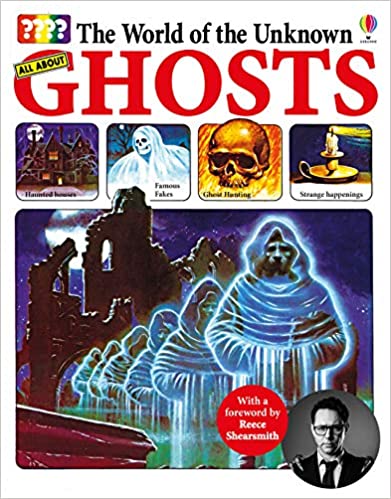
219 – The Usborne book of GHOSTS with Christopher Maynard
Download as MP3 (right-click, save-as)
Both hosts read the book as children on opposite sides of the world — Blake in the American South, Karen on the northern beaches of Sydney — and credit it with sparking a lifelong fascination with the strange. It is, in their telling, one of the founding documents of MonsterTalk itself.
📖 How the Book Was Made
Maynard was a freelance writer-for-hire in the early years of Usborne, commissioned the way most projects were in that world: a phone call, a start date, a delivery deadline. He estimates he worked on roughly 80 books over a career spanning the 1970s through the late 1990s — astronomy, ecology, insects (written from the insects’ point of view), the Black Death — but the ghosts book is the one that followed him.
The team was a London art-college collision: Maynard on text, art director David Jeffries on layout, and illustrators including Roland Berry, Gordon Davies, John Francis, Brian Lewis, Malcolm McGregor, and Michael Roth. The process was analogue to the core — large A3 grid sheets, hand-lettered copy, original artwork produced at two or three times final print size and photographically reduced. The team’s editorial consultant was Eric Maple, a veteran of psychical research who had written widely on British folklore and the occult, and who apparently did some of his best consulting over long sessions in the pubs of Covent Garden.
Research in the pre-internet era meant the Westminster Reference Library, newspaper cuttings archives, university libraries, and — crucially — the library of the Society for Psychical Research, which was conveniently close to the Usborne offices. Maynard estimates he gathered enough material for 96 pages; the finished book is 32.
👻 The Editorial Philosophy: Intergalactic Archaeologists
Maynard describes the team’s approach as that of “intergalactic archaeologists” — arriving on Earth from planet Zog and observing, without any prior axe to grind, that humans everywhere talked about invisible presences as if they were real. The framing is almost accidentally skeptical: no declared belief or disbelief, just documentation of a universal human phenomenon. Maynard notes that as far as his research could determine, there is no human culture without some concept of ghosts — a point the hosts find entirely consistent with what MonsterTalk has explored over the years in terms of psychology, memory, and the sociology of the paranormal.
That same curiosity pushed the book backward in time: if haunted houses exist in the 1920s, why not look for ghost accounts from Roman antiquity and ancient China? The book includes stories drawn from classical sources alongside its British cases, an unusual move for a children’s book of the era.
🗺️ Pluckley, Borley, and the Stories That Stuck
Karen flags three stories that lodged permanently in her memory: Gef the Talking Mongoose (rendered as “Jeff” in the book and in the hosts’ shared mythology), Borley Rectory, and the double-page spread on Pluckley, billed as the most haunted village in England.
Maynard reveals that the Pluckley spread was the one moment of genuine field research: he and Jeffries drove out to the village with a large Ordnance Survey map, walked the lanes plotting reported sighting locations, and photographed the (thoroughly unremarkable) scenery — while the locals apparently mistook them for estate agents. The result, a map annotated with compass directions and ghost-by-ghost notations, is Maynard’s own favorite page in the book, precisely because it transforms something visually boring into something that feels like evidence.
As for Borley Rectory: the name never appears in the book. Maynard was aware of ongoing litigation involving the families connected to the property and deliberately kept his distance, instead folding details from roughly ten different haunted-house cases into a single composite “haunted house.” The Black Shuck illustration by John Francis — a snarling, full-moon-lit phantom hound breaking out of its panel frame — is singled out by both host and guest as a masterclass in children’s-book design: the technique of containing art within a border and then deliberately rupturing it was a deliberate trick taught in London art colleges of the era.
🌍 The Finnish Resurrection
The book went out of print and, as far as Maynard knew, simply receded into the past. What he didn’t know — and only discovered when Usborne contacted him around 2020 — was the chain of events that brought it back. An animated ghost film involving actor and writer Reece Shearsmith (of The League of Gentlemen) screened at a festival in Finland. When the filmmaker stood up afterward and credited the Usborne book as his inspiration, the entire Finnish audience erupted in recognition. Word reached the Finnish publisher; 3,000 copies were printed — a large run for Finland — and sold out. That ripple reached Usborne’s marketing team, who noticed the social media chatter, printed a cautious thousand copies for the UK, and sold out before the books even arrived. Shearsmith went on to write the introduction to the new UK edition. Nick Frost is also among the book’s famous admirers.
🕯️ Memory, Nostalgia, and Why It Lasted
Much of the conversation turns on why a 32-page children’s reference book published in 1977 is still generating this kind of response. Maynard — genuinely surprised by all of it — offers the analogy of recording a piece of music, walking away, and discovering decades later that people are still playing it. Blake’s explanation: Gef the Talking Mongoose was the first obscure paranormal reference he and Karen had in common when they met, and that shared knowledge was the seed of MonsterTalk. Karen adds that for children in the 1980s, the book occupied a rare space — it treated strange stories seriously, presented them beautifully, and arrived at a moment when such topics felt slightly forbidden. Nothing comparable existed on library shelves.
Maynard reflects that whatever the book did, it seems to have initiated an ongoing inner conversation in its young readers — one that, for some of them, never really ended.
📚 Further Reading
– 📚 World of the Unknown: Ghosts 💵 by Christopher Maynard (Usborne, reissued edition)
🔗 Related Links
– Usborne Publishing
– Gef the Talking Mongoose (Wikipedia)
– Borley Rectory (Wikipedia)
– Pluckley — “Most Haunted Village in England” (Wikipedia)
– Black Shuck (Wikipedia)
– Society for Psychical Research (Wikipedia)
– Reece Shearsmith (Wikipedia)
– The League of Gentlemen (Wikipedia)
Note: ads inserted into the distributed audio alter the timestamps in unpredictable ways, so timing references in these notes are approximate.
Join us for a very Halloween themed look at a book which was deeply influential on Karen and Blake. Usborne’s WORLD OF THE UNKNOWN: GHOSTS authored by our very special guest, Christopher Maynard.
Blake Smith
0
Tags :