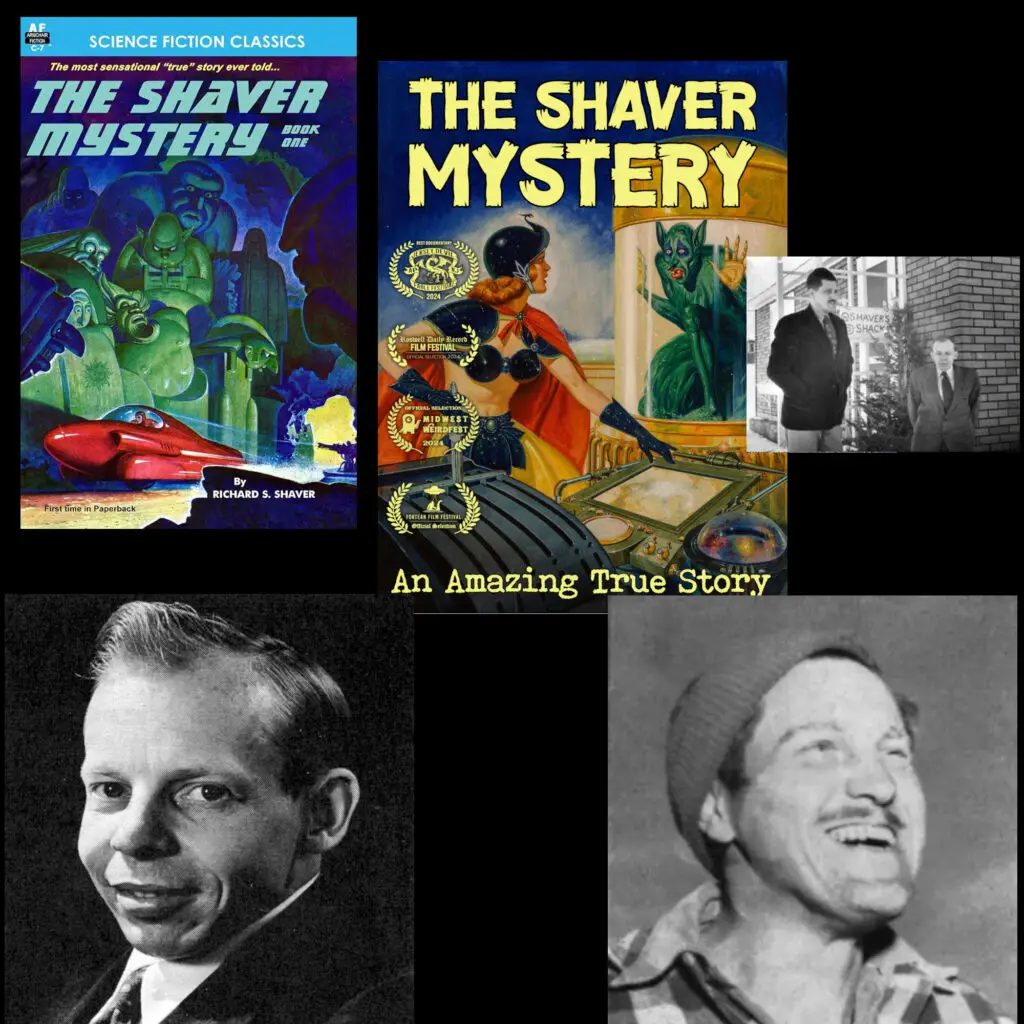
Flashback: Shaver Mysteries Super-Cut
It’s Hollow Earth, UFOs, the birth of Sci-Fi, and more wierdshit than you can believe as we present a super-cut of our 2-part interview with Jerry Drake and Jeb Card about one of the foundational stories of “weirdshitology” in a new ginormous single episode.
And there’s a little bit of reading if you want to follow us down the rabbit hole…
I can’t remember how rowdy our language gets so I’m slapping the explicit tag on just in case. And If you’ve got friends who would enjoy or benefit from this episode, I’ve made it “free” for anybody without commercials but I’m not publicizing that on our ad-supported feed. You know what to do!
Some links from the Hollow Earth introduction:
- Duane Griffin’s academic research on Hollow Earth history (From archive.org snapshot)
- 1665 — Athanasius Kircher — review of The Subterranean World (Mundus Subterraneus)
- 1692 — Edmond Halley’s paper “An account of the cause of the change of the variation of the magnetical needle with an hypothesis of the structure of the internal parts of the Earth”, Philosophical transactions, xvi (1692), 563–87
- 1721 — An Account of a Voyage from the North Pole to the South Pole via the Centre of the Earth (Anonymous French volume)
- 1741 — The Journey of Niels Klim to the World Underground
- 1818 — John Cleves Symmes issues tract urging exploration of the poles and hollow earth
- 1820 — Symzonia: Voyage of Discovery
- 1826 — James McBride — Symme’s Theory of Concentric Spheres
- 1838 — The Great United States Exploring Expedition
- 1833 — E.A. Poe’s MS Found in a Bottle
- 1864 — Jules Verne’s Journey to the Center of the Earth
- 1869 — Cyrus “Koresh” Teed starts Koreshanity
- 1871 — (more on this in pt2) Bulwer Lytton’s The Coming Race
- 1888 — Helena Blavatsky’s The Secret Doctrine
- 1905 — Frederick Oliver’s A Dweller on Two Planets
- 1906 — William Reed’s Phantom of the Poles
- 1909 — Cook & Peary race for the Pole!
- 1913 — Marshall Gardner’s A Journey to the Earth’s Interior, or Have the Poles Really Been Discovered?
- 1914 — Edgar Rice Burroughs At The Earth’s Core
- 1931 — Harvey Spencer Lewis’s Lemuria: The Lost Continent of the Pacific
- 1934 — Guy Ballard’s Unveiled Mysteries

There’s lots more discussed in the episode and in part 2’s show notes. Here are a few more helpful links:
- Dan Loxton’s Junior Skeptic Hollow Earth coverage Part 1 and Part 2 were very helpful.
- Wired magazine’s 2014 Hollow Earth article was also useful for me.
- I haven’t read it, but 2004’s book-length bibliography of Hollow World texts Subterranean Worlds looks both comprehensive and interesting.
Here are some more links to dig deeper into the topic:
- The Man from Mars: Ray Palmer’s Amazing Pulp Journey — a biography of Ray Palmer by Fred Nadis
- War Over Lemuria: Richard Shaver, Ray Palmer and the Strangest Chapter of 1940s Science Fiction — a biography of Richard Shaver and much about the impact and history of the Shaver Mystery by Richard Toronto
- Scientifiction or Science-Fiction? STF vs SF? Gernsback coined scientifiction back in 1926 but by the mid 1930s science fiction had effectively won the terminology war. Thankfully nobody argues or complains about that today! 😉
- Fancyclopedia.org has a lot of interesting lore and history around the early days of fandom from Gernsback’s era to current times.
- Long John Nebel featuring Ray Palmer and Richard Shaver from the ever useful website Archive.org.
- Some additional audio from Palmer and Shaver from the Long John Nebel show — via Archive.org, and collected by Wendy Connors (Faded Disks)
- A fascinating overview of Nazis and the Hollow Earth. There is a messy intermingling of genuine history of Nazi fascination with the occult, and a modern belief that the Nazis had real occult power. This includes a lot of strange ideas around Nazis on the moon, in a hollow earth, flying around in flying saucers — that sort of thing.
- Reification — making an idea or abstract into something more concrete
- Shibboleth — a common word that can serve as a code for identifying “in-group” members
Some famous UFO cases referenced in part two
- Dulce Base Conspiracy — this is a complicated tale of real craft, government manipulation, mental illness and expanding conspiracy narrative. Some of it is covered in the documentary Mirage Men which is available on Amazon Prime.
- The Aztec UFO Crash — notable (to me) for being part of the famous UFO book Behind the Flying Saucers by Frank Scully. Although the case was a hoax (perpetrated on, not by Scully) and used as part of a criminal conspiracy confidence-game, Scully’s book about the story tied his name firmly to the foundational UFO lore in America. While there are many references online to Chris Carter naming his FBI character Dana Scully of the TV show The X-Files, apparently he actually named her after Vin Scully, the baseball announcer. (As of this posting, you’ll find conflicting info on Wikipedia but the article on Dana Scully says Vin is the source. Meanwhile the page on Frank Scully says he is the source. The Dana article doesn’t cite a source — but I linked to the LA Times on that. The Frank article links to a source but that 2007 book doesn’t seem to contain the reference as listed. I’m going to trust the LA Times on this.) [Additional update: Here is Carter saying where he got the name for Scully confirming the Vin Scully story.]
- Ashtar — A space entity “channeled” by various UFO Contactees — most notably, George Van Tassel. GVT is famous for organizing the Giant Rock Space Conventions.
- An interview with contactee Woody Derenberger. (Famous of The Mothman Prophecies)
- The Philadelphia Experiment — the obsessive work of someone unwell becomes the basis of a huge bit of paranormal lore as well as a movie. I’ve linked to Brian Dunning’s nice skeptical summary of the case.
- We also briefly discussed The Montauk Project — a “real” case where yet another unreliable set of stories become part of urban legend and fiction and were inspirational to Stranger Things.
Books behind this episode
- The Man from Mars: Ray Palmer’s Amazing Pulp Journey by Fred Nadis
- War Over Lemuria: Richard Shaver, Ray Palmer and the Strangest Chapter of 1940s Science Fiction by Richard Toronto
- The Shaver Mystery books themselves — You can get quite a lot of them inexpensively as digital downloads, but probably should start with I Remember Lemuria, the first volume in the series.
- Mr. Toronto, who authored War Over Lemuria, also manages the (ongoing) magazine of all things Shaver, called Shavertron. He also wrote another book which appears to be a primer for the Shaver universe called Shaverology. I haven’t read that one — but Toronto knew Shaver and also has a book about the rock-art Shaver turned to later in life.
- The book Jeb was trying to remember the name of — the book Lovecraft read that got him started on Atlantis — was The Story of Atlantis and The Lost Lemuria by William Scott-Elliot.
Music
- Monstertalk Theme: Monster by Peach Stealing Monkeys