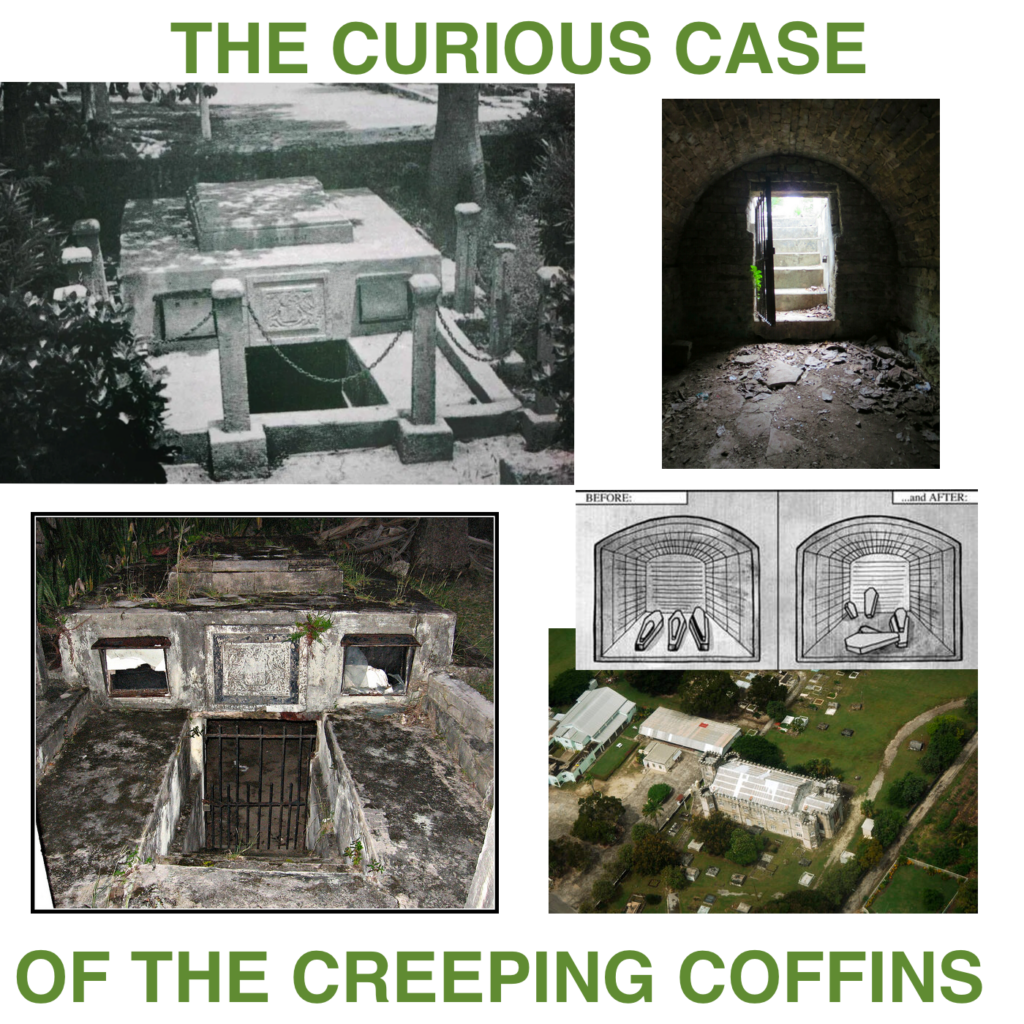
228 – The Chase Vault
The story has everything a good campfire mystery needs: a sealed tomb, heavy lead coffins found in violent disarray, a skeptical colonial governor, fine sand scattered on the floor to catch intruders, and — after every mundane explanation fails — a stubborn residue of the inexplicable. Karen and Matt go well beyond the usual YouTube retelling, tracing the primary sources, checking genealogical records, and raising some pointed questions about whether the Chase Vault is even the Chase Vault.
⚰️ The Folklore: What the Story Claims
The Chase Vault sits in the Christchurch Parish Cemetery in Oistins, a coastal town in southern Barbados. According to the legend:
– The vault was built around 1724 by a James Elliot but sat unused for roughly 70 years — a gap no retelling bothers to explain.
– Its first occupant, Thomasina Goddard, was interred in a wooden coffin in July 1807.
– The vault was purchased by Colonel Thomas Chase, a plantation owner with a reputation for cruelty toward both the people he enslaved and his own family. His two-year-old daughter Mary followed Goddard into the vault in 1808.
– In 1812 his teenage daughter Dorcas died — legend holds she starved herself to death to escape her father’s brutality. Thomas Chase himself died by suicide one month later.
– At each subsequent interment, the sealed vault was found in violent disarray: coffins overturned, the tiny infant’s coffin flung against the wall, Thomasina’s wooden coffin eventually shattered and repaired with wire.
– For the final opening in 1820, presided over by the island’s governor, Lord Combermere (Field Marshal Stapleton Cotton, 1st Viscount Combermere), the floor was dusted with fine white sand and the marble slab was impressed with official seals. When the vault was reopened, the sand was undisturbed — and every coffin had moved again. Thomas Chase’s massive lead coffin was standing on end, blocking the doorway.
– In frustration, the governor ordered all coffins removed and reburied elsewhere in the cemetery. The vault was left open and never used again.
📜 The Source Problem: One Rector, Many Names
Karen’s most significant original finding concerns the provenance of the story itself. The first published account appeared in 📚 Transatlantic Sketches 💵 (1833) — fully thirteen years after the alleged events, and without cited sources. From there the trail gets stranger:
– A version in Sir Robert Herman Schomburgk‘s The History of Barbados (1844) is signed by a J. Anderson, Rector.
– A pamphlet titled Death’s Deeds (1860), printed by Mr. Robert Reese Jr., carries a version signed by Thomas Harrison Audison DD, Rector of Christchurch Barbados.
– The account in the Memoirs and Letters of Lord Combermere (1868) credits “a native of the colony” as its source — almost certainly the same rector.
– J. Anderson and Thomas Harrison Audison are the same person. All three foundational accounts of the Chase Vault story trace back to a single author writing under different names.
The 1907 academic article Death’s Deeds: A Bilocated Story by Andrew Lang and F. A. Paley, published in Folklore (Vol. 18, No. 4), is the earliest serious scholarly treatment of the case. Karen notes she is likely among the few researchers to have actually read it in full rather than simply citing it at second hand — it frames the Chase Vault tale as the probable origin point for similar stories that subsequently appeared in England and Estonia.
🔬 Theories, Natural and Otherwise
Proposed explanations have accumulated over two centuries, ranging from the mundane to the baroque:
– Grave robbers / vandals: Quickly dismissed — the half-tonne marble slab showed no signs of forced entry, and nothing was reported missing from any coffin.
– Vengeance by enslaved people: A theory floated early in the narrative, and one the transcript notes reflects the racial dynamics of the era more than any credible evidence. The African workers who first discovered the disarray reportedly fled in terror and were harshly punished despite their obvious superstitious dread of the site.
– Poltergeists / spirits: Sir Arthur Conan Doyle attributed the movement to residual spiritual energy — specifically a “fluvia” — from the deceased. The activity is notably poltergeist-like in character (objects moved violently, no apparitions) though poltergeist cases are almost never cemetery-based.
– Decomposition gases: Theorized by a George Hunt. Lead-lined coffins are largely airtight, promoting liquefaction rather than gas expansion sufficient to move a coffin carried by eight men. No comparable phenomena have been reported from other sealed vaults.
– Flooding: Barbados sits atop porous coral limestone riddled with aquifers and underground rivers. The cemetery, however, is on elevated ground; tidal flooding sufficient to reach it would affect every vault on the property, not just this one.
– Seismic activity: Barbados sits on the boundary of the Caribbean and South American tectonic plates and is rated medium for seismic activity. Magician and mentalist Banachek suggested to Karen that even low-level vibration, combined with moisture reducing floor friction, could cause heavy objects to shift gradually — enough for stacked lead coffins to topple one another in a chain reaction. Plausible in principle; unverifiable in practice.
– Masonic allegory: Skeptical investigator Joe Nickell‘s two-part analysis in Fate magazine (April–May 1982) identifies Masonic language and structural motifs throughout the printed accounts, suggesting the story may function as allegorical literature rather than a record of real events. Blake finds the literary reading interesting but unsatisfying as an answer to whether anything actually happened.
🪦 The Cautionary Tale Hypothesis
Karen and Matt raise a thread that other investigators have overlooked: both deaths that triggered the alleged phenomenon — Dorcas Chase and Thomas Chase — were rumored suicides. In early 19th-century Anglican society, suicide was simultaneously a sin, a crime, and an emerging public-health concern. Those who died by suicide were traditionally denied burial in consecrated ground; governments were just beginning to collect suicide statistics, creating a perception that rates were rising.
The story’s single identifiable author, Rector Audison, was a clergyman writing at the exact moment when religious and secular attitudes toward suicide were in tension. Karen suggests the entire Chase Vault narrative may be a moral fable — a warning, from a man of God, that suicides disturb the peace of the dead and the living alike. The Anglican Church did not formally end its ban on full Christian funerals for people who died by suicide until 2017.
🗺️ Bilocated Stories and the Question of the Vault Itself
Lang and Paley’s 1907 article coined the term “bilocated story” for legends that migrate geographically with altered local details. The Chase Vault appears to be the source text: a nearly identical case was reported in a “Staunton in Suffolk” (a place Karen and Matt could not locate under that spelling) dated to 1833 — suspiciously coincident with Alexander’s first publication — and another in Stamford, Lincolnshire, first written up in 1867. An Estonian case from 1844 substituted wood ash for Barbados sand on the floor. All include the sealed-vault motif; the Suffolk variant also involves a suicide.
Karen closes with a finding that reframes the entire mystery. Veer Langford Oliver‘s The Monumental Inscriptions in the Churches and Churchyards of the Island of Barbados, British West Indies (1915) is a meticulous on-the-ground survey of Caribbean cemetery inscriptions. His entry for the relevant vault at Christchurch attributes it to the Adams Castle estate — the Waldrons, then the Elliots — and records explicitly that it has no inscription. The “Chase Vault” carving visible on the structure today appears to postdate 1915, raising the possibility that the label was added after the fact to anchor the legend to a physical location, in much the same way that the Winchester Mystery House was embellished by later owners to support its ghost-tour mythology. Whether the vault currently shown to visitors is even the vault described in the folklore remains an open question.
Genealogical searches do confirm that a Thomas Chase, a Mary Anna Maria Chase (baptized 1807, died 1808), and a Dorcas Chase (born 1795, died 1812) existed in Christchurch parish — the Reverend Audison’s own handwritten church records show them. A Samuel Brewster also appears, apparently killed during an insurrection and moved from St. Philip’s cemetery. But there is no record of a Thomasina Goddard and no documentation that any of the coffins were relocated within the cemetery after 1820. Every element of the story, as Blake notes in his outro, ultimately traces back to a single rector writing under multiple names.
📚 Further Reading
– 📚 Transatlantic Sketches, Vol. 1 💵 by Sir James Edward Alexander (1833) — the earliest published account of the Chase Vault story
– 📚 Haunting America 💵 by Karen Stollznow — includes Karen’s investigation of the bilocated Colorado/San Antonio railroad-tracks legend
🔗 Related Links
– Chase Vault — Atlas Obscura (photographs and visitor information)
– Chase Vault — Wikipedia
– Field Marshal Lord Combermere (Stapleton Cotton) — Wikipedia
– Taphonomy — Wikipedia (decomposition processes relevant to several proposed explanations)
– Caribbean Plate — Wikipedia (seismic context for Barbados)
– Poltergeist — Wikipedia
– Skeptoid: The Moving Coffins of Barbados — Brian Dunning’s skeptical overview of the case
Note: ads inserted into the distributed audio alter the timestamps in unpredictable ways, so timing references in these notes are approximate.
Karen Stollznow and Matt Baxter team up to discuss one of Karen’s favorite mysteries: The moving coffins of Chase Vault, Barbados.
Note:
This episode deals with themes of suicide and death. If you’re feeling at all suicidal please get help immediately by calling the national suicide hotline: 1-800-273-8255. (TALK)
Some links for today’s episode:
Chase Vault (Atlas Obscura)
Transatlantic Sketches (Vol 1) by By Sir James Edward Alexander
An article with excellent photos of the tomb & cemetery.
Referenced in this episode:
Joe Nickell’s 2-part coverage of the Chase Vaults in Fate Magazine:
Nickell, J. “Barbados’ restless coffins laid to rest.” Fate. 1 Apr. 1982, Volume 35, Number 4: 50-56. (story continues in part 2 in the May 1982 issue pages 79-86.)
Lang & Payley’s folklore “bi-located story”
Skeptoid coverage of the case.