Regular Episode
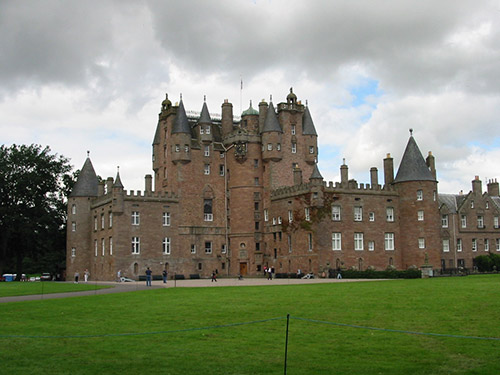
#166 – CHAINED HEIR: GOTHIC HORROR IN GLAMIS CASTLE
Before the interview proper, Blake and Karen run through the castle’s ghost roster and compare notes on why old buildings with big heating bills have such a reliable tendency to become “the most haunted place in Scotland” (or England, or America, or Australia).
🏰 A Castle With Layers
Glamis (correctly pronounced “Glams” in Lowland Scots) dates its current structure mostly to the 15th and 16th centuries, though the site itself is far older — it appears in Macbeth as the seat of the Thane of Glamis, and King Malcolm II is said to have been murdered there. It is the ancestral home of the Bowes-Lyon family, most famously the childhood home of Queen Elizabeth, the Queen Mother.
Mike describes it not as a classic fortress-keep but as a massively fortified manor house, with exterior walls in the central section up to sixteen feet thick — plenty of room to hide something. The castle’s first brush with literary spookiness came when a young Walter Scott stayed there in the 1790s, alone in a distant room, and later wrote that as he heard the factor retreating down the corridor locking door after door, he felt he had been left “somewhat too far from the living and somewhat too close to the dead.”
👻 The Ghost Catalogue
Karen surveys the castle’s crowded spectral roster before the interview begins — Glamis is claimed to harbour upward of twenty ghosts:
– The Grey Lady, identified as Lady Janet Douglas, accused of witchcraft by King James V (who had a longstanding feud with the Douglas family) and burned at the stake in the 16th century.
– The Woman Without a Tongue — a badly disfigured female figure seen running the grounds at midnight; her identity and backstory remain unknown.
– Earl Beardy, a notoriously dissolute gambler said to have accepted the Devil’s invitation to play cards on the Sabbath and been condemned to game forever in the hidden room.
– Reports of disembodied screaming, slamming doors, and unexplained hammering throughout the night.
Karen and Blake briefly detour into Borley Rectory and the investigator Harry Price as examples of the broader tradition of elaborately haunted British buildings — a tradition they’d both like to revisit in a future episode.
🚪 The Secret Room and Its Legends
The two-part secret of Glamis is, Mike argues, worth separating carefully. The first part — the hidden room itself — has genuine architectural plausibility: early estate records from around 1620–1630 confirm that a secret hiding-place was built into the structure by one of the early Earls. A visitor named Ernest Hamilton described, in memoirs written in the 1920s, lowering himself through a trap door in the Blue Room as a boy and following a twisting staircase down to a passage that ended in a blank wall.
The most famous attempt to locate the room from the outside dates to around 1850, under the 12th Earl of Strathmore: houseguests, with the Earl conveniently away on business, toured the castle hanging sheets from every accessible window. When they went outside to compare, one to four windows had no sheets. The Earl returned at precisely the wrong moment, flew into a rage, accused his wife of treating a serious family matter as lighthearted banter — and the couple subsequently divorced, the Countess eventually dying alone in Italy. Mike notes that the almost novelistic tidiness of the Earl’s reappearance “just in the nick of time” is itself a small historiographical warning flag.
The older story of what was in the room involves the Earl Beardy legend — the Devil’s card game, still unfinished — and a separate tale in which enemies of the Earls of Strathmore, the Ogilvys, were lured into the hidden room under a flag of truce and left to starve, their skeletons allegedly showing evidence of cannibalism. Mike treats this as legend-craft rather than history: “the elements are so explicitly well-crafted and legendary-sounding that, as a historian, one’s alarm bells start ringing.”
👾 The Monster: The Chained Heir
The second, more sensational part of the secret is the one that drives this episode: the claim that the hidden room was home to a living monster — specifically, the rightful heir to Glamis, born so hideously deformed that the family could not allow him to inherit and instead kept him locked away, cared for by trusted retainers.
The earliest surviving description, from a Miss Gilchrist writing in 1885, describes a creature “in the shape of a sort of half-frog.” Later, the writer James Wentworth Day, researching his 1960s book The Queen Mother’s Family Story, gathered a more specific account from family members: a creature with no neck (head mounted directly on the body), a massively powerful and hairy torso, and severely attenuated limbs. Mike reads the frog description as a clumsy metaphor for this kind of profound congenital abnormality rather than a literal amphibian resemblance.
The most frequently cited candidate for the monster’s identity is a child listed in the Scots Peerage as born and died on the same day in October 1821 — a detail seized upon by journalist Paul Bloomfield writing for Queen magazine in the 1960s to argue the child had in fact survived, hidden. An older variant, published in Notes and Queries in 1884, places the birth around 1799 under the 11th Earl instead.
The creature’s alleged longevity spans most of the 19th century depending on which source you follow: the New York Times reported its death in 1884; 1904 is another often-cited year; and Lord Mountbatten claimed to have heard it did not die until the 1920s. An area of the battlements, Mike mentions, is still known as “the Mad Earl’s Walk.”
The secret was said to be held by exactly three people: the Earl, his heir (informed on coming of age at 21), and the family’s factor (estate manager). Glamis notably had only four factors between 1765 and 1949 — these were multigenerational family retainers, not ordinary servants. Mike quotes the celebrated exchange in which the Countess of Strathmore, having cornered the factor Andrew Ralston, begged him to tell her the secret: “Lady Strathmore, it is fortunate for you that you do not know and cannot know the secret. For if you did know it, you would never be a happy woman.” Ralston himself, it was said, refused ever to sleep inside the castle under any circumstances — on one occasion having every servant roused to dig a path through a heavy blizzard rather than accept a spare room for the night.
📰 Victorian Media and the Story’s Spread
Charles Dickens’s magazine All The Year Round — likely under the editorship of his son by that point — ran a version of the story in 1884, helping cement it in popular Victorian consciousness. The singer Virginia Gabriel, a prominent figure of the 1870s, spent an extended period as a guest at Glamis and returned, according to her grand-niece A.M.W. Sterling writing in the 1920s, “full of the mysteries.”
The story also invites comparison to the gothic literary tradition running from Horace Walpole‘s The Castle of Otranto (1764) through Charlotte Brontë‘s Jane Eyre — both featuring the “madwoman in the attic” trope of a socially unacceptable family member hidden from view. Mike also notes that the nearby English manor of Vale Royal in Cheshire carries a near-identical legend of a secret room whose contents are known only to three people — and that this legend predates its Glamis counterpart, suggesting the story is drawn from a shared folkloric well rather than a single originating event.
🔎 The Skeptical Denouement
By around 1900 the story fades from active circulation. The New York Tribune noted in 1904 that Glamis had been put up for public rent — which, Mike argues, would have been unthinkable if there were any risk of unsupervised strangers stumbling across a living secret. When James Wentworth Day spoke to the then-Earl in the 1960s, the Earl confirmed he had never been initiated into any secret; it appeared the chain of transmission had broken sometime around the First World War, possibly when the last initiate was killed without passing it on.
The most concise verdict comes from the diary of the Earl of Crawford, written in 1905 after a stay with the Bowes-Lyon family. He observed that the family seemed to know surprisingly little of their own history, that they clearly enjoyed embellishing stories for the benefit of guests, and that they took an evident theatrical pleasure in creating an atmosphere of mystery. His conclusion: “I quickly realised that the secret of Glamis is that there is no secret.”
Mike and Karen also note that the Bowes-Lyon family does have a documented real-world parallel to the legend: two cousins of the Queen, born with mental disabilities in the 1920s, were institutionalised and never visited by the family — a fact occasionally raised by republican commentators. The impulse to conceal family members deemed “unfit” for public life, especially within a class whose claim to authority rested partly on notions of physical and hereditary perfection, requires no supernatural explanation.
📚 Further Reading
– 📚 Borderlands 💵 by Mike Dash
– 📖 The Castle of Otranto by Horace Walpole
– 📖 Jane Eyre by Charlotte Brontë
🔗 Related Links
– Glamis Castle (Wikipedia)
– Bowes-Lyon Family (Wikipedia)
– Lady Janet Douglas, the Grey Lady (Wikipedia)
– All The Year Round — Dickens’s magazine (Wikipedia)
– The Castle of Otranto and the Gothic tradition (Wikipedia)
– Joseph Merrick, “The Elephant Man” (Wikipedia)
– Sin-eating — Mike’s next research topic (Wikipedia)
Note: ads inserted into the distributed audio alter the timestamps in unpredictable ways, so timing references in these notes are approximate.
Glamis Castle has secrets—and one of them is monstrous. Mike Dash (Spring Heeled Jack) joins us to talk about his research into the dark folklore around this ancient, beautiful household.
Referenced in this episode
- Who Knows book
- Mike’s Glamis Research
- Mike’s book Borderlands
- Mike’s Amazon authors page
Music
- Monstertalk Theme: Monster by Peach Stealing Monkeys
MTArchivist
0