Regular Episode
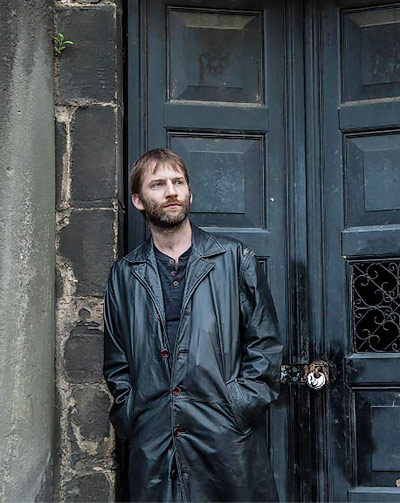
#155 – THE GREYFRIARS KIRKYARD GHOST
⛪ A Very Brief History of a Very Complicated Graveyard
The Greyfriars Kirkyard (Scots: kirkyard = churchyard) sits in the southwestern corner of Edinburgh’s Old Town, bisected by the Flodden Wall. Originally a burial ground for Franciscan monks in the early 1600s, the site expanded over time, and its southernmost section — the Covenanters’ Prison — was the last land added. Before it became consecrated burial ground, it served as an open-air prison for the Covenanters: Scottish Presbyterians who, in 1638, signed the National Covenant in the kirkyard itself, asserting their right to worship outside the English episcopal style demanded by Charles I. Fred notes, with some awe, that portions of this document may have informed the foundations of the American Constitution — a claim worth a skeptical raised eyebrow, but not without some historical currency.
The graveyard is also the resting place of James Hutton, the father of modern geology, commemorated with a relatively fresh plaque — one of many reminders that this isn’t just a gothic tourist prop but a site woven into the fabric of Scottish intellectual history.
⚔️ Bloody George Mackenzie and the Covenanters’ Prison
The villain — or at least the man most conveniently cast as one — is Sir George Mackenzie, the King’s Advocate who oversaw the imprisonment of somewhere between 400 and 1,200 Covenanter soldiers in 1679 following the collapse of the Covenanting armies. Marched barefoot from England through a brutal Scottish winter, the prisoners were held in the unconsecrated strip of ground at the back of the kirkyard, given just enough food and water to prolong their suffering, and reportedly shot if they moved or attempted escape. The musket holes in the surrounding wall are, according to Fred, still visible.
Fred is careful to complicate the easy villain narrative. Mackenzie — known to history as “Bloody Mackenzie” — also wrote remarkably progressive treatises for the late 1600s, arguing that criminal behavior was a product of environment and upbringing rather than innate moral deficiency. Fred’s point: one man’s monster is another man’s complex historical figure, and the story that survives is rarely the whole one.
👻 The 1998 Break-In and the Birth of the Poltergeist
Mackenzie’s ornate mausoleum had long been a rite of passage for Edinburgh schoolchildren (“Mackenzie, Mackenzie, come out and get me”), but the modern haunting story dates to 1998. As the tale goes, a homeless man broke through the old mortar at the back of the tomb, descended into the sub-chamber containing Mackenzie’s coffin, and fell through a hidden burial pit beneath the floor — a pit no one knew existed. The kirkyard caretaker, Graham, arrived to investigate a noise, opened the grate for what Fred says was the first time in living memory, and encountered the man emerging from the pit in the dark. Blake confirmed via follow-up email with Fred that Graham is a real person who has since visited the tours, and that police were called — though exactly what was recorded is uncertain.
Fred is emphatic about one common piece of misinformation: the Black Mausoleum, where the bulk of reported activity now occurs, is not Mackenzie’s tomb. It belongs to the Dundas family and sits roughly halfway down the left side of the Covenanters’ Prison. Mackenzie’s tomb is about 100 feet from the prison entrance; the Black Mausoleum is inside the prison itself. This distinction has been thoroughly muddied by competing tour companies and internet retelling — a small, real-time demonstration of how folklore mutates even while the primary sources are still alive.
🩹 The Attacks: What People Actually Report
City of the Dead Tours holds the exclusive (council-permitted) access to the Covenanters’ Prison, which means that if something is happening to visitors in that space, it’s happening on their tours. Fred describes a broad range of reported experiences: cold sensations, feelings of being choked, pushed, punched, or scratched, and visible injuries — cuts and bruises found on visitors after leaving the Black Mausoleum. Fred himself walked out after one tour with three deep gouges across his chest, having felt nothing at the time. The company keeps a log book of signed accounts from visitors, though Fred acknowledges the data collection is informal and many experiences go unrecorded out of embarrassment or confusion.
The most unsettling incidents Fred describes involved two separate women (across more than a decade of tours) who collapsed, lost consciousness, and went into convulsive episodes inside the prison — cycling between unconsciousness and convulsions until they were helped out through the gate, at which point they recovered. Blake notes in the post-interview segment that this doesn’t match his familiarity with epileptic seizures, and draws a cautious parallel to the kind of dissociative episodes documented in exorcism contexts — not as an endorsement, but as a behavioral pattern worth examining. He floats a rough methodology for a real investigation: photograph participants before and after, video the tour, and compare reported injuries against what’s actually captured on film.
🐕 Greyfriars Bobby, Harry Potter, and Famous Residents
The kirkyard’s most beloved former resident is Greyfriars Bobby, the Skye Terrier (or possibly Dandie Dinmont, depending on which book you read) reputed to have guarded his master’s grave for 14 years in the 19th century. Fred notes that contemporary newspaper records do support Bobby’s existence and suggest he was buried in a flower bed near the church — not in the kirkyard itself, since dogs were not permitted in a human burial ground. A memorial headstone erected by an American admirers’ society now marks a spot inside the main gate, though Bobby isn’t actually buried there. Fred adds the pointed observation that the city apparently gave Bobby the keys of Edinburgh — effectively the right to the city — well before women could vote.
The other famous draw is purely fictional: the imposing school behind the Covenanters’ Prison is George Heriot’s School, widely cited as an inspiration for Hogwarts. The western end of the kirkyard contains a headstone for one Thomas Riddle — a name Harry Potter readers will recognize — along with a memorial to William McGonagall, officially the world’s worst poet (and, Fred notes, the namesake of Professor McGonagall). Harry Potter tourism has now apparently surpassed even the Bobby pilgrimage as the primary reason visitors seek out Greyfriars.
🔬 The Skeptical Angle: Priming, Psychology, and Testability
Fred, despite his deep investment in telling these stories well, is refreshingly ambivalent about their ultimate explanation. He describes himself as occupying the uncomfortable middle ground between flat dismissal (“it’s all in your head”) and credulous acceptance (“it’s definitely a poltergeist”) — and he finds both camps equally prone to shutting down inquiry. Blake invokes Richard Wiseman‘s research on how prior expectation (priming) shapes paranormal experience in reportedly haunted locations — a well-documented psychological phenomenon that doesn’t fully explain away the reported physical injuries but does suggest the interpretive framework visitors bring matters enormously.
Blake’s post-interview notes are worth reading in full: the MonsterTalk position remains that paranormal claims should be examined individually rather than bundled under a single “haunting” explanation, and that the injury reports at Greyfriars are the most empirically interesting aspect — precisely because they could, in principle, be tested.
📚 Further Reading
– 📚 The Ghost That Haunted Itself 💵 by Jan-Andrew Henderson (the history of the Mackenzie Poltergeist from the perspective of City of the Dead Tours)
🔗 Related Links
– Greyfriars Kirkyard — Wikipedia overview
– Sir George Mackenzie — the historical figure behind the legend
– Covenanters — the prisoners whose suffering underpins the site’s dark history
– National Covenant (1638)
– Greyfriars Bobby
– George Heriot’s School — the Hogwarts inspiration
– James Hutton — father of modern geology, buried at Greyfriars
– William McGonagall — the world’s worst poet, also memorialized in the kirkyard
– Flodden Wall — the historic city wall that bisects the graveyard
– Poltergeist — the parapsychological concept the phenomenon is named after (though Fred notes most researchers do not attribute it to Mackenzie’s ghost specifically)
Note: ads inserted into the distributed audio alter the timestamps in unpredictable ways, so timing references in these notes are approximate.
Since the late 1990s people have been reporting strange incidents and injuries when touring the graveyard known as the Greyfriars Kirkyard. Some call it The Mackenzie Poltergeist, but whatever you call it it’s been the claimed cause of numerous injuries and scary stories. In this episode we interview City of the Dead tour-guide Fred Fogarty. We discuss the history of the site, some of the stories, and how one might do deeper research into this mystery. Note: Fred will be appearing at the Hawaii Paranormal Conference July 13–15, 2018.
![Greyfriars Kirkyard, Edinburgh, Scotland (photo by Carlos Delgado [CC BY-SA 3.0], from Wikimedia Commons](https://www.skeptic.com/podcasts/monstertalk/18/05/16/images/Greyfriars_Kirkyard.jpg)
Greyfriars Kirkyard, Edinburgh, Scotland (photo by Carlos Delgado [CC BY-SA 3.0], via Wikimedia Commons)

Of Interest
Music
- Intro Music: Blue Grey Mist by Olga Scotland
- Monstertalk Theme: Monster by Peach Stealing Monkeys
MTArchivist
0