Regular Episode
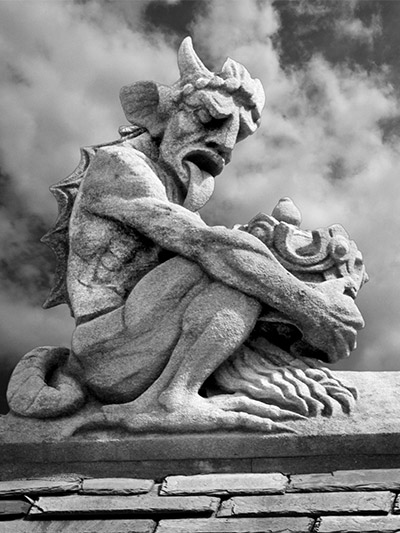
#153 – SPOUTING OFF ABOUT GARGOYLES
As Blake notes up front, gargoyles occupy an unusual corner of monster lore: widely recognized, endlessly reproduced in film and fiction, yet almost entirely lacking the kind of “they’re real and they’re coming for you” folklore that drives most MonsterTalk episodes. What they do have is centuries of architectural history, surprising humor, and more hidden Easter eggs per square foot than most Disney theme parks.
🏛️ Gargoyles vs. Grotesques: Setting the Record Straight
The terminology has gotten muddled in popular use, so Matthew draws the distinction clearly. A grotesque is the broad architectural term for any sculptural figure — human, animal, or fantastical — carved on or into a building. A gargoyle is a specific subset: a grotesque that also functions as a rain spout, channeling water away from the building’s walls to prevent erosion. The word itself descends from the Old French gargouille (throat) — the same root as the English word “gargle.” So technically, if it doesn’t spit water, it’s a grotesque, not a gargoyle.
The functional role of gargoyles faded around the 15th–16th centuries with the development of enclosed downspouts. The style was later revived in the early 19th century largely as decorative affectation, divorced from the original plumbing purpose.
⛪ Medieval Symbolism and the Illiterate Congregation
In their original Gothic church context, grotesques served several overlapping purposes. Demonic imagery on the exterior signaled that evil was kept outside the sanctified interior. Fearsome figures were also thought to ward off malevolent spirits. But Matthew highlights a more pragmatic function: with most medieval congregants illiterate, the Church relied heavily on visual storytelling to convey moral and theological concepts. Grotesques and gargoyles functioned as stone picture books — a point Blake finds amusingly incongruous when applied to Yale, whose student body is presumably literate.
Blake also raises the tradition of grotesque carvings inside English churches — a topic familiar to readers of M. R. James ghost stories — and Matthew connects these interior figures to the broader tradition of using monstrous imagery to bracket and heighten the beauty of sacred art by contrast.
🏫 Collegiate Gothic and Yale’s Stone Theme Park
Collegiate Gothic architecture — the style responsible for Yale’s iconic look — was a 19th-century American revival movement designed to associate new institutions with the prestige of medieval European universities like Oxford and Cambridge. The style peaked at Yale in the late 1920s and early 1930s, producing buildings deliberately engineered to look far older than they are.
Architect James Gamble Rogers, responsible for many of Yale’s landmark Gothic buildings including Sterling Memorial Library and Harkness Tower, reportedly went to elaborate lengths to age his materials. One story has him burying freshly quarried roof slates in Long Island Sound for eight months so they’d emerge pitted and discolored. Another — which Matthew admits strains credulity — claims Rogers had acid poured down the sides of the 200-foot Harkness Tower (completed 1921, then the tallest freestanding stone structure in North America) to weather the stonework, inadvertently weakening it enough to require internal steel supports.
Other aging tricks Matthew documents: stairs molded with artificial wear depressions, windows blocked up at the time of construction to imply centuries of alteration, and rows of empty sculptural niches designed to suggest that the original statues were long ago stolen or lost. Matthew’s verdict: less a university campus, more a very convincing theme park.
🦎 The Grotesques of Yale: Hidden, Humorous, and Occasionally Terrifying
Yale’s gargoyles and grotesques range from the expected demonic imagery to Handsome Dan the Bulldog (the university mascot, depicted as an actual water-spouting gargoyle on newer buildings) to an iPhone grotesque on one of the two new residential colleges completed just before the episode was recorded. Matthew estimates “many hundreds” of individual figures across campus — a number he can’t pin down precisely because he keeps finding new ones, especially in winter after the leaves drop.
Some of his favorites are what he calls reclusive grotesques: figures deliberately hidden in places most passersby never look. A small face sticking its tongue out lurks under a decorative canopy at the Hall of Graduate Studies, visible only if you press close and crane your neck upward. A spider is tucked far up under a library corner — technically public but practically invisible. Matthew’s theory: these hidden figures reward the curious and invite visitors to look more closely at everything around them.
The episode’s scariest specimen lives at Trumbull College: a lizard-like demon with a ridge of dorsal spines, apparently clutching a crown — with what may or may not be a severed head inside it. Matthew couldn’t confirm from ground level, and the roofline geometry made other angles impossible. The ambiguity, he suggests, is part of the point.
A standout piece is the Ledger Flagstaff at the base of a campus flagpole — a cast-bronze memorial erected in 1908 by classmates of Augustus Canfield Ledger (Yale class of 1898, killed in the Spanish-American War in 1899). The grotesque face on the memorial — possibly Bacchus, given the surrounding fruit imagery — is startlingly ugly. Matthew reads it as intentional: a memento mori set against the campus’s architectural grandeur.
📸 The Photography: Why Black and White?
Matthew shot everything in color originally, then discovered that converting to black and white dramatically improved the images. Since most grotesques are unpainted stone, their character is entirely defined by the interplay of light and shadow. Color photographs introduced distracting elements — sky, leaves, surrounding stonework — that pulled focus away from the sculpture itself. In black and white, he says, “the true character of the grotesque really pops and shines through.”
Seasonality matters too. Matthew learned the hard way that summer photography is deceptive: foliage hides dozens of figures. His preferred shooting windows are winter and early spring, before the leaves return — the same conditions that also reveal gargoyles in their functional glory, sporting long icicle “goatees” from their open mouths during freezing weather.
🗺️ Grotesque Safaris and Future Projects
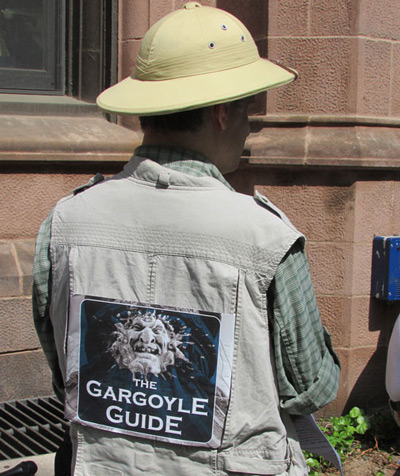
Matthew leads public tours of Yale’s grotesques, which he bills as grotesque safaris — conducted in a photographer’s vest, cargo pants, and a pith helmet (practical as well as theatrical: it helps tour participants spot their guide in a crowded urban campus). He also noted that at the time of recording he was working on a follow-up volume, tentatively titled The Grotesque Ten, documenting collegiate Gothic grotesques at nine other American university campuses including Duke, Princeton, the University of Chicago, and the City College of New York.
The episode opens with a clip from the 1972 made-for-TV film Gargoyles — notable mainly as an early showcase for special effects work by a young Stan Winston. Blake rates it as not-great but watchable, and at time of recording it was available free on YouTube: 📺 Gargoyles (1972) on YouTube.
📚 Further Reading
– 📚 An Education in the Grotesque: The Gargoyles of Yale University 💵 by Matthew Duman
🔗 Related Links
– Gargoyle — Wikipedia
– Grotesque (architecture) — Wikipedia
– Collegiate Gothic — Wikipedia
– James Gamble Rogers (architect) — Wikipedia
– Sterling Memorial Library, Yale — Wikipedia
– Harkness Tower, Yale — Wikipedia
– Hampton Court Palace (eavesdropper grotesques) — Wikipedia
– Matthew Duman’s Yale Gargoyles website
Note: ads inserted into the distributed audio alter the timestamps in unpredictable ways, so timing references in these notes are approximate.
We’re getting our minds in the gutter this week but hopefully won’t leave you drained as we climb into the nooks and crevices of Yale University’s gargoyles and grotesques with photographer and author Mathew Duman, author of An Education in the Grotesque: The Gargoyles of Yale University.
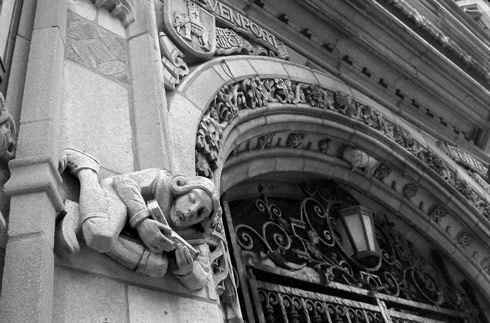
Image copyright Mathew M. Duman
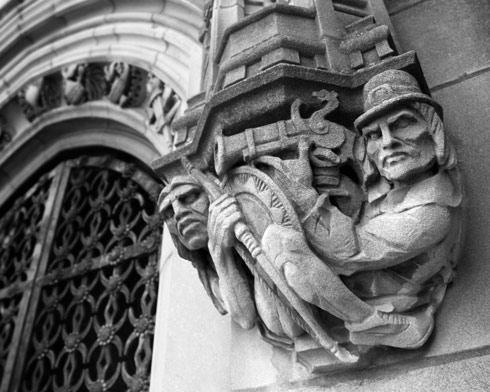
Image copyright Mathew M. Duman
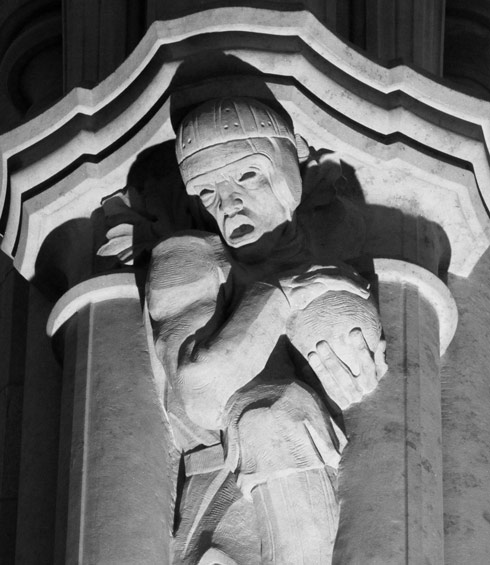
Image copyright Mathew M. Duman
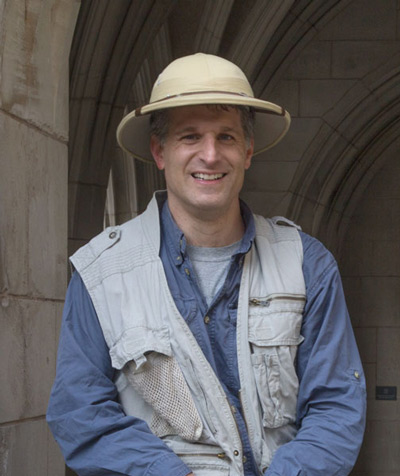
Mathew Duman
Of Interest
- Gargoyles (1972) — Complete Movie
Music
- Monstertalk Theme: Monster by Peach Stealing Monkeys
MTArchivist
0