Regular Episode
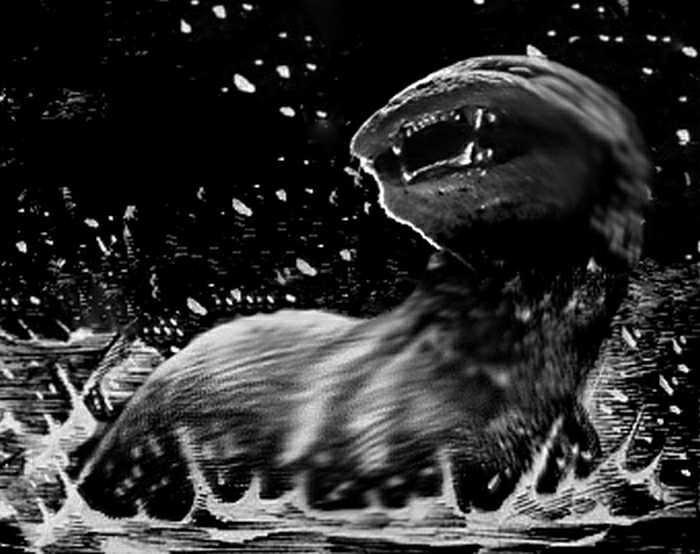
#230 – Otter King & Other Things
The conversation was supposed to stay tidily within the borders of Ireland, but monster lovers gonna monster-talk, and it sprawled beautifully into Australian prehistory, colonial linguistics, changeling psychology, and the eternally underrated Father Ted.
🦦 The Dobhar-chú: Ireland’s King of the Otters
When it comes to animal cryptids, Ireland’s menu is famously sparse — no wolves for centuries, nothing bigger than a deer, and (thanks to a certain fifth-century bishop) no serpents at all. Rob and Eamonn argue this is partly a forest problem: cryptid traditions tend to flourish where dense wilderness gives dangerous unknowns somewhere to hide, and Ireland is the least forested country in Europe.
Into this ecological gap steps the Dobhar-chú (roughly “otter-hound” in Irish), also rendered Dorchú or Doyarchu — the self-styled King of All Otters. Described as ranging anywhere from the size of a regular otter up to that of a large dog, with dark fur and reportedly orange flippers, the creature has been sighted across the west of Ireland. One of the most recent alleged encounters (circa 2000) involved Irish artist Seán Corcoran and his wife, who reported seeing a large, dark animal swimming in a lake on Omey Island in Connemara, Galway, before it let out what Corcoran described as a haunting screech.
What makes the Dobhar-chú unusual even in cryptozoological terms is physical evidence: there is reportedly a 17th-century gravestone in County Leitrim that attributes a killing directly to the creature — making it one of very few cryptids with a period stone inscription to its name. (The MonsterFuzz lads also float a true-crime reading of the inscription, which is equally plausible and considerably more sinister.)
🧚 Fairies, Changelings, and the Bridget Cleary Case
Ireland’s cautionary folklore runs more spectral than zoological. The changeling tradition — the belief that fairies steal a human and leave behind an exact replica — appears across European folklore but is particularly well-documented in Ireland. The modern Irish girl’s name Saoirse aside, there is even a girl’s name, Síofra, that translates roughly as “changeling child,” derived from sí, the Irish word for fairy (the same root as in banshee, from bean sí, “woman of the fairy mound”).
The group discusses the tragic 1895 case of Bridget Cleary, in which a County Tipperary woman was killed by her husband and nine others who claimed she had been replaced by a changeling. The case became an international scandal and illustrates how sincere — and deadly — folk belief could be even in the late Victorian era.
Blake notes a clinical parallel: Capgras delusion, a neuropsychological condition in which a person loses the emotional recognition of familiar faces while retaining visual recognition, producing the uncanny conviction that a loved one has been replaced by an impostor. The group also floats the idea that changeling lore may have provided pre-diagnostic communities a framework for understanding what we now recognize as autism in children and dementia in the elderly — the personality seeming to leave while the body remains.
👻 Roland Doe and the Exorcist Connection
The changeling discussion naturally leads to Roland Doe — the pseudonymous teenager whose alleged 1949 possession became the basis for William Peter Blatty’s novel and the subsequent The Exorcist film. Eamonn offers the sensible two-option analysis: either he was having everyone on, or he was experiencing something that had a more conventional explanation, filtered through a religious lens that could only frame it as demonic. The conversation broadens into how religious and folk frameworks shape the expression of psychological distress — the symptom vocabulary you have is the one you use.
🪨 Newgrange, the Pyramids, and Convergent Architecture
A mention of Irish stone forts sends the episode on a delightful detour to Newgrange, the passage tomb in County Meath that predates both Stonehenge and the Egyptian pyramids by several centuries. Like the pyramids, Newgrange is astronomically aligned: on the winter solstice (around December 21st), a shaft of sunlight penetrates the 19-metre passage and illuminates the burial chamber — an effect that draws visitors from around the world and has a waiting list reportedly stretching a decade for the real event. Blake promises a link in the show notes to an interactive 3D model of the site.
Rob raises the question of possible Egyptian influence on Irish megalithic culture. Blake — ever the skeptic — gently invokes hyperdiffusionism as a label for that line of thinking and steers toward a more parsimonious explanation: when you build any large structure without advanced metallurgy or interlocking woodwork, physics pushes you toward something pyramidal. The solar-alignment feature, meanwhile, looks like a strong candidate for convergent cultural evolution — independent peoples arriving at the same astronomical insight because the sky is the same sky everywhere.
🌿 Banshees, Fairy Rings, and the Living Tradition
The banshee (bean sí) gets a more sympathetic origin story than its screaming-specter reputation might suggest: Eamonn traces it to the historical practice of keening, in which women — sometimes hired, sometimes neighbors — would wail at funerals as a formalized expression of communal grief. Only later did the figure become a death omen in her own right. The Fomorians (Fomoire), the malevolent supernatural beings of Irish mythology — giant demons of the underworld with Celtic heaven-and-hell connotations — also get a mention, partly as a segue into the Irish professional wrestler Finn Bálor, whose ring name combines Fionn Mac Cumhaill and Balor, the destructive one-eyed king of the Fomoire.
On the question of whether anyone in Ireland actually believes this stuff today: yes, absolutely, among older generations. Eamonn recounts his grandmother’s folk cure for a stye (involving a buried object and a woman of uncertain provenance), and the group notes that Irish elected officials have been known to argue against disturbing fairy forts and fairy tufts — rings of flowers, mushrooms, or stones associated with the Good Folk — on the floor of the Dáil. Roads in Ireland have, famously, been rerouted around such sites.
🌏 Australia, Aboriginal Antiquity, and the Kangaroo Problem
A riff on colonial linguistics — the Ogopogo‘s name being an English music-hall rhyme pasted over a First Nations spiritual tradition, the kangaroo possibly being a colonial mishearing — leads to a brief but staggering correction from Blake: the minimum estimated date for human occupation of Australia is 48,000 years, with some evidence pushing it as far as 65,000–70,000 years. The European presence of roughly 250 years is, in that context, genuinely a rounding error. The Aboriginal Australians represent the longest continuously residing population on Earth, with Dreamtime oral traditions passed down using sophisticated memory techniques across that entire span.
📺 The Beast of Craggy Island
Karen’s husband deserves credit for the episode’s most precisely targeted question: have two Irish monster podcasters ever heard of the Beast of Craggy Island? They have. Father Ted — the Channel 4 sitcom set on a fictional island off the west coast of Ireland — is apparently compulsory viewing in Ireland regardless of generation, even if the older generations found it rather close to the bone. Father Jack’s encounter with the Beast remains, the lads confirm, entirely canonical within the show.
📚 Further Reading
– 🎬 Baby: Secret of the Lost Legend 💵 — the 1985 Disney-distributed film featuring William Katt and Patrick McGoohan; discussed as the premier (if unintentionally campy) cinematic treatment of the Mokele-mbembe legend
– 🎬 The Mothman Prophecies 💵 — cited as one of the more serious cryptid-based films
– 🎬 A Glitch in the Matrix 💵 — documentary on simulation theory and synchronicity, mentioned in the context of the conversation about pattern recognition
🔗 Related Links
– Dobhar-chú (Wikipedia)
– Newgrange (Wikipedia)
– Interactive 3D model of Newgrange
– Bridget Cleary case (Wikipedia)
– Capgras delusion (Wikipedia)
– Roland Doe / The Exorcist case (Wikipedia)
– Banshee (Wikipedia)
– Changeling folklore (Wikipedia)
– Fomorians (Wikipedia)
– Fairy forts / fairy rings (Wikipedia)
– Selkies (Wikipedia)
– Wild man / Woodwose tradition (Wikipedia)
– The Green Man (Wikipedia)
– Ogopogo and First Nations traditions (Wikipedia)
– Human occupation of Australia — timeline (Wikipedia)
– Father Ted (Wikipedia)
Note: ads inserted into the distributed audio alter the timestamps in unpredictable ways, so timing references in these notes are approximate.
Karen and Blake are joined by the hosts of MonsterFuzz, Eamonn O’Neill and Rob Billington, to discuss monsters and folklore of Ireland. Well, that’s what we were supposed to talk about but we wandered a bit because it was obvious we all loved talking about monsters. So… that’s on brand right?
Giant Otter Irish cryptid/folklore
Human occupancy of Australia is really, really old
Interactive 3D model of Newgrange tomb
Bridget Cleary “Changeling” murder
The Beast of Craggy Island (Father Ted reference)
MonsterTalk Admin
0
Tags :