Regular Episode
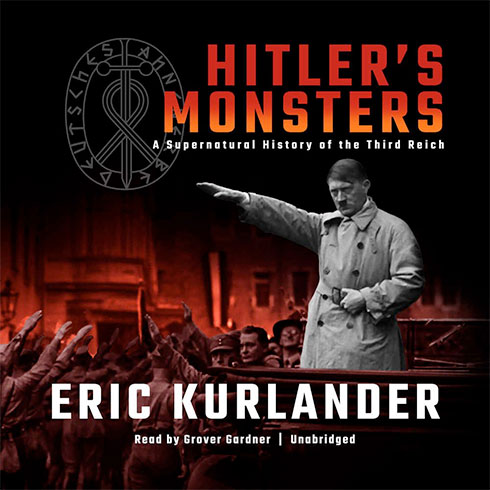
#187 – HITLER’S MONSTERS
The conversation is dense with unfamiliar terminology, so Blake flags that linked definitions for terms like Ariosophy, Anthroposophy, Theosophy, and Völkisch ideology appear in the show notes — because these movements were once widely known but have grown obscure since the end of World War II.
🌋 The Late 19th-Century Soil: Occultism, Border Science, and Alternative Religion
Kurlander frames his story as beginning in the late 19th century, when rapid industrialization and the rise of modern science left many people caught between what Max Weber famously called the “disenchantment of the world” and a desire for spiritual meaning. He identifies three interlocking clusters of belief that would eventually feed into Nazism:
– Modern occultism — distinct from medieval occult traditions, this was a self-consciously contemporary movement claiming empirical legitimacy.
– Border science (Grenzwissenschaft) — a fusion of scientific-sounding methods with faith-based or occult premises; Kurlander’s term for phenomena like pendulum dowsing rebranded as “radiesthesia,” or astrology framed as a mathematically rigorous discipline.
– Alternative and neo-pagan religion — including Ariosophy (which grafted Theosophical “root race” ideas onto explicitly racial Germanic nationalism) and Anthroposophy, the more moderate system developed by Rudolf Steiner.
Kurlander is careful to note this was not a uniquely German phenomenon — William James was conducting clairvoyance experiments, Aleister Crowley was flourishing in Britain, and Margaret Murray was constructing her witch-cult hypothesis in England. What made the Austro-German case distinctive was that these ideas arrived pre-loaded with racial imperialism, Nordic paganism, and resentment over colonial disadvantage — content that proved explosively compatible with post-WWI political grievance.
🔬 Border Science in Practice: Pendulums, World Ice, and the Wehrmacht
One of the book’s most striking arguments is that supernatural thinking influenced not just Nazi culture but operational decisions. Kurlander walks through several examples:
– Pendulum dowsing: Himmler deployed pendulum dowsers (Radiesthesisten) with Waffen-SS units to locate water and precious metals, believing they were at least as effective as conventional geologists. During the Battle of the Atlantic, elements of the German Navy — baffled by British radar and sonar — set up a pendulum and astrology institute to find Allied warships. It did not work.
– World Ice Theory (Welteislehre): Devised by Austrian amateur writer Hanns Hörbiger, the theory held that ice was the fundamental substance of the cosmos and could explain geology, meteorology, and more. Himmler established a meteorological institute within the Ahnenerbe (the SS research bureau) to promote it, and issued what Kurlander calls the “Piedmont Protocol 36” — effectively threatening funding cuts to scientists who refused to work within the World Ice framework. Mainstream German scientists wrote letters of protest; almost none faced serious retribution.
– Finding Mussolini: When Mussolini was deposed and hidden in 1943, SS intelligence chief Walter Schellenberg set up a pendulum and astrology institute to locate him. Post-war SS testimony indicates he was actually found through conventional code-breaking. Himmler believed it was the pendulums.
– Other highlights: Rudolf Hess opened a homeopathic institute and slept with magnets above and below his bed to deflect “death rays.” Hitler hired a dowser to patrol the Reich Chancellery for cancer-causing hidden energies.
Kurlander characterizes the Third Reich as running two parallel cultures simultaneously — a highly modern industrial-scientific state and a faith-based, border-scientific one — and argues the friction between them was a genuine strategic liability.
🕍 Hitler’s Eclectic Spirituality
Blake asks what Hitler actually believed, given how often he is described (inaccurately, Kurlander suggests) as either a conventional Christian or a straightforward atheist. Kurlander’s answer is characteristically nuanced: Hitler occupied a position somewhere between “German Christian” (an Aryanized Christianity stripped of its Jewish elements) and full-on Himmler-style paganism — without firmly committing to either.
Hitler spoke approvingly of Shinto, Hinduism, Buddhism, and Islam as “heroic” religions suited to warriors, while dismissing Christianity as weakened by its Jewish roots and its focus on the afterlife. He read Gustave Le Bon‘s theory of crowd psychology and annotated a parapsychology book titled Magic, underlining passages about charismatic manipulation and the power of personality over rational argument. Whether Hitler genuinely believed in occult forces or was simply studying techniques of mass persuasion remains ambiguous — but Kurlander argues it may not matter much, because enough people around him did believe, and he was content to let them.
🏰 The Holy Grail, the Ahnenerbe, and Nazi Archaeology
The SS’s Ahnenerbe (“ancestral heritage”) research bureau — the real-world counterpart to the fictional archaeology obsession of the Indiana Jones films — funded expeditions and desk-research projects aimed at recovering evidence of ancient Aryan civilization. Kurlander describes two types of researchers who worked within this system: credentialed scientists who privately knew better but bent their findings for funding, and true-believing border scientists who led with ideology and dressed it in scientific vocabulary afterward.
The Holy Grail was a particular fixation. Himmler and others interpreted it as a pre-Christian Indo-Aryan relic that the Catholic Church had tried to suppress — connecting it to the Cathars and to Castle Wewelsburg, which Himmler redesigned as an SS ceremonial center intended to evoke Arthurian mythology. The Italian fascist philosopher Julius Evola was corresponding with the SS archives as early as 1938 about Grail research — and then re-emerged in the postwar decades as a founding intellectual of the European far right, a lineage Kurlander traces with some alarm.
🐺 Persecution, Contradiction, and the Nazi Werewolves
A persistent historiographical claim holds that the Nazis systematically suppressed occultism. Kurlander pushes back: the regime’s relationship with fringe groups was selective and often arbitrary. Groups got arrested not because their ideas were occult, but because they represented potential rival loyalties — an independent charismatic authority (like Steiner’s following) or an organization outside party control (like the Freemasons or certain astrology circles). Biodynamic agriculture, the Anthroposophical farming practice based on lunar and stellar alignments, was quietly tolerated even as its parent movement was persecuted — because leading Nazis found it useful.
The episode closes with Kurlander’s analysis of the Nazi Werewolf partisan program — named deliberately to invoke the werewolf’s status in Germanic folklore as a heroic, Odin-allied forest protector rather than the French or Christian version of the beast as a monster. At the same war’s end, ethnic Germans fleeing east reported being attacked by “Slavic vampires” allied with the communists. Kurlander notes that his final chapter, “Nazi Twilight” — a double reference to Wagner’s Götterdämmerung and the Twilight franchise — is not accidental: the wartime mythology sorted itself neatly into werewolves (Aryan, heroic) versus vampires (Slavic, Jewish, parasitic).
⚠️ Then and Now: Magical Thinking as a Political Warning
Kurlander is explicit that his book is not an argument that supernatural belief inevitably produces fascism — he notes that faith-based movements have at times supported democracy and abolitionism. His argument is more specific: when occult and border-scientific thinking becomes the primary framework through which people interpret political, economic, and social reality — rather than a private enthusiasm — it degrades the epistemic guardrails that liberal democracy depends on. Combined with the pre-existing racial and imperial content of the German supernatural imaginary, it created the ideological substrate for Nazism. Without the First World War, the Versailles Treaty, and the Great Depression, he argues, none of it would have been sufficient. But those conditions are not as reliably absent as we might hope.
He draws a direct line from Himmler’s Grail researchers to Evola’s postwar influence, to contemporary far-right movements, and observes that the same epistemological pattern — suspending empirical standards in favor of faith-and-emotion-based political judgment — is visible today, without a comparable socioeconomic crisis to explain it.
📚 Further Reading
– 📚 Hitler’s Monsters: A Supernatural History of the Third Reich 💵 by Eric Kurlander
– 📚 Living with Hitler: Liberal Democrats in the Third Reich 💵 by Eric Kurlander
– 🎬 Overlord 💵 (2018) — fictional WWII horror film touching on Nazi occult experimentation
🔗 Related Links
– Ariosophy — the racially inflected occult doctrine that merged Theosophy with Germanic nationalism
– Anthroposophy — Rudolf Steiner’s spiritual philosophy; source of Waldorf education and biodynamic agriculture
– Theosophy — Madame Blavatsky’s root-race doctrine, a key upstream source for both Ariosophy and Anthroposophy
– Völkisch movement — the ethno-nationalist cultural movement from which many Nazi ideas drew
– World Ice Theory (Welteislehre)
– Ahnenerbe — the SS “ancestral heritage” research institute
Note: ads inserted into the distributed audio alter the timestamps in unpredictable ways, so timing references in these notes are approximate.
In MonsterTalk episode # 187, we talk about the role of the supernatural and occult in Nazi Germany. Our guest is author Dr. Eric Kurlander, author of the book Hitler’s Monsters, which chronicles the rise of the Nazis and their strange relationship with the occult including fringe theories, Border Science, astrology, homeopathy, and even Nostradamus.
Related material
- Ariosophy
- Anthroposophy
- Aryans
- Theosophy
- Volkish ideology
- World Ice Theory (Welteislehre)
- Steiner’s Waldorf Education
- Castle Wewelsburg (mentioned in Grail discussion)
Music
- Monstertalk Theme: Monster by Peach Stealing Monkeys
MTArchivist
0