Regular Episode
#182 – TEACHING WITH MONSTERS
The course was co-developed with Bruce Beasley, a professor in WWU’s English department and a fellow lover of creepy things. Where Thor brought dinosaurs, giant sharks, and the square-cube law, Bruce brought 📚 Frankenstein 💵 and 📚 Oryx and Crake 💵. The two courses ran simultaneously with the same cohort of students — and both counted toward general university requirements, which helped fill seats fast.
📐 The Physics of Being Enormous
Thor opens the science portion of the course with the square-cube law — the mathematical reason why movie giants are physically impossible as drawn. If you doubled Thor’s height (he’s six and a half feet tall), his weight would increase eightfold while his strength increased only fourfold. The result: a 50-foot woman would need to be barrel-shaped just to stand up, nothing like the proportional figure on that famous poster.
The analysis doesn’t stop at shape. Thor plays recordings of his own voice pitched down to demonstrate what a giant would actually sound like — dropping the frequency by half strips out so much acoustic information that the result is, in Blake’s words, “a drunk Klingon.” Students learn about the range of human hearing (roughly 20 Hz to 20,000 Hz in a young, healthy ear) along the way. The 1950s film Attack of the 50 Foot Woman — released shortly after Sputnik‘s launch — serves as a case study in how monster movies encode contemporary anxieties, with the alien arrival craft in the film conspicuously resembling the Soviet satellite and emitting similar beeps.
🦠 Plague, Smallpox, and Monstrous Disease
Thor uses epidemic and plague films (including 🎬 Outbreak 💵 and 🎬 Contagion 💵) to teach virology and immunology. His showpiece is smallpox — arguably the most “monstrous” disease in human history. Key points he covers with students:
– Smallpox was eradicated in the wild by the 1970s through a strategy of ring vaccination, encircling outbreaks and immunizing inward.
– It remains one of the few human pathogens with no animal reservoir — eliminate it in people and it is truly gone.
– Live stocks are still held by the US and Russia, and the Russian military reportedly weaponized an enhanced strain during the Cold War.
– The virus particle is roughly the size of cigarette smoke, meaning passive exposure at close range is sufficient for transmission — Thor demonstrates this in class with a smoke-infused towel: “You’ve all been infected with smallpox.”
– Today’s global population is essentially a virgin population with respect to smallpox; historical mortality rates in unimmunized groups ran 60–70%.
He draws an analogy to the scene in The Fellowship of the Ring where Isildur refuses to destroy the One Ring at Mount Doom: the US and Soviet Union had smallpox conquered and chose, like Isildur, to keep it.
The 1918 influenza pandemic also comes up — notable for killing disproportionately healthy young adults and causing internal hemorrhaging, symptoms more reminiscent of Ebola than typical flu.
🪲 Parasites: Nature’s Real Monsters
Content warning duly issued: this section is not for the faint of stomach. Thor argues that parasites are the most naturally “monstrous” organisms on earth — and that a large fraction of all species on the planet (possibly three-quarters, by some estimates) are parasitic.
The 🎬 Alien 💵 franchise, which Bruce sometimes assigned in the English course, gave Thor a peg for a lecture on real-world parasitic life cycles that inspired the films. Highlights include:
– The ichneumon wasp, which paralyzes a host (spider or caterpillar), lays eggs inside it, and whose larvae consume non-vital organs first, keeping the host alive until the final kill — the biological template for the chestburster scene.
– Ophiocordyceps fungi that hijack ant behavior.
– Toxoplasma gondii, which completes part of its life cycle in rats by suppressing their fear of cats and inducing attraction to cat urine — and which has documented behavioral effects in humans as well.
– A caterpillar-parasitizing wasp whose larvae, after bursting free, compel the still-living caterpillar to act as a bodyguard for the cocoons.
Thor’s personal encounter watching a wasp systematically dismantle a spider on the edge of his hot tub — removing its jaws, then its legs one by one, before stinging it into paralysis and flying off with the still-living body — is perhaps the most viscerally effective argument that nature requires no embellishment to be horrifying.
🧟 Frankenstein and the Ship of Theseus
When Bruce assigned 📚 Frankenstein 💵, Thor covered the actual state of transplant science — which turns out to be stranger than fiction. He describes documented cases of surgeons temporarily grafting a severed hand onto a patient’s chest wall (keeping it vascularized) while preparing the arm stump for reattachment. Peripheral nerves regrow at roughly one to two millimeters per day; central spinal nerves do not regrow at all, which is why head transplantation — experimentally attempted in animals, including a Soviet two-headed dog — produces a living but paralyzed transplanted head.
The philosophical thread running through these cases — at what point does replacing parts make someone a different person? — maps directly onto the Ship of Theseus paradox. Thor (the materialist) held that identity persists as long as the brain does; Bruce (the humanist) felt that replacing the heart or other organs already changes something essential. The same cohort of students got both perspectives in the same week.
🦶 Bigfoot and the Wild Man
Living in the Pacific Northwest, Thor couldn’t ignore Bigfoot. His approach is rigorously evidentiary: he walks students through the Bigfoot Field Researchers Organization sighting maps, noting that reports appear in suburban Washington, D.C. as readily as in the Cascades, and points out that a viable breeding population would need to have persisted for hundreds of thousands of years across multiple continents without leaving a single bone, tooth, or hide.
He illustrates eyewitness unreliability with a personal story: in San Francisco he leaped away from what his peripheral vision rendered as a lunging German shepherd — which turned out to be a panhandler in burlap bags, crouching behind a newspaper box and growling for tips. The “German shepherd” was vivid and detailed in his memory. It never existed.
Thor connects Bigfoot to the medieval Wild Man archetype — the untamed human who lives beyond the borders of civilization — and suggests that modern cryptozoological Bigfoot belief is essentially a secular, naturalistic update of that ancient myth. Regional variants discussed include the Skunk Ape (Florida), the Wookie (Louisiana), the Yeti, and the Yowie (Australia).
🎓 Running the Course
Thor and Bruce taught the linked in-person version for about ten years. Because WWU had no mechanism for paired course registration, they had to lobby the registrar to create one — the first linked courses on campus. Both sections were approved as lower-division General University Requirements (GURs), making them attractive to students who needed science or English breadth credits. Enrollment filled immediately once word spread, and they regularly had to turn students away.
Guest speakers added texture: Dennis Avner — known online as “Stalking Cat” or the “Cat-Faced Man” — visited the class to discuss his extensive cosmetic surgeries (subdermal implants, filed teeth, facial tattooing) designed to make him resemble a tiger. Thor notes that within ten seconds of conversation, students forgot they were talking to someone who looked like a cat. Avner died in 2012; the Wikipedia article on Dennis Avner has further background.
The course is now available online through Western Washington University. Listeners interested in enrolling can search for Geology 204 in the WWU Western Online catalog — no matriculation required.
📚 Further Reading
– 📚 Frankenstein 💵 by Mary Shelley (annotated edition for makers and educators)
– 📚 Oryx and Crake 💵 by Margaret Atwood
🔗 Related Links
– Square-Cube Law (Wikipedia)
– Smallpox (Wikipedia)
– 1918 Influenza Pandemic (Wikipedia)
– Toxoplasma gondii (Wikipedia)
– Ichneumon Wasps (Wikipedia)
– Wild Man myth (Wikipedia)
– Dennis Avner / Stalking Cat (Wikipedia)
– Ship of Theseus paradox (Wikipedia)
– Western Washington University
Note: ads inserted into the distributed audio alter the timestamps in unpredictable ways, so timing references in these notes are approximate.
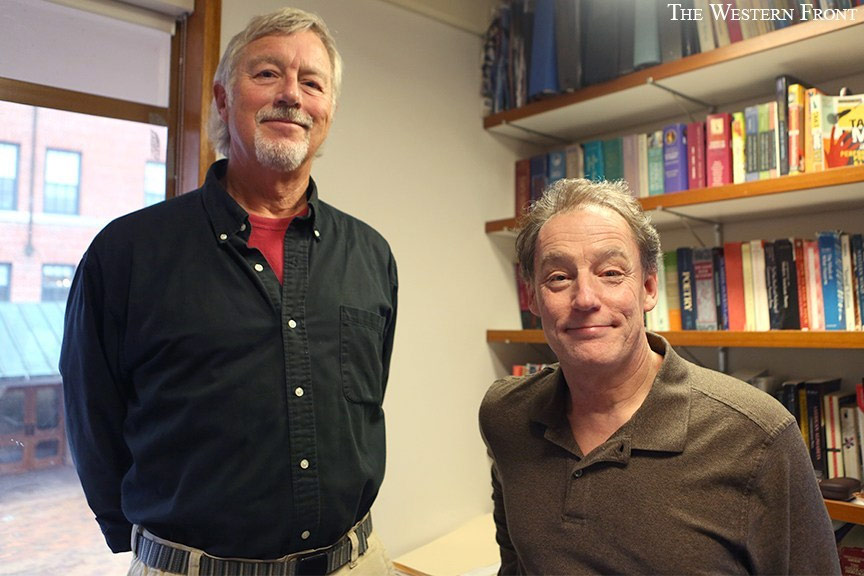
(above) Geology professor Thor Hansen (left) and English professor Bruce Beasley (right) pose for a portrait in Beasley’s office in the Humanities building. (Photo by Caleb Galbreath)
In episode 182 of MonsterTalk, we are delighted to introduce Dr. Thor Hansen to listeners. For several years he’s been teaching a course at Western Washington University that uses monsters to teach science. I think you’re going to enjoy what he’s been up to — and I know some of you may want to reach out to him about similar projects or check out his course online.
Books Mentioned
- Frankenstein by Mary Shelley (link is to annotated version for Makers)
- Oryx and Crake by Margaret Atwood
Other Things
- High frequency sounds to deter loitering
- Spanish Flu of 1918 (details Louisiana’s “Wookie”)
- Stalking Cat (the “Cat Faced Man” (1958–2012)
Thor Hansen’s Class (Online)
- Geology 204 Syllabus
- Western Washington University Online (non-Matriculated student info)
Music
- Monstertalk Theme: Monster by Peach Stealing Monkeys
MTArchivist
0