Regular Episode
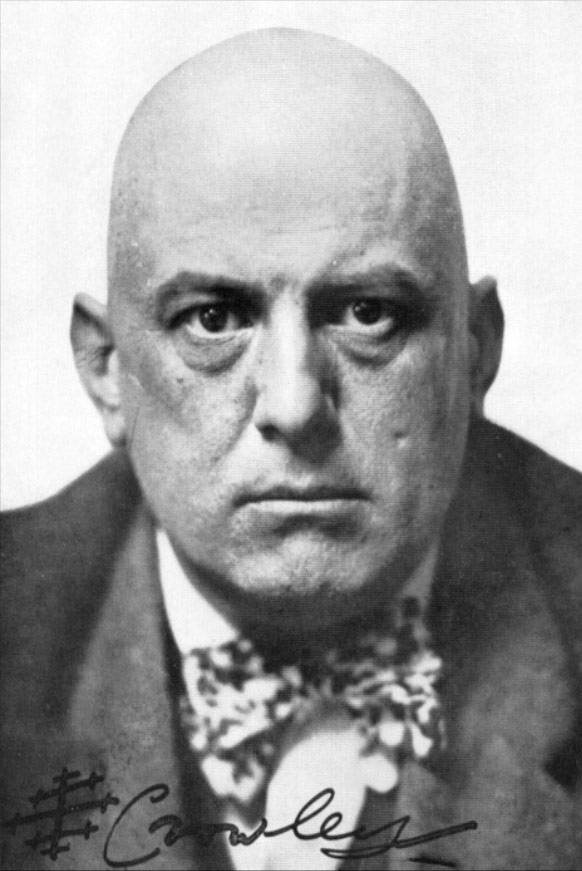
#151 – THE GREAT BEAST 666
This episode follows parts one and two, which covered the broader rise of Western esotericism, Theosophy, and the Hermetic Order of the Golden Dawn. If Blavatsky and the Golden Dawn were the soil, Crowley was the particularly strange weed that grew out of it.
🧒 The Making of a Rebel: Crowley’s Early Life
Crowley was born into a prosperous family — his father had built a brewing business — but his upbringing was dominated by the strict conservative Protestant sect known as the Plymouth Brethren. (Blake notes in an editorial aside that his guest called them the “Plymouth Brotherhood,” but the correct name is Plymouth Brethren.) The sect discouraged normal childhood socialization, toys, and play. Crowley was deeply attached to his father, who died when Aleister was young, triggering financial hardship and a difficult period living with relatives he resented.
By the time he reached university, the pattern of his life was set: he rejected Christianity root and branch, embracing what he framed as its precise opposite — hedonism and the diabolical. He left without graduating, became a poet, and threw himself into philosophy, literature, science, and the occult simultaneously. John Crow notes that Crowley’s refusal to observe disciplinary boundaries between the humanities and sciences was actually one of his intellectual strengths, even if the conclusions he drew were unorthodox.
✨ The Golden Dawn and the Education of a Magician
Crowley was introduced to the Golden Dawn through a friend and took to it quickly, absorbing Kabbalistic and other esoteric frameworks with enthusiasm. Around 1899, he struck up a pivotal relationship with Allan Bennett — considered the second most capable magician in the Golden Dawn after co-founder Mathers. Crowley offered Bennett housing and financial support in exchange for magical instruction, an arrangement that worked well for both until Bennett’s interests drew him toward Eastern traditions and he eventually left the Golden Dawn.
By 1900, Crowley was skilled enough to seek entry into the Golden Dawn’s inner order — but the existing members blocked him. It was a personality conflict that would foreshadow many others throughout his life. He subsequently founded his own initiatory group, the A∴A∴, modeled on the Golden Dawn’s structure but built around his own emerging system of Thelema.
📖 The Book of the Law and the Religion of Thelema
In 1904, while in Egypt, Crowley claimed to have received dictation from a preternatural entity over three days — the resulting text became The Book of the Law. He reportedly set it aside and even misplaced it for a few years, only recognizing its significance around 1907. Its most famous line — Do what thou wilt shall be the whole of the law — has an earlier literary antecedent: François Rabelais used the phrase “Do what thou wilt” to describe the rule of the Abbey of Thélème in his 1532 satirical novel Gargantua and Pantagruel.
John Crow explains that “do what thou wilt” is frequently misread as license for impulsive self-indulgence. Within Thelema, “will” (from the Greek thelema) refers not to passing wants but to a person’s deepest authentic purpose — the core reason for their existence. Most religious systems ask the individual to subordinate their will to God or community; Thelema inverts this, placing individual will at the centre of everything. The system’s goal is to discover what that true will actually is — a process involving ceremonial magic, self-examination, and, for advanced practitioners, knowledge and conversation with one’s Holy Guardian Angel (a concept Crowley described variously as an external entity and as the practitioner’s own higher self).
🔮 Sex Magic, the OTO, and Apostolic Succession
The Ordo Templi Orientis (OTO) predated Crowley — it was a fringe Masonic organization founded in Germany, with Theodor Reuss among its prominent figures. Sex magic was already part of its system when Reuss offered Crowley leadership of the OTO’s English-speaking branch. Crowley accepted and retrofitted the OTO’s initiatory structure around The Book of the Law and Thelema.
Blake asks John Crow to explain what sex magic actually entails. Crow frames it practically: sexuality generates some of the most intense emotional and physical states available to human beings, and magical systems exploit that intensity to shift consciousness, consecrate ritual objects, or create conditions conducive to mystical experience. Techniques range from solitary to group, and the goals vary accordingly. Crow notes that this is quite different from Eastern tantric practice, where orgasm would typically be considered a failure — the aim there is to sustain and redirect sexual energy rather than release it. Western appropriations of “tantra” usually get this backwards.
Blake also asks about the Gnostic Catholic Church and Crow unpacks the concept of apostolic succession — the Catholic doctrine of an unbroken chain of bishops physically consecrated back to Peter. Bishops expelled from Rome still technically possess that succession, and various independent Gnostic churches trace lines through either documented expelled bishops or claimed mystical re-consecrations (Crow notes, wryly, that Mormonism‘s Melchizedek priesthood works similarly). Crowley eventually received ordination within the Gnostic Catholic Church, creating a third institutional strand alongside the OTO and the A∴A∴ — all three overlapping in membership and all incorporating Thelema.
💊 The End of a Prophet: Decline, Drugs, and Legacy
Crowley died in December 1947 in a rented room in England, relatively impoverished, his organizations in disarray. John Crow notes that his heroin addiction dated back to a period when the drug was legal and medically prescribed — specifically for asthma, a condition Crowley had. (Blake observes that “Heroin” was a brand name, and that cocaine enjoyed similarly respectable pharmaceutical status at the time — a context that doesn’t excuse the wreckage but does complicate any simple moral narrative.)
His successor in the OTO was Karl Germer, who kept the OTO and A∴A∴ alive. The groups survive today in multiple competing lineages, with arguments about legitimacy ongoing. His cultural footprint, meanwhile, grew after his death: Led Zeppelin‘s Jimmy Page bought Boleskine House (the lakeshore property on Loch Ness where Crowley had conducted an unfinished ritual to contact his Holy Guardian Angel) and accumulated a large collection of Crowley’s writings. Ozzy Osbourne’s song “Mr. Crowley” — which, Blake notes, mispronounces its subject’s name — is perhaps the most widely heard tribute.
Blake’s closing reflection cuts through the infamy neatly: in a century that produced genocide, carpet bombing, and nuclear weapons, the “wickedest man in the world” label looks contextually absurd. Crowley’s genuine wickedness, such as it was, appears to have been concentrated on the people closest to him.
📚 Further Reading
– 📚 The Book of the Law 💵 by Aleister Crowley
– 📚 Perdurabo: The Life of Aleister Crowley 💵 by Richard Kaczynski
– 📚 Do What Thou Wilt: A Life of Aleister Crowley 💵 by Lawrence Sutin
🔗 Related Links
– 📺 Masters of Darkness: Aleister Crowley (BBC documentary, 2002)
– Aleister Crowley (Wikipedia)
– Thelema (Wikipedia)
– The Book of the Law (Wikipedia)
– Plymouth Brethren (Wikipedia)
– Ordo Templi Orientis (Wikipedia)
– Boleskine House (Wikipedia)
– Paschal Beverly Randolph — early American sex magic theorist mentioned in the episode (Wikipedia)
Note: ads inserted into the distributed audio alter the timestamps in unpredictable ways, so timing references in these notes are approximate.
In this episode of MonsterTalk, we complete our discussion about Western Esotericism with John L. Crow. In this final part we talk about the life of occultist Aleister Crowley, a man some called The Wickedest Man on Earth.
Of Interest
- The Wickedest Man in the World—Masters of Darkness (2002)
- Contemporary newspaper articles on Crowley
- Aleister Crowley (Wikipedia)
- Thelema (Wikipedia)
- The Plymouth Brethren (Wikipedia)
- The Book of the Law (Wikipedia)
Music
- Monstertalk Theme: Monster by Peach Stealing Monkeys
MTArchivist
0