Regular Episode
#136 – AMERICAN GOBLINS—PART 1
Blake opens by reading directly from what many consider the definitive write-up of the case: Close Encounter at Kelly, a report compiled roughly ten months after the events by investigators Isabel Davis and Ted Bloecher of the Civilian Saucer Intelligence group — a New York–based organization that researched UFO phenomena from roughly 1947 through 1959. That report, along with contemporary newspaper accounts (several dug up by listener Chris Henderson — thank you, Chris), forms the primary source backbone of this episode.
🌽 The Setting: Kelly, Kentucky, August 21, 1955
The farmhouse at the center of the story sat about seven to eight miles north of Hopkinsville, Kentucky, closer to the tiny unincorporated community of Kelly — population roughly 150 at the time. Hopkinsville itself had around 20,000 residents and was home to a large military installation, Fort Campbell, a detail that becomes relevant when military police join the investigation later that night.
The farmhouse was a modest, unpainted wood structure shaded by maple trees, with no radio or telephone, only a handful of low-wattage bulbs for light, and no indoor plumbing to speak of. It grew tobacco and vegetables and housed considerably more people than its square footage might suggest.
👨👩👧👦 The Cast of Characters
On the night of Sunday, August 21st, the farmhouse was occupied by eight adults and three children:
– Mrs. Glenny Lankford, 50, the family matriarch (widowed twice)
– Elmer “Lucky” Sutton, 25, her son by her first husband
– Vera Sutton, 29, Lucky’s wife
– J.C. (John Charlie) Sutton, 21, another son
– Aileen Sutton, 27, J.C.’s wife
– Three children: Lonnie (12), Charlton (10), and Mary Lankford (7)
– Billy Ray Taylor, 21, Lucky’s friend and a traveling carnival worker
– June Taylor, 18, Billy Ray’s wife
– O.P. Baker, 30–35, Aileen’s brother, who often overnighted at the farm for work convenience
The Taylors and the Elmer Suttons had been staying at the farm for some months, having recently been traveling with a carnival. Four firearms were in the house that night: a 20-gauge single-barrel shotgun (J.C. Sutton), a 12-gauge shotgun (Lucky Sutton), a .22 rifle (Billy Ray Taylor), and an unused .22 pistol — though sources disagree slightly on the last point.
🛸 The Flying Saucer That Started It All
Events began around sunset — approximately 7:30 p.m. — when Billy Ray Taylor went out to fetch water from the well and returned claiming he had seen a craft with rainbow-colored exhaust land in the gully behind the house. The rest of the family, apparently accustomed to Billy Ray’s excitability, did not bother to go look. Davis’s report characterizes Taylor as an unreliable witness who on several occasions had to walk back outlandish claims.
Worth noting: the Kappa Cygnids meteor shower had peaked just days before, and other witnesses in the area did report seeing streaks of light in the sky that night. Whether what Taylor saw was a meteor, a fireball, or something he embellished considerably, the family dog provided the first indication that something was amiss: shortly after dark, it began barking frantically — and then hid under the house.
👾 The Goblins Themselves
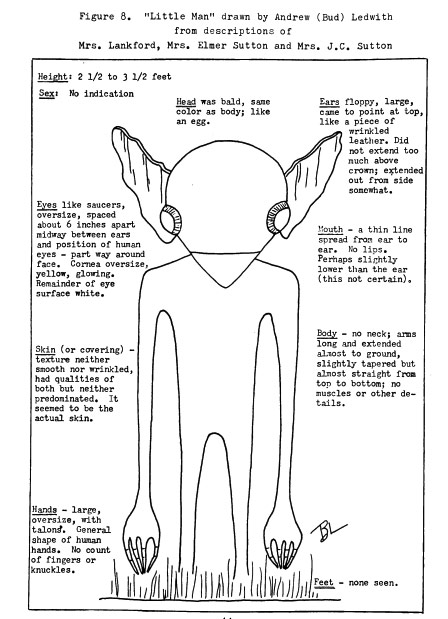
Lucky Sutton and Billy Ray Taylor went outside to investigate the dog’s commotion and encountered the first creature approaching from the fields. Davis’s report describes it as roughly three and a half feet tall, with an almost perfectly round oversized head, arms that extended nearly to the ground, huge talon-tipped hands, and eyes far larger than human eyes that glowed with a yellowish light — positioned neither front-facing nor side-facing, but somewhere in between. The whole body appeared to be made of a silvery, luminescent metal, described by one witness as glowing like the radium dial of a watch, and by Mrs. Lankford as looking like “a five-gallon gasoline can with a head on top and small legs… shimmering bright metal like on my refrigerator.” Some newspaper accounts called them the “Tubmen.”
The creatures were described as floating or gliding rather than walking, with legs “spindly as broom handles” and seemingly inflexible. They were not described as aggressive — Mrs. Lankford specifically noted they never attempted to harm anyone — but they did approach the house repeatedly, perch on the roof, appear at windows, and at one point reach a claw down to touch Billy Ray Taylor’s hair as he stepped out the front door. They proved impervious to shotgun and rifle fire; when hit, they would flip over and then scurry or glide away into the darkness.
The creatures avoided direct light. When flashlights were turned on them, their glow disappeared and they appeared plainly metallic. When they crawled across the tin roof, witnesses heard their claws scraping the metal. Their eyes were described as large and without pupils, leading Davis to theorize they might be sensitive to bright light.
Radio engineer Bud Ledwith of WHOP radio conducted early witness interviews and produced sketches from the descriptions — the round-headed, big-eared, talon-handed drawings that have become the iconic images of the Kelly Goblins. Multiple witnesses contributed to multiple drawings, and they aligned closely — except for Billy Ray Taylor, who wanted to add antennae and a nose.
🚔 Police, Press, and the Morning After
By 11 p.m., the family had endured enough. They piled into two vehicles and drove at speed to the Hopkinsville Police Department. Whatever the officers thought of the story, they could not doubt the sincerity of the family’s fear. The farm was soon swarming with city police, county police, state police, military police from Fort Campbell, a newspaper photographer, and assorted investigators. They found no silver spacemen, no blood, no feathers — but did locate spent shell casings and a few beer cans. The family returned to the farm around 2 a.m. and attempted to sleep.
Around 2:30 a.m., Mrs. Lankford spotted one of the glowing figures at the window again. The creatures continued to be intermittently sighted until approximately 4:45 a.m., then disappeared for good. The next day, news and radio coverage spread the story of the “little green men” across the country. Curious onlookers descended on the farm in numbers. The Sutton family was ridiculed, their privacy shattered, and they ultimately made no money from the notoriety. By the time Davis arrived to conduct her research, they had grown understandably tight-lipped.
Blake notes — with characteristic wryness — that the “little green men” label almost certainly came from reporters recycling a pre-existing cultural shorthand. None of the original witnesses ever described the creatures as green. The radium-dial comparison (radium does glow green) may have helped seed the description, but the phrase “little green men” was already in wide use to describe sprites and mysterious humanoids well before 1955.
🔬 What Comes Next
Blake is keeping the skeptical analysis for Part 2 — including commentary from noted skeptic Joe Nickell, who has investigated the case, and a planned conversation with Scott Philbrook and Forrest Burgess of the Astonishing Legends podcast, whose three-part treatment of the Kelly–Hopkinsville case sparked some interesting reflections on critical thinking. Blake also teases a personal experiment to attempt to replicate one piece of physical evidence from the story. Stay tuned.
📚 Further Reading
– Close Encounter at Kelly by Isabel Davis and Ted Bloecher (Civilian Saucer Intelligence, 1978) — available as a PDF
🔗 Related Links
– Kelly–Hopkinsville encounter (Wikipedia)
– Flatwoods Monster — another 1950s UFO-occupant case with notable parallels
– Kappa Cygnids meteor shower
– Fort Campbell, Kentucky
– Joe Nickell’s analysis of the Kelly–Hopkinsville case (Skeptic Magazine)
– Skeptoid podcast coverage by Brian Dunning
Note: ads inserted into the distributed audio alter the timestamps in unpredictable ways, so timing references in these notes are approximate.
In August of 1955, a farm family in Kentucky found their home under attack by strange goblin-like monsters. In the years since the attack, the case has retained a perplexing endurance. What happened that night in Kentucky? Were aliens to blame? Underworld monsters? Misidentified natural causes? This is part one of our discussion of what has become known as The Kelly-Hopkinsville Encounter.
Of Interest
- Close Encounter at Kelly (considered by many to be the definitive coverage of the case)
- Noted Skeptic Joe Nickell’s take on the story
- Skeptoid Podcast Coverage
- Astonishing Legends Coverage: Part 1, Part 2, and Part 3
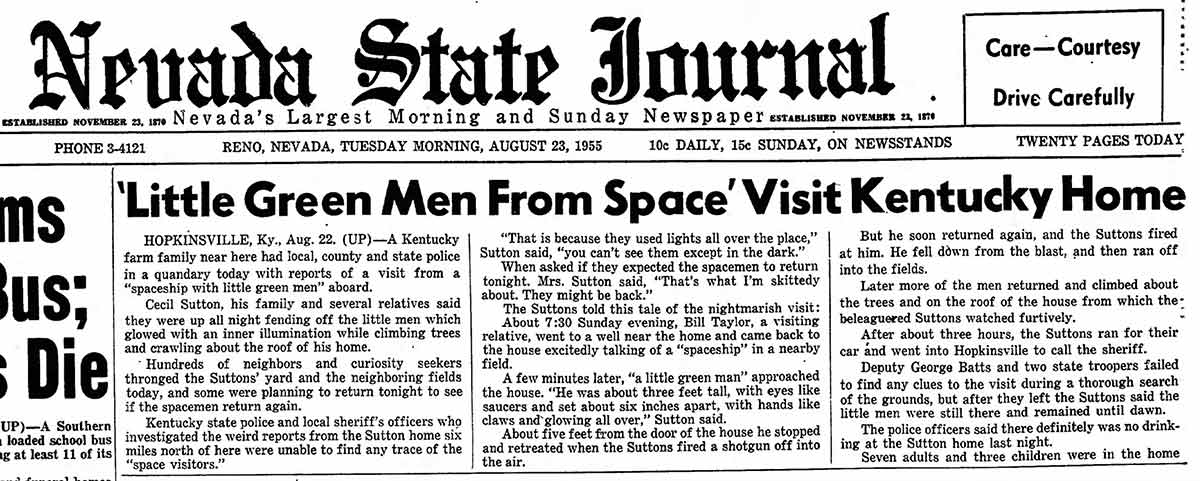
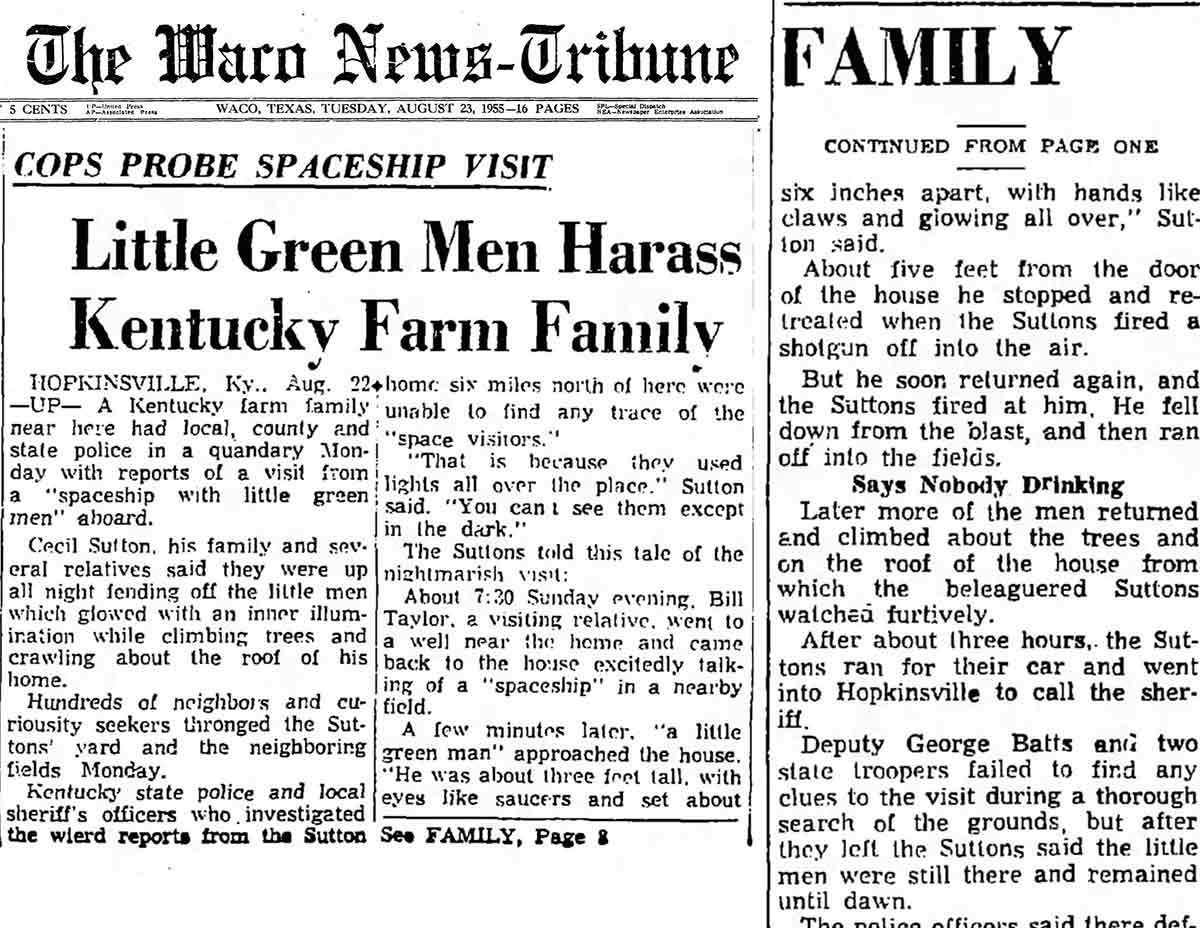
Thanks to MonsterTalk listener Chris Henderson for finding these contemporary newspaper articles.

Music
- Monstertalk Theme: Monster by Peach Stealing Monkeys
MTArchivist
0