Regular Episode
#128 – SPOOKY GEOLOGY
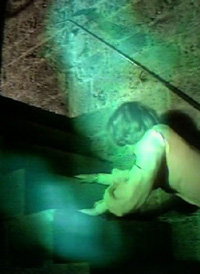
(Above) Jill Greeley (played by Jane Asher) in the The Stone Tape, a 1972 BBC drama by Nigel Kneale. In the movie, Jill can hear sounds and see the apparition of a young woman who apparently had fallen to her death here in the past. Read more about this story.
🪨 What Is Spooky Geology?
Sharon explains how burnout from six years of Doubtful News — “no, it’s not the Loch Ness Monster; no, it’s not a UFO, for real” — led her to pivot toward something fresher. The result is Spooky Geology, a science blog exploring the geological underpinnings (or lack thereof) of paranormal claims. The name was inspired in part by Jeb Card‘s Spooky Paradigm archaeology project and carries on that tradition of applying rigorous field science to spooky folklore. Topics range from haunted bedrock to volcano legends — plenty of material, as Sharon notes, and she’s just getting started.
📻 15 Credibility Street
Sharon also co-hosts the skeptical news podcast 15 Credibility Street, which Blake describes as “Doubtful News, if it were a podcast” — covering science, politics, paranormal news, and current events through a critical lens. The show features co-hosts with different disciplinary backgrounds (including Torkel and, at the time of recording, Howard, who has since moved on). Sharon flags something worth noting: female-led skeptical podcasts are still a rarity, and the show’s unscripted, conversational format keeps it genuinely unpredictable.
📋 The Media Guide to Skepticism
Inspired by a volcanologist’s press primer, Sharon produced Media Guide to Skepticism — a plain-language reference document aimed at journalists covering controversial science and paranormal topics. The guide addresses common misconceptions: that skeptics are all atheists, that skeptics are automatically mean-spirited, and that “climate skeptic” means the same thing as “scientific skeptic.” Sharon and Blake also discuss the difference between science and skepticism — the latter, as Sharon learned from colleagues including Bob Blaskiewicz and Eve Siebert, doesn’t require a lab coat. Good textual analysis, art history, and careful investigation can all be forms of rigorous skepticism.
👻 The Stone Tape Theory: A Skeptical Geology Lesson
The centerpiece of the episode. The Stone Tape Theory holds that emotionally charged events can be “recorded” into the physical fabric of a location — stone walls, bedrock, soil — and then “played back” for sufficiently sensitive witnesses, producing what ghost researchers call a residual haunting: a looping, non-interactive apparition or sound.
Sharon traces the idea well before magnetic tape existed. The earliest versions, circulating through the Society for Psychical Research (SPR), framed it as a “place memory” — some kind of psychic field around an object, receivable only by the impressionable. The concept was dramatically developed by T.C. Lethbridge, whose speculative and assertion-heavy writing style Sharon cheerfully admits drives her nuts (though SPR’s Alan Murdie urged her not to be too hard on the man — “he was a fun character”).
The naming convention itself — “stone tape” — only became possible after magnetic recording tape was invented, giving the idea a technological metaphor it didn’t previously have. The 1972 BBC television play The Stone Tape, written by Nigel Kneale, crystallized all these ideas for popular audiences and has since become the primary reference point for ghost hunters invoking the theory. Blake notes he only watched it for the first time about eighteen months before the episode, and Sharon likewise found it surprisingly impressive.
The geological problems are stark: modern ghost hunters claim granite or limestone bedrock is “recording” events, which, as Sharon notes, makes any working geologist cringe. There are three unanswered mechanical questions the theory never resolves — how does a memory get recorded, how is it stored, and how is it triggered for playback? — and none of the proposed answers have any empirical support. The theory is, in Sharon’s words, speculation dressed in scientific-sounding vocabulary: quintessentially “scientifical.”
🔬 Scientifical Americans: Sharon’s Forthcoming Book
Sharon’s book — at time of recording, already with the publisher — is titled Scientifical Americans. It examines amateur paranormal investigation groups (ghost hunters, cryptozoologists, UFO researchers) and the way they deploy scientific-sounding language and gadgetry without the underlying methodology. The word “scientifical” — people who perform science rather than practice it — was the central concept of Sharon’s academic thesis and became the book’s title. Blinky-light gadgets, invocations of “quantum,” and confident pronouncements to credulous journalists: all get examined against what scientific investigation actually looks like. The book covers ghosts, UFOs, and Bigfoot hunters alike.
📚 Further Reading
– 📚 Scientifical Americans 💵 by Sharon Hill
– Media Guide to Skepticism by Sharon Hill — free PDF via CFI
🔗 Related Links
– Spooky Geology — Sharon Hill’s science blog
– 15 Credibility Street — Sharon’s skeptical news podcast
– The Stone Tape (1972 BBC drama) — Wikipedia article on Nigel Kneale’s television play
– Society for Psychical Research
– T.C. Lethbridge — paranormal theorist who developed “place memory” ideas
– Residual Haunting — Wikipedia overview of the concept
– Skeptical Inquirer — magazine mentioned by both Blake and Sharon as formative reading
– Sharon Hill’s article on the Stone Tape Theory at Spooky Geology (see show notes at monstertalk.org for direct link)
Note: ads inserted into the distributed audio alter the timestamps in unpredictable ways, so timing references in these notes are approximate.
In this episode, MonsterTalk welcomes back notable skeptic, scientist, researcher and author (and now Podcaster) Sharon Hill. Sharon’s got a new podcast (15 Credibility Street), new science blog (Spooky Geology), and a book coming out later this year. In this discussion we talk about skepticism, science communication and the mysterious phenomena known as The Stone Tape theory of repetitive hauntings.
Related
Music
- Monstertalk Theme: Monster by Peach Stealing Monkeys
MTArchivist
0