Regular Episode
#126 – THE ENFIELD POLTERGEIST — PART 2
The setting, briefly revisited: 284 Green Street, Enfield, north London, 1977. Single mother Peggy Hodgson and her four children — Margaret (13), Janet (12), John (11), and Billy (7) — report furniture moving, objects flying, foul smells, and a gravelly disembodied voice. The Society for Psychical Research (SPR) dispatches investigators Playfair and Maurice Grosse, and a media circus follows. What the films don’t show is how bitterly divided the SPR itself was about what was really going on.
🎭 Deborah Hyde: Children, Context, and the Sociology of Belief
Deborah Hyde — editor-in-chief of The Skeptic (UK), folklorist, and cultural anthropologist — met Janet as an adult on the British morning programme This Morning, where she had been invited to offer a skeptical perspective while Janet appeared alongside Playfair in connection with the then-upcoming dramatisation. Hyde’s impression: Janet is a private person who did not appear to enjoy being thrust back into the spotlight, whatever her reasons.
Hyde’s core skeptical argument is sociological as much as evidential. The Hodgson household in 1977 was unusual for its neighbourhood: a divorced single mother, a father whose visits caused stress, four children hungry for attention. Then two avuncular men — Playfair and Grosse — arrived and lavished the family with time and interest. Grosse had recently lost his own daughter, also named Janet, in a motorcycle accident, and had joined the SPR partly in search of evidence for life after death. Hyde argues the investigators’ emotional investment made them exactly the wrong people to run a rigorous inquiry.
She draws a pointed methodological lesson: anyone who questioned the phenomena was not welcomed back into the house, meaning that by design, only data gathered by believers ever made it into the record. She also highlights SPR researcher Anita Gregory, whose doctoral thesis concluded the Enfield evidence was “questionable, greatly exaggerated, and ultimately pathetic” — and who separately reported that the police officer who witnessed the chair move, WPC Carolyn Heaps, privately told Gregory she thought the children were playing tricks. Gregory’s neighbour source Peggy Nottingham was even more blunt: “What was going on now was pure nonsense and it was kept going by the investigators.”
Hyde also contextualises Enfield within a long history of young girls at the centre of alleged supernatural events — the Salem witch trials, the Pendle Witches, the Warboys Witches — noting that in earlier eras, such accusations had lethal consequences. One additional note: Janet once described an experience that Hyde immediately recognises as classic sleep paralysis, a well-documented phenomenon responsible for a wide range of seemingly paranormal nocturnal experiences.
🧠 Chris French: The Psychology of Deception and Spectacular Claims
Chris French, professor of psychology at Goldsmiths, University of London and one of Britain’s most prominent scientific skeptics, has participated in multiple documentaries about Enfield. He is careful to distinguish between what he believes on balance of probability and what can be proven — a distinction, he notes, that tends to get flattened in headline-friendly articles like the one that quoted him under the title “Five Reasons Why Enfield Was a Hoax.”
French’s key points:
– The children were caught cheating and have admitted it. The believer’s fallback — “they only cheated sometimes” — requires the unjustified assumption that investigators of ordinary competence could not be systematically fooled by motivated children. French counters: even skilled conjurers fool trained observers. The inability to explain a trick does not make it paranormal.
– His rule of thumb: the more spectacular the alleged phenomena, the more likely a deliberate hoax. Sincere, mild haunting reports (a sense of presence, an unexpected noise) are a different class of thing from objects flying across rooms and fires starting spontaneously.
– Police officers, military personnel, and pilots are frequently cited as uniquely credible witnesses to paranormal events. French’s own research demonstrates that suggestion alone can cause a sizable minority of people to report seeing and hearing things that are not there.
– The “skeptic as inhibitor” claim — Playfair’s assertion that phenomena only occurred around believers — is not evidence for the paranormal. It is exactly what you would expect if the children were performing tricks and preferred not to be caught.
French also touches on the broader crisis of replication in psychology, prompted by Blake’s question about whether catching someone faking data invalidates an entire body of work. He distinguishes outright fraud (career-ending, everything suspect) from the far more pervasive problem of undisclosed analytic flexibility — the accumulation of small, seemingly innocuous methodological choices that together dramatically inflate false-positive rates. Neither, he emphasises, is the kind of self-correction science can skip.
🔍 Joe Nickell: Markers, Magic, and the Poltergeist Faking Syndrome
Joe Nickell — described as possibly the world’s only full-time professional scientific paranormal investigator, a senior research fellow at the Committee for Skeptical Inquiry — approaches Enfield as a magician as much as a scholar. He credits magician and paranormal investigator Milbourne Christopher, who visited the Hodgson home briefly and concluded Janet was “a very bright and clever and tricky girl,” as an early influence. Nickell’s own conjuring background, he argues, is not incidental: magicians are trained to see how illusions work, and to understand that “I can’t figure out how they did it” is emphatically not equivalent to “it must be paranormal.”
Nickell catalogues what he calls the markers of his named concept, the poltergeist faking syndrome — a cluster of characteristics that appear, with striking regularity, in case after case:
– Phenomena cluster around a specific person (here, Janet; secondarily Peggy).
– Phenomena refuse to occur under observation — the “demonic” voice would only speak with the girls alone and the door closed; objects were only found displaced, never seen in flight by a credible witness.
– The phenomena are of a type a child could and would produce — pranks and play-acting.
– Direct evidence against genuineness exists: the famous “levitation” photographs, Nickell argues, show Janet jumping on her bed as a trampoline, not floating.
– Expert witnesses — a ventriloquist and a magician — both concluded independently that Janet’s gruff voice was amateur ventriloquism and the physical tricks were stage trickery.
– Controlled separation tests: when Janet and Margaret were housed separately, phenomena appeared at both locations; when neither girl was present, nothing happened.
– The girls eventually confessed, before Playfair and Grosse persuaded them to retract.
Nickell’s verdict, framed via Occam’s razor: the hypothesis “schoolgirls playing tricks” requires no exotic assumptions, accounts for all the evidence, and has never been shown to have a fatal flaw. The paranormal hypothesis requires the positive existence of poltergeists — entities for which there is no independent evidence. The case, he concludes, is a preferred hypothesis for the mundane explanation, not a mystery.
🎬 The Warrens, The Films, and What Really Happened
A recurring thread across both episodes is the distance between the Enfield case as it actually unfolded and as it has been dramatised. 🎬 The Conjuring 2 💵 centres the story on Ed and Lorraine Warren — a framing that Playfair himself reportedly repudiated, telling an interviewer that Ed Warren showed up once, was primarily interested in making money, and was asked to leave. Blake notes that the film, enjoyable as horror, effectively erases Playfair and diminishes Grosse’s work while continuing what he calls the ongoing effort to “canonise Ed Warren.”
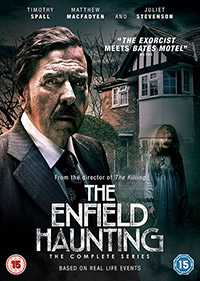
The UK television dramatisation The Enfield Haunting is treated more charitably — both Blake and Deborah found it a reasonably crafted piece of television, even if it takes dramatic licence. Neither is a substitute for the primary source record.
📚 Further Reading
– 📚 This House Is Haunted 💵 by Guy Lyon Playfair — the primary believer account of the investigation
– 📚 Will Storr vs. the Supernatural 💵 by Will Storr — includes interviews with Maurice Grosse, adult Janet, and research into the Anita Gregory correspondence
– 📚 Entities: Angels, Spirits, Demons, and Other Alien Beings 💵 by Joe Nickell — contains Nickell’s earlier summary of the Enfield case
– 📚 American Hauntings 💵 by Joe Nickell and Robert Bartholomew — develops the “poltergeist faking syndrome” concept
– 📚 ESP, Seers & Psychics 💵 by Milbourne Christopher — includes Christopher’s account of his visit to the Hodgson home
– 📚 Mediums, Mystics & the Occult 💵 by Milbourne Christopher
– 📚 Search for the Soul 💵 by Milbourne Christopher
🔗 Related Links
– Enfield Poltergeist — Wikipedia
– Anita Gregory — Wikipedia
– Joe Nickell on Enfield — Skeptical Inquirer
– Milbourne Christopher — Wikipedia
– Society for Psychical Research — Wikipedia
– Sleep Paralysis — Wikipedia
– Cottingley Fairies — Wikipedia (referenced by Hyde as an example of children deceiving credulous adults)
– Fox Sisters — Wikipedia
– Tina Resch poltergeist case — Wikipedia (cited by Nickell as a parallel case where James Randi was denied access)
Note: ads inserted into the distributed audio alter the timestamps in unpredictable ways, so timing references in these notes are approximate.
Part 2 of our look at the Enfield Poltergeist brings together interviews with Chris French (@ChrisCFrench), Joe Nickell (@RealJoeNickell) and Deborah Hyde (@jourdemayne). We look at why skeptics tend to be so reluctant to accept the existence of poltergeists.
Related Links
- Skeptic’s Dictionary: Poltergeist
- Nickell on Enfield
- Anita Gregory
- Video: Janet & Margaret return to Enfield
- The Conjuring 2
- The Enfield Haunting (DVD)
- This House is Haunted
- Will Storr vs The Supernatural
- Joe Nickell’s Books
Guests
Books by Milbourne Christopher
Music
- Intro mood music: Maia by Kreng [CC BY-NC-SA 3.0 US]
- Monstertalk Theme: Monster by Peach Stealing Monkeys
MTArchivist
0