Regular Episode
#120 – BITCHIN’ ‘BOUT SITCHIN
The episode opens with Blake’s exasperation at discovering the new Scooby-Doo series had Velma — Velma — enthusiastically validating Sitchin’s Nibiru mythology. For a show whose original two seasons were a model of evidence-based skepticism, this felt like a betrayal of the highest order. It’s a fitting setup for a conversation about how fringe ideas launder credibility through pop culture.
🪐 Who Was Zechariah Sitchin?
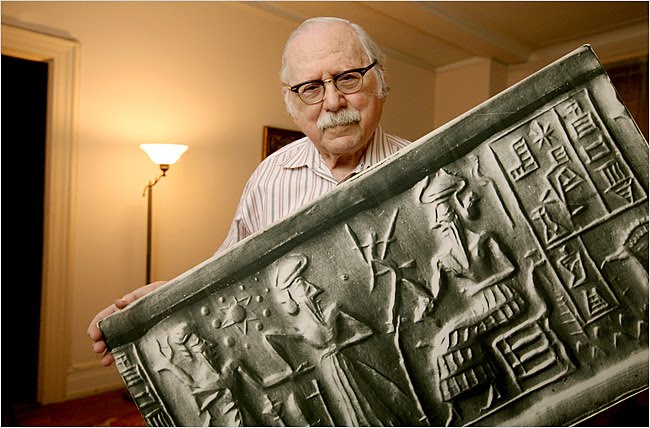
Zechariah Sitchin (1920–2010) was a journalist-turned-author whose Earth Chronicles book series — beginning with 📚 The 12th Planet 💵 — proposed that a rogue planet called Nibiru orbits our sun every 3,600 years, ferrying its inhabitants, the Anunnaki, to Earth to mine gold and genetically engineer humanity as a slave race. What set Sitchin apart from predecessors like Erich von Däniken was the veneer of scholarly authority — his publishers positioned him as an expert in ancient languages, a claim Heiser finds entirely unsupported. Sitchin never submitted his ideas to peer review, and his work never appeared in any academic journal. Heiser’s more charitable reading: Sitchin probably came to believe his own mythology, especially once the books started selling.
📜 What the Tablets Actually Say
Heiser’s core argument is more damning than a translation dispute — he contends that the things Sitchin claims are in the cuneiform tablets simply are not there at all. Heiser directs listeners to the Electronic Text Corpus of Sumerian Literature (ETCSL), where anyone can search for every occurrence of “Anunnaki” and pull up English translations with a few clicks. The results contain nothing about a home planet called Nibiru, nothing about spacefaring visitors, and nothing about a 3,600-year orbital cycle.
As for Nibiru itself, Heiser notes it appears in several cuneiform sources — and is associated with Jupiter in one text, Mercury in another, and described simply as a star in others. In the Mul.Apin astronomical compendium it appears annually. At its root the word likely denotes a “crossing” — a celestial event, not a planet. The Chicago Assyrian Dictionary (a 40-volume, 70-year scholarly project, now freely available as PDFs) provides the reference framework — and confirms none of Sitchin’s readings.
📖 Lexical Lists: The Ancient World’s Fact-Checkers
Even setting aside the passages that simply don’t exist, Heiser explains why translation disputes aren’t really a stalemate either. When the Akkadians adopted Sumerian cuneiform, their scribes produced lexical lists — essentially bilingual dictionaries pairing Sumerian terms with their Akkadian equivalents. Because Akkadian is an extremely well-documented East Semitic language, these lists eliminate ambiguity about what Sumerian vocabulary actually meant. When you consult them, the words Sitchin interprets as “rockets” or “spacecraft” mean nothing of the sort. As Heiser puts it: you can either let the Sumerians and Akkadians define their own vocabulary, or you can let Sitchin do it.
🌍 Ancient Cosmology and the Stars as Gods
Heiser offers useful context for why ancient peoples wrote about celestial bodies the way they did. Mesopotamian, Egyptian, and Israelite cosmologies all shared the intuition that moving objects in the sky must be alive — or divinely controlled — because movement implied agency. The Hebrew Bible, read consistently and literally, describes a flat, round earth covered by a solid dome to which stars are affixed, with windows in the heavens and waters above and below. This cosmology is entirely consistent with its ancient Near Eastern context, not a coded record of extraterrestrial visitors. The prohibitions in Israelite religion against celestial worship, Heiser notes, are themselves evidence that the temptation was real and widespread.
🔬 The Peer Review Problem — and the Popularization Gap
The conversation broadens into a discussion both hosts clearly feel strongly about: the failure of academic communities to make good scholarship accessible to non-specialists. The peer-reviewed literature addressing ancient engineering, textual analysis, and archaeoastronomy exists — but it lives behind journal paywalls, written in dense specialist prose. Meanwhile, Ancient Aliens-style programming fills the vacuum with “wouldn’t it be cool if?” questions dressed up as evidence. Heiser draws on his own experience at Logos Bible Software to illustrate the economic catch-22: the tools most needed by the public are the hardest to fund. The parallel to Carl Sagan — who took considerable heat from colleagues for popularizing science — is raised as both a cautionary tale and an inspiration.
📚 Further Reading
– 📚 The 12th Planet 💵 by Zecharia Sitchin (the primary text under discussion)
– 📚 The Facade 💵 by Michael Heiser (the sci-fi novel that led Heiser to Sitchin in the first place)
– 📚 How to Build a Dinosaur 💵 by Jack Horner and James Gorman (recommended by Heiser during the closing conversation about paleogenetics)
🔗 Related Links
– SitchinIsWrong.com — Heiser’s primary reference site, with screen-capture video walkthroughs of primary source searches
– Electronic Text Corpus of Sumerian Literature — search Anunnaki, Nibiru, and related terms yourself
– Chicago Assyrian Dictionary — all 40 volumes freely available as PDFs
– Nibiru Cataclysm — Wikipedia overview of the modern doomsday claim
– Ancient Astronauts — Wikipedia
– Lexical Lists (cuneiform) — the bilingual Sumerian-Akkadian dictionaries central to Heiser’s rebuttal
– Pseudo-Astronomy Podcast with Stuart Robbins — referenced by both Heiser and Blake for the astronomical side of Planet X claims
Note: ads inserted into the distributed audio alter the timestamps in unpredictable ways, so timing references in these notes are approximate.
Ancient Aliens theorists seem to love the work of Zecharia Sitchin (The 12th Planet). Sitchin proposed that mysterious space beings called Anunnaki visited earth to steal our gold, and passed on their wisdom to the ancient people of Sumer. In this first of a 2-part look at Sitchin’s impact on Ancient Astronaut lore, we talk with Dr. Michael Heiser about the plausibility of Sitchin’s views from an evaluation of the ancient texts Sitchin purports to have used for his source material.
Items of Interest
- www.sitchiniswrong.com
- The Facade, a novel by Michael Heiser
- Lexical Lists
- The Electronic Corpus of Sumerian Literature
Music
- Monstertalk Theme: Monster by Peach Stealing Monkeys
MTArchivist
0