Regular Episode
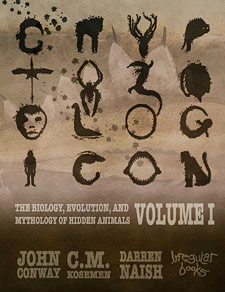
#074 – CRYPTOZOOLOGICON: VOLUME I
The book grew out of the team’s earlier work on 📚 All Yesterdays 💵, a celebrated exercise in speculative paleontological illustration — asking what extinct animals might really have looked like beyond the tired tropes of paleo-art. Cryptozoologicon applies that same spirit of informed speculation to mystery animals: each of 28 cryptids gets a critical evaluation of the evidence, a novel speculative biological interpretation, and a full-colour illustration. It is emphatically not a credulous cryptozoology book, and Darren makes no effort to hide that.
📖 What Makes This Book Different
Most cryptozoology books recycle the same black-and-white drawings and the same tired hypotheses — Bernard Heuvelmans‘s stegosaur interpretation of the Mabili-Mabilu (a Congolese water monster documented by the late Roy Mackal) being a classic example — repeated across decades without anyone asking whether better alternatives exist. Darren argues that a large share of cryptozoological speculation suffers from a lack of zoological grounding: authors often approach the subject from sociological or folkloric angles rather than from a working knowledge of animal biology and evolution.
The book pairs skeptical evaluation with genuinely novel speculative zoology — ideas informed by current technical literature that most cryptozoology writers simply aren’t reading. Each creature also receives a tongue-in-cheek binomial scientific name, as if the animal were being formally described.
🐾 The Creature List
Volume I covers 28 cryptids ranging from the globally familiar to the genuinely obscure. Among those discussed in the episode:
– The Rau (or Roe) — a mystery giant reptile from New Guinea, known from a single report long considered a hoax
– The Canvey Island Monster — a peculiar carcass case from Essex, England
– The Chupacabra — speculatively reimagined here as a giant bipedal predatory marsupial, Deinaru caprophagus (“terrible goat-eating kangaroo-like thing”)
– The Waitoreke — an alleged amphibious mammal from New Zealand
– The Beast of Gévaudan
– The Bunyip
– The Mabili-Mabilu — the triple-named Congolese water monster
– Cadborosaurus
– The Tizarek — an obscure marine creature
– The Buru
– The Hoop Snake — a folkloric serpent that Blake notes his grandmother also described alongside a related legend, the “joint snake” (probably inspired by glass lizards, legless anguid lizards whose tails shatter into fragments)
– Megalodon — the megatooth shark
– The Ahool — a giant bat-like creature; the book draws on newer ideas about bat evolutionary history absent from most cryptozoological treatments
– The Trinity Alps Giant Salamander — an alleged oversized salamander from northern California
– The Goatman — whose chapter is subtitled, with full awareness, “Half Man, Half Goat, Half Satire”
– The Stupendoconda — a giant Amazonian anaconda tradition, anchored partly in Colonel Percy Fawcett‘s claim of a 19-metre specimen; the speculative section engages seriously with herpetological objections and research on fossil giant snakes
🦎 Speculative Zoology Done Right
Darren is clear throughout that the book’s speculations are not serious proposals — they are informed thought experiments. But “informed” is doing real work here. The Chupacabra-as-marsupial scenario, for instance, was inspired by a paper published during the book’s production describing a living South American opossum barely 15 cm long that sports saber-tooth proportions relative to its body size — a genuine “saber-tooth mouse.” Scaling that up made for a biologically grounded (if frankly absurd) reimagining of what the Chupacabra could be.
Similarly, the Stupendoconda section engages with the real herpetological objection — if a second anaconda species grows to near 20 metres, why do collectors who have taken millions of specimens for the skin trade never encounter juveniles? — and proposes a speculative viviparous solution: perhaps the species gives birth to a single enormous offspring already larger than any known snake.
🔬 On Cryptozoology’s Credibility Problem
Darren pulls no punches about the field’s foundational figures. Heuvelmans, widely venerated in cryptozoological circles, was in some cases citing zoological ideas that were already obsolete in the 1930s when he was writing in the 1950s. Ivan Sanderson — whose alleged giant-penguin footprints on a Florida beach get a mention — also claimed to have personally witnessed one of the giant penguins. These are not the track records of rigorous field researchers.
Darren contrasts this with 📚 Abominable Science! 💵 by Daniel Loxton and Donald Prothero, which he describes as possibly the most scholarly critical treatment of cryptozoology yet published — high praise that, he notes, made some people quite cross.
🧪 On Scientists and the Sense of Wonder
Blake raises the recurring cryptozoology-forum trope that mainstream scientists live in ivory towers and reflexively dismiss the wondrous. Darren finds the stereotype puzzling — most researchers he knows went to see Jurassic Park, argue about Godzilla films, and are passionately interested in speculative evolution and what-ifs about the living world. The point is made well by Charles Paxton, a fisheries ecologist and statistician who has published serious statistical analyses of sea-serpent sighting data — not exactly the profile of a wonder-phobe.
The deeper point: science is structurally incentivized toward discovery, not suppression. Grant success rates hover around 8%. Nobody with a genuine new hominid carcass is sitting on it.
📚 Further Reading
– 📚 Cryptozoologicon: Volume I 💵 by Darren Naish, John Conway, and C. M. Koseman
– 📚 All Yesterdays 💵 by John Conway, C. M. Koseman, and Darren Naish
– 📚 Abominable Science! 💵 by Daniel Loxton and Donald R. Prothero
– 📚 A Living Dinosaur? 💵 by Roy P. Mackal
🔗 Related Links
– Bernard Heuvelmans — founder of cryptozoology as a formal discipline
– Ivan T. Sanderson — naturalist, cryptozoologist, and alleged giant-penguin witness
– Roy Mackal — University of Chicago biologist and cryptozoological field researcher
– Percy Fawcett — British explorer and source of the most-cited giant anaconda claim
– Glass lizards (Anguidae) — the probable real animal behind “joint snake” and “hoop snake” legends
– The Lambton Worm — County Durham legend of a creature that reassembles its severed pieces, discussed as a parallel to the joint-snake motif
– Tetrapod Zoology blog (Wikipedia overview) — Darren Naish’s long-running science blog
Note: ads inserted into the distributed audio alter the timestamps in unpredictable ways, so timing references in these notes are approximate.
DARREN NAISH RETURNS to MonsterTalk to discuss his latest book, Cryptozoologicon: Volume I. From the well known to the very obscure, this book takes three looks at monsters. It critically examines them, but also speculates on what they might be like if they were real — combined with fantastic illustrations by science illustrators John Conway and C. M. Koseman.
Darren Naish is co-host of the Tetrapod Zoology Podcast and a blogger for Scientific American.
Music
- Monstertalk Theme: Monster by Peach Stealing Monkeys
MTArchivist
0