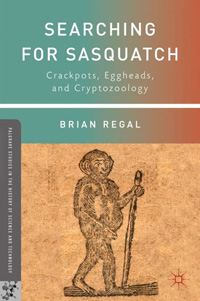
036 – SEARCHING FOR SASQUATCH
The book is the culmination of five years of archival research and, as Regal is at pains to emphasize, is emphatically not a book about whether Bigfoot exists. It’s a scholarly history of the people who searched — the amateur naturalists and the credentialed scientists — and the surprisingly complicated relationship between them.
🦴 Grover Krantz: The Academic Who Believed
Grover Krantz is the book’s central figure — a trained paleoanthropologist who earned his PhD in human evolution at UC Berkeley and joined the faculty of Washington State University in 1968. His conversion to Bigfoot belief came in 1969, when he drove up to the tiny town of Bossburg, Washington over Thanksgiving break to examine a set of tracks that would become known as the “Cripplefoot” prints — tracks that appeared to show one foot healed badly after a break. Krantz, steeped in foot morphology and human locomotion, concluded no hoaxer could have known to fake that kind of anatomical detail. He never really looked back.
Despite being a credentialed professional — not an amateur by any stretch — Krantz spent the next three decades largely dismissed or indulged by his Washington State colleagues, received no institutional funding for his Sasquatch work, and waited 20 years to make full professor. (That promotion finally squeaked through thanks largely to a friend and later department chair, John Bodley, who pushed for it in the mid-1990s.) Regal draws a poignant parallel between the death of Krantz’s beloved Irish wolfhound Clyde and the intensification of Krantz’s Bigfoot obsession — suggesting the creature in the woods may have absorbed some of the emotional energy left by the dog’s passing.
Krantz’s skeleton — along with a dog skeleton — is now on display at the Smithsonian’s National Museum of Natural History, posed to recreate a photograph of him with Clyde. His Bigfoot research files are held at the National Anthropological Archive — and it was access to those papers that anchored Regal’s research.
🧭 René Dahinden and Ivan Sanderson: The Anti-Krantz and the Science Journalist
René Dahinden, whom Regal calls “the anti-Krantz,” was Swiss-born, spent part of his childhood in an orphanage, wandered post-war Europe, and eventually immigrated to British Columbia with little formal education but enormous natural intelligence and determination. He became fixated on Sasquatch reports just as they were beginning to get media traction in the 1950s, and he and Krantz developed a love-hate relationship that lasted the rest of their lives. (Krantz outlived Dahinden by just one year.) Regal originally planned to write parallel biographies of the two men, but Dahinden’s papers remain inaccessible in private collections.
Ivan T. Sanderson — Scots naturalist, Cambridge-trained with an undergraduate degree in biology, professional science journalist — is painted in the book as something of a tragic figure: a man who believed he should have been an academic, resented the academic world partly because of it, and hustled his whole career writing articles about anomalous primates and other cryptids while never quite achieving the institutional standing he craved.
🕵️ Cold War Yetis: Spies, Commissions, and Tom Slick
One of the episode’s more surprising threads is the intersection of Cold War geopolitics and Yeti hunting. The Soviet government actually convened an official snowman commission in the 1950s — prompted by sightings reported by respected Soviet scientists — and funded expeditions into the Pamir Mountains. After one or two fruitless expeditions, the commission was quietly disbanded.
On the Western side, several of the so-called “golden age” monster hunters — including Sanderson, anthropologist George Agogino (an OSS agent in the Far East), and physical anthropologist Carleton Coon (OSS in North Africa) — had intelligence backgrounds. Tom Slick, the enigmatic Texas oil millionaire who bankrolled multiple Yeti and Bigfoot expeditions, has also been alleged to have had CIA connections. Regal is careful to note he could never definitively prove a coordinated intelligence operation, but the circumstantial overlap — monster hunters with OSS pedigrees heading into the Tibet-Nepal-China border region at the height of Cold War tension — is, at minimum, historically striking. The whole enterprise collapsed, monster-hunting-wise and espionage-wise alike, when Slick died young in a plane crash.
🧊 The Minnesota Iceman: A Case Study in Scientific Caution
The Minnesota Iceman episode receives extended treatment in the book as a case study in why mainstream institutions have grown reluctant to engage with cryptozoological claims. When Sanderson and Belgian cryptozoologist Bernard Heuvelmans examined and publicized the frozen exhibit, the Smithsonian — then staffed with several veterans of the earlier Yeti searches, including secretary S. Dillon Ripley (himself a former OSS officer) and primatologist John Napier — was genuinely excited. Internal memos show the institution buzzing with anticipation.
Ripley cut through the intermediaries and called exhibitor Frank Hansen directly, offering money and credit in exchange for access. Hansen immediately backpedaled, claimed the original specimen was gone, and admitted he only had a fabricated model. The Smithsonian concluded it had been hoaxed and withdrew. Regal uses this as a precise illustration of his broader argument: scientists weren’t reflexively hostile to the idea of anomalous primates — they were repeatedly burned by hoaxes, and institutional self-preservation eventually made caution the rational default.
🔬 Is Cryptozoology a Science? The Coelacanth Problem
Regal addresses the standard cryptozoological argument head-on: the coelacanth, the okapi, and the megamouth shark are frequently cited as proof that cryptozoology works — “unknown” animals that turned out to be real. His rebuttal is pointed: none of those discoveries involved cryptozoologists. They were found by accident, by non-cryptozoologists, and none of them were folkloric creatures in the technical sense (a creature known from local legend whose reality is being investigated). The coelacanth was simply unknown; no one suspected it was there. Cryptids, by definition, are suspected of being there. The pro-cryptozoology argument is that undiscovered large animals almost certainly exist — new species are found regularly — but those discoveries tend not to involve the monster-hunting community in any direct way.
Regal also dismantles the “science ignores us” complaint from another angle: the historical record shows that plenty of professional scientists were eager to engage with cryptozoological evidence. What drove them away wasn’t dogma — it was hoax after hoax after hoax. As he puts it: paleoanthropologists he knows would be thrilled to examine a Bigfoot carcass. Nobody’s brought them one. Even a few teeth and jaw fragments, he notes, were enough for the Gigantopithecus to be accepted by the paleoanthropological community as having existed.
📚 Further Reading
– 📚 Searching for Sasquatch: Crackpots, Eggheads, and Cryptozoology 💵 by Brian Regal
– 📚 Tracking the Chupacabra 💵 by Benjamin Radford
– 📚 The Making of Bigfoot: The Inside Story 💵 by Greg Long (on the Patterson film)
🔗 Related Links
– National Anthropological Archives, Smithsonian (Krantz Papers)
– Grover Krantz — Wikipedia
– Patterson–Gimlin Film — Wikipedia
– Minnesota Iceman — Wikipedia
– Tom Slick — Wikipedia
– Gigantopithecus — Wikipedia
Note: ads inserted into the distributed audio alter the timestamps in unpredictable ways, so timing references in these notes are approximate.

This week on MonsterTalk, we talk with Dr. Brian Regal about his new book, Searching For Sasquatch: Crackpots, Eggheads & Cryptozoology. It’s an academic book about the history of the search for Sasquatch—yet not about Sasquatch.
Is cryptozoology a pseudoscience? Is it a waste of time? Does real science care about monsters? Does science suppress the secret existence of mystery apes—or has it simply withdrawn from the quest, smarting from hoax after hoax—but secretly hoping that someday the beast’s corpse will hit the lab table?
In this episode of MonsterTalk we’ll take a look at Cryptozoology through the eyes of a science historian, and find that many of the common myths about why science doesn’t embrace cryptzoology have less to do with dogma and more to do with caution.
Further Reading
- Grover Krantz—display at Smithsonian: Article on Krantz and the display of his bones.
- Article showing Krantz display and the photo on which it was based
Music
- Monstertalk Theme: Monster by Peach Stealing Monkeys