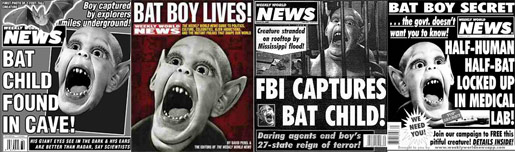
#025 – The Rise of Bat Boy
At its peak, the Weekly World News was moving close to a million copies a week from supermarket checkout aisles across America. It was black-and-white, proudly tabloid, and home to aliens, vampire wars, Bigfoot prostitutes, and a certain large-eared cave child who would become the paper’s most enduring icon. The episode asks the question skeptics and fans alike have always wondered: how much was made up, who was in on the joke, and where on earth did Bat Boy actually come from?
🗞️ Inside the Weekly World News
Tye estimates that on any given week roughly 30–40% of WWN’s content was rooted in something real — a genuine caller, a foreign wire story, a person who sincerely believed their own account. The rest was creative fabrication, shaped by editors and then vetted by a surprisingly large corridor of staff attorneys whose job was to read every page before publication. Managing editor Dick Culpa (also publisher of Cracked Magazine, which is how Tye got connected) had final say on story leads, and the legal team had final say on what survived.
The paper was part of the American Media Incorporated stable alongside The National Enquirer, The Star, and The Sun. (Ben notes that the name Skeptical Enquirer was itself a gentle parody of The National Enquirer — a bit of skeptical etymology that surprises even the hosts.) Lawsuits were a fact of life; the most memorable Tye recalls involved an unauthorized photo and a libel claim, rather than anything involving the grey aliens who, as he drily observes, “don’t necessarily bring suit.”
📞 The Phones Were Something Else
One of Tye’s favorite pastimes on staff was covering the receptionist’s desk and taking listener calls — a perk that provided a vivid window into the paper’s readership. Most callers were in on the joke or simply entertained. Some were not. A story about a faith healer with an, ah, unconventional laying-on-of-hands technique generated weeks of calls from genuinely desperate people, including some with terminal illnesses, hoping to reach the (fictional) preacher. Tye was not permitted to tell them the story was entertainment. It remains the hardest memory from his time there.
He also fielded calls from self-described alien abductees, illegitimate children of Elvis, and — memorably — people who described intimate relationships with Bigfoot. All were logged professionally and passed up the chain as potential story leads.
🦇 The Origin of Bat Boy
Bat Boy — the wide-eyed, enormous-eared, hairless cave mutant who adorned WWN covers throughout the 1990s and 2000s — was, according to Tye, primarily the brainchild of Dick Culpa. The physical image was constructed in-house: the body belonged to a lanky production staffer, the oversized ears and other features were added by the paper’s digital artists. Culpa maintained that Bat Boy was inspired by something real-ish — some genuine encounter or urban legend he’d come across in his travels — but Tye never saw that original source, spoke to it on the phone, or found a photograph of it.
The Bat Boy stories Tye himself generated were, he confirms, entirely fabricated. His method for WWN leads in general: watch the news, find an interesting headline, swap out a key noun for “vampire,” “mutant,” “alien,” or “Bigfoot” — whichever fit best — and see what the editors liked. Bat Boy’s in-universe biography grew elaborate over the years: a human keeper named Dr. Ron Dillon, appearances atop New York City subway cars, backing of political candidates, and a wartime deployment with U.S. special operations forces in Iraq to root out insurgents. Tye also recalls covering Bat Boy’s role in domestic vampire-eradication efforts — the vampire wars being, apparently, an ongoing WWN serialized concern.
Bat Boy later inspired Bat Boy: The Musical, which ran Off-Broadway and had productions in the United Kingdom, and an IDW Publishing comics miniseries collecting WWN’s greatest monsters.
👽 The Alien, the Clintons, and Jay Leno
The paper’s other signature recurring character was a government-affiliated alien ambassador — name approximately “Plog” — who appeared in Photoshopped images alongside various U.S. presidents. Tye notes, with a straight face, that every candidate the alien publicly endorsed went on to win. The alien’s most sensational story involved a romantic affair with Hillary Clinton and the subsequent fistfight between the alien and Bill Clinton (Bill was depicted with a black eye on the cover).
Tye sent an advance copy to The Tonight Show. Jay Leno pulled it out on air and asked Hillary Clinton about it. She laughed and said, “I took him to one state dinner and they make all this fuss.” Leno later signed the cover and returned it to Tye, who has it framed. A follow-up request for Hillary Clinton’s signature was returned unsigned. Tye has a theory about why.
🦶 Bigfoot, Nessie, and the Tabloid Mythology Machine
Bigfoot was, by Tye’s estimate, in the magazine four or five times a month. Ben points out that this tabloid ecosystem wasn’t purely passive — he notes that Puerto Rican supermarket tabloids played a measurable role in shaping the early descriptions and spread of the Chupacabra legend after 1995. WWN’s “exclusive real photos” of the Loch Ness Monster generated some of the highest call volume Tye can remember — people wanted to see those photos. They were, he clarifies, very much fabricated. “They looked good,” he says. “Too good.”
The conversation also touches on crop circles, the Nazca Lines, ancient astronaut theories popularized by Erich von Däniken, and Sumerian religious texts — all topics WWN covered enthusiastically. Blake’s observation that the Sumerians might have been running their own version of the Weekly World News — “on stone tablets, like Fred Flintstone” — is perhaps the episode’s best line.
📉 The Decline and Fall
By the time Tye left (after roughly three years), circulation had dropped from nearly a million copies a week to around 100,000 on a good week. The paper relocated from its Florida home base to New York alongside The Star when that publication went glossy, and never recovered its numbers. The recurring “Black Thursday” layoffs — Tye recalls one that cut 40 people in a single day — were a grim feature of life under AMI’s ownership. The paper eventually ceased print publication; a web presence and the Sun tabloid carried some of its legacy content forward. Fictional reporters like Ed Anger (the paper’s over-the-top right-wing pundit columnist) and Matthew Damon, Seeker of Obscure Supernaturals — not the actor; a different Matthew Damon — live on in the memories of those who were paying attention.
📚 Further Reading
– 📚 Going Mutant: Bat Boy Exposed! 💵 — the fictional Bat Boy novel chronicling his adventures
– 📚 Weekly World News: The Greatest Headlines in the History of Journalism 💵
🔗 Related Links
– Weekly World News — Wikipedia overview of the publication’s history
– Bat Boy — the character’s full Wikipedia entry
– Bat Boy: The Musical
– American Media Incorporated — the parent company behind WWN, The Enquirer, and The Star
– The Onion — the satirical paper the hosts compare to WWN’s editorial DNA
– Chupacabra — Ben Radford’s research on tabloid media’s role in the legend’s spread
– In Search Of… — the Leonard Nimoy–hosted series Tye credits with stoking his childhood Bigfoot fascination
Note: ads inserted into the distributed audio alter the timestamps in unpredictable ways, so timing references in these notes are approximate.
IN THE PANTHEON OF AMERICAN MONSTERS, only one truly dominated the newspapers of the 1990s. Checkout lines everywhere were haunted by the bald-headed, wide-mawed visage of Bat Boy.
What was Bat Boy, and where did he come from? The MonsterTalk team interviews cartoonist Tye Bourdony, a former employee of the Weekly World News and creator of the online comic “The Lighter Side of Sci-Fi”. Bourdony has had his comics published in Cracked, Sci-Fi and Star Trek magazines. He provides a behind-the-scenes look at the rise and fall of the famous tabloid paper the World Weekly News and shares his insights about the paper’s most popular recurring character: Bat Boy.
On Wikipedia
Bat Boy Book (Fictional Novel)
In this episode
- How much of the content of WWN was just made up?
- Did the readers know that the paper wasn’t “for real?”
- What is the origin of Bat Boy?
- What was the role of Bigfoot, Nessie and other cryptids at WWN?
Plus lots of stories about what it was like to work at one of the country’s most unusual newspapers.
Music
- Monstertalk Theme: Monster by Peach Stealing Monkeys
- Grocery-store ambient sound effects by ZuluT via freesound.org, used with permission under Creative Commons License.
Episode Transcript
Read a complete transcript of this episode.